
2019
4(60)
DOI: 10.37190/arc190408
* ORCID: 0000-0003-1323-0924. Wydział Architektury Poli-
techniki Gdańskiej / Faculty of Architecture, Gdańsk University of Tech-
nology.
** ORCID: 0000-0002-7006-4865. Wydział Architektury Poli-
techniki Gdańskiej / Faculty of Architecture, Gdańsk University of Tech-
nology.
Wprowadzenie
W 2014 r. zarząd oddziału Stowarzyszenia Architek -
tów Polskich w Toruniu i Bydgoszczy zorganizował
kon kurs „Architektura z Energią”. Jego celem było wy-
łonienie zrealizowanych projektów architektonicznych
charakteryzujących się dbałością o środowisko naturalne
przez zastosowanie rozwiązań umożliwiających ograni-
czenie zapotrzebowania budynków na energię nieodna-
wialną. Wśród kilkudziesięciu zgłoszonych prac tylko
jedna podparta była pogłębioną ekologiczną myślą pro-
jektową. Pozostałe tworzyły mniej lub bardziej liczne
zbiory kojarzonych z energooszczędnością, a niepowią-
zanych ze sobą rozwiązań. Większość z nich to były roz-
wiązania instalacyjne, takie jak wentylacja z rekuperacją,
i budowlane – jak pogrubiona warstwa termoizolacji.
Odrzucone w konkursie prace obrazują zdiagnozowany
już i poruszany w wielu publikacjach problem tracenia
pełnego potencjału możliwości w realizacji celów pro-
ekologicznych przy braku myślenia o nich od pierwszych
założeń kon cepcyjnych. Robert Kaltenbrunner, autor roz-
działu „Architecture and sustainability – dicult realtion-
ship” w ważnej i uznanej książce Energy Manual, napisał:
Jedno czy dwa ekologiczne rozwiązania tu i tam to nie to
Introduction
In 2014, the board of the Toruń and Bydgoszcz divi-
sion of the Association of Polish Architects organized
a competition by the name of “Architecture with Ener-
gy”. The purpose was to select implemented architectural
projects that are characterized with care for the natural
environment by applying solutions with which to reduce
the demand for non-renewable energy generated by the
building. Among dozens of submitted works, only one
was supported by in-depth ecological design thought.
The remaining projects comprised more or less numerous
clusters of solutions associated with energy eciency,
but unrelated to one another. Most of these referred to
installation-related solutions, such as recuperation ven-
tilation, and construction-related solutions like a thick-
ened thermal insulation layer. The works rejected from
the competition illustrate the already diagnosed and
discussed problem of losing the full potential of oppor-
tunities to implement ecological goals in the absence of
consideration to such issues at the stage of initial concep-
tual assumptions. Robert Kaltenbrunner, the author of the
chapter entitled “Architecture and sustainability – di-
cult relationship” to Energy Manual, an important and
recognized book, stated: One or two ecological measures
here and there are not the same as ecological architec-
ture: solar panels and passive use of the sun, greenhous-
es and thermal insulation are not reaching enough at all
for real sustainable building […]. Isolated aspects rather
than a total concept of sustainability-oriented planning
principles [1, p. 19].
Katarzyna Zielonko-Jung*, Ziemowit Belter**
Źródła inspiracji w projektowaniu budynków proekologicznych.
Co zamiast Pinteresta?
Sources of inspiration in designing ecological buildings.
If not Pinterest than what?
112 Katarzyna Zielonko-Jung, Ziemowit Belter
samo, co architektura ekologiczna. Panele słoneczne czy
pasywne użycie słońca, szklarnie i izolacja cieplna nie są
wystarczające dla prawdziwie zrównoważonego budow-
nictwa […]. To wyizolowane fragmenty zamiast pełnego
konceptu opartego na ekologicznych założeniach [1, s. 19].
Podobne myśli można znaleźć u wielu innych auto-
rów zarówno polskich [2], [3], jak i zagranicznych [4],
[5]. Co ciekawe, dochodzą do nich zarówno architekci
zaangażowani naukowo i zawodowo w zagadnienia pro-
jektowania budynków proekologicznych, jak i projektan-
ci branżowi [6] „przejmujący” projekty koncepcyjne na
pewnym etapie zaawansowania, by zaproponować wła-
ściwą infrastrukturę techniczną. Sławomir Grabarczyk
w książce Fizyka budowli – komputerowe wspomaganie
projektowania budownictwa energooszczędnego [7] do-
konał szczegółowych analiz energochłonności budynku
mieszkalnego niezaprojektowanego z myślą o efektywno-
ści energetycznej. Po dodaniu na potrzeby symulacji do
wyjściowego projektu wielu rozwiązań energooszczęd-
nych udało się poprawić jego parametry energetyczne.
Jednak, jak zauważył cytowany autor, nie tak skutecznie,
jak można by było, gdyby uwzględnić rozwiązania archi-
tektoniczne takie jak na przykład właściwe pod względem
termicznym ułożenie i wymiarowanie przeszkleń.
Choć znaczenie ukierunkowania myślenia koncepcyj-
nego na cele proekologiczne jest już znaną i utrwaloną
wiedzą, jej stosowanie w praktyce nie jest powszechne.
Spójność idei środowiskowych z pierwszymi pomysła-
mi architektonicznymi widoczna w szkicach na przykład
u Richarda Rogersa, Mario Cuccinellego, Thomasa He-
rzoga to nadal rzadkość, możliwa do zaobserwowania
u najbardziej zaangażowanych i zdeterminowanych pod
tym względem twórców, którzy swój talent potraą wła-
ściwie wesprzeć wiedzą interdyscyplinarną. Wydaje się,
że jednym z ważniejszych powodów trudności rozpo-
wszechnienia takiego podejścia projektowego może być
brak właściwych narzędzi wspomagających pracę archi-
tekta na etapie opracowywania koncepcji.
Niniejszy artykuł odnosi się do szczególnego, trudno
uchwytnego i ulotnego wręcz elementu tego etapu, jakim
jest poszukiwanie i podążanie za inspiracją. Podjęto tu
rozważania na temat możliwości jej prośrodowiskowego
kierunkowania w projektowaniu architektonicznym i na-
rzędzi, które mogą temu służyć. Niewątpliwie istotnym
wsparciem dla projektantów mogą być znane już i roz-
wijane metody integrujące dyscypliny współuczestniczą-
ce w procesach inwestycyjnych. Do metod tych zaliczyć
można Integrated Design Process (IDP), Building Infor-
mation Modeling (BIM) czy Post Occupancy Evaluation
(POE). Nie odnoszą się one jednak bezpośrednio do po-
szukiwań inspiracji, które uruchamiane są w procesie
projektowym, zanim można sięgnąć do profesjonalnych,
eksperckich narzędzi. Punktem wyjścia podjętych tu roz-
ważań stał się Pinterest, najbardziej znana i popularna
platforma rozpowszechniania obrazu służącego katalogo-
waniu pomysłów dotyczących różnych aspektów życia,
w tym także związanych z przestrzeniami miast, architek-
turą, architekturą wnętrz, designem. Wielorakie doświad-
czenia autorów wykazują realny wpływ tej platformy
na inspiracje projektowe studentów architektury, którzy
Similar statements may be found in studies by many
other authors, both Polish [2], [3] and foreign [4], [5]. In-
terestingly, the conclusions are arrived at by both, archi-
tects who are scientically and professionally involved in
the design of ecological buildings, as well as by industry
designers [6] who “take over” conceptual designs at some
stage of advancement in order to suggest proper techni-
cal infrastructure. In the book Fizyka budowli – kompu te-
rowe wspomaganie projektowania budownictwa energo -
oszczędnego (Building Physics – computer aided design
of energy-saving buildings) [7], Sławomir Grabarczyk
has conducted detailed analyses of the energy consump-
tion generated by a residential building not designed with
energy eciency in mind. Once numerous energy saving
solutions were added to the initial design for the sake of
simulation, it was possible to improve energy parameters
of the building. However, as noted by the abovementioned
author, the improvement was not as eective as it would
have been if one took into account architectural solutions
such as, for example, thermally appropriate layout and di-
mensioning of the glazing.
Although the significance of directing conceptual
thinking towards ecological goals is already known and
established knowledge, its practical application is not as
common. It is still rare to observe coherence of environ-
mental concepts with initial architectural ideas, as visi-
ble in sketches by, for instance, of Richard Rogers, Mario
Cuccinella or Thomas Herzog. Such an approach to de-
signing is observable in the works by the most engaged
and determined artists in this respect as they are able to
properly support their talent with interdisciplinary knowl-
edge. It seems that one crucial reason why such diculty
may have arisen in popularizing such a design approach
lies in the lack of proper tools with which to support the
architect’s work at the concept development stage.
The present article concerns a special, hardly notice-
able and almost elusive element of the design stage, name-
ly seeking inspiration and following it. Considerations
have been made in the article on whether it is possible to
direct inspiration towards environmental approach in ar-
chitectural design and on tools that can serve this purpose.
Undoubtedly, the already known and developed methods
for integrating disciplines that contribute to investment
processes can provide an important support for designers.
These methods include Integrated Design Process (IDP),
Building Information Modelling (BIM) or Post Occu-
pancy Evaluation (POE). However, none of the enlisted
methods relates directly to the search for inspiration that
is commenced in the design process before professional,
expert tools may be applied. The starting point for the
considerations here is Pinterest, the most known and pop-
ular image dissemination platform that serves the purpose
of cataloguing ideas on various aspects of life, also ones
related to urban spaces, architecture, interior architecture,
design. The authors’ multiple experiences indicate genu-
ine impact the platform has on design inspirations for sev-
eral groups. Firstly, for architecture students who, due to
habits related to the generation they belong to, naturally
reach for Pinterest. Secondly, for architects actively en-
gaged in designing processes. Thirdly, for investors who
Źródła inspiracji w projektowaniu budynków proekologicznych /Sources of inspiration in designing ecological buildings 113
z racji przyzwyczajeń pokoleniowych naturalnie do niej
sięgają, czynnie projektujących architektów, a także in-
westorów konkretyzujących pod jej wpływem formalnie
i wrażeniowo swoje wyobrażenia o planowanej inwesty-
cji, zanim dojdzie do pierwszych rozmów z architektem.
Rodzi się zatem pytanie o to, jakie powinno być narzę-
dzie, które z podobną możliwością rozpowszechnienia
jak Pinterest, a dużo bardziej efektywnie może wspomóc
etap konkretyzowania myśli koncepcyjnej w projektowa-
niu budynków proekologicznych. Ciekawym przykładem
„zaczątku” tego rodzaju narzędzia jest platforma Palette
2030, stworzona w Stanach Zjednoczonych w ramach ru-
chu ekologicznego Architecture 2030 [8].
W dalszej części artykułu dokonano analizy tych dwóch
platform pod kątem wartości merytorycznych, sposobu
działania i możliwości wpływu na proces projektowy.
Wzięto pod uwagę również okoliczności związane po-
średnio z aplikacją, takie jak społeczne przyzwyczajenia,
aktualne trendy i warunki wynikające bezpośrednio z psy-
chologii użytkownika. Pozwoliło to na sformułowanie
ogólnych wniosków co do kryteriów, jakie powinno speł-
niać narzędzie zdolne zapełnić widoczny brak na rynku
narzędzi architektonicznych skutecznie wspomagających
mądry projekt.
Pinterest – inspiracja obrazem
Pinterest został stworzony, by oddziaływać na użyt-
kownika obrazem. U podstaw jego idei raczej nie odnaj-
dzie się myśli o racjonalnym wspieraniu projektowania,
ale o wizualnym inspirowaniu się w różnych dziedzinach
życia. Jest to jedna z najbardziej popularnych platform na
świecie. Nie sposób lekceważyć jej zmieniającej rzeczy-
wistość siły – 250 milionów zarejestrowanych użytkowni-
ków, nie licząc hermetycznego rynku Chin, który stworzył
swoją własną wersję aplikacji Hauban. W ciągu ostatnich
kilku lat to narzędzie, stworzone jako rodzaj katalogu idei
związanych np. z modą, jedzeniem, urządzaniem imprez
czy remontem, stało się dominującym źródłem inspiracji
i wyznacznikiem stylu także w architekturze, zarówno dla
architektów, jak i ich klientów. Pinterest ma wiele nieza-
przeczalnych atutów, które decydują o jego powszechno-
ści. Warto przeanalizować mechanizmy logiczne tworzą-
ce tę platformę pod kątem możliwości ich wykorzystania
w narzędziach rozpowszechniających lozoę architektu-
ry proekologicznej i wspierających jej realizację.
Wśród algorytmów Pinteresta wyodrębniono te, które
mają największy bezpośredni wpływ na korzystających
z niej projektantów. To kolejno: machine learning, smart
feed factor, following feed factor, keywords search i qua-
lity>quantity engine [9]–[11].
Machine learing polega na procesie postępującej umie-
jętności kompletowania obrazów podobnych do siebie
oraz katalogowania ich ze względu na treść, styl, estety-
kę i tematykę. Im liczniejszy jest zbiór zdjęć porówny-
wanych przez aplikację, tym dokładniejsze są rezultaty
wyszukiwania w ramach podanej tematyki. Początkowo
propozycje Pinteresta były grupami ilustracji o podobnym
rozkładzie pikseli (np. pod hasłem „dom na wodzie” po-
jawiały się zdjęcia jezior bez zabudowy). Obecnie można
formalize their concepts about the planned investment
under the inuence of the platform before even the rst
consultations with an architect can take place. Therefore,
the question arises: what type of a tool should be applied
that is characterised with a similar dissemination possi-
bility as the one enjoyed by Pinterest, but is capable of
much more eective support at the stage of formalizing
conceptual thought in the design of ecological buildings?
The Palette 2030 platform, created in the United States
as part of the Architecture 2030 ecological movement [8]
may be seen as an interesting example of the “stirring” of
this type of tool.
The following part of the present article provides ana-
lysis of these two platforms in terms of substantive val-
ues, mode of operation and the possibility to inuence the
design process. The circumstances indirectly related to
the application, such as social habits, current trends and
conditions directly resulting from the user’s psycholo-
gy were also taken into account. This approach oered
a chance to formulate general conclusions related to the
criteria to be met by a tool so that it is capable of ll-
ing the visible market void of such architectural tools that
eectively support wise design.
Pinterest – inspiration by means of image
Pinterest was created to inuence the user with an im-
age. Hardly any thought of rational support for design lies
at the root of the concept for the platform. However, it pro-
vides visual inspiration in various areas of life. Pinterest
remains one of the most popular platforms in the world. It
is impossible to underestimate its power to change reali-
ty – 250 million registered users, excluding the hermetic
market of China, where Hauban, a Chinese version of the
application, was created. Over the past few years, the tool,
shaped as a kind of catalogue of ideas related to elds of
interest, such as fashion, food, party organization or ren-
ovation, has become the dominant source of inspiration
and a determinant of style also in architecture, both for
architects and their clients. Pinterest oers a number of
undeniable advantages that determine its universality. It is
worth analysing the logical mechanisms that construct the
platform in terms of the possibility to apply them in tools
used for disseminating the pro-ecological architecture
philosophy and for supporting implementation thereof.
Of all algorithms of Pinterest, ones that exert the greatest
direct impact on designers that use the platform have been
identied. These include: machine learning, smart feed
factor, following feed factor, keywords search and qua lity
>quantity engine [9]–[11].
Machine learning concerns the process of progress-
ing ability to gather images similar to each other and to
catalogue them in relation to content, style, aesthetics
and subject matter. The more numerous the set of imag-
es compared by the application, the more accurate the
search results within a given topic. Initially, suggestions
made by Pinterest comprised groups of illustrations with
a similar pixel distribution (for example, pictures of lakes
with no building development were yielded by the entry
“house on the water”). At present, answers in the form
114 Katarzyna Zielonko-Jung, Ziemowit Belter
spodziewać się odpowiedzi w postaci obrazów dokładnie
traających treściowo w zakres poszukiwań, nawet przy
ogólnie zarysowanej tematyce. Użytkownik tworzy wła-
sne katalogi i przegląda kolejne obrazy, a machine learning
podpowiada następne, które według algorytmu odpowia-
dają podobnym kryteriom. W ten sposób platforma bar-
dzo szybko personalizuje zarówno tematykę ulubionych
wyborów, jak i ich estetykę. Im więcej obrazów zobaczy
użytkownik, tym większa szansa, że każdy kolejny będzie
dla niego interesujący. Jest to często spotykany sposób
prostej gratykacji oglądającego za jego aktywność. Two-
rzy on rozbudowane, zindywidualizowane katalogi zachę-
cany kolejnymi porcjami atrakcyjnych zdjęć. Następnie
ogląda je w wieloelementowych zestawieniach. Im więk-
szy zbiór, tym poszczególne elementy zbioru wydają się
atrakcyjniejsze. Potwierdzają to badania przeprowadzone
przez duet psychologów z Uniwersytetu Kalifornijskiego
w San Diego, Drew Walker i Edwarda Vula [12]. Opisują
zjawisko nazwane cheerleader eect, polegające na pod-
noszeniu wartości wizualnej poszczególnych osób w gru-
pie w porównaniu z oceną tych samych osób w sposób
indywidualny. Zaobserwowany proces tłumaczy się tym,
że mózg w sytuacji oceny większej liczby elementów wy-
biera te składowe, które traktuje jako najbardziej atrakcyj-
ne. Na podobnej zasadzie mózg buduje wyidealizowany
obraz iluzorycznej architektury oglądanej z korzystnych
stron, o odpowiedniej porze dnia i starannie dobranym
kadrze. Prowadzi to do sytuacji, w której niekoniecznie
wartościowa, ale wizualnie efektowna, a dokładniej rzecz
biorąc – efektownie zobrazowana architektura kształtuje
oczekiwania inwestorów i inspiruje projektantów. Natłok
pociągających obrazów konkretyzujących wizję estetycz-
ną obiektów zostawia mało możliwości zauważenia in-
nych ich wartości, w tym wartości środowiskowych czy
społecznych – elementów, które z rzadka wyróżniają się
jednoznaczną wartością wizualną.
Kolejnym założeniem platformy jest smart feed factor.
Polega ono na tworzeniu przez Pinteresta prolu użytkow-
nika za pomocą danych, które ten zostawia po sobie w In-
ternecie. Nie są to tylko elementy wyszukiwania w samej
platformie, ale również informacje zaczerpnięte z innych
aplikacji i historii przeglądarki. W ten sposób aplikacja
wiele „wie” o osobie korzystającej z platformy, zanim
rozpocznie się rzeczywista interakcja. Konsekwencją tego
algorytmu jest niezwykła wygoda w komunikacji na linii
odbiorca–platforma. Użytkownik Pinteresta ma słuszne
wrażenie, że aplikacja „rozumie” jego potrzeby i świet-
nie „doradza” mu w poszukiwaniach kolejnych inspiracji.
W przypadku relacji z drugim człowiekiem dużo trudniej
osiągnąć poziom podobnego „zrozumienia”. Wymaga to
pracy obu stron, a i tak nie zawsze kończy się sukcesem.
Following feed jest uspołecznioną wersją smart feed.
Polega on na tworzeniu pinterestowej sieci społecznej,
w której częściej pojawiają się obrazy „polubione” przez
innych użytkowników tej sieci. W ten sposób powstaje
dynamiczny przepływ obrazów, który żywo reaguje i pod-
syca zmiany trendów wśród przeglądających. Prowadzi
to do stałego podtrzymywania masowej uwagi. Tworząc
interaktywne, społeczne środowisko użytkowników, pro-
jektanci zapewnili ciągłość aktywności bez konieczności
of images that accurately match the scope of the search
may be expected, even in case topics are rather vaguely
outlined. The user creates his own catalogues and brows-
es subsequent images, while machine learning suggests
the following ones which match similar criteria according
to the algorithm. In this way, the platform very quickly
personalizes both the theme of the user’s favourite choic-
es, as well as their aesthetics. The more images the user
sees, the greater the chance that each subsequent one
will be interesting to him. This is a common method of
simple gratication oered to the viewer for his activi-
ty. The user creates extensive, individualized catalogues
encouraged by successive portions of attractive photos.
Then he watches the images in multi-element combina-
tions. The larger the set, the more attractive the individ-
ual elements of the set appear. This pattern is conrmed
by studies conducted by Drew Walker and Edward Vul,
a duo of psychologists from the University of California
in San Diego [12]. The researchers describe a phenome-
non called the cheerleader eect that consists in raising
the visual value of individual people in a group compared
to the assessment of the same people individually. The
observed process is explained by the fact that the brain,
when assessing more than one element at a time, tends
to select those components that it considers most attrac-
tive. In a similar way, the brain builds an idealized image
of illusory architecture viewed from favourable sides, at
the right time of the day and within a carefully selected
frame. This leads to a situation in which not necessarily
valuable architecture, but one that proves visually impres-
sive, and, more precisely, one that has been eectively
illustrated shapes the investors’ expectations and inspires
designers. The barrage of appealing images that clarify
the aesthetic vision of objects leaves little opportunity
to notice their further values, such as environmental or
social values, namely elements that rarely stand out with
their unambiguous visual value.
The second assumption of the platform concerns the
smart feed factor. It consists of creating a user prole by
Pinterest with the data that the user leaves behind on the
Internet. Rather than being only search elements within
the platform itself, also information taken from other ap-
plications and browser history is used. In this way, the
application “knows” a lot about the person using the plat-
form even before the actual interaction begins. Such an al-
gorithm results in the extraordinary convenience in terms
of communication between the recipient and the platform.
The Pinterest user is under the correct impression that the
application “understands” his/her needs and manages to
provide the user with great “advice” on the search for fur-
ther inspirations. In the case of relationships with fellow
human beings, it is much more dicult to achieve a sim-
ilar level of “understanding”, as it requires work on both
sides, and, thus, often fails.
Following feed is a socialized version of smart feed. It
consists in creating a Pinterest social network, in which
images “liked” by other users of this network are dis-
played more frequently. This mechanism creates a dy-
namic ow of images that reacts vividly and fuels chang-
es in trends among fellow viewers. The eect is constant
Źródła inspiracji w projektowaniu budynków proekologicznych /Sources of inspiration in designing ecological buildings 115
zewnętrznych ingerencji w treść portalu. Oznacza to rów-
nież, że zawartość platformy nasycana jest tematami,
które
są ważne w danym czasie dla wielu korzystających
z niej osób. Rzadko są to treści o pogłębionym znaczeniu
np. społecznym, etycznym czy środowiskowym. Zazwy-
czaj platforma reaguje na płytkie nowości, które przycią-
gają krótkotrwałą uwagę ogółu. Według danych Pinteresta,
najbardziej popularnymi trendami w aspekcie „design”
w 2019 r. są: kolor musztardowy, owijanie ścian tekstylia-
mi, kominki na drewno, wzory na podłogi i baseny.
Keywords search jest systemem wyszukiwania treści
według słów-kluczy określających dany obraz. Dzięki temu
użytkownicy mogą otrzymywać precyzyjne rezultaty bez
ograniczania się do ram pojedynczego hasła. Pinterest jest
serwisem opartym na społecznej wymianie informacji, więc
to do użytkowników należy obowiązek podawania słów
kluczowych tworzonych „pinów”. Istnieją całe podręczni-
ki służące najbardziej optymalnym konguracjom, które
umożliwiają zwiększenie szansy na częstszy wybór wła-
snych zdjęć w celach promocyjnych. Tak skonstruowany
mechanizm prowadzi do nadużywania słów, które niosą za
sobą konkretne znaczenie, zubożając ich faktyczną wartość.
Dobrym przykładem jest określenie „ekologiczny”, które
odnosi się w masowej kulturze do bardzo szerokiego zesta-
wu pojęć. Występowanie tego słowa jako klucza w społecz-
nym serwisie utrudnia zatem uzyskanie merytorycznych
rezultatów, gdyż pojawiają się one pomiędzy wieloma
innymi, wynikającymi z powierzchownego rozumienia.
Ostatnim z omawianych tu założeń Pinteresta jest algo-
rytm quality>quantity engine. Polega on na premiowaniu
jakości poszczególnych elementów, tak zwanych pinów,
a nie ich liczby. W tym przypadku jakość oznacza jedy-
nie skalę popularności danego elementu. Obrazy, które
nie przejdą wczesnej werykacji popularności, zostają
odrzucone, a te, które są najczęściej wybierane, zostają
podsyłane jako niezależne inspiracje. W rezultacie jest
pewna pula obrazów, które pojawiają się na tyle często, że
przyciągają masową uwagę. Doprowadza to do tworzenia
wizualnych trendów w sposób wygenerowany przez al-
gorytm. Może mieć to wpływ także na architektów pra-
cujących nad koncepcją projektu wykonywaną na zlece-
nie konkretnych klientów. Widząc szereg bezpiecznych
i akceptowanych estetycznie przez siebie rozwiązań wi-
zualnych na zestawieniach (tablicach) klienta, projektant
będzie odczuwał wielką pokusę, aby z nich skorzystać.
Należy jednak zdać sobie sprawę, że jest to stosunkowo
wąska paleta wybrana spośród zdjęć z całego świata za
pomocą elektronicznego konkursu popularności.
Opisane powyżej czynniki składają się na sukces Pin-
teresta jako masowego źródła inspiracji. Duże znaczenie
ma także zauważalne, zwłaszcza wśród użytkowników
Internetu, zjawisko przewagi znaczenia bodźców wizual-
nych nad innymi. W świecie architektury proces zachodzi
nieprzerwanie od dłuższego czasu. Już w 1996 r. w swojej
głośnej książce Oczy skóry [13] i późniejszej Myśląca dłoń
[14] Juhani Pallasmaa odniósł się do nieproporcjonalnie
dużego znaczenia przypisywanego roli zmysłu wzroku
w odbiorze architektury. Według niego percepcja bu-
dynków zbyt mocno skupia się na bodźcach wizualnych,
podczas gdy obiekty te powinno się doświadczać całym
sustaining of mass attention. By creating an interactive,
social environment of users, Pinterest developers ensured
continuity of activity with no need for external interfer-
ence in the portal content. It also means that the content
of the platform is packed with topics that are of signif-
icance at a given time for multiple users. Such content
rarely concerns issues with deepened signicance, e.g.,
social, ethical or environmental topics. Typically, the
platform responds to shallow novelties that attracts short-
term public attention. According to Pinterest data, trends
in the “design” aspect that proved most popular in 2019
included: mustard colour, textile wall wrapping, wood-fu-
elled replaces, oor designs and pools.
Keywords search is a content search system by means
of entering keywords, that is, expressions that dene
a given image. Thanks to this function, users can receive
precise results without limiting themselves to a single
keyword framework. Pinterest is a platform based on
social information exchange, so the duty to provide key-
words for the “pins” created lies with the users. Entire
manuals have been created on how to arrive at the most
optimal congurations that allow a user to increase the
chance for more frequent selection of their photos for
promotional purposes. The mechanism constructed in
this way leads to the abuse of words that carry a specic
meaning, thus to impoverishment of the actual value of
certain expressions. A good example of this situation is
provided by the term “ecological”, which refers in mass
culture to a very broad set of concepts. The occurrence of
the term as a keyword on a social platform makes it dif-
cult to obtain substantive results, as they appear among
many other results, which in turn leads to supercial un-
derstanding of the concept.
The nal assumption of Pinterest to be discussed here
is the quality>quantity engine algorithm. It is based on re-
warding the quality rather than the amount of individual
elements, the so-called pins. In this case, quality refers
exclusively to the scale of popularity of a given element.
Images that fail the early verication of popularity are re-
jected, while the most often chosen ones are fed as inde-
pendent inspirations. As a result, a certain pool of images in
created that appear often enough to attract mass attention.
This leads to the creation of visual trends in the way gen-
erated by the algorithm. The phenomenon may also aect
architects working on the project concept being developed
at the request of specic clients. Seeing a number of safe
and aesthetically acceptable visual solutions on the client
prole (tables), the designer may feel greatly tempted to
apply them. However, it should be realized that this is a re-
la tively narrow palette selected from photos from around
the world by means of an electronic popularity contest.
The factors described above contribute to the success
of Pinterest as a mass source of inspiration. Moreover, the
phenomenon of the advantage of visual stimuli over oth-
er types of incentives, especially notable among Internet
users, is of great importance. In the world of architecture,
t
he process has been underway for a long time now. Already
in 1996, Juhani Pallasmaa referred in his famous book The
Eyes of the Skin, and subsequently in the book The Think-
ing Hand [14], to the disproportionately important
role
116 Katarzyna Zielonko-Jung, Ziemowit Belter
ciałem. Pallasmaa zauważa, że terapeutyczna, cielesna
rola architektury spychana jest przez drugorzędne znacze-
nie wizualne, spowodowane między innymi zwyczajo-
wym przedstawieniem budynku w formie nieruchomych
ujęć. Era informatyzacji popchnęła proces dalej i każdy
aspekt życia, pozornie nawet ledwo związany z doświad-
czeniami wizualnymi, coraz bardziej traci swój właściwy
wyraz, zyskując na wartości w przedstawionym obrazie.
Jako przykład może posłużyć aktywność społeczna, coraz
częściej doświadczana właśnie w formie odpowiedniego
jej przedstawienia w relacji zdjęciowej. Już w latach 70.
XX w. lozof i poeta Sir Raymond Douglas Davies pod-
kreślał: Ludzie robią sobie nawzajem zdjęcia jako dowody
własnego istnienia [15].
Zjawisko to nie ominęło architektury – wręcz przeciw-
nie, uderzyło w nią ze spotęgowaną siłą, choćby właśnie
poprzez aplikacje takie jak Pinterest. Trudno rozstrzy-
gnąć, czy jest to proces zapoczątkowany przez architek-
tów, czy przez użytkowników architektury, inwestorów
i klientów, a jedynie zaaprobowany przez architektów dla
wygody, czyli ułatwienia pracy. Wygoda jest tu słowem
kluczowym, ponieważ o ile wartościowa architektura wy-
maga wysiłku intelektualnego nie tylko by ją stworzyć,
ale także w pełni zrozumieć, o tyle Pinterest prowadzi do
skracania procesów myślowych użytkownika i zwalnia go
z obowiązku świadomego wyboru i żmudnego dochodze-
nia od ogólnych idei do wizualnych efektów. Platforma za
pomocą algorytmu smart feed najpierw gromadzi i prze-
twarza informacje o użytkowniku, który wiedziony algo-
rytmami follow feed i quality engine akceptuje podsunięty
obraz. Machine learning engine w oparciu o wcześniejsze
algorytmy podrzuca mu kolejne pokusy z szansą traenia
rzędu 90%. Architekt uzbrojony w tak pieczołowicie wyli-
czone „inspiracje” może z dużym prawdopodobieństwem
przewidzieć oczekiwania, niestety przede wszystkim wi-
zualne, swoich klientów, tracąc jednocześnie możliwość
głębszego poznawania i wpływania na nie. Dodatkowo
wartości inspiracji niewizualnych takich jak podejście
prośrodowiskowe czy energooszczędność tracą na zna-
czeniu w zestawieniu z pogłębiającym się konsumpcjoni-
zmem (nie tylko) wizualnym.
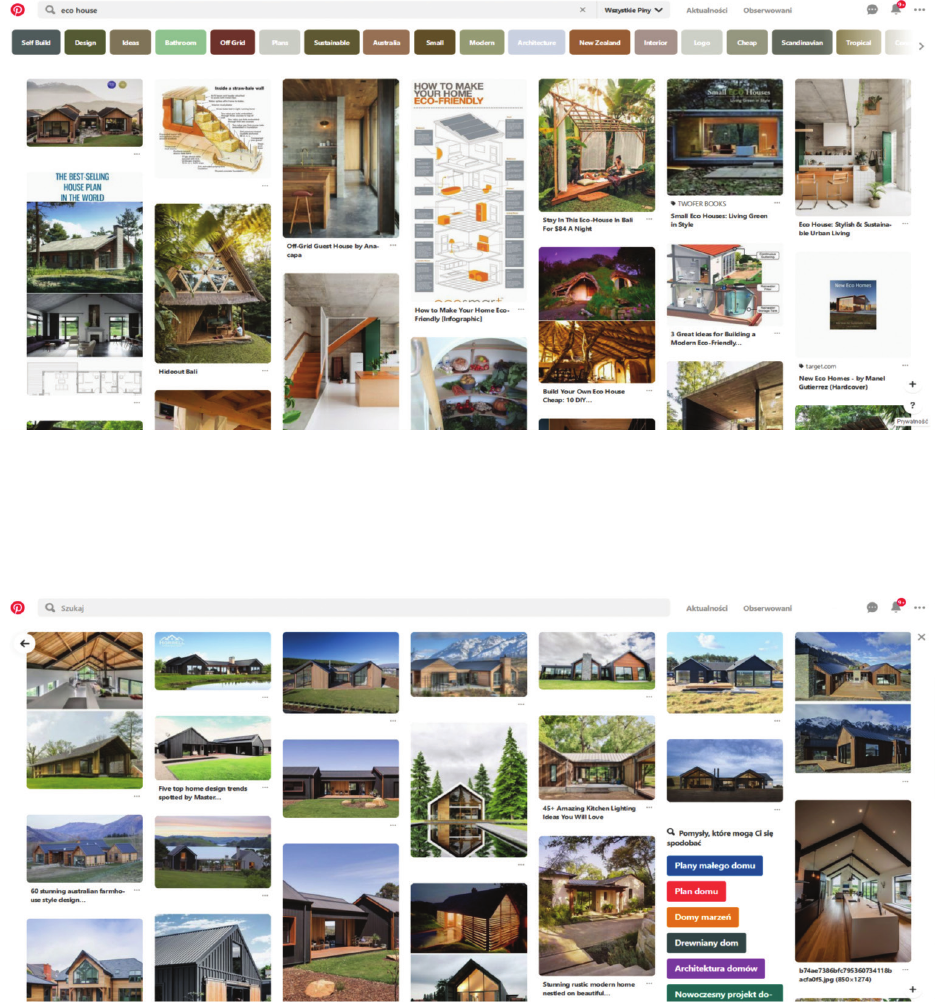
Warto zobrazować zjawisko przykładem. Po wpisaniu
przez użytkownika słowa kluczowego ecohouse Pinterest
wyświetla kolaż obrazów – głównie zdjęć domów i wnętrz
w otoczeniu natury, schematy instalacji i urządzeń oszczę-
dzających energię i wodę, schematy rozwiązań materia-
łowych (il. 1). Pojawiają się także odniesienia do innych
słów kluczowych, np. selfbuild, design, ideas, bathroom,
o grid, plans. Na dalekim miejscu pojawia się określenie
sustainable (tuż przed hasłem Australia). Szukanie w tym
kolażu inspiracji wynikających z merytorycznej wiedzy
jest bardzo trudne i opiera się na przypadku. Po dokonaniu
przez użytkownika pierwszego dostępnego wyboru algo-
rytm odsyła go do zbioru atrakcyjnych kadrów z domami
o jednakowej, modnej stylistyce, kojarzonej luźno z archi-
tekturą ekologiczną (np. uproszczone, zwarte formy, prze-
szklenia). Widoczne jest w nich zespolenie z krajobra zem
– otwartym i efektownym wizualnie – oraz duży udział
materiałów naturalnych w formie elewacji, np. drewna czy
kamienia (il. 2). Osoby o pogłębionej wiedzy dotyczącej
of the sense of sight when it comes to perception of archi-
tecture [13]. According to the writer, perception of build-
ings focuses too much on the visual stimuli, whereas ar-
chitectural objects should be experienced with the entire
body. Pallasmaa notes that the therapeutic, physical role of
architecture is pushed aside by a secondary visual signi-
cance, caused, among other factors, by the usual depiction
of the building in the form of motionless photographs.
The era of computerization has pushed the process further
and every aspect of life, even if seemingly hardly related
to the visual experience, is increasingly losing its proper
expression while it gains in value when shown in a pic-
ture. Social activity, increasingly experienced in the form
of an appropriate representation in photographic account,
may be seen as an example of the above trend. As early as
in the 1970s, Sir Raymond Douglas Davies, a philosopher
and poet, emphasized: People take pictures of each other,
just to prove that they really existed [15].
Architecture is no exception to the phenomenon. On the
contrary, architecture was hit by the trend with intensied
force, even if only by means of applications such as Pinter-
est. It is dicult to decide whether it is a process initiated
by architects or by architecture users, investors and clients,
but merely accepted by architects for the sake of conve-
nience, i.e., facilitation of work. Convenience should be
seen a keyword here. While valuable architecture requires
intellectual eort not only to be created, but also to fully
understand its implications, Pinterest leads to shortening
of the users’ thought processes and frees them from the
obligation of conscious choice and tedious investigation
from general ideas into visual eects. Using the smart
feed algorithm, the platform rst collects and processes
information about the users who, guided by the follow
feed and quality engine algorithms, accept the image fed
to them. The machine learning engine based on previous
algorithms prompts further inspirations, with a chance
of a 90% match. An architect armed with such carefully
calculated “inspirations” can most likely predict the ex-
pectations of his/her clients, unfortunately primarily visu-
al ones, while losing the opportunity to learn more about
user needs and to inuence them. In addition, the values
of non-visual inspirations such as the pro-environmental
approach or energy saving lose their relevance in conjunc-
tion with the deepening (not only) visual consumerism.
It is worth illustrating the phenomenon on an example.
Upon entering the keyword ecohouse, Pinterest displays
a collage of images (Fig. 1) – mainly photos of houses
and interiors surrounded by nature, drafts of energy-ef-
ficient and water-saving installations and equipment,
schema of material solutions. Moreover, references to
other keywords, e.g., self build, design, ideas, bathroom,
o grid, plans are displayed. The term sustainable (just
ahead of the result Australia) appears on a far position.
Searching the collage for inspirations resulting from sub-
stantive knowledge poses major diculty and is based on
chance. Once the user makes the rst available choice, the
algorithm sends him/her to a collection of attractive shots
of houses with uniform, fashionable style loosely associ-
ated with ecological architecture (e.g., simplied, com-
pact forms, glazing). These buildings present a noticeable
Źródła inspiracji w projektowaniu budynków proekologicznych /Sources of inspiration in designing ecological buildings 117
fusion with open and visually eective landscape, while
a large proportion of natural materials in the form of
façades, e.g. wood or stone (Fig. 2) is used. People with
in-depth knowledge of environmentally friendly design
are aware of the superciality of such associations, but
other users perpetuate these connotations.
It is signicant that architects are not fully aware of how
much impact Pinterest exerts on the eects of their work.
Accustomed to the platform as users who seek inspiration
in other, everyday areas of life, they reach for Pinterest.
Rather than treating the platform as a real tool, they adopt
projektowania przyjaznego środowisku zdają sobie spra-
wę z powierzchowności takich skojarzeń, ale inni użyt-
kownicy utrwalają je.
Znamienne jest to, że architekci nie są w pełni świado-
mi, w jak dużym stopniu Printerest wpływa na efekty ich
pracy. Przyzwyczajeni do tej platformy jako użytkownicy
poszukujący inspiracji w innych, codziennych dziedzi-
nach życia, sięgają po nią, traktują ją nie jako prawdziwe
narzędzie, ale oczywisty element towarzyszący swobod-
nemu strumieniowi myśli tworzących jedynie tło pracy
projektowej.
Il. 1. Kolaż obrazów wygenerowanych przez Pinteresta na podstawie słowa kluczowego ecohouse (źródło: https://pl.pinterest.com/search/
pins/?q=eco%20house&rs=typed&term_meta[]=eco%7Ctyped&term_meta[]=house%7Ctyped; data dostępu: 3.06.2019)
Fig. 1. Collage of images generated by Pinterest based on the keyword ecohouse (source: https://pl.pinterest.com/search/
pins/?q=eco%20house&rs=typed&term_meta[]=eco%7Ctyped&term_meta[]=house%7Ctyped; accessed: 3.06.2019)
II. 2. Kolaż obrazów wygenerowanych przez Pinteresta na podstawie kolejnego rozwinięcia słowa kluczowego ecohouse
(źródło: https://pl.pinterest.com/pin/334744184801914515/, data dostępu: 3.06.2019)
Fig. 2. Collage of images generated by Pinterest based on the next development of the keyword ecohouse
(source: https://pl.pinterest.com/pin/334744184801914515/, accessed: 3.06.2019)
118 Katarzyna Zielonko-Jung, Ziemowit Belter
it as an obvious element accompanying the free stream of
thoughts that form only the background for design work.
2030 Palette – knowledge guide
The existing range of tools for designing environmen-
tally responsible buildings is extensive. A large group of
tools consists of simulation programs that make it possi-
ble to predict phenomena occurring in the building, e.g., in
terms of thermal management, the possibility of lighting it
with daylight or in the eld of energy consumption. Para-
metric design methods allow for optimization of design
elements according to given conditions – for example, en-
ergy or material conditions. With the help of specialized
professional programs, parameters of selected solutions
vital from the point of view of energy eciency (glaz-
ing, thermal insulation, installations that actively generate
renewable energy, etc.) can be properly selected. These
tools may be applied at various stages of design, usually
already advanced ones. Certain tools have the benet of
providing support at the conceptual stage. The initial part
of this stage, that is the search for inspiration, remains the
least supported one. Seeking inspiration is followed close-
ly by searching for an idea that would connect the archi-
tectural concept with the model of energy and matter ow
through the building. The Palette 2030 platform should,
therefore, be seen as one of the tools that can support this
initial design stage. Palette 2030 falls under the ecologi-
cal movement intended to reduce carbon footprint in the
construction sector. Architecture 2030, as the movement
was named, united the leading architectural organizations
in North America, such as The American Institute of Ar-
chitects (AIA) and International Union of Architects, as
well as multiple private companies and universities. As
part of the program, competitions and trainings were held,
international agreements and actual ventures have been
launched. The movement was founded by Edward Maz-
ria, an architect known for the implementation of environ-
mentally friendly, energy-saving buildings, the author of
The Passive Solar Energy, a book published in 1979.
Palette 2030 serves the function of a platform for ar-
chitects and architecture students, through which one can
choose proper pro-ecological solutions, adequate to the
existing spatial and climatic conditions. It is an online
database that aims to facilitate access to knowledge con-
cerning ecological solutions at an early design stage. The
tool works in such a way as to enable the user to easily
and freely review the available design options. Unlike
Pinterest, Palette 2030 uses no positioning algorithms,
nor does it obtain data from the recipient. The platform
plays no active role in the dialogue between the user and
the information, but presents content in the form of trans-
parent catalogues. It is the user who is looking for content
related to the area of interest. However, the process diers
signicantly from searching the resources of a classic li-
brary – instead of selecting the issues one is interested
in from extensive monographs, contents are accessed
through a process analogous to the stages of the design
process. In this way, not only the legitimacy of decisions
taken is controlled, e.g., at the stage of choosing a
material
2030 Palette – przewodnik po wiedzy
Istniejąca paleta narzędzi przeznaczonych do projek-
towania budynków odpowiedzialnych środowiskowo jest
rozbudowana. Dużą grupę tworzą programy symulacyjne
pozwalające na przewidywanie zjawisk zachodzących
w budynku, np. w zakresie gospodarki termicznej, moż-
liwości oświetlania go światłem dziennym czy zużycia
energii. Metody projektowania parametrycznego pozwala-
ją na optymalizację elementów projektu według zadanych
warunków – na przykład energetycznych czy materiało-
wych. Za pomocą specjalistycznych programów branżo-
wych można właściwie dobrać parametry wybranych roz-
wiązań ważnych z punktu widzenia energooszczędności
(szklenia, termoizolacji, instalacji aktywnie pozyskują-
cych energię odnawialną itd.). Narzędzia te można zasto-
sować na różnych etapach projektowania, z reguły już za-
awansowanych. Niewielka ich część może wspomóc etap
koncepcyjny. Najsłabiej wspierana jest wstępna część tego
etapu, czyli poszukiwanie inspiracji, a w ślad za nią idei,
która wiązałaby pomysł architektoniczny z modelem prze-
pływu energii i materii przez budynek. Jednym z narzędzi,
które mogą wesprzeć ten etap projektowania, jest platfor-
ma Palette 2030. Jest ona częścią ruchu ekologicznego,
którego misją jest obniżenie śladu węglowego w sektorze
budowlanym. Architecture 2030, bo tak nazywa się ruch,
zjednoczył czołowe organizacje architektoniczne w Ame-
ryce Północnej, takie jak The American Institute of Archi-
tects (AIA) i International Union of Architects, oraz wiele
prywatnych rm i uczelni. W ramach programu odbyły
się konkursy, szkolenia, doszło do porozumień między na-
rodowych i realnych przedsięwzięć. Został założony przez
Edwarda Mazrię, architekta znanego z realizacji proeko-
logicznych, energooszczędnych budynków, autora książki
The Passive Solar Energy Book wydanej w 1979 r.
Palette 2030 pełni funkcję platformy dla architektów
i studentów architektury, za pomocą której można dobrać
odpowiednie rozwiązania proekologiczne, adekwatne do
zastanych warunków przestrzennych i klimatycznych.
Jest to internetowa baza danych, która ma na celu uła-
twienie dotarcia do wiedzy na temat rozwiązań proeko-
logicznych na wczesnym etapie projektowania. Działa
tak, aby użytkownik mógł w prosty, nieangażujący czasu
sposób przeglądać dostępne opcje projektowe. W prze-
ciwieństwie do Pinteresta Palette 2030 nie wykorzystuje
żadnego algorytmu pozycjonującego ani nie pozysku-
je danych od odbiorcy. Platforma nie odgrywa czynnej
roli w dialogu między użytkownikiem a informacją, lecz
prezentuje treści w formie przejrzystych katalogów. To
użytkownik poszukuje zawartości związanej z obszarem
zainteresowań. Proces różni się jednak znacząco od prze-
szukiwania zasobów w klasycznej bibliotece – zamiast
wyłuskiwać interesującą nas problematykę z rozległych
monograi, dochodzi się do nich przez proces analogicz-
ny do etapów procesu projektowego. W ten sposób można
nie tylko kontrolować zasadność podjętych decyzji, np.
na etapie wyboru materiału czy konkretnego rozwiązania,
ale również zaczerpnąć inspirację z dobrych praktyk przy
wyborze charakterystycznego regionu i uwarunkowań
terenowych, z dostępnych w bazie danych przykładów.
Źródła inspiracji w projektowaniu budynków proekologicznych /Sources of inspiration in designing ecological buildings 119
Dodatkowo platforma zachęca do sięgnięcia po obszer-
niejsze źródła w postaci publikacji, proponując je odpo-
wiednio do wyszukiwanych zagadnień.
Palette 2030 ma także odnośniki do narzędzi, które
mogą wspomóc projektowanie proekologiczne w prakty-
ce. Opisy zawarte w bazie danych platformy odnoszą się
do konkretnych programów, zatem nie są to tylko ogól-
ne wytyczne, ale informacje, które można wykorzystać
bezpośrednio np. w kształtowaniu bryły budynku i jego
różnych rozwiązań. Wśród programów wspomagających
proces projektowy inspirowany przez Palette 2030 wy-
szczególniono pozycje takie jak:
– Edge – darmowe oprogramowanie on-line, pozwala
ustalić najbardziej korzystne rozwiązania proekologiczne
dla projektowanego budynku za pomocą produktów rm
wiodących na rynku amerykańskim – tych samych, które
zostały zaangażowane w misję Architecture 2030,
– Sefaira – pomaga opracowywać strategie dla zrównowa-
żonego budownictwa we współpracy interdyscyplinarnej,
– Insight 360 – pozwala generować analityczne modele
umożliwiające symulację chłodzenia, ogrzewania, oświe-
tlenia i rozkładu promieniowania słonecznego,
– Climate Consultant – dostarcza danych klimatycz-
nych o wybranej lokalizacji, pomaga również dobrać
ogólną strategię dla budynku w zależności od warunków
klimatycznych lokalizacji,
– Sunrel – program do symulacji przepływu energii
słonecznej, który wspomaga wybór i projektowanie roz-
wiązań wykorzystujących tę energię, np. ścian akumula-
cyjnych, systemów zacieniających, naturalnej wentylacji.
Palette 2030 sugeruje, czy w wybranym zagadnieniu
wskazane jest posiłkowanie się wyspecjalizowanym pro-
gramem. Tak jak w przypadku wszystkich innych funkcji
programu, to użytkownik samodzielnie podejmuje decy-
zje i wyciąga wnioski. Platforma korzysta z udogodnień
wizualnych i intuicyjnych systemów pomocy w wyszu-
kiwaniu tematów. Są one jednak, jak całość treści Palette,
podporządkowane merytorycznym wartościom indywi-
dualnych artykułów. Przykładowo, kiedy przegląda się
kartę informacyjną zagadnienia heat island mitigation, do
dyspozycji jest zestaw zdjęć obrazujących problem, ale
również odnośniki do artykułów pokrewnych tematyce,
takich jak parks, green roofs, vegetative cooling, sustaina-
ble sites oraz cool roof. Załączony jest również zestaw od-
nośników do stron internetowych zawierających obszerne
opracowania na dany temat.
Merytorycznych inspiracji można poszukiwać w ra-
mach różnych kategorii: region, city/town, district, site,
building, material. Można traktować je wybiórczo lub
zanalizować temat kompleksowo, przechodząc po kolei
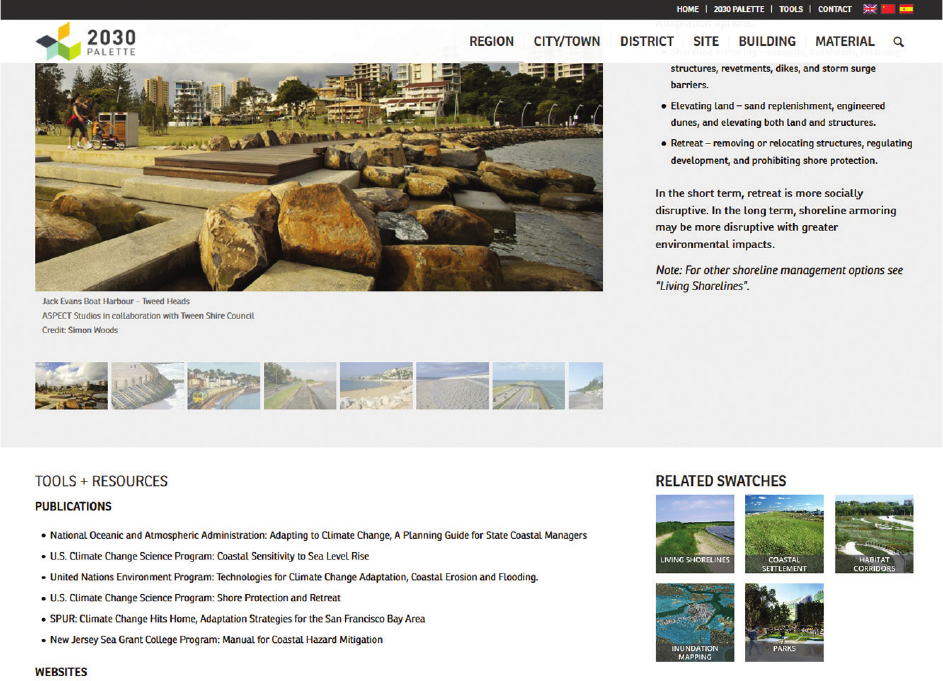
przez wszystkie kategorie. Na ilustracji 3 pokazano przy-
kładową kartę regionu nabrzeżnego. Zawiera ogólne rady,
zdjęcia, listę publikacji, proponowane narzędzia, strony
internetowe i tematy opracowane w Palette, związane
merytorycznie z wybraną kartą. Pozostałe odnośniki mają
taki sam schemat, więc niezależnie od tego, czy będzie-
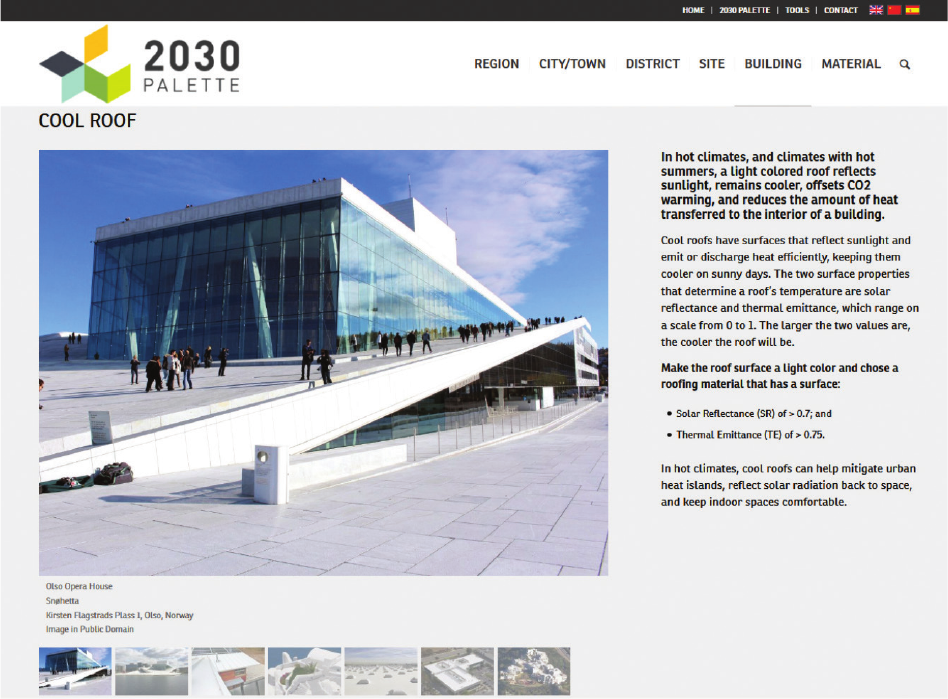
my chcieli dowiedzieć się więcej – np. o projektowaniu
w otoczeniu parkowym, o technologii nienagrzewającego
się dachu czy zastosowaniu drewna na elewacji – pojawia
się analogiczna karta wypełniona inną treścią (il. 4).
or a specic solution, but also inspiration is drawn from
good practices when choosing a characteristic region and
area conditions, from examples available in the database.
In addition, the platform encourages reaching for more
extensive sources in the form of publications, feeding
them to suit the searched issues.
Moreover, Palette 2030 provides links to tools that
can aid pro-ecological design in practice. The descrip-
tions contained in the platform database refer to specic
programs. Therefore, rather than serving only as general
guidelines, they provide information that can be applied
directly, e.g., in shaping the building body and various
solutions to be implemented. Among the programs that
facilitate the design process inspired by Palette 2030, the
following items have been specied:
– Edge – free online software that allows the user to
determine the most favourable pro-ecological solutions
for the designed building with the application of products
by leading companies on the American market – the same
ones that were involved in the Architecture 2030 mission,
– Sefaira – helps to develop strategies for sustainable
construction in interdisciplinary cooperation,
– Insight 360 – allows the user to generate analytical
models that enable simulation of cooling, heating, light-
ing solutions and solar radiation distribution,
– Climate Consultant – provides climate-related data
for the selected location, helps to choose an overall strat-
egy for the building depending on the climatic conditions
of the location,
– Sunrel – a program to simulate the ow of solar ener-
gy, which supports the selection and design of such solu-
tions that take advantage of energy, e.g., accumulation
walls, shading systems, natural ventilation.
Palette 2030 suggests whether it is advisable to apply
a specialized program in relation to the selected issue. As
with all other program functions, it is up to the user to
make the decisions and draw conclusions. The platform
uses visual amenities and intuitive assistance systems
while searching topics. However, as in the case of the en-
tire content of Palette, these solutions are subordinated to
the substantive values of individual articles. For example,
when viewing the heat island mitigation issue factsheet,
a set of pictures that illustrate the problem is available,
but so are links to related articles, on topics such as parks,
green roofs, vegetative cooling, sustainable sites and cool
roof. A set of links to websites containing extensive stud-
ies on a given topic is also included.
Substantive inspirations can be sought in various cate-
gories: region, city/town, district, site, building, material.
These may be treated selectively or a topic may be com-
prehensively analysed by passing through each category in
turn. Figure 3 features a sample card that presents a coastal
region. It contains general advice, photos, a list of publi-
cations, suggested tools, websites and topics developed in
Palette that are related to the selected card. The remain-
ing links are marked with the same pattern, so regard-
less of whether the user wants to learn more – e.g., about
designing in a park environment, about the technology of
a non-heating roof or the use of wood on the façade – an
analogous card lled with diverse content appears (Fig. 4).
120 Katarzyna Zielonko-Jung, Ziemowit Belter
II. 3. Karta z katalogu Palette 2030 zawierająca inspiracje dla projektowania budynków proekologicznych w regionie nabrzeżnym
(źródło: http://www.2030palette.org/coastal-adaptation/; data dostępu: 3.06.2019)
Fig. 3. A card from the Palette 2030 catalog containing inspiration for the design of ecological buildings in the seaside region
(source: http://www.2030palette.org/coastal-adaptation/; accessed: 3.06.2019)
Wnioski – podstawowe różnice działania
obu platform i ich znaczenie
dla projektowania proekologicznego
Obie opisywane tu platformy trudno jednoznacznie po-
równać, gdyż z założenia nie służą takim samym celom
i nie są adresowane do tego samego rodzaju odbiorców.
Możliwe jest jednak wychwycenie zasadniczych różnic
zarówno w założeniach, jak i w kontekście ich znaczenia
dla projektowania opartego na celach prośrodowis kowych.
Podstawowa, najbardziej zauważalna różnica dotyczy
podejścia do użytkowników. Pinterest prowadzi ich za
pomocą wyspecjalizowanych inteligentnych algorytmów,
podczas gdy Palette 2030 traktuje jak podmioty mające
motywację i umiejętności, by zawartą wiedzę móc wy-
korzystać. Obie platformy różnią się też zasadniczo pod
względem sposobu przekazu informacji. Palette 2030,
pomimo nowoczesnych udogodnień i operowania progra-
mami komputerowymi, w wielu aspektach podporządko-
wana jest tradycyjnej idei przekazywania wiedzy, czyli za
pomocą odpowiednio dobranych materiałów, przykładów
i publikacji. Nie tylko wymaga czasu i wysiłku intelektu-
alnego w zrozumieniu treści, ale również pozostaje nie-
zmienna w kontakcie z użytkownikami w odróżnieniu od
Pinteresta reprezentującego charakterystyczną dla XXI w.
Conclusions – basic differences in the ways
both platforms operate and their importance
for ecological design
Both platforms described in the present article are dif-
cult to compare clearly, as they are not intended to serve
the same purposes and are addressed to a dierent type of
recipients. However, it is possible to capture fundamen-
tal dierences when it comes to the assumptions of the
two tools and to the context of their importance for design
based on environmental goals.
The main, most noticeable dierence concerns the ap-
proach to users. Pinterest leads them using specialized
intelligent algorithms, while the Palette 2030 treats users
as entities that possess motivation and skills to apply the
knowledge it provides. Both platforms also dier funda-
mentally in terms of the way information is transmitted.
Despite modern facilities and computer programmes,
Palette 2030 in many respects is subordinated to the tra-
ditional idea of transferring knowledge, i.e. by means of
appropriately selected materials, examples and publica-
tions. Not only does it require time and intellectual ef-
fort to understand the content, but also the tool remains
unchanged in contact with users. Pinterest, on the
other
hand, represents the characteristic of the 21
st
century
Źródła inspiracji w projektowaniu budynków proekologicznych /Sources of inspiration in designing ecological buildings 121
zasadę dynamiki przepływu informacji i interaktywności.
Gilles Deleuze [16] pisał o schyłku społeczeństwa dyscy-
pliny – pojęcia sformułowanego przez Michela Foucaulta
[17] – i zastąpienia go społeczeństwem kontroli. Według
teorii, społeczeństwo dyscypliny wszelkie procesy traktu-
je w sposób analogiczny do używanych narzędzi – mają
swój wyraźny początek i koniec, z kolei społeczeństwo
kontroli traktuje je w charakterze równoległych dzia-
łań, odbywających się w sposób ciągły i interaktywny.
Jan Słyk w książce Źródła architektury informacyjnej
[18] zestawia myśli Deleuze’a z Toerowską denicją
„prosumenta” jako konsumenta, który aktywnie uczest-
niczy zarówno w procesie konsumpcji, jak i produkcji.
Architekt staje się „programistą procesu wielowarstwo-
wej kreacji”, czyli innymi słowy, kształtuje i wpływa na
sam proces kreowania obiektu, lecz nie na jego końcowy
efekt. Pinterest umożliwia taką relację i co więcej, ideal-
nie wpisuje się w charakterystykę społeczeństwa kontroli,
zdeniowanego przez Deleuze’a, co może być jednym
z powodów jego niezwykłej popularności. Palette 2030
jest natomiast narzędziem wygasającego społeczeństwa
dyscypliny – użytkowanie przebiega według określonego
schematu, ma swój klarowny początek i koniec. Służy tyl-
ko i wyłącznie do osiągnięcia konkretnego celu.
principle that triggers dynamics of information ow and
interactivity with the user. Gilles Deleuze [16] wrote
about the decline of the discipline society – the concept
formulated by Michel Foucault [17] – and its replacement
with a control society. According to the theory, the disci-
pline society treats all processes in an analogous way to
the tools they use – both are marked with a clear begin-
ning and end. Whereas the control society treats processes
and tools as parallel actions that occur in a continuous and
interactive way. In the book Źródła architektury infor-
macyjnej (Sources of Information Architecture) [18], Jan
Słyk juxtaposes Deleuze’s views with Toer’s denition
of a “prosumer”, namely a consumer who actively partic-
ipates in both the consumption and production process.
The architect becomes a “programmer of the multilayer
creation process”. In other words, the architect shapes and
inuences the process of creating the object, but not its
nal eect. Pinterest facilitates such a relationship. More-
over, the platform perfectly ts the characteristics of the
control society, as dened by Deleuze, which may be seen
as one of the reasons for its extraordinary popularity. Pal-
ette 2030 is, however, a tool of the fading discipline so-
ciety – its use follows a specic pattern, it has its clear be-
ginning and end. It serves only to achieve a specic goal.
II. 4. Karta z katalogu Palette 2030 zawierająca informacje o technologii nienagrzewających się dachów
(źródło: http://www.2030palette.org/cool-roof/; data dostępu: 3.06.2019)
Fig. 4. A card from the Palette 2030 catalog containing information about the technology of cool roofs
(source: http://www.2030palette.org/cool-roof/; accessed: 3.06.2019)
122 Katarzyna Zielonko-Jung, Ziemowit Belter
The creators of Palette 2030 also assumed that the lack
of experience and adequate access to knowledge among
architects is the biggest problem in terms of implement-
ing energy-saving architecture. In this respect, Palette lls
this void, although the platform can be accused of a cer-
tain anachronism in its functioning, which can discour-
age generations raised with access to tools like Pinterest,
Instagram and Facebook. Unfortunately, sharing substan-
tive knowledge and supporting its implementation fails to
provide sucient action to support pro-ecological design.
It seems, however, that the lack of developed methods to
properly present pro-ecological solutions to people who
are not professionals poses a signicant and unnoticed
obstacle to the dissemination of such concepts. What is
more, the lack of an attractive representation of architec-
ture focused on environmental goals also presents a prob-
lem among architects. In the book Green Building, Mate-
rials and Civil Engineering, the words of Peter Eisenman,
a famous American architect, were quoted. The architect
ironically commented on sustainable design: To talk to
me about sustainability is like talking to me about giving
birth. Am I against giving birth? No. But would I like to
spend my time doing it? Not really. I’drather go to a base-
ball game (after: [19, p. 667]).
Architects faced with the choice between an eective
and convenient tool or a valuable one that fails to fol-
low trends and is dicult to use, may often be tempted,
perhaps even unconsciously, to choose the rst option.
Pinterest features facilitate communication with the cli-
ent, associating the client’s expectations with a number
of properly targeted images that can be easily used. All
those factors provide a great encouragement for the de-
signer to use the platform. The rationality of Palette plat-
form may not balance the advantages oered by Pinterest.
Architects, including those seeking knowledge in the eld
of pro-ecological approach, lack a tool that would allow
them to show non-professionals (e.g., investors, ocials)
the scope of benets that taking ecological topics entails
in general, and this issue seems especially notable at an
early stage of designing.
It seems that the environment-friendly architecture
movement, including energy-saving architecture, fails to
fully apply the potential with which it may impact recipi-
ents, also non-professionals. The lack of room for the in-
vestor in the designing process of this type of buildings
may be listed among the main problems. Pinterest has the
advantage in this respect, being equally a tool for archi-
tecture users and architects. This problem can be broadly
understood as the lack of space for creating a dynamic
community in the process of pro-ecological design. Its
creation would signicantly improve the exchange of
information, experience and eects, thereby building an
abundant base for valuable, ideologically deepened, rath-
er than just visual, inspiration.
Conclusion – what instead?
The reexions made in the present article allow to
draw a conclusion concerning the apparent shortcomings
in the tools applied to support the early stage of design
Twórcy Palette 2030 wyszli również z założenia, że
największym problemem w realizacji architektury ener-
gooszczędnej jest brak doświadczenia i odpowiedniego
dostępu do wiedzy wśród architektów. Pod tym wzglę-
dem Palette wypełnia ten brak, choć można zarzucić jej
pewien anachronizm w funkcjonowaniu, który może
zniechęcić pokolenia wychowane na platformach typu
Pinterest, Instagram i Facebook. Niestety, udostępnienie
merytorycznej wiedzy i wspieranie w jej wdrażaniu nie
jest wystarczającym działaniem we wspomaganiu pro-
jektowania proekologicznego. Wydaje się natomiast, że
istotną, a niezauważoną przeszkodą w rozpowszechnie-
niu rozwiązań proekologicznych jest brak opracowanych
metod odpowiedniego ich zaprezentowania osobom, któ-
re nie są profesjonalistami. Co więcej, brak atrakcyjne-
go przedstawienia architektury ukierunkowanej na cele
prośrodowiskowe jest problemem również wśród archi-
tektów. W książce Green Building, Materials and Civil
Engineering przytoczono słowa słynnego amerykańskie-
go architekta Petera Eisenmana, który w ironiczny spo-
sób wypowiedział się o projektowaniu zrównoważonym:
Rozmawiać ze mną o zrównoważonym budownictwie to
jakby rozmawiać ze mną o porodzie. Czy jestem przeciwny
porodom? Niespecjalnie. Ale wolałbym iść na mecz base-
balla (za: [19, s. 667]).
Architekci postawieni przed wyborem pomiędzy na-
rzędziem efektownym i wygodnym a wartościowym, ale
niepodążającym za trendami i trudnym w użytkowaniu
często mogą wybrać to pierwsze, być może nawet nie-
świadomie. Funkcje Pinteresta pozwalające na komunika-
cję z klientem, skojarzenie jego oczekiwań z szeregiem
traonych obrazów, z których łatwo można skorzystać,
to wielka zachęta dla projektanta. Racjonalność platform
typu Palette może jej nie zrównoważyć. Architektom,
także tym poszukującym wiedzy w zakresie podejścia
proekologicznego, brakuje narzędzia, które pozwalałoby
w sposób prosty i przystępny pokazać nieprofesjonali-
stom (np. inwestorom, urzędnikom) zakres korzyści, jakie
niesie ze sobą podjęcie wątków proekologicznych w ogó-
le, a w szczególności na wczesnym etapie projektowania.
Wydaje się, że ruch architektury przyjaznej środowi-
sku, w tym energooszczędnej, nie wykorzystuje w pełni
potencjału możliwości oddziaływania na odbiorców, także
nieprofesjonalistów. Jednym z problemów jest brak miej-
sca dla inwestora w procesie projektowania tego rodzaju
budynków. Pinterest ma pod tym względem przewagę,
będąc w równym stopniu narzędziem i dla użytkowników
architektury, i dla architektów. Problem ten można ująć
szerzej jako brak miejsca dla tworzenia dynamicznej spo-
łeczności w procesie projektowania proekologicznego.
Jej powstanie usprawniłoby znacznie wymianę informa-
cji, doświadczeń i efektów, budując tym samym bogate
podłoże dla wartościowych, pogłębionych ideowo, a nie
jedynie wizualnych inspiracji.
Podsumowanie – co zamiast?
Podjęte tu rozważania pozwalają na wyciągnięcie
wniosku o wyraźnych brakach w zakresie narzędzi wspie-
rających wczesny etap projektowania ukierunkowanego
Źródła inspiracji w projektowaniu budynków proekologicznych /Sources of inspiration in designing ecological buildings 123
na cele proekologiczne, poszukiwania inspiracji, groma-
dzenia wiedzy i formułowania pierwszych idei koncep-
cyjnych. Dotyczy to na pewno warstwy merytorycznej,
istotnej szczególnie dla architektów zdobywających
i pogłębiających doświadczenie w tym zakresie, ale tak-
że tych, którzy nie poszukują sami tej wiedzy, ale mogą
się nią zainteresować, jeśli skutecznie do nich tra. Istot-
ne jest także poszukiwanie dróg, być może również tych
pozamerytorycznych, docierania do nieprofesjonalistów,
którzy współdecydują o projekcie koncepcyjnym budyn-
ku. Ich motywacja do samodzielnego zdobywania wiedzy
ze starannie i mądrze zaprojektowanej platformy jak Pa-
lette 2030 jest znikoma, a chęć sięgnięcia po inspiracje
do Pinteresta, by szybko ukształtować wizualnie swoje
oczekiwania – ogromna.
Analiza założeń opisanych tu dwóch platform – Pin-
teresta i Palette 2030 – odniesiona do sytuacji zaobser-
wowanej przez autorów w realiach działania pracowni
projektowych i studentów architektury w Polsce pozwala
nakreślić ogólną charakterystykę narzędzia, które mogło-
by zapełnić wspomniany brak. Są to:
– ujęcie możliwie szerokiej wiedzy w sposób mini ma-
lizujący czas na jej poszukiwanie i przyswajanie, wiązanie
różnych wątków, odnajdowanie wskazówek co do dob rych
praktyk w odniesieniu do konkretnych uwarunkowań,
– dynamiczne ujęcie informacji, interaktywność z użyt-
kownikiem,
– ukazanie wartości niewizualnych w sposób traający
do użytkownika o nawykach wyrobionych podczas ko-
rzystania z platform typu Pinterest, Instagram, Facebook
(określenie tego sposobu wydaje się szczególnie trudne),
– ukazanie szerokiej palety możliwości kreowania wi-
zualnego architektury proekologicznej, wiązanie wartości
wizualnych z niewizualnymi,
– nastawienie na skupianie społeczności o różnym
stopniu wiedzy dotyczącej projektowania budynków pro-
ekologicznych, w tym nieprofesjonalistów; tworzenie
moż liwości dynamicznego wzajemnego przepływu infor-
macji formujących poglądy, inspirujących w sposób wie-
lowymiarowy.
Wydaje się uzasadnione, by rozwijać badania nad ana-
lizą potrzeb w zakresie wspierania wstępnych faz projek-
towania nakierowanego na cele proekologiczne. Powinny
stać się one podstawą dla prób stworzenia właściwych na-
rzędzi dedykowanych obecnym i przyszłym pokoleniom
architektów.
focused on ecological goals, seeking inspiration, gather-
ing knowledge and formulating initial conceptual ideas.
The conclusions certainly apply to the substantive layer,
which is particularly important to architects in the pro-
cess of gaining and deepening their expertise in this eld,
but also to users who do not seek this knowledge on their
own, but may become interested in it if the information
successfully reaches them. It is also important to search
for ways, perhaps including non-substantive methods, to
reach non-professionals who participate in the decision
process when it comes to the conceptual design of the
building. Motivation of users to independently acquire
knowledge from a carefully and wisely designed plat-
form, like the Palette 2030 is negligible, whereas the de-
sire to reach Pinterest for inspiration on how to quickly
shape their visual expectations – immense.
An analysis of the assumptions behind the two plat-
forms, Pinterest and Palette 2030, described above – relat-
ed to the situation observed by the authors in the realities
of design studios and in the case of architecture students in
Poland allows to outline the general characteristics of the
tool that could ll the aforementioned void. These include:
– accounting for the widest possible scope of know-
ledge in a way that minimizes the time required for
searching for it and assimilating it, connecting various is-
sues, nd ing tips on good practices in relation to specic
conditions,
– dynamic presentation of information, interactivity
with the user,
– presentation of non-visual values in a way that reach-
es the user whose habits have been developed while using
platforms such as Pinterest, Instagram, Facebook (deter-
mining this method seems particularly dicult),
– presentation of a wide range of possibilities to cre-
ate visual pro-ecological architecture, linking visual and
non-visual values,
– focus on bringing together communities with vary-
ing degrees of knowledge about the design of eco-friendly
buildings, including non-professionals; creating the pos-
sibility of dynamic mutual ow of information that forms
views, inspires in a multidimensional way.
It seems justied to develop research concerning the
analysis of needs in the scope of supporting the initial
stages of design focused on ecological goals. Such re-
search should provide the basis for attempts to create
proper tools dedicated to current and future generations
of architects.
Translated by
Emilia Mełgieś
Bibliografia /References
[1] Kaltenbrunner R., Architecture and sustainability – dicult relation-
ship, [w:] M. Hegger, M. Fuchs, T. Stark, M. Zeumer (eds), Energy
Manual, Sustainable Architecture, Birkhauser, Berlin 2008, 15–32.
[2] Bać A., Zrównoważenie w architekturze. Od idei do realizacji na
tle doświadczeń kanadyjskich, Ocyna Wydawnicza PWr, Wrocław
2016.
[3] Marchwiński J., Zielonko-Jung K., Współczesna architektura pro-
ekologiczna, PWN, Warszawa 2012.
[4] Daniels K., The Technology of Ecological Building (1997), Birk-
hauser, Berlin 1997.
[5] Hausladen G., De Sladanha M., Liedl P., Sager Ch., Climate De
sign,
Birkhauser, Berlin 2005.
124 Katarzyna Zielonko-Jung, Ziemowit Belter
Streszczenie
Efektywność rozwiązań proekologicznych w budynkach zależy od tego, jak wcześnie w procesie projektowania zostanie zdeniowany cel środowi-
skowy i na ile uda się powiązać go z fazą koncepcyjną projektu. Artykuł odnosi się do wstępnego etapu tworzenia koncepcji architektonicznej budyn-
ku, jakim jest poszukiwanie inspiracji i wiązanie ich z wiedzą dotyczącą rozwiązań proekologicznych. Podjęto tu rozważania na temat możliwości
prośrodowiskowego kierunkowania inspiracji w projektowaniu architektonicznym i narzędzi, które mogłyby temu służyć. Zdaniem autorów ich brak
jest zauważalny i ogranicza możliwości rozpowszechniania projektowania odpowiedzialnego środowiskowo.
Zamierzeniem artykułu jest określenie ogólnej charakterystyki narzędzia, które mogłoby wypełnić ten brak. W tym celu dokonano analizy dwóch
platform internetowych: popularnej platformy Pinterest, która choć nie jest przeznaczona bezpośrednio do projektowania architektonicznego, stano-
wi powszechne źródło inspiracji dla architektów i inwestorów, oraz specjalistycznej platformy Palette 2030 stworzonej jako baza danych ułatwiająca
dotarcie do wiedzy na temat rozwiązań proekologicznych na wczesnym etapie projektowania. Wnioski dotyczą możliwości łączenia cech obu plat-
form w celu usprawnienia wymiany informacji, doświadczeń i efektów, a także tworzenia podłoża dla wartościowych, pogłębionych ideowo, a nie
jedynie wizualnych inspiracji.
Słowa kluczowe: rozwój zrównoważony, architektura proekologiczna, inspiracje, Pinterest, Palette 2030
Abstract
Eciency of ecological measures for sustainable architecture depends greatly upon the moment in which it is dened as essential, and how early it
can be applied during the design concept stage. The following article refers to inspiration, the initial stage of the design and means to combine it with
substantial knowledge regarding ecological architecture. Means, such as computer programs were taken into consideration. Authors conclude that
a visible void of viable tools in such regard is observable, which might lead to limited popularity of sustainable architecture in general.
The article is mainly intended to evaluate the characteristic for a tool that could match the prole of ecological inspiration enhancer, and would be
able to function in the reality of a complex architecture market. An assessment of two internet platforms was conducted for this purpose, namely
Pinterest and Palette 2030. Pinterest, although not dedicated only to architects, found its way to the architects tool box thanks to its popularity among
clients. Palette 2030, on the other hand, is a professional internet database that allows architects to access ecological knowledge at the early stage of
the design process. Conclusions combine specic characteristics of both platforms in a way that would allow to estimate, if any potential solution for
a tool with which to encourage smart, ecological solutions is possible.
Key words: sustainable development, ecological architecture, inspirations, Pinterest, Palette 2030
[6] Laskowski L., Ochrona cieplna i charakterystyka energetyczna bu-
dynku, Ocyna Wydawnicza PW, Warszawa 2008.
[7] Grabarczyk S., Fizyka budowli – komputerowe wspomaganie pro-
jektowania budownictwa energooszczędnego, Ocyna Wydawni-
cza PW, Warszawa 2008.
[8] Architecture 2030, Roadmap to zero emissions, New Mexico 2014,
https://architecture2030.org/wp-content/uploads/2018/12/Road-
map-to-Zero-Emissions.pdf [accessed: 3.06.2019].
[9] Zhai A., Kislyuk D., Jing Y. et al., Visual Discovery at Pinte-
rest, Cornell University, New York 2017, https://arxiv.org/abs/
1702.04680 [accessed: 3.06.2019].
[10] Kislyuk D., Liu Y., Liu D., Tzeng E., Jing Y., Human Curation and
Convnets: Powering Item-to-Item Recommendations on Pinte rest,
Cornell University, New York 2015, https://arxiv.org/abs/ 1511.
04003 [accessed: 3.06.2019].
[11] Mao J., Xu J., Jing Y., Yuille A., Training and Evaluating Mul-
timodal Word Embeddings with Large-scale, Web Annotated-
Images, Cornell University, New York 2016, https://arxiv.org/
abs/1611.08321 [accessed: 3.06.2019].
[12]
Vul E., Walker D., Hierarchical Encoding Makes Individuals in
a Group Seem More Attractive, University of California, San
Diego 2013, https://journals.sagepub.com/doi/abs/10.1177
/0956797613497969
[accessed: 3.06.2019].
[13] Pallasmaa J., Oczy skóry, Instytut Architektury, Kraków 2012.
[14] Pallasmaa J., Myśląca dłoń, Instytut Architektury, Kraków 2015.
[15] Davies R.D., People make pictures of each other, [w:] The Kinks,
The Kinks are the village green preservation society, Pye Records,
1968 [LP].
[16] Deleuze G., Post-scriptum sur lessociétés de contrôle, „L’autre Jour-
nal” 1990, No. 1, https://sites.google.com/site/deleuzemedia/textes/
post-scriptum-sur-les-societes-de-controle [accessed: 3.06.2019].
[17] Foucault M., Discipline and Punish: The Birth of the Prison, Galli-
mard, Paris 1977.
[18] Słyk J., Źródła architektury informacyjnej, Ocyna Wydawnicza
PW, Warszawa 2012.
[19] Rui J.L., Integrating sustainability into design planning,
[w:] J.C.M. Kao, W. Sung, R. Chen (eds), Green Building, Mate-
rials and Civil Engineering, CRC Press, London 2015, 667–669.