
2025
3(83)
Joanna Gronostajska-Kadecka*
Spa and wellness architecture: Definition and conceptualization
DOI: 10.37190/arc250310
Published in open access. CC BY NC ND license
Abstract
The spa and wellness trend is a rapidly growing movement in the architectural industry. This topic aims to dene and clarify the concept of spa and
wellness architecture, which has not been thoroughly researched despite its frequent mention in both popular and scientic literature. The author ad-
dresses the issue by starting with a general denition and then moving on to a specic classication of the various types of structures that fall under spa
and wellness architecture. To dene this concept, the author rst discusses the terms architecture, spa, and wellness separately before synthesizing them
into a cohesive denition. The above-mentioned research resulted in a classication in which ve groups of contemporary facilities were distinguished,
dened according to the previously established denition: spas, saunas, thermal baths, baths, and spa & wellness hotels. The research provides a clear
denition of spa and wellness architecture. It is based on available scientic literature and popular sources, ensuring its universal applicability within the
architectural industry. Furthermore, within the term spa and wellness architecture, ve groups of architectural facilities or assumptions are characterized.
The spatial and functional programs of these categories are determined by the types of treatments and relaxation practices oered at each facility.
Key words: architecture, spa, wellness, health services
Introduction
In recent years, the demand for health and well-being
services has increased signicantly, largely due to the im-
pact of the SARS-CoV-2 pandemic. This shift in social
pre ferences has inuenced various industries, including ar -
chi tecture (Choudhary, Qadir 2021). Over the last decade,
there has been a noticeable rise in the number of buildings
designed to oer health-promoting services. Consequently,
a slogan has emerged in both literature and the industry: spa
and wellness architecture. However, this term is often used
without a precise denition or a systematic understanding
of its scope
1
. In the state of research on this topic, some
publications discuss the health aspects of spa and wellness
architecture (Chinwe 2023), spa and wellness tourism (Dry-
glas 2012), and sustainable design of spa and wellness facil-
* ORCID: 0000-0003-0627-9930. Faculty of Architecture, Wro-
cław University of Science and Technology, Poland, e-mail: joanna.gro-
nostajska-kadecka@pwr.edu.pl
1
The study focuses on architectural assumptions. While existing
literature addresses the issues concerning the tourism industry, it also re-
veals a gap in the proper denition of spa and wellness facilities (Abram,
Kosińska 2020).
ities (Singh 2024). However, no publication was found that
would be devoted to a theoretical treatise on the denition
of spa and wellness architecture itself. This is a signicant
scientic gap, which means that part of the literature from
the state of research presented above does not analyze all fa-
cilities that may fall within the scope of architecture and spa.
This article is organized into two main sections. The rst
part seeks to provide a clear denition of spa and wellness
architecture, based on an analysis and synthesis of available
literature sources, particularly dictionaries. In the second
part, groups of spa and wellness architecture facilities were
created by comparing their features.
Definitions
No clear and universally accepted denition of spa and well-
ness architecture has been found in the literature sources. How-
ever, the term frequently appears in everyday language and pop-
ular science publications
2
. In order to dene this term for this
2
In the collections of the publicly available online encyclopedia
Wikipedia in English, there is an entry for Spa architecture. The article
is mainly based on the historical genesis of the facilities where water
therapy services were oered (Wikipedia 2022).

108
Joanna Gronostajska-Kadecka
study, the denition of the term architecture and the terms spa
and wellness were discussed separately, and then their synthesis
was made. According to the Collins dictionary and PWN dic-
tionary
3
, architecture (Latin from Greek architéktōn – builder)
is the art of planning, designing, and constructing buildings. In
the encyclopedia, this denition expands to include aspects relat-
ed to meeting people’s multiple physical, material and cultural
needs. The denition of spa and wellness (wellbeing
4
) is much
more complex because these are relatively new terms still subject
to modications. Many sources state that spa comes from Latin
and means Sanus per Aquam, which translates into English as
health through water (Błądek, Błądek and Manikowski 2013).
In the PWN dictionary, the word spa has three primary mean-
ings: 1) care treatments aimed at moisturizing and nourishing
the skin; also: cosmetics used for such treatments; 2) a centre
oering such treatments; 3) a hot tub (Słownik języka polskiego
PWN 2022b). Some sources indicate that the term comes from
a city in Belgium called Spa, located near Liège. In the 18
th
cen-
tury, this city was the destination of many European royal fam-
ilies due to the valuable mineral water springs there (Britannica
2022). The concept of wellness was dened in the 1950s in the
United States, when a healthy lifestyle was popularized among
the American community, contributing to maintaining good
psycho-physical condition (Błądek, Błądek and Manikowski
2013). One of the doctors who popularized the term wellness
was Herbert L. Dunn, author of a work published in 1961 en-
titled High-Level Wellness: A Collection of Twenty-Nine Short
Talks on Dierent Aspects of the Theme “High-Level Wellness
for Man and Society” (Dunn 1961; Zimmer 2010). The concept
of wellness was created from a combination of two other terms:
wellbeing and tness. Although this denition was formulat-
ed in the 20
th
century, practices aimed at improving wellbeing
were known and applied in ancient times. In India, traditional
Ayurvedic medicine, dating back to 3000–1500 BCE, assumed
that maintaining harmony between body, mind, and spirit pre-
vented disease and promoted health. The theory of the Ayurve-
dic concept was translated into practice in the form of yoga and
meditation, which are also used today as adjunctive therapies.
Holistic aspects of treatment
5
also found their manifestations
in Chinese culture, where 2,000 years ago, acupuncture, herbal
medicine, qi gong
6
and tai chi
7
were used to improve the state of
the spirit, body and mind (Global Wellness Institute n.d.). Today,
wellness terminology includes various types of treatments, e.g.,
3
Both English and Polish dictionaries were used in this research
to more precisely dene the research subject. The study initially relied
on Polish dictionaries, but following a deeper analysis and the prepa-
ration of the article in English, the sources were expanded to include
English-language dictionaries.
4
The term wellness is assumed to come from this word (Global
Wellness Institute n.d.).
5
This is in relation to holistic medicine, which was based on the as-
sumption that the state of mind, spirit, and body mutually inuence each
other and that the whole organism should be treated to heal (Słownik
języka polskiego PWN 2022a).
6
Qigong (from Chinese qi-life energy, gong-mastering a skill) is
a unique exercise that stimulates life energy ow to increase immunity
and self-healing processes (Portal Fizjoterapeuty 2021).
7
Tai chi is a form of martial art originating from China, which
involves slow, uid movements combined with deep breathing. The ef-
fects of performing these exercises are to strengthen the upper and lower
body, stretch and calm the mind (Bury-Motyl 2020).
massages, baths, sports and artistic activities, and an appropri-
ate diet to improve or maintain wellbeing and physical tness
generally (Słownik języka polskiego PWN 2022c). In Poland,
wellness services were developed in the 1990s (Hotelarz 2010).
By integrating the denitions mentioned above, we can
create a clear denition of spa and wellness architecture.
This original denition states that spa and wellness architec-
ture encompasses all buildings, small architectural features,
urban complexes, and other construction elements designed
to support users’ health and wellbeing, with a particular em -
phasis on water’s therapeutic properties
8
. According to the
denition provided, a facility or concept that meets cer tain
requirements can be classied as spa and wellness architec-
ture. On the ArchDaily portal, the healthcare architecture
category is divided into three subcategories: healthcare ar-
chitecture, wellbeing, veterinary and research. The well-
being subcategory includes spas, saunas, bath houses, and
therms (ArchDaily n.d.). When analyzing facilities that uti-
lize water for therapeutic purposes, it is essential to consider
the strong historical connection between spas, healing func-
tions and accommodation – an association that dates back to
ancient times (Milewska, Włodarczyk 2015). In recent de-
cades, this has led to a new type of facility known as spa and
wellness hotels. These hotels distinguish themselves from
traditional accommodation services by oering bathing ser-
vices alongside lodging. Based on this understanding, the
following original denition for the term “spa and wellness
hotel” is proposed: a facility that primarily provides accom-
modation services while also oering services designed to
meet the health-related needs of its guests, particularly em-
phasizing the healing properties of water.
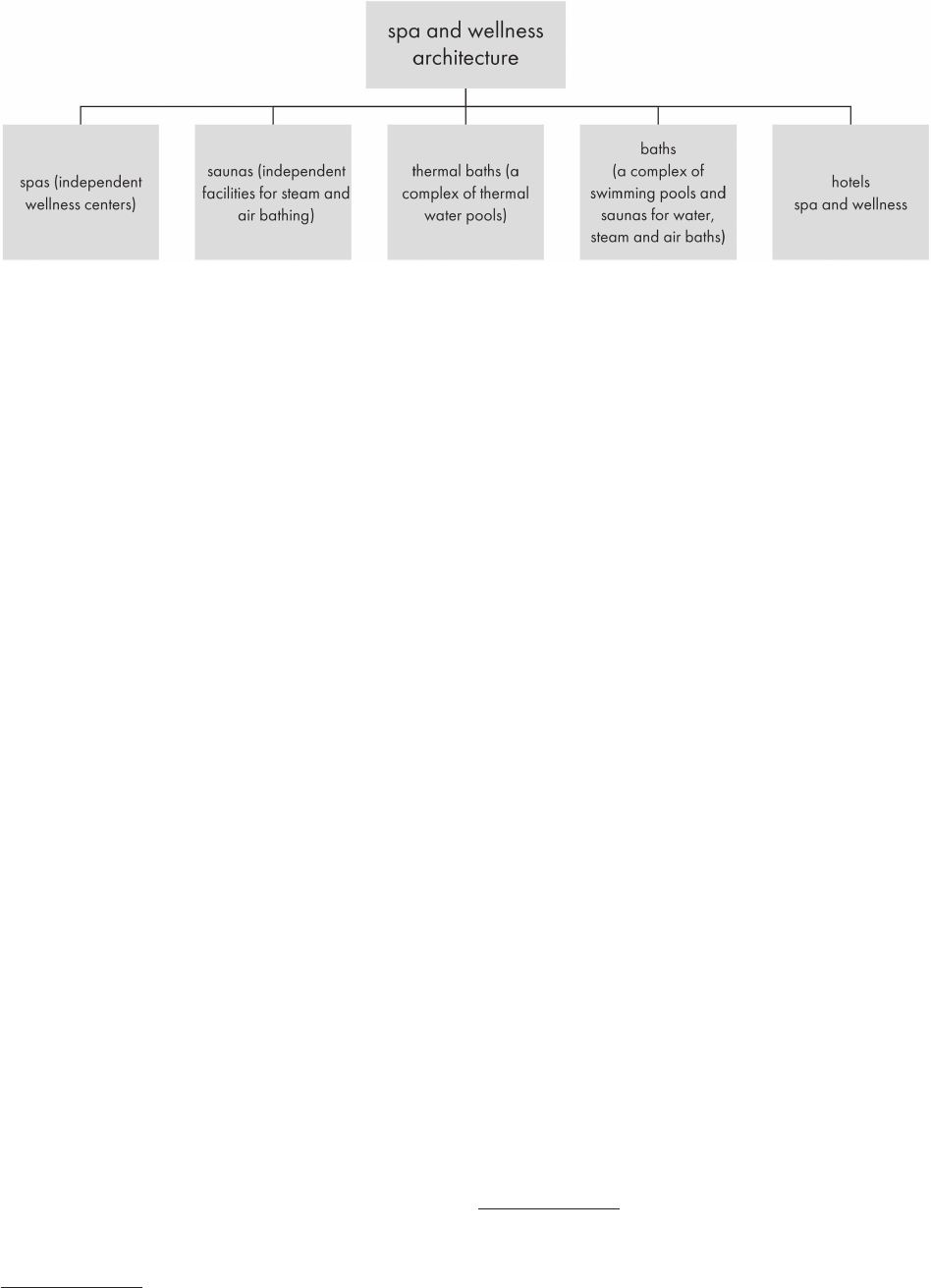
It is proposed to categorize spa and wellness architecture
facilities into subgroups based on the collected data and
considerations regarding the origins of concepts (Fig. 1)
9
.
Spa and wellness architecture
– classification
Summarizing the previous chapter, spa and wellness ar-
chitecture should be designed with a primary focus on en-
hancing the well-being of its users. Such buildings must be
designed with great accuracy, because human well-being
is associated with all their senses. Even though their func-
tional program is based on various water-related services
(in its various states of matter), it is essential to create the
so-called atmosphere
10
(Feniak n.d.). Therefore, when de-
signing spa and wellness buildings, one cannot focus only
on the form of the facility, but also on aspects such as sound
(acoustics), light, structure (material), and smell. Another,
no less important element is the landscape surrounding spa
and wellness architecture. Numerous scientic studies have
8
In this case, health-related needs include prevention, rehabilita-
tion, treatments and exercises improving health and beauty, and similar
spa-related ones. Hospital and sanatorium treatment are not included.
9
The research focuses on spatial architecture with spa and well-
ness functions; therefore, cities and health resort complexes were ex-
cluded from the division.
10
Atmospheric factors are background conditions in the environ-
ment, e.g., temperature, scent, noise, music, and lighting (Heide, Lærdal
and Grønhaug 2007).
Spa and wellness architecture: Denition and conceptualization
109
shown that being surrounded by nature positively aects
human well-being and contributes to improved health.
Additionally, properly designed green spaces accompa-
nying spa and wellness architecture can help treat specic
diseases and ailments (Zhang et al. 2024). Nature’s inspira-
tions can also be seen in the building itself and its interiors.
Spa and wellness architecture often features streamlined,
organic forms and natural materials such as stone, wood,
amber, linen, and cotton textiles. Their appropriate combi-
nation in the interior positively impacts the spa and wellness
user experience.
This chapter briey describes the subgroups of facili-
ties included in the spa and wellness architecture taxonomy
(Fig. 1).
Spa
Despite the apparent dominance of the spa and wellness
hotels within the taxonomy of spa and wellness architecture,
there is a growing emergence of independent spa facilities
across Europe. They are most often located in the centres of
large and medium-sized cities, and their oer is focused on
biological regeneration services, including core treatments
such as massages, baths, and body and facial therapies. De-
pending on the user’s needs, it is possible to choose one spe-
cic service or a package consisting of several treatments.
Such facilities are referred to as Day Spa (Spaeden 2021).
Due to their location, they are rarely designed as separate
buildings. They are usually planned (separated) as zones in
larger oces and service facilities, as in the case of Baltica
Wellness & Spa in Szczecin
11
. Biological regeneration cen-
tres in the suburbs or outside the city limits can be enriched
with green areas. An example is the Vabali Spa complex lo-
cated in Berlin’s Fritz-Schloß-Park, which oers numerous
treatments and wet and steam baths (Vabali spa n.d.). There
has also been an increase in spa facilities outside urbanized
areas, primarily in forests
12
. Sometimes, in particularly dif-
11
The building also houses the residence functions – Radisson Blu
Hotel and recreational functions – Fitness World gyms. This is an exam-
ple of the location of three independent services, the specicity of which
guarantees the cooperation of the owners and mutual nancial benet.
12
An example of such a facility is Camp SPA in Włodów. Its of-
fer includes, among other things, bathing in a tub, herbal massages, and
cult-to-access places, a complementary function is located
in comfortable and luxurious campsites, commonly called
glamping
13
. Situating such functions in places close to the
natural environment is closely related to the spa and well-
ness culture that draws from nature.
In summary, the spa function is located as a complemen-
tary (accompanying) function in large service facilities or in-
dependently located in medium-sized facilities (as a compact
form). It often occurs as a group of low buildings (as a frag-
mented form) with external spaces, as in the case of Vabali
Spa. The spa facility primarily contains spaces for perform-
ing numerous specialist treatments, often including saunas
and swimming pools. Such facilities should be designed to
maintain maximum intimacy for its users, who most often
move around naked. It is recommended to use soft lighting
and natural materials in the interior. The design avoids the
creation of large, high-ceilinged spaces. Instead, it empha-
sizes the use of intimate areas dened by numerous parti-
tions. When the facility is situated in a naturally attractive
setting, window glazing is strategically used to frame valu-
able views. However, it is important to limit the number of
glazed surfaces to prevent excessive exposure of the interior.
Saunas
The spas mentioned earlier are very popular, much like
saunas, which scientists have extensively studied for their
health benets in recent decades (Hussain, Cohen 2018).
The positive eects of sauna bathing on health have con-
tributed to its widespread popularity. Most independent sau-
na facilities are found in northern Europe, notably Finland,
the birthplace of sauna culture (Kryniewski n.d.). These
facilities are typically situated in rural areas like forests
or along the shores of lakes and seas, although some can
a sauna. All treatments take place in the surroundings of wild nature.
Due to the spa’s specicity, it is open seasonally, from May to September
(Moniq music travel 2020).
13
The term glamping is a combination of two words in English:
glamorous and camping. It is a place intended for camping, where tem-
porary accommodation facilities are located, such as: a summer house,
a tent, a tree house. Inside such a facility, there are usually bathrooms,
kitchenettes and full furniture equipment (bed, armchair, desk, etc.), thanks
to which the stay in such a place is denitely more comfortable than at
a classic campsite (Horwat 2018).
Fig. 1. Spa and wellness architecture – systematics of subgroups or complexes of facilities (elaborated by J. Gronostajska-Kadecka)
Il. 1. Architektura spa i wellness – systematyka podgrup lub zespołów obiektów (oprac. J. Gronostajska-Kadecka)
110
Joanna Gronostajska-Kadecka
also be found in urban environments, often situated near
river banks. The architecture of these saunas often reects
traditional Finnish designs, predominantly featuring wood
and stone materials. A sauna facility may consist of a single
building with a classic dry sauna, a complex of buildings of-
fering dierent types of saunas, or a structure that includes
various sauna options. Additionally, saunas can be designed
as mobile units, such as trailers or barges that oat on wa-
ter. This mobility allows them to be relocated based on user
preferences and weather conditions (O’Kelly 2022).
Compared to spa facilities, sauna buildings are designed
for one function – air baths. Therefore, the structure of the
building is not overly complicated and results primarily
from the types of saunas used in the functional program.
Complementary rooms include changing rooms with sani-
tary facilities and a relaxation area with hot and cold water
showers. All of the above functions can be located in one
closed cubicle (as a compact form), but there are also saunas
in a group of buildings (as a fragmented form). Then, enter-
ing each sauna cabin directly from the outside is possible,
which is part of the traditional sauna ritual (Oviir 2018).
Thermal baths
In areas with sources of medicinal water with elevated
temperatures, thermal baths are established. These facilities
combine swimming pool complexes with thermal water
and sauna facilities, which may include steam baths. Of-
ten, a massage zone is also integrated into the thermal bath
experience. Newly constructed thermal baths are typically
spacious buildings that oer an extensive range of services.
In addition to their diverse internal functions, they feature
large outdoor pools. The naturally warm water allows these
outdoor thermal bath areas to operate year-round energy-ef
-
ciently. In some instances, plans are made to expand the
thermal baths to include visitor accommodation facilities;
however, these do not typically qualify as spa and wellness
hotels
14
(Özen, Varolgüneş 2018).
In Poland, the largest deposits of thermal water are lo-
cated in the central part of the country (Ciechocinek, Unie-
jów) and Małopolska (Ustroń, Rabka-Zdrój) (Sztuka Ar-
chitektury 2021). Additionally, there are several deposits
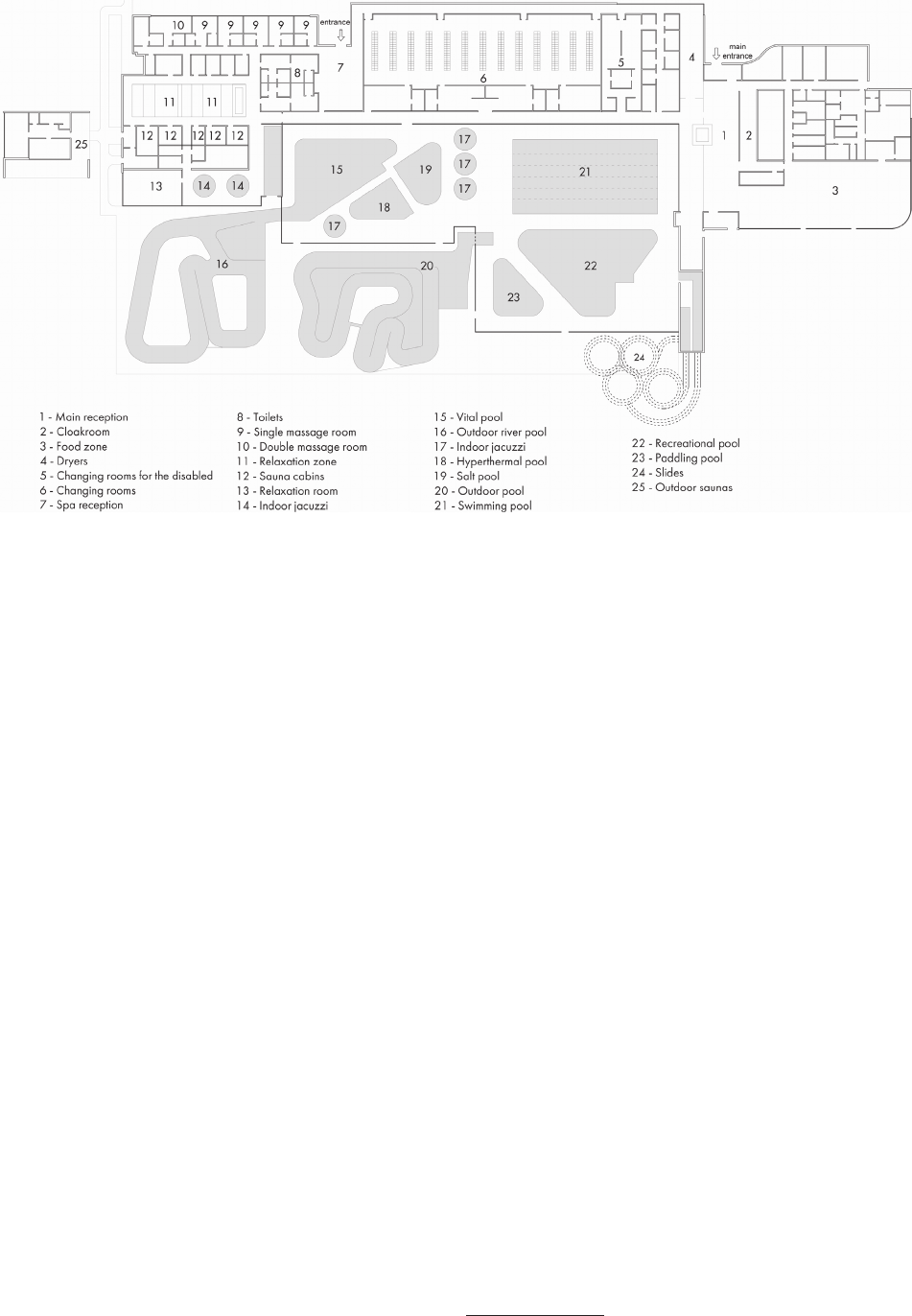
in northern Poland, particularly in Warmia, where Termy
War mińskie (Fig. 2) were established in 2014. This facility
features a comprehensive range of services, which include:
– changing rooms and sanitary areas,
– indoor pool complex (three relaxation pools, two rec-
reational pools for children, one sports pool, and whirlpool
baths),
– outdoor pool complex (two pools),
– sauna complex (various sauna cabins, relaxation area,
and showers),
– treatment rooms,
– catering options (restaurant and bar),
– conference facilities (halls and oces),
– shopping gallery,
– bowling alley and music club,
– accommodation area (rooms) (ArchDaily 2018).
The facility that houses the function of thermal pools has
an extended functional program. Its structure is usually di-
vided into appropriate zones: treatment, sauna, swimming
pool, catering, and accommodation. In addition, the chang-
14
A spa and wellness hotel is a facility in which the accommoda-
tion service is superior to the other services, i.e., recreational, gastro-
nomic, and conference services.
Fig. 2. Plan of the Termy Warmińskie (recreational part) (elaborated by J. Gronostajska-Kadecka)
Il. 2. Rzut Term Warmińskich (część rekreacyjna) (oprac. J. Gronostajska-Kadecka)
Spa and wellness architecture: Denition and conceptualization
111
ing rooms are more extensive than in facilities that house the
functions of independent spa centers and spa buildings. For
this reason, the volume of the building that houses the func-
tion of thermal pools is dened as medium or large (in com-
parison to the other facilities from the studied subgroups).
Baths
Facilities that share a similar functional program to ther-
mal baths – comprising a complex of swimming pools,
saunas, and wellness centers – but do not utilize hot spring
waters are referred to as baths. They are usually designed
as one compact medium or large building, with possible
outdoor areas. These establishments are often located in ur-
ban areas, cities, or regions with signicant landscape and
tourist appeal where thermal water sources are unavailable.
Modern baths are designed to echo the style and purpose
of ancient baths. A good example of such a design is the
saunarium in Wrocław
15
.
15
The sauna is located in the city water park building, where sports
pools and recreational pools were designed in addition to the aforemen-
tioned function. All zones are interconnected, but tickets for each service
must be purchased separately to use them. The user also has the option
of using only one selected zone because each has a separate independent
entrance, changing room, and sanitary complex.
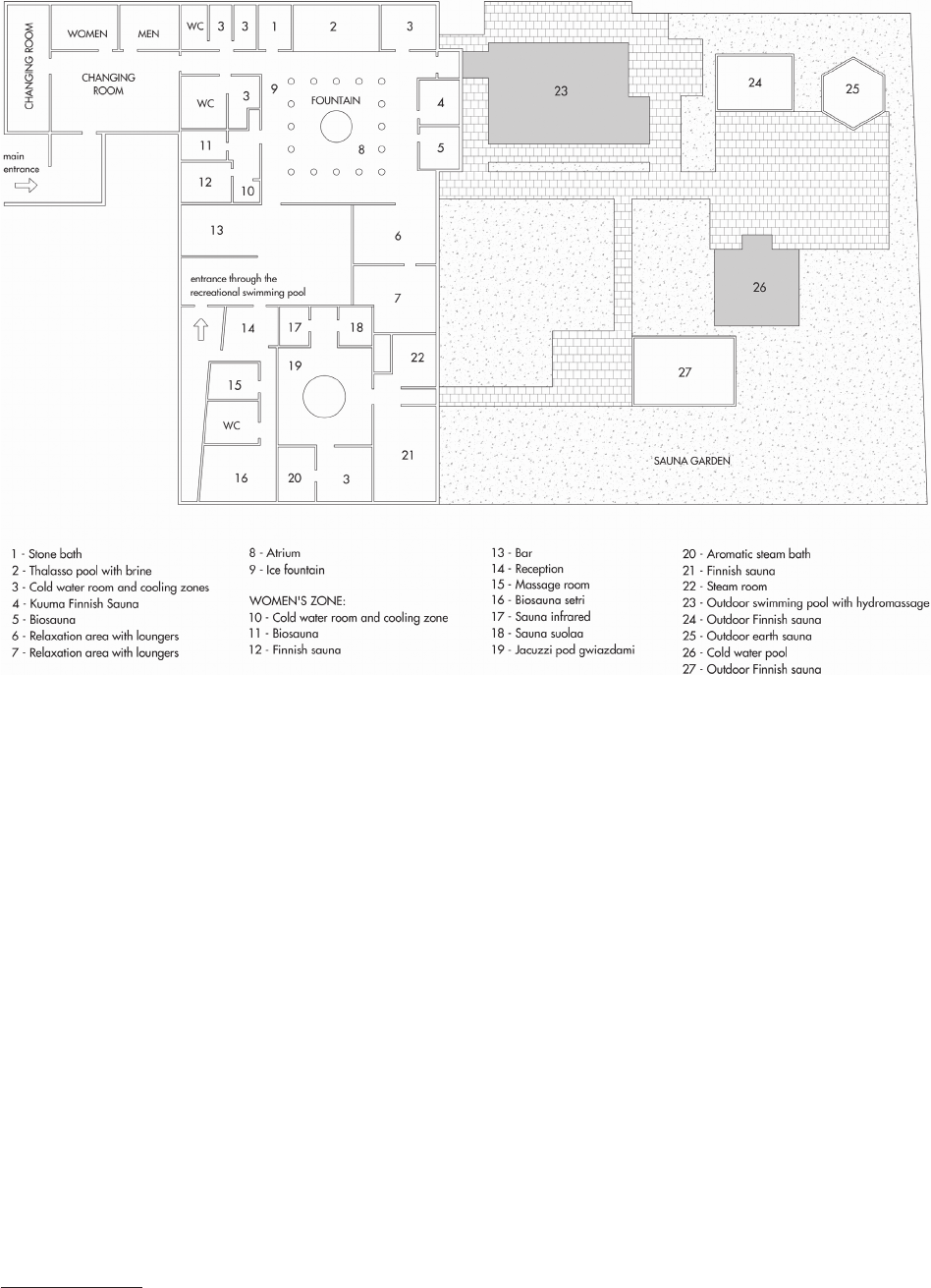
The Wrocław saunarium encompasses two expansive
zones:
indoor and outdoor (Fig. 3). The facility features ten
types of saunas, a saltwater pool, a jacuzzi, a massage room,
and a special area dedicated exclusively for women. Addi-
tionally, a coeducational changing room complex includes
separate rooms for women and men, along with sanitary fa-
cilities equipped with toilets and showers. The design also
incorporates an independent catering section, structured as
a self-service bar, and two relaxation rooms that eectively
divide the sauna area into two functional parts. This layout
creates a central communication system and facilitates ac-
cess to the outdoor space. In the central areas of both sec-
tions, a fountain and an internal jacuzzi have been included,
surrounded by sauna cabins and cooling zones equipped
with showers. The sauna garden features two pools with
cold and warm water, three saunas, and a relaxing area with
portable loungers (Aquapark Wrocław n.d.).
Spa and wellness hotels
The main architectural feature that distinguishes spa
and wellness hotels from other facilities in the hotel indus-
try is an additional recreational section, which houses the
above-mentioned functions. Usually, the scope, structure
and size of the recreational section determine the function-
al layout of the other zones within the complex. Therefore,
Fig. 3. Plan of the Saunarium in Wrocław (elaborated by J. Gronostajska-Kadecka)
Il. 3. Rzut saunarium we Wrocławiu (oprac. J. Gronostajska-Kadecka)

112
Joanna Gronostajska-Kadecka
were opened in 1996
16
(Zumthor 2007). Prior to this, the
village had experienced a decline in tourism, with a num-
ber of outdated hotels dating back to the 1960s. However,
following the successful launch of the thermal baths, Vals
underwent a signicant revival in tourist interest – a trend
that continues to this day (Architektura Info 2009).
Conclusions
The article denes spa and wellness architecture based
on available scientic and popular literature, making it uni-
versally applicable within the architectural industry. This
denition may also serve as a step towards establish ing
standards for spa and wellness facilities, which often en -
com pass intricate structures and combine health, recreatio-
nal, and accommodation services, among other features.
The second part of the work explores various solutions re-
lated to the culture of treatment and recreation using water,
which has gained popularity in contemporary architecture.
The author has identied ve main categories of architec-
tural facilities:
1. Spas as independent wellness centers.
2.
Saunas as standalone facilities for steam and air baths.
3. Thermal baths as complexes featuring thermal water
pools.
4. Baths as complexes that include pools and saunas for
water, steam, and air baths.
5. Spa and wellness hotels.
The spatial and functional programs of these categories
are determined by the types of treatments and relaxation
practices oered at each facility. Each type – saunas, ther-
mal baths, and spa centers – has its unique design approach.
Notably, spa and wellness hotels stand out because they
integrate complementary services, which is economically
benecial. These hotels meet the needs of today’s travelers
and adapt to the changing market for tourism and business
services. Moreover, the market for these services is highly
competitive. The table (Table 1) presents the ve subgroups
identied in the study, focusing on three specic features
16
The Zumthor Thermal Baths, the ve-star hotel, and the House of
Architects accommodation facility form a complex called 7132 Thermal
Baths. The above facilities are dened ambiguously because the thermal
baths building was added later and currently functions independently of
the hotel. Because of this, it is not easy to classify the above complex as
a spa and wellness hotel.
the design process typically begins with a detailed deni-
tion of services oered in this recreational area, which can
sometimes be as extensive as the accommodation and ca-
tering sections (Brzaković, Nikolić and Milojković 2022).
Since no detailed denitions of spa and wellness exist and
the literature does not dene the division between these two
concepts, the hotel industry does not precisely assign recre-
ational services to either term. Moreover, the literature con-
tains proposals for classifying wellness services both to the
term wellness (Błądek, Błądek and Manikowski 2013) and
to the term spa (Słownik języka polskiego PWN 2022b).
Nevertheless, it is noted that the spa zone program includes
beauty treatments, mainly using water, and the wellness
zone plan is closely related to improving well-being and vi-
tality. The formation of a wellness team is closely related to
trends in treatments (preventive, beautifying, and relaxing),
technological progress, and discoveries in medicine. In ad-
dition, the spa and wellness oer, in the case of large hotel
facilities, can go beyond the building and be implemented
in the form of saunas, swimming pools, and outdoor bath-
ing areas.
The discussed enterprises often include additional rec-
reational spaces related to sports and entertainment to en-
hance the guest experience. Increasingly, these facilities are
designed to meet all customers’ needs, covering everything
from accommodation and dining to entertainment options.
Most commonly, outdoor recreational complexes are devel-
oped, featuring amenities such as tennis courts, mini-golf,
walking and cycling paths, multi-purpose sports elds, and
playgrounds (Błądek, Błądek and Manikowski 2013). In
some cases, guests may spend their entire stay within the
hotel premises without the need to leave.
In connection with the previous discussion, it is import-
ant to note that when a hotel’s oerings are suciently
compelling, its location may become a secondary consid-
eration. However, this assumption has not been universally
applicable in the context of Poland. Spa and wellness ho-
tels have their roots in sanatoriums and are often situated in
health resorts and popular tourist destinations. While each
facility benets from a scenic location, many of these hotels
are being constructed in areas rich in cultural and natural
attractions, which do not necessarily have high tourist traf-
c. Interestingly, introducing a new investment can elevate
a location’s status, resulting in a sudden inux of tourists.
A notable example of this can be found in the Swiss village
of Vals, where thermal baths designed by Peter Zumthor
Spas Saunas Thermal baths Baths
Spa and wellness
hotels
Form compact/fragmented compact/fragmented compact/fragmented compact/fragmented compact/fragmented
Function
(in order
of importance)
treatment, saunas,
swimming pools
saunas
thermal water pools,
saunas,
treatment rooms
swimming pools,
saunas
hotel, treatment
rooms, swimming
pools, saunas
Volume
*
small/medium small/medium medium/large large medium/large
Table 1. Comparison table for subgroups or complexes of facilities in spa and wellness architecture (elaborated by J. Gronostajska-Kadecka)
Tabela 1. Charakterystyka podgrup lub zespołów obiektów architektury spa i wellness (oprac. J. Gronostajska-Kadecka)
*
Compared to the remaining facilities from the studied subgroups.
Spa and wellness architecture: Denition and conceptualization
113
References
Abram, Maciej, and Agnieszka Kosińska. “Problemy związane z typo-
logią obiektów spa i wellness na świecie i w Polsce.” Zeszyty Nau-
kowe Wyższej Szkoły Turystyki i Ekologii 17, no. 1 (2020): 5–20.
ArchDaily. “Warmia Thermal Baths / Plaskowicki + Partnerzy Architek-
ci.” Published December 12, 2018. Accessed December 10, 2022, at
https://www.archdaily.com/907555/warmia-thermal-baths-plasko-
wicki-plus-partnerzy-architekci.
ArchDaily. “Architecture Projects.” Published n.d. Accessed October 11,
2022, at https://www.archdaily.com/search/projects?ad_source=jv-
header&ad_name=main-menu.
Architektura Info. “Kąpielisko termalne Vals”. Published June 22, 2009.
Accessed June 20, 2022, at https://architektura.info/architektura/
polska_i_swiat/kapielisko_termalne_vals.
Aquapark Wrocław. “Saunarium – Aquapark Wrocław.” Published n.d.
Accessed October 25, 2022, at https://aquapark.wroc.pl/pl/saunarium.
Błądek, Zenon, Włodzimierz Błądek, and Sławomir Manikowski. No-
wo czes ne hotelarstwo. Palladium Architekci – Błądek, Manikowski,
2013.
Britannica. “Spa.” Revised and updated by Amy Tikkanen. Accessed Au-
gust 21, 2022, at https://www.britannica.com/topic/spa-health-resort.
Brzaković, Milan, Marko Nikolić, and Aleksandar Milojković. “Archi-
tec ture of contemporary spa hospitality – current tendencies in de-
sign ing spa hotels.” Architecture and Civil Engineering 20, no. 2
(2022): 177–92. https://doi.org/10.2298/FUACE220519014B.
Bury-Motyl, Magdalena. “Tai chi – co to jest, co daje i jak ćwiczyć?
Jak wygląda trening tai chi dla początkujących?” Published July 15,
2020. Accessed August 22, 2022, at https://zycie.hellozdrowie.pl/
tai-chi-co-to-jest-co-daje-i-jak-cwiczyc-jak-wyglada-trening-tai-chi
-dla-poczatkujacych/.
Chinwe, Ebubechukwu. “Healing Through Architecture: The Impact
of Architecture in the Process of Healing and WellBeing in Thera-
peutic Resorts.” International Journal of Innovative Environmental
Studies Research 11, no. 4 (2023): 65–9.
Choudhary, Bushra, and Abdul Qadir. “Impact of COVID-19 on Well-
ness and Spa Industry.” International Journal of Spa and Wellness
4, no. 2–3 (2021): 193–203. https://doi.org/10.1080/24721735.202
1.1986970.
Dryglas, Diana. “Spa and Wellness Tourism as a Spatially Determined
Pro duct of Health Resorts in Poland.” Current Issues of Tourism Re-
search 2, no. 2 (2012): 30–8.
Dunn, Halbert L. High-Level Wellness: A Collection of Twenty-Nine
Short Talks on Dierent Aspects of the Theme “High-Level Wellness
for Man and Society.” Beatty, 1961.
Feniak, Hannah. “Relax, Take it Easy: How Spa Architecture Designs for
Wellness.” Published n.d. Accessed May 7, 2025, at https://architizer.
com/blog/inspiration/collections/spa-architecture-wellness-design/.
Global Wellness Institute. “History of Wellness.” Published n.d. Ac-
cessed October 22, 2022. https://globalwellnessinstitute.org/what-
is-wellness/history-of-wellness/.
Heide, Morten, Kirsti Lærdal, and Kjell Grønhaug. “The Design and Ma-
na gement of Ambience – Implications for Hotel Architecture and
Service.” Tourism Management 28, no. 5 (2007): 1315–25. https://
doi.org/10.1016/j.tourman.2007.01.011.
Horwat, Krzysztof. “Kemping na pięć gwiazdek, czyli glamping. Ten
sposób wypoczynku po cichu podbija serca Polaków.” Published
July 18, 2018. Accessed October 13, 2022, at https://businessin-
sider.com.pl/lifestyle/podroze/glamping-czyli-kamping-w-luksu-
sowym-stylu/hhk2bvl.
Hotelarz. “Wellness – więcej niż spa.” Published March 17, 2010. Ac-
cessed October 25, 2022, at https://www.e-hotelarz.pl/artykul/8653/
wellness-8211-wiecej-niz-spa/.
Hussain, Joy, and Marc Cohen. “Clinical Eects of Regular Dry Sau na
Bathing: A Systematic Review.” Evidence-Based Com ple men tary
and Alternative Medicine 7, (2018). https://doi.org/ 10.1155 / 2018/
1857413.
Kryniewski, Leszek. “Historia sauny.” Published n.d. Accessed October
25, 2023, at http://www.cabines.pl/artykuly/732/historia-sauny.html.
Milewska, Mariola, and Bogdan Włodarczyk. Hotelarstwo. Podstawowe
wiadomości. Polskie Wydawnictwo Ekonomiczne, 2015.
Moniq music travel. “Camp Spa. Najlepsze leśne spa w Polsce.” Pub-
lished September 1, 2020. Accessed October 13, 2022, at https://
www.moniqmusictravel.pl/camp-spa-najlepsze-lesne-spa-w-polsce/.
O’Kelly, Emma. “Take a Plunge with Oslo’s Floating Sauna Island.”
Last updated August 26, 2022. Accessed October 18, 2022, at
https://www.wallpaper.com/architecture/oating-sauna-biotope-os-
lo-norway.
Oviir, Anni. “Here’s Why the History of the Sauna is Deeper Than You
Might Think.” Published March 18, 2018. Accessed October 25,
2022, at https://medium.com/estoniansaunas/heres-why-the-histo-
ry-of-the-sauna-is-deeper-than-you-might-think-d8e5127a8232.
Özen Nurtekin, and Fatma K. Varolgüneş. “Assessment of Thermal
Tourism Facilities (TTFS) from the Perspective of Ecological Ar-
chitecture – The Case of Eastern of Turkey.” Online Journal of Art
and Design 6, no. 5 (2018): 360–80.
Portal Fizjoterapeuty. “Qigong – sposób na długowieczność.” Published
December 3, 2021. Accessed October 27, 2022, at https://zjotera-
peuty.pl/zdrowie/qigong-sposob-na-dlugowiecznosc.html.
Singh, Aprajita. “Sustainability in Design and Construction of a ‘Spa and
Wellness’ Through the Application of Traditional Building Methods
and Techniques.” International Journal of Creative Research Thoughts
12, no. 5 (2024): 716–66.
Słownik języka polskiego PWN. “Medycyna holistyczna.” Accessed
September 21, 2022a, at https://sjp.pwn.pl/slowniki/medycyna-ho-
listyczna%3B2482134.html.
Słownik języka polskiego PWN. “Spa.” Accessed September 21, 2022b,
at https://sjp.pwn.pl/slowniki/spa.html.
Słownik języka polskiego PWN. “Wellness.” Accessed September 21,
2022c. at https://sjp.pwn.pl/sjp/wellness;2579657.
Spaeden. “SPA WARSZAWA, poznaj najlepsze day SPA w Warszawie.”
Published June 30, 2021. Accessed October 25, 2022, at https://
spaeden.pl/spa-wellness/day-spa/2991-day-spa-warszawa.
Sztuka Architektury. “Termy – bryły, które kryją odpoczynek.” Published
December 24, 2021. Accessed August 22, 2022, at https://sztuka-ar-
chitektury.pl/article/15378/termy-bryly-ktore-kryja-odpoczynek.
Vabali spa. “The Balinese Wellness Oasis in the Middle of Berlin.” Pub-
lished n.d. Accessed December 20, 2022, Published n.d. Accessed
December 20, 2022, at https://www.vabali.de/en/berlin/.
Wikipedia. “Spa Architecture.” Accessed September 28, 2022, at https://
en.wikipedia.org/wiki/Spa_architecture.
Zhang, Zhiyong, Ye Bing, Yang Wenjuan, and Gao Yue. “Eect of Na-
ture Space on Enhancing Humans’ Health and Well-Being: An Inte-
grative Narrative Review.” Forests 15, no. 100 (2024). https://doi.
org/ 10.3390/f15010100.
Zimmer, Ben. “Wellness.” The New York Times, April 16, 2010. https://
www.nytimes.com/2010/04/18/magazine/18FOB-onlanguage-t.html.
Zumthor, Peter. Therme Vals. Scheidegger & Spiess, 2007.
related to these facilities: form, function, and volume. It can
be noticed that as the complexity of the functional program
increases, particularly when it includes technologically ad-
vanced elements like swimming pools and thermal pools,
the volume of the facilities tends to be larger. The forms of
all studied facilities are designed to be compact and frag-
mented. However, it is noted that thermal baths and bath
subgroups more frequently utilize a compact structure.
Consequently, spa and wellness zones serve as excellent
examples for analyzing contemporary architectural solu-
tions, including their functional and spatial aspects and cur-
rent design trends.
114
Joanna Gronostajska-Kadecka
Streszczenie
Architektura spa i wellness: denicja i konceptualizacja
W ostatnich latach popyt na usługi związane ze zdrowiem i dobrym samopoczuciem znacznie wzrósł, głównie z powodu pandemii SARS-CoV-2.
Ta zmiana preferencji społecznych wpłynęła na różne branże, w tym architekturę. W ciągu ostatniej dekady zauważalnie wzrosła liczba budynków za-
projektowanych w celu oferowania usług prozdrowotnych. Zamierzeniem autorki artykułu było zdeniowanie i uszczegółowienie terminu architektura
spa i wellness, który pomimo częstego występowania w piśmiennictwie popularnonaukowym i naukowym, nie został odpowiednio zbadany. W celu
zdeniowania pojęcia omówiła ona oddzielnie denicję terminu architektura oraz terminów spa i wellness, a następnie dokonała ich syntezy. Wynikiem
prac jest denicja architektury spa i wellness oraz klasykacja, w której wyróżniono pięć grup obiektów współczesnych: spa, sauny, termy, łaźnie, ho-
tele spa i wellness. Sformułowana denicja jest oparta na dostępnej literaturze naukowej i popularnych źródłach. Programy przestrzenne i funkcjonalne
wyodrębnionych kategorii obiektów są z kolei określane przez rodzaje zabiegów i praktyk relaksacyjnych oferowanych w każdym obiekcie.
Słowa kluczowe: architektura, spa, wellness, usługi zdrowotne