2017
4(52)
DOI: 10.5277/arc170402
Bartosz Adamiczka*
Kropla: zjawisko percepcji form swobodnych –
poszukiwanie cech charakterystycznych zjawiska percepcji
The Drop: phenomenon of free forms’ perception –
searching for characteristic features of perception phenomenon
Wstęp: forma swobodna w architekturze
Przełom XX i XXI w. to okres szybkich zmian i gwał-
townego rozwoju w wielu dziedzinach, m.in. ekonomii,
technologii, medycynie, jak również w architekturze [1].
Jak wiadomo, postęp pewnych dyscyplin wpływa na inne,
pozornie z nimi niezwiązane. Idąc tym tropem, można
obserwować i analizować wpływ poszczególnych dzie-
dzin na proces rozwoju architektury – na przykład rolę
i oddziaływanie ewolucji rzeczywistości rozszerzonej.
Biorąc pod uwagę założenia projektu badawczego, jedną
z głównych korzyści rozbudowy wirtualnego świata dla
projektowania architektonicznego jest stworzenie środo-
wiska pracy pozbawionego jakichkolwiek ograniczeń
związanych z tworzeniem formy geometrycznej. Wysoce
zaawansowana technologia umożliwia pokonanie barier
fizycznego świata i swobodne kształtowanie formy archi-
tektonicznej budynków [2]. W tym wirtualnym kontek-
ście architektonicznym projektant może wyeliminować
każdy czynnik, który mógłby ograniczyć proces projekto-
wy, w tym m.in.: siły fizyczne, cechy charakterystyczne
materiałów czy też technologie związane z samą budową
obiektu. Jednakże twórca ma również możliwość odwzo-
rowania ich, zarówno w celu osiągnięcia konkretnego
efektu projektowego, jak i w celu weryfikacji jego wyni-
ku. Łącząc to z zaawansowaniem technologii budowy
obiektów, projektant otrzymuje możliwość poszukiwania
Introduction: Free form in architecture
The turn of the 20
th
and 21
st
century is the moment of
progressive changes and rapid development of many dif-
ferent domains: economy, technology, medicine and many
others, as well as in architecture [1]. Important is the fact
that the progress in one field affects many others, often
seemingly unrelated domains. Following this path, we
can observe and analyze the influence of certain domains
on the development process of architecture – for example,
the role of augmented reality. For this research project,
one of the principal benefits of the evolution of virtual
environment for architectural design is the creation of
workspace without any limitations. Highly advanced
technology allows us to break barriers of the physical
world and freely shape the architectural form of buildings
[2]. In this augmented architectural context, the designer
can eliminate any factor that may limit the design process,
such as: physical forces, characteristics of materials or
building construction process technology. However, he
can also imitate them as well to obtain different results of
the design process or to verify its results. Combining this
with the advancement in technology of building construc-
tion, the designer receives the possibility to search for the
architectural form of a building completely apart from its
structural system. This is […] a new fashion, (called Free
Form Design), with the prevalence of aesthetics over stat-
ic rationality where the role played by the structures is
merely to support the architectural design [3, p. 79]. As
a result, an enormous diversity of buildings form can be
observed. Most of them are particular – unusual and
* Wydział Architektury Politechniki Wrocławskiej/Faculty of Ar
chi tecture, Wrocław University of Science and Technology.
16 Bartosz Adamiczka
formy architektonicznej budynku całkowicie niezależnie
od jego systemu konstrukcyjnego. Jest to […] nowa moda
(zwana Free Form Design, tj. FFD), podkreślająca prze-
wagę efektu wizualnego nad statyczną racjonalnością,
w której jedyną rolą konstrukcji jest wsparcie projektu ar-
chitektonicznego [3, s. 79]. Efektem takiego podejścia jest
ogromna różnorodność ukształtowania obiektów budowla-
nych. Większość z nich jest szczególna – nietypowa i wy-
jątkowa w swoim kształcie (il. 1). Analizując metody pro-
jektowania i sposoby wznoszenia tego typu obiektów,
moż na odnieść współczesne poszukiwania formy do rozwa-
żań Waltera Gropiusa, że […] zewnętrzna forma nowocze-
snej architektury jest nieuniknionym wytworem uwarunko-
wań intelektualnych, społecznych i technicznych na szych
czasów […]. Rozwój nie dokonuje się jednak bez prze szkód,
wśród których napotkaliśmy: mylące teorie, dogmaty i prywat-
ne manifesty, techniczne trudności, czy wresz cie nie bez pie
czeństwa płynące z formalistycznych ma jaków [4, s. 91, 92].
Wspomniane wcześniej możliwości pozwalają na two-
rzenie form pozornie negujących siły ciężkości, np. obiek
tów zdających unosić się nad ziemią, utrzymujących się
w stanie zawieszenia lub pozostających w stanie ciągłego
napięcia. Silnie zauważalny jest dynamizm powstających
form oraz sugestia ruchu. Prowadzi to również do wraże-
nia dematerializacji samej formy [5]. Dynamizm oraz de-
materializację formy, jako cechy form swobodnych, od-
naleźć można w traktacie Juliusza Żórawskiego, zgodnie
z którym forma swobodna stanowi swoiste zaprzeczenie
formy spoistej – określonej geometrycznie, o ograniczo-
nej liczbie elementów. Jednocześnie architekt, jako twór-
ca, może dążyć do stworzenia jedynie częściowo swobod-
nej formy – architektura musi być jednoznacznie i dobitnie
uformowana, ponieważ w ramach postrzegania nie ma dla
człowieka materii bez formy. Prawdziwej swobody formy
należy doszukiwać się w organizacjach formalnych (kom-
pozycjach elementów), których układ nie jest jednoznacz-
nie zdefiniowany [6]. Efektem tych dążeń są rozwiązania,
unique in its shape (Fig. 1). Analyzing the design methods
and ways of building objects of this type, contemporary
search for form can be referenced to Walter Gropius re-
flections, that […] the external form of modern architec-
ture is an inevitable result of the intellectual, social and
technical conditioning of our times […]. Development is
not without obstacles, among which we encounter: mis-
leading theories, dogmas and private manifestos, techni-
cal difficulties, and finally the dangers of formalistic hal-
lucinations [4, p. 91, 92].
The above mentioned possibilities allow the creation
of forms that seemingly negate the force of gravity – for
example, objects that float above the ground, remain sus-
pended or remain in a constant state of tension. The dy-
namics of the emerging forms and the suggestion of
movement are noticeable. This also leads to the impres-
sion of dematerialization of the form itself [5]. Dynamism
and dematerialization of form, as a feature of free forms,
can be found in the treatise of Juliusz Żórawski, accord-
ing to which the free form is a specific denial of a cohe-
sive form – geometrically defined, with a limited number
of elements. At the same time, the architect, as creator,
may seek to create only a partially free form – architec-
ture must be unequivocally and emphatically formed,
because in the context of perception, there is no material
for a man without a form. The real freedom of form must
be found in form organizations (compositions of ele-
ments), which system is not clearly defined [6]. Some of
the solutions can be treated as revolutionary but others
seem to be strange, odd or even mad. However, the form
is much more than just a geometrical representation of the
shape – quoting the painter Ben Shahn: form is the visible
shape/representation of a content [acc. 7, p. 109]. Certain
structures are considered as safe and trustworthy others
as insecure, shaky or dangerous. Why are they seen so?
Even if they are all well and safely constructed? On what
basis are they evaluated? Referring to Steen Eiler Ras
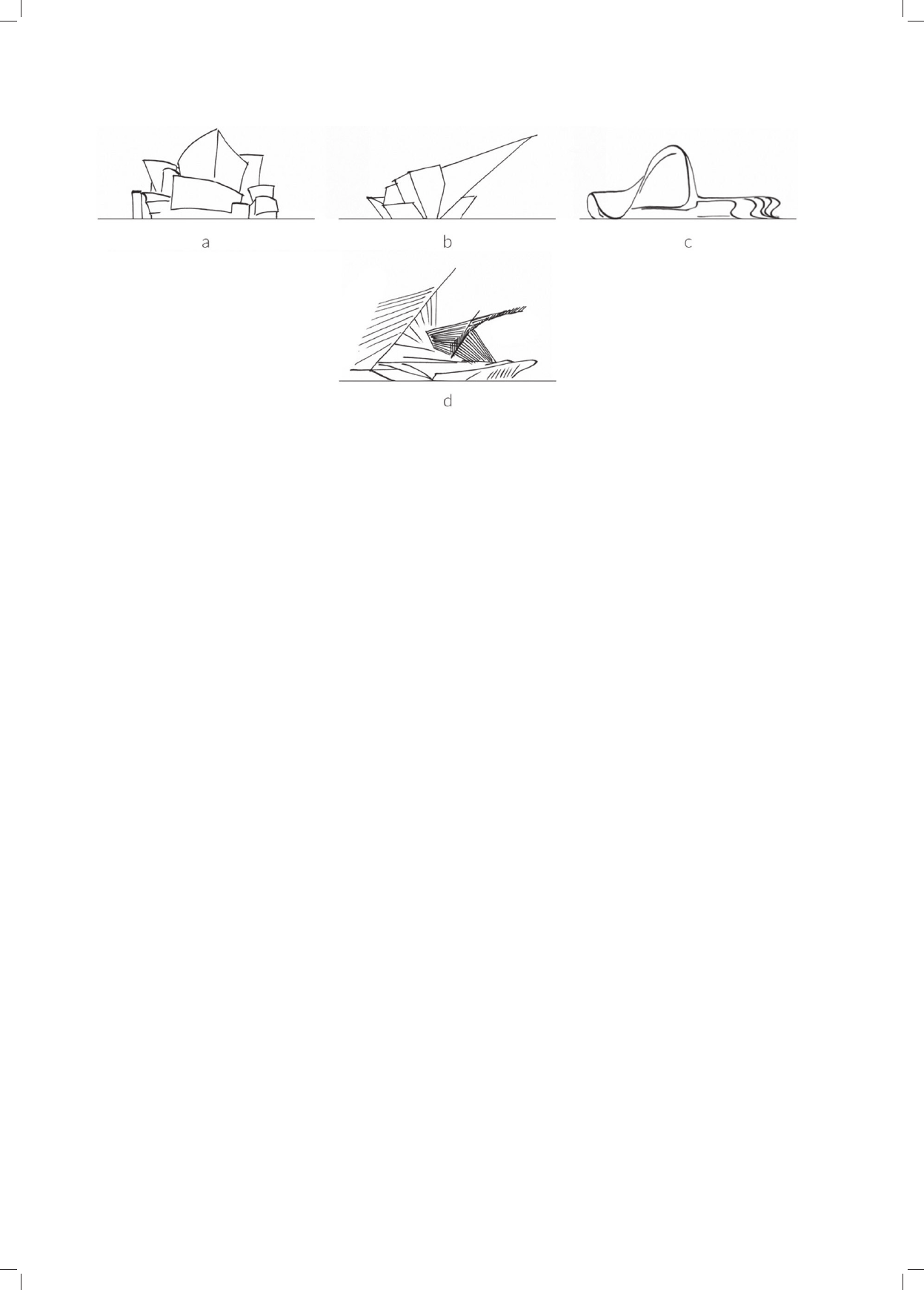
Il. 1. Wybrane przykłady form swobodnych: a) Frank Gehry, Walt Disney Concert Hall, 2003; b) Daniel Libeskind, Denver Art Museum, 2006;
c) Zaha Hadid, Heydar Aliyev Center, 2013; d) Santiago Calatrava, Milwaukee Art Museum, 2001 (rys. B. Adamiczka)
Fig. 1. Selected examples of free forms: a) Frank Gehry, Walt Disney Concert Hall, 2003; b) Daniel Libeskind, Denver Art Museum, 2006;
c) Zaha Hadid, Heydar Aliyev Center, 2013; d) Santiago Calatrava, Milwaukee Art Museum, 2001 (drawn by B. Adamiczka)

Kropla: zjawisko percepcji form swobodnych/The Drop: phenomenon of free forms’ perception 17
których część może być traktowana jako rewolucyjna,
tymczasem inne wydają się dziwne, obce lub nawet sza-
lone. Jednak forma stanowi znacznie więcej niż wyłącz-
nie geometryczną reprezentację kształtu – cytując mala-
rza Bena Shahna: forma to widzialny kształt treści [cyt.
za: 7, s. 109]. Część struktur odbierana jest jako bezpiecz-
ne i budzące zaufanie, inne zaś jako niepewne, chwiejne
czy wręcz stanowiące zagrożenie. Dlaczego są postrzegane
w ten sposób? Nawet jeśli są zbudowane w sposób solidny
i bezpieczny? Na jakiej podstawie są oceniane? W nawią-
zaniu do poglądu Steena Eilera Rasmussena, odpowiedzią
na te pytania może być percepcja – jako że granice archi-
tektury nie są jasno określone, nie należy jej wyjaśniać,
lecz odczuwać [8].
Odnosząc definicję form swobodnych do obiektów ar-
chitektonicznych, […] architekturę o swobodnej formie
(ang. free form architecture) można scharakteryzować
jako swobodnie płynącą ekspresję, która stara się równo-
cześnie odzwierciedlać i pogodzić nieuniknioną różnorod-
ność sił wpływających na każdy projekt architektoniczny
[9, s. 237–267]. Formy swobodne w projektowaniu bu-
dynków FFD mogą odpowiadać jednemu z dwóch sposo-
bów podejścia w tworzeniu ich formy – albo związanemu
z przyczynami konstrukcyjnymi, albo z przyczynami ar-
chitektonicznymi [10]. W pierwszym wypadku istotne jest
to, że proces tworzenia formy bazuje na konkretnym, szcze
gólnym materiale. W pewnym sensie forma budynku oraz
układ nośny sam w sobie tworzone są w procesie konstru-
owania. Tym samym można stwierdzić, że forma obiektu
powstaje z jego własnej konstrukcji. W drugim wypadku
forma obiektu architektonicznego jest osobnym, niezależ-
nym elementem dodanym do obiektu. W efekcie można
przyjąć, że forma obiektu jest oparta na jego konstrukcji,
jednak nie jest jej koherentną częścią i może zostać bez
większych trudności zmieniona lub usunięta, bez znaczą-
cych konsekwencji dla samego układu strukturalnego.
Upraszczając, można powiedzieć, że pierwsze podejście
oznacza sytuację, w której forma i układ nośny obiektu są
spój ne i zależne od siebie, zaś drugie – sytuację, w któ rej
forma i konstrukcja obiektu są, przynajmniej częściowo,
niezależne od siebie i mogą być rozpatrywane oddzielnie.
Głównym celem pracy jest zdefiniowanie i scharaktery
zowanie aspektów, czynników oraz efektów (ergo wpły wu
oddziaływania) percepcji form swobodnych jako jednego
z atrybutów w procesie powstawania formy architekto-
nicznej. To właśnie percepcja jest tym, co odpowiada za
sposób, w jaki odbieramy otacza jący nas świat [11], włą-
czając również architekturę. Wszel kie rezultaty badań
mogą rozwinąć i rozszerzyć wiedzę i pojmowanie relacji
pomiędzy twórcą, obserwatorem i użytkownikiem oraz
samym procesem projektowym jako takim. Pierw szym
zamysłem projektu badawczego jest zwiększenie wiedzy
w zakresie samego zjawiska percepcji. Drugim zadaniem
jest stworzenie modelu symulacyjnego, pozwalającego
wyróżnić instrumenty i cechy charakterystyczne umożli-
wiające opisanie wpływu zjawiska percepcji na proces
projektowania.
W celu poznania głównych aspektów percepcji został
przy gotowany prosty prototyp symulacji badawczej.
Prze bieg doświadczenia: na stole ustawione jest naczynie
mussen, the
answer to these questions may be perception
– as the boun
daries of architecture are not clearly defined,
it should not be explained but felt [8].
Referring to the definition of free forms for architec-
tural objects, […] freeform architecture’ may be charac-
terized by a free-flowing expression that seeks to simulta-
neously reflect and reconcile the inevitability of a di versity
of forces influencing any architectural design [9, p. 237–
267]. Free forms in free form buildings design can reflect
one of two approaches in creating their form – either re-
lated to structural or designing (architectural) reasons
[10]. In the first case, an important thing is that the pro-
cess of form creation is based on a particular material. In
a way, the form of a building and the structure itself are
created through the process of constructing. Consequently
in that case it can be stated that the form of an object arise
from its structure. In the second case, the form of an ar-
chitectural object is a separate, independent thing, added
to the object. We can therefore assume that the form of an
object is based on its structure but is not a coherent part
of this structure and can be easily removed or changed
without consequences for the structure itself. Simplifying,
it can be said that the first approach indicates the situation
in which the form and the structure of the object are co-
herent and depend upon each other, and the other one in-
dicates the situation in which the form and the structure of
the object are, at least partly, independent of each other
and may be considered individually.
The main aim of the research project is to define and
characterize aspects, factors and effects. Through the no-
tion of the effect of perception the author understands the
influence that perception exerts on particular aspects of the
perception of free form as a one of the attributes in the
process of shaping the architectural form. It is the percep-
tion which is responsible for the way we perceive the world
that surrounds us [11], including architecture. Any results
of the research may help to improve and expand the know
ledge and understanding of the relation between the creator
and the observer or user and the design process itself. The
first of the expected effects of the research project is to in-
crease the knowledge of perception itself. The second one
is to create a simulation model to distinguish instruments
and characteristic traits allowing to describe their influence
on the design process. The last one is to recognize the set
of aspects related to the phenomenon of the perception.
To examine the main aspects of the perception, a sim-
ple prototype of research simulation was prepared. Pro
cess of study: there is a vessel filled with water and a ca
mera, both on a table; the person tested is given ink – his
or her task is to pour the ink into the vessel while watch-
ing it through the camera; when the person sees a shape
recalling a geometric or an architectural form, he or she
takes a picture; the researcher asks questions and makes
notes; the procedure may be repeated if necessary (this
depends on the researcher). The study can be carried out
on a group of people. This research simulation allows
observing the process of perception and its attributes, at the
same time controlling the external factors and focusing on
the impressions of the person tested, also with reference
to these factors.

18 Bartosz Adamiczka
wypełnione wodą oraz aparat fotograficzny; osoba bada-
na dostaje tusz – jej zadaniem jest aplikacja tuszu do na-
czynia przy jednoczesnej obserwacji tej czynności po-
przez wizjer aparatu; kiedy badany dostrzeże kształt
przypominający formę geometryczną lub architektonicz-
ną, naciska spust migawki i robi zdjęcie; osoba przepro-
wadzająca badanie zadaje pytania i robi notatki; procedu-
ra w razie koniecz ności (decyzja osoby przeprowadzającej
symulację) może zostać powtórzona. Badanie przeprowa-
dzić można na wybranej grupie osób. Symulacja ta po-
zwala na obserwację procesu percepcji oraz związanych
z nią atrybutów, przy jednoczesnej możliwości kontroli
czynników zewnętrznych oraz skoncentrowaniu uwagi na
wrażeniach jed nostki poddanej badaniu, również w od-
niesieniu do tych czynników.
Relacja twórca–obserwator w procesie percepcji
Skupiając się na samym procesie poszukiwania formy,
niejednokrotnie zapomina się o udziale w nim istoty ludz-
kiej. Myśląc o roli człowieka, można zauważyć dwie
funkcje. Pierwsza z nich, już wspomniana, to rola projek-
tanta. Nawiązując do przedstawionych możliwości proce-
su poszukiwania formy, projektant odgrywa rolę twórcy
o niemal nielimitowanej kontroli nad wirtualną formą
budynku oraz jego otoczeniem [12]. Może on nawet zo-
stać nazwany demiurgiem. Drugą rolą człowieka w tym
procesie jest funkcja użytkownika. Użytkownik wchodzi
w interakcje z budynkiem, wprowadza do niego życie, ale
i ocenia go. Zdarza się, że przystosowuje go do swoich
potrzeb, w tym nawet go przebudowując. W rzeczywisto-
ści sposób, w jaki człowiek postrzega budynek oraz jego
otoczenie, może stanowić kluczowy czynnik dla wyglądu
samej formy obiektu. Staje się to jeszcze ważniejsze w przy-
padku budynków typu free form – kiedy forma obiektu
jest niecodzienna, nieoczywista i zupełnie inna od tej, do
której przywykł odbiorca. Budynki o tradycyjnej formie
są często niezauważane przez obserwatora, jako że ich
forma jest mu dobrze znana. Budynki typu free form wy-
różniają się w tkance miejskiej, przyciągają uwagę od-
biorcy. Można powiedzieć, że stymulują one proces per-
cepcji w dużo bardziej zdecydowany sposób.
W odniesieniu do tych dwóch zaprezentowanych ról
najważniejszym czynnikiem wpływającym na proces po-
szukiwania formy architektonicznej jest relacja twórcy
i użytkownika. Bardzo często ta relacja jest niebezpośred-
nia – wyraża się poprzez budynek. Kształtując szczególną
formę budynku, kreator igra z jego percepcją, oglądając
zachowania i odpowiedzi odbiorcy.
Wcześniej kształt architektoniczny budynku miał
świad czyć o jego solidności i wytrzymałości. Dlatego też
system konstrukcyjny był jednym z najważniejszych as
pektów projektowych w procesie poszukiwania formy.
Rozwój systemów konstrukcyjnych pozwolił wypracować
zdecydowanie bardziej spektakularne bryły budynków.
Jak już wspomniano, zaawansowanie współczesnych tech
nologii budownictwa pozwoliło na kształtowanie formy
architektonicznej w oderwaniu od konkretnego systemu
konstrukcyjnego. Budynki dzisiejszych czasów mają za-
skakiwać użytkowników, wprawiać w zdumienie. Każ dy
Creator vs. observer in the process of perception
Focusing on the architectural form finding process itself,
it often happens that one forgets about the human participa-
tion in this process. Thinking about the human role, we can
notice two functions. The first, already mentioned, is the
role of the designer. According to presented capabilities in
the form finding process, the designer plays the role of a cre-
ator. The creator has a nearly unlimited control over the
virtual form of a building and its environment [12]. He can
be even called a demiurge. The second role of man in this
process is the function of the user. The user interacts with
the building, introduces life into it. It happens that he adapts
the building to his needs, sometimes even rebuilding it. But
he also evaluates it. In fact the way he perceives the build-
ing and its surroundings might be a crucial factor for the
appearance of the building’s form itself. This becomes even
more important in the case of free form objects – where the
form is unusual, not obvious and quite different from what
the observer has been used to. Buildings of traditional form
are often unnoticed by the observer as their form is well
known to him. Free form buildings stand out in the urban
tissue, they attract his attention. One can say that they sti
mulate the process of perception more firmly.
Referring to these two presented roles, the most impor-
tant factor in form finding process is the relation between
the creator and the user. Very often this relation is indirect
– it is expressed through the building. Shaping a particu-
lar form of a building, the creator plays with building per-
ception, watching the users response and behavior.
Formerly the architectural form of a building was to
give evidence of its reliability and durability. That is why,
the structural system, was one of the most important as-
pects in the form finding process in designing. The devel-
opment of structural systems allowed achieving much
more spectacular buildings’ forms. As it was mentioned,
the advancement in contemporary technology of building
con struction, allows shaping the architectural form apart
from the structural system. The buildings of our times
have to surprise users and astound them. Each of them,
pre tends to be unique – one of a kind. To achieve this, new
barriers are overcome: visual, aesthetic or structural [12].
What would the architectural form look like without the
user? An attempt can be made to present the extreme state
of this situation by analogy with the experiment of Erwin
Schrödinger – according to the quantum theory and the
experiment, every object is in superposition of states, un-
less measurements are made – for example observation
[13]. If so, it means that the architectural form is indeter-
minate until being watched by someone (Fig. 2). In fact,
further research expanded this theory by the phenomenon
of decoherence – briefly speaking, nature plays the role of
the observer, so objects set in an environment are already
specified in one of its states [13]. In this way, the present
lack of possibility of direct observation of the assumptions
of quantum theory for macroscopic objects is explained –
such objects do not reveal their wave properties due to the
too small wavelength of matter. Although the shape of ar
chi
tectural objects must be unequivocally and emphatically
formed, the architectural form being […] the visible
Kropla: zjawisko percepcji form swobodnych/The Drop: phenomenon of free forms’ perception 19
z nich pretenduje do miana niepowtarzalnego, jedynego
w swoim rodzaju. Aby to osiągnąć, pokonywane są nowe
bariery: wizualne, estetyczne czy strukturalne [12].
W jaki sposób forma architektoniczna wyglądałaby
bez użytkownika? Dokonać można próby przedstawienia
stanu granicznego tej sytuacji poprzez analogię do ekspe-
rymentu Erwina Schrödingera – zgodnie z teorią kwanto-
wą oraz wspomnianym eksperymentem każdy obiekt
znajduje się w superpozycji stanów, dopóki nie zostaną
wykonane pomiary, np. obserwacja [13]. Jeśli przedstawi
się ten stan graniczny w ten sposób, to znaczy, że forma
architektoniczna jest nieokreślona, dopóki nie będzie
przez kogoś oglądana (il. 2). W efekcie kolejne badania
rozszerzyły tę teorię o zjawisko dekoherencji – krótko
mówiąc, natura pełni funkcję obserwatora, dlatego też
obiekty osadzone w środowisku mają już sprecyzowany
jeden ze stanów [13]. W ten sposób tłumaczyć można
obecny brak możliwości bezpośredniej obserwacji zało-
żeń teorii kwantowej dla obiektów makroskopowych, jako
że tego typu obiekty nie ujawniają swoich własności falo-
wych, ze względu na zbyt małą długość fali materii. Mimo
że kształt obiektów architektonicznych musi być jed
noznacznie i dobitnie uformowany, forma architektonicz-
na – jako „widzialny kształt treści” [7] – może znacząco róż
nić
się w sposobie odczuwania (percepcji) obserwatora,
a co za tym idzie, stanowić może inną formę pomi mo nie-
zmiennego kształtu (superpozycja stanów). Ko lej nym po-
twierdzeniem niematerialnego i zło żonego cha rakte ru for-
my architektonicznej może być ujęcie zgod ne z ujęciem
Juchanim Pallasmaa, który traktuje architekturę jako ro-
dzaj egzystencjalnego i metafizycznego filozofowania za
pomocą przestrzeni, struktury, materii, grawitacji i świa-
tła [14]. Jednakże teoria kwantowa nie jest jedyną, która
podkreśla znaczenie obserwatora.
Angloirlandzki filozof George Berkeley stworzył kon
cepcję „bytu obserwowanego”. Powiedział on: „być” to
znaczy być postrzeganym. Podążając tym tokiem myśle-
nia, należy uznać, że obiekt (lub rzecz) może istnieć wte-
dy i tylko wtedy, kiedy jest obserwowany. Jednocześnie
nikt nie może być pewny istnienia tej rzeczy – pozostaje
to tylko w wyobraźni [15]. Obie te teorie uwypuklają
znaczenie percepcji badanego obiektu i jego interakcji
z użytkownikiem. Był to jeden z bodźców do podjęcia
przedmiotowych badań przez autora.
shape/representation of a content [7] can significantly dif-
fer in the manner of perception of the observer, and thus
may constitute another form despite of unchanging shape
(superposition of states). In accordance with Juchani Palla
smaa, another confirmation of the intangible and complex
nature of the architectural form, might be architecture
definition as a kind of existential and metaphysical phi-
losophizing by means of space, structure, matter, gravity
and light [14]. However, the quan tum theory is not the
only one that emphasizes the role of the observer.
An AngloIrish philosopher George Berkeley created
the concept of “observed existence”. He said: “to be”
means “to be seen”. It means that an object or something
can exist if and only if it is being observed. Otherwise,
one cannot be certain of the existence of this thing – it
remains only in the imagination [15]. Following this path,
both these theories enhance the importance of perception
and interaction of the user with an examined object. That
was one of the incentives to start the research project.
In the research simulation prototype there are two roles
of man – the researcher and the person tested. The re-
searcher is a supervisor. He or she helps the person tested
during the simulation and at the end of each sequence he
or she asks questions. The person tested might be called
a “dropper” or an “observer”. His or her main task is to
observe and interpret appearing shapes. He or she is the
one who interacts and brings to life those shapes. Both
participants have to deal alike with the real and virtual
context of the research project. The real life simulation is
combined with virtuality – the imagination on the one
hand and the digital representation of reality (digital pic-
tures) on the other hand. Such a combination provides the
ability to access nearly unlimited possibilities of the vir-
tual world and its technology while, at the same time, the
research itself is set in the reality. Thus one may be able
to explore the free form’s perception and to draw conclu-
sions in relation to the architectural objects.
Aspects of perception
What is perception? How does it work? What are the
factors that affect the perception? What is the difference
in perception of particular people? These and others simi-
lar question are very important to understand the way
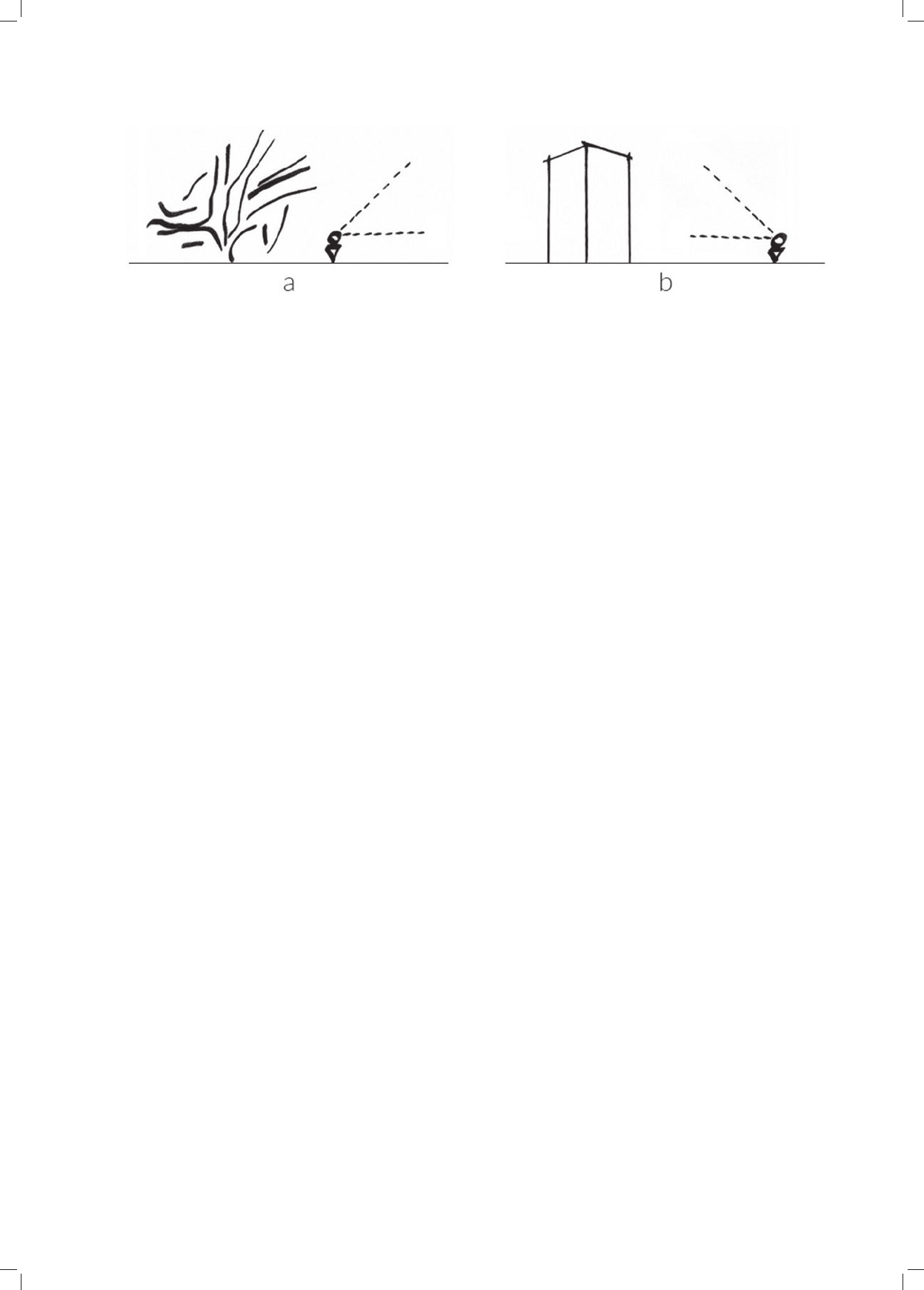
Il. 2. Schemat koncepcyjny: a) forma nieobserwowana – nieokreślona; b) forma obserwowana – określona
(rys. B. Adamiczka na podstawie eksperymentu E. Schrödingera)
Fig. 2. Concept diagram: a) form not observed – indeterminate; b) form observed – determinate
(drawn by B. Adamiczka based on experiment of E. Schrödinger)

20 Bartosz Adamiczka
W prototypie symulacji badawczej można wyróżnić
dwie role człowieka – naukowiec oraz osoba poddana do-
świadczeniu. Osoba prowadząca test jest opiekunem.
Pomaga on uczestnikowi doświadczenia podczas symula-
cji i zadaje pytania na koniec każdej sekwencji. Osoba
zaproszona do eksperymentu może być nazwana „krople-
rem” albo „obserwatorem”. Jej głównym zadaniem jest
obserwować i interpretować pojawiające się kształty. Jest
jednostką, która wchodzi w interakcje i powołuje do życia
te kształty. Obaj uczestnicy muszą obcować zarówno
z wirtualnym, jak i rzeczywistym kontekstem projektu
studialnego. Realna symulacja jest połączona ze środowi-
skiem wirtualnym – wyobraźnia z jednej strony i cyfrowa
reprezentacja (fotografie cyfrowe) z drugiej. Takie połą-
czenie daje możliwość dostępu do prawie nielimitowa-
nych możliwości cyfrowego świata i jego technologii
podczas samych badań osadzonych w tym czasie w świecie
materialnym. Dzięki temu istnieje możliwość odkrywania
percepcji form swobodnych oraz wyciągania wniosków
w nawiązaniu do obiektów architektonicznych.
Aspekty percepcji
Czym jest percepcja? Jak działa? Jakie czynniki mają
na nią wypływ? Czym się różni percepcja u poszczegól-
nych ludzi? Te i inne, podobne pytania są bardzo istotne,
by zrozumieć sposób, w jaki postrzegane są budynki.
Głównym celem omawianego projektu i symulacji jest
przestudiowanie zjawiska percepcji oraz odnalezienie
użytecznej informacji, potrzebnej do lepszego zrozumie-
nia tego zjawiska, a także, być może, odpowiedź na wyżej
wymienione pytania.
Zgodnie z powszechną definicją, percepcja jest kom-
pleksowym procesem poznawczym [16]. To jest sposób,
w jaki myślisz o czymś albo rozumiesz coś lub kogoś, albo
sposób, w jaki postrzegasz lub rozumiesz coś, używając jed
nego ze swoich zmysłów [17]. W rzeczywistości, w szcze
gólnym przypadku architektury lepsze rozumienie tego
procesu może pozwolić na bardziej kreatywne podejście
do tworzenia i projektowania [18].
Zastanawiając się nad koncepcją percepcji oraz same-
go prototypu symulacji badawczej, autor wyróżnił pięć
okoliczności będących głównymi atrybutami lub as pek
tami percepcji: kontekst/tło, czas, projekcję, interpretację
oraz zmysły. Każdy z nich oddziałuje na proces postrze-
gania w pewien sposób. Zmiana jednego z nich wpłynie
na odbierany obraz badanego obiektu oraz rzeczywis
tości. Po zebraniu atrybutów przeprowadzono symulację
pro ble
mów z nimi związanych. W tym celu zadano pytania
ba daw cze o to, jakim problemem może być konkretna oko
licz ność i jaki problem można połączyć z daną okolicznoś
cią. W efekcie dla każdej z okoliczności zdefiniowano
prob l
em. Następnie wykonano symulację pomysłów zwią-
zanych z każdym z określonych problemów. Do każdego
z nich dopasowano pomysł mogący posłużyć jako jego
rozwiązanie. Ilustracja 3 ukazuje relacje pomiędzy grupa-
mi faktów, problemów i pomysłów.
Pierwszym problemem była zmienność kontekstu – ten
sam obiekt jest postrzegany zupełnie inaczej w zależnoś
ci od zmiany tła [11]. Próbując rozwiązać ten problem,
buildings are seen. The main aim of the research project
and the research simulation is to study the phenomenon of
perception and find some useful information, needed to
better understand it and perhaps to answer those questions.
According to the common definition, perception is
a complex cognitive process [16]. It is the way you think
about or understand someone or something or the way
that you notice or understand something using one of
your senses [17]. In fact, in the particular case of architec-
ture, a better understanding of this process may allow for
a more creative approach to its design and creation [18].
Reflecting on the concept of perception and the re-
search simulation itself, the author distinguished five facts
being main attributes or aspects of perception: context/
background, time, projection, interpretation and incentives
(senses). Each one of them influences the process of the
perception in some way. Changing one of them will influ-
ence the perceived image of the examined object and the
reality. After gathering these attributes, a simulation of the
problems was conducted and examining questions were
asked: “a certain fact is a problem of what?”, “what prob-
lem might be connected with a certain fact?” For each fact,
its problem was defined. Than a stimulation of ideas gen-
erated by those problems was realized. For every problem
the idea of a solution was matched. Figure 3 demonstrates
relations between groups of facts, problems and ideas.
The first problem was the variability of the context –
the same object is seen completely differently on various
background [11]. Trying to solve the question of variabil-
ity a solution of a studio was proposed. Thereby the re-
searcher may fully control the background for the research
simulation. For example he can use a totally neutral,
white setting to eliminate its influence on the object. On
the other hand he may affect its perception by colors, lu-
minosity, shapes or patterns. Everything is under the con-
trol of the researcher. In practice it is impossible to ma-
nipulate the context of the building in this way. However
the possibility of this procedure in the research simulation
allows determining the influence of the background and
context on the perception process.
Another problem might be the passage of the time –
every moment is unique and unrepeatable, it is impossible
to control the time. The issue of time is impossible to com-
pletely control but it might be counted in order to draw
some conclusions. In relation to the topic of architecture,
the question of time has many aspects. It happens that the
observer becomes used to certain particular forms and ob-
jects, that were initially unusual. Some characteristics as-
sociated with the fashion or technology becomes obsolete
– something which was recognized as innovative and fresh
loses its validity and importance. Moreover, buildings are
transformed in time. Their form changes – they are rebuilt,
modified or they simply deteriorate during their use.
Thinking of projection, one cannot forget about the
issue of subjectivism of the observer – every person
perceives in his own way [19]. Among other things, it de-
pends on the imagination, education, cultural background
or age [20]. The problem of subjectivism and unpredicta
bility is also present in the field of the inter pretation. Ana
lyzing the facts of projection and interpre tation and its
Kropla: zjawisko percepcji form swobodnych/The Drop: phenomenon of free forms’ perception 21
zaproponowano zastosowanie studia – przestrzeni staran-
nie
przygotowanej i odpowiednio wyposażonej do celów
eksperymentu. Dzięki temu badacz mógłby w pełni kon
trolować tło w trakcie symulacji. Na przykład mógłby
zasto sować całkowicie neutralną, białą oprawę w celu wy-
eliminowania lub osłabienia jej wpływu na obiekt. Jed
nocześnie mógłby dokonać próby wpłynięcia na percep
cję poprzez zastosowanie kolorów, jasności, kształtów
lub
wzorów. Wszystko
byłoby pod kontrolą osoby przepro-
wadzającej badanie. W praktyce manipulowanie kontek-
stem budyn
ku w taki sposób jest czymś niemożliwym.
Jednakże wdro
żenie takiej procedury w ramach symula
cji pozwala na określenie wpływu tła i kontekstu na pro-
ces percepcji.
Kolejnym problemem jest upływ czasu – każda chwila
jest wyjątkowa i niepowtarzalna. Niemożliwe jest kontro-
lowanie czasu, jednak istnieje ewentualność mierzenia
lub liczenia go w celu wyciągnięcia pewnych wniosków.
W architekturze czas ma wiele aspektów. Zdarza się, że
ob serwator przyzwyczaja się do form i obiektów, które
początkowo uważał za niecodzienne. Niektóre cechy
zwią za ne z modą i technologią dezaktualizują się – coś,
co było kiedyś postrzegane jako innowacyjne i świeże,
traci swoje znaczenie i ważność. Co więcej, budynki są
przekształcane w czasie; ich forma ulega zmianie – są
przebudowywane, modyfikowane lub po prostu niszczeją
w trak cie użytkowania.
Myśląc o projekcji, nie można zapominać o subiekty-
wizmie obserwatora – każda osoba postrzega otaczające
ją elementy w sobie właściwy sposób [19]. Zależy to od
wielu czynników, m.in. od wyobraźni, wykształcenia,
kul tury czy też wieku [20]. Problem subiektywizmu i nie-
przewidywalności jest również obecny w zakresie inter-
pretacji. Podczas analizy okoliczności projekcji i interpre-
tacji oraz związanej z nimi problematyki subiektywizmu
i nieprzewidywalności w rozważaniach uwzględniono
czynnik poziomu edukacji i rozwoju osoby badanej. W eks-
tremalnych przypadkach, aby zrozumieć, dlaczego pew
ne
formy zostały stworzone w tak szczególny sposób, ko-
nieczne
jest poszerzenie zakresu swojej wiedzy – odkrycie
questions
of subjectivism and unpredict ability the idea of
education and development of the person tested appeared.
Sometimes to understand why certain forms were created
in such a particular way, it is necessary to increase the
knowledge – recognize the intentions of the creator or
get to know circumstances of the creation process. Un
doubtedly, knowledge plays a key role in the way man
perceives his environment [20], including architecture.
The last fact – incentives (senses) is related with the
problem of insensibility. The problem of insensibility is
a complex problem. On the one hand it is nearly impos-
sible to overcome physical barriers related with sensitiv-
ity but on the other hand there is a chance to emotionally
sensitize the person tested. More than once, the aesthetic
sensitivity differentiates the way in which people per-
ceives art and architecture. Some are able to see aspects
which to others are hidden.
All those groups of facts, problems and ideas could be
useful in further stages of the research project – in some
way these elements determine and describe its main aim.
Sensory stimuli of perception
In the course of reflection and research, the author pre-
pared an intuitive image of the concept nucleus of the
research project inspired by the theory of George Ber
keley. Elements from which it was created correspond to
the facts previously featured and perception is compared
to life and its interactions which are expressed and condi-
tioned through the senses. It is presented by the form of
a horizontal lifeline or cardiogram line that vary under the
influence of the senses presence – they stimulate it, ani-
mate it and provoke interactions. This line might be also
identified as a manifestation of the time passage. The dot-
ted line around the cardiogram line fluctuation is another
significant element – it is a representation of thinking pro-
cesses including projection and interpretation which are
indispensable in the process of the perception. They are
crucial for understanding and processing of sensory sti
muli. In this case, the white background is treated as
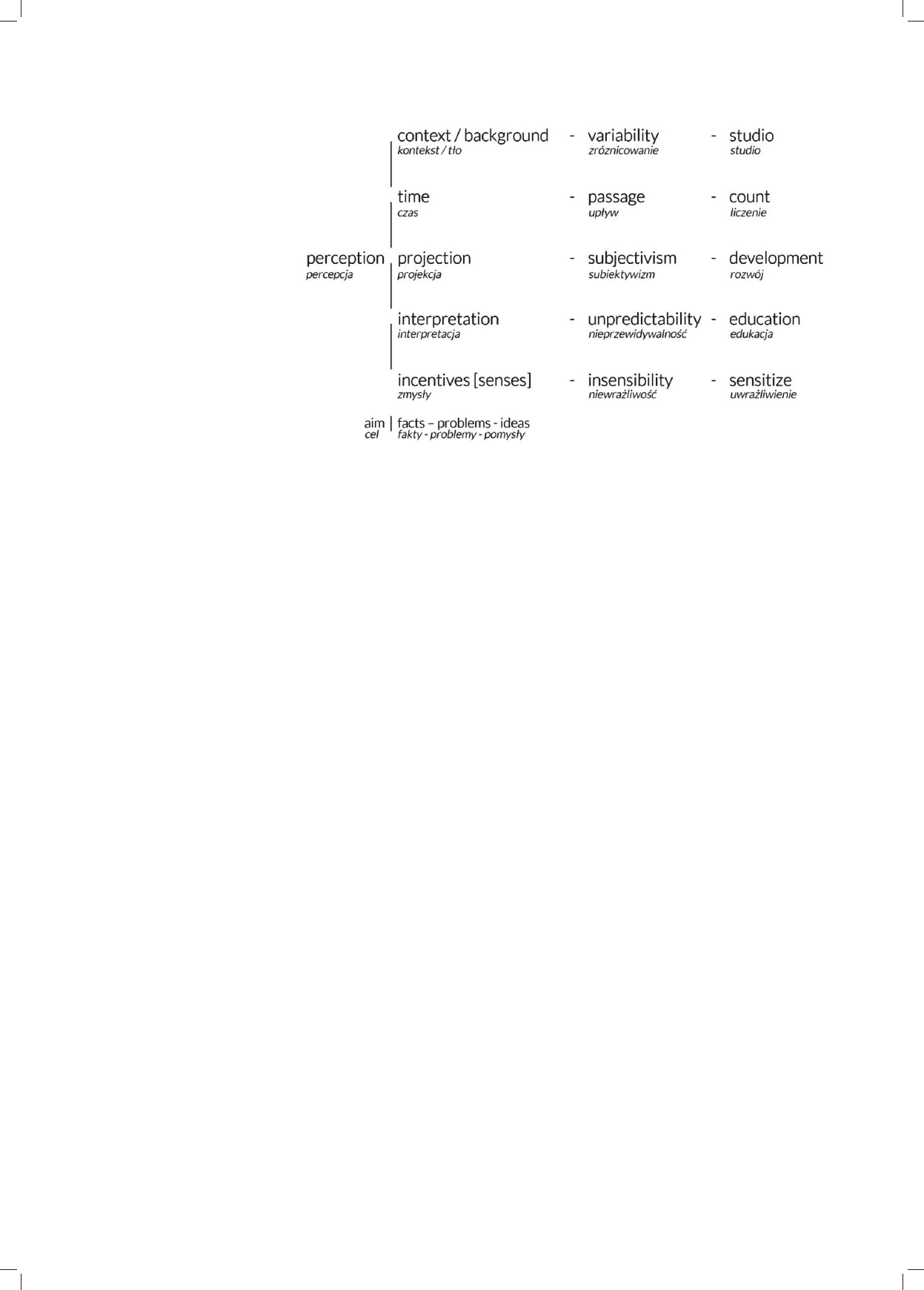
Il. 3. Symulacja grup faktów,
problemów i pomysłów
(rys. B. Adamiczka)
Fig. 3. Simulation of groups of
facts, problems and ideas
(drawn by B. Adamiczka)

22 Bartosz Adamiczka
intencji twórcy oraz poznanie okoliczności towarzyszą-
cych procesowi tworzenia. Niewątpliwie wiedza odgrywa
kluczową rolę w sposobie, w jaki człowiek postrzega
swoje otoczenie [20], w tym architekturę.
Ostatnia okoliczność – zmysły – jest złożonym proble-
mem, związanym z nieczułością. Z jednej strony niemal
niemożliwe jest pokonanie barier fizycznej niezdolności
do używania zmysłów, jednak z drugiej strony istnieje
możliwość emocjonalnego uwrażliwienia osoby badanej.
Wrażliwość estetyczna różnicuje sposób, w jaki ludzie
po strzegają architekturę. Każdy jest w stanie dostrzec as
pekty, które dla innych osób pozostają ukryte.
Wszystkie te grupy okoliczności, problemów i pomy-
słów mogą stać się użyteczne w dalszych etapach projek-
tu badawczego – w pewnym sensie elementy te określają
i opisują jego główny cel.
Bodźce zmysłowe percepcji
W trakcie rozważań i badań autor przygotował intuicyj-
ną grafikę, inspirowaną teorią Georga Berkeleya, ukazują-
cą rdzeń koncepcji projektu badawczego. Jej elementy
składowe odpowiadają wcześniej omówionym okoliczno-
ściom, zaś percepcja porównana jest do życia oraz obec-
nych w nim interakcji, które wyrażają się i są warunkowane
przez zmysły. Została ona przedstawiona jako ho ryzontal
na
linia życia lub kardiogramu, która zmienia się pod
wpływem obecności zmysłów – one ją stymulują, animu-
ją i prowokują interakcje. Sama linia może być też inter-
pretowana jako manifestacja czasu oraz jego upływu.
Przerywana linia wokół fluktuacji kardiogramu stanowi
kolejny znaczący element – reprezentuje tok myślenia,
w tym projekcję i interpretację, które są niezbędnymi ele-
mentami w procesie percepcji. Są one kluczowe dla zro-
zumienia i przetwarzania bodźców zmysłowych. W tym
wypadku białe tło potraktowane zostało jako neutralny
kontekst, który nie ma żadnego szczególnego wpływu na
ukazanie percepcji. Jego jedyną rolą jest wzmocnienie i ja-
sne przedstawienie innych elementów obrazu.
Percepcja odgrywa jedną z kluczowych ról w istnieniu
człowieka. Wpływa ona na jego życie oraz sposób, w jaki
postrzega świat. Poprzez percepcję elementy jego otocze-
nia są animowane i powoływane do życia i istnienia.
Głównym czynnikiem oddziałującym na ten proces jest
czas i jego upływ. Brak możliwości kontroli, niezmienny
przebieg i niewzruszoność stanowią jego główne cechy.
Atrybuty percepcji
Celem wcześniejszych symulacji było zwiększenie
i rozwój świadomości dotyczącej obszaru badawczego,
który z kolei służy rozwojowi wiedzy na temat percepcji.
Rozpoznanie i określenie każdej przedstawionej sekwen-
cji celu/okoliczności/problemu/pomysłu stanowi ważny
aspekt i powinno być traktowane jako nieodłączna część
tego badania naukowego. Każdy z ciągów stanowi cząst-
kę informacji określającą właściwości analizowanego ob-
szaru. Kolejnym krokiem było poszerzenie wiedzy w za-
kresie wcześniej przedstawionych układów. Dla lepszego
ich zrozumienia wyznaczono ekstrema dla każdego
a neutral context that has no particular impact on the per-
ception representation. Its only role is the enhancement
and clear presentation of the other elements of the image.
Perception plays one of the most important roles in the
human being. It affects the way he lives, and the way he
perceives the world around him. Through the human per-
ception the elements of his environment are animated and
brought to life and existence. The main factor that influ-
ence this process is time and its passage. The lack of abil-
ity to control, constant passage and imperturbability are
its principal features.
Attributes of perception
The purpose of earlier simulations was to enhance and
de velop the awareness of the research area, that may serve
to increase the knowledge of the perception. The recogni-
tion of every presented sequence of aim/act/problem/idea
constitute an important quality or feature regarded as a cha
racteristic or inherent part of this research area. Each of
them is a piece of information that determines the properties
of this field. A further step was to expand the know ledge
of previously presented sequences. For a better understand-
ing, the extremes for each attribute were determined. There
by the conditions, that are as different from each other as
possible, were designated. The following figure de mon
strates the set of these extremes and oppositions (Fig. 4).
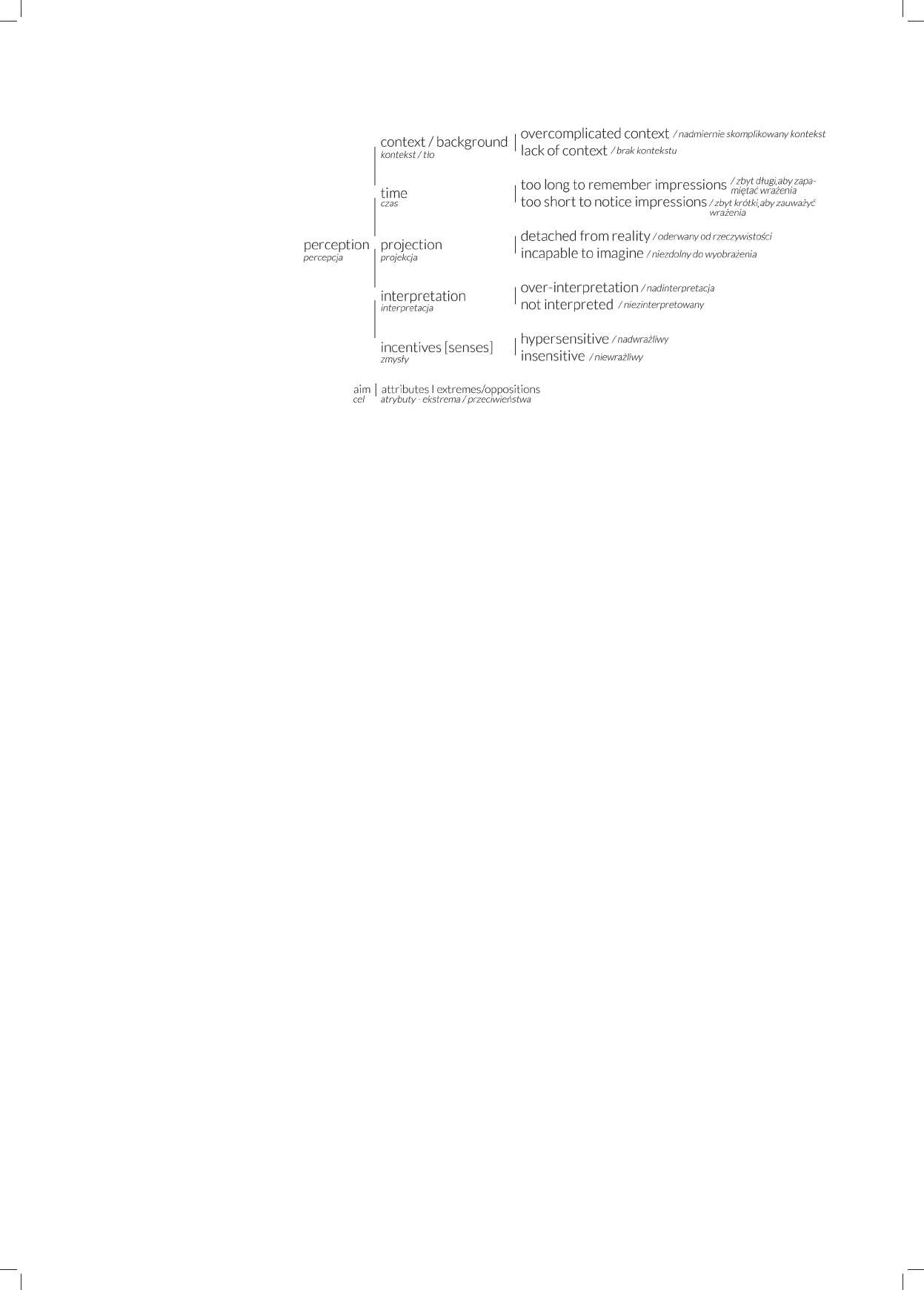
Thinking about the context attribute one can distin-
guish two extremes: overcomplicated context and lack of
context. The state of overcomplicated context appears
when the background consist of too many interconnecting
parts or elements and dominates something that was ob-
served. It is hard to imagine the total lack of the back-
ground or context. However, it might be simulated by a com-
pletely neutral background that does not impact on the
subject of observation – for example some kind of studio
or atelier. Also the time of the observation has a signifi-
cant influence on its effect. On the one hand a too short
exposure may cause the impossibility of noticing any im-
pressions. On the other hand the excessive prolongation
of the observation can result in unnecessary thinking
about the object, so impressions can flee or vanish and
become impossible to remember. In addition, taking into
consideration attributes of projection and interpretation,
either the observer might be nearly unable to imagine or
interpret certain aspects of the object, or he will overin-
terpret them and the image will be detached from reality.
In both cases the image seen by the observer is distorted
and is different from the initial idea of the object. Similar
or even the same is the situation related to the attribute of
senses. The hypersensitivity or insensitivity of the observ-
er may affect the perception in a similar way and cause
misunderstanding or incomprehension of the object.
Drop: prototype of research experiment
Man perceives the world through senses – a faculties
by which his body receives external stimuli. There are
five of them: sight, smell, hearing, taste, and touch. For
the architectural form perception the most essential is the
Kropla: zjawisko percepcji form swobodnych/The Drop: phenomenon of free forms’ perception 23
faculty of sight. Therefore, the study was designed to fo-
cus on this sense and to recognize which factors have
a decisive influence on it.
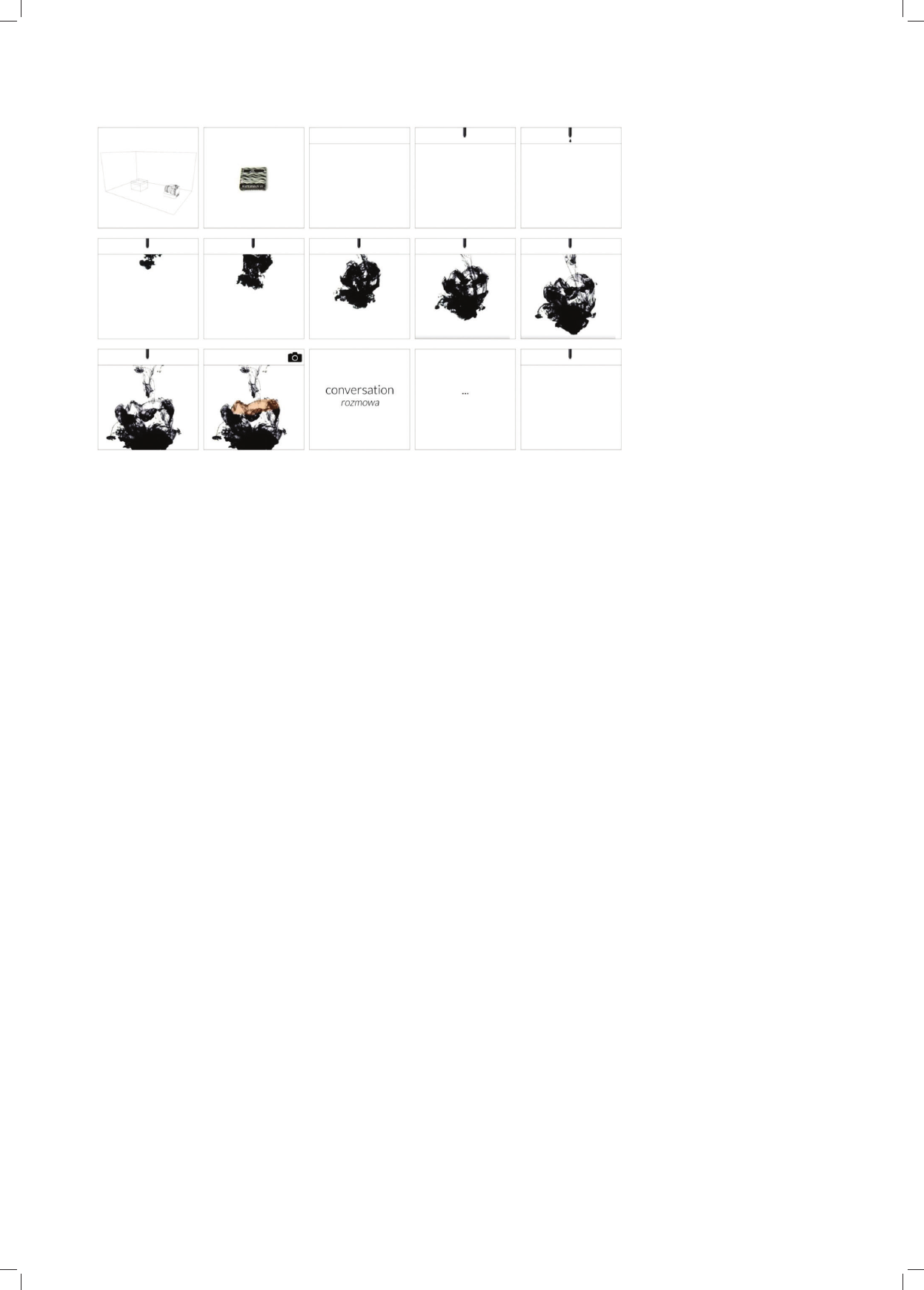
As it was mentioned, a simple research simulation pro-
totype was prepared to examine the main aspects of per-
ception (Fig. 5). This real life simulation was called “The
Drop”. Its type was defined as experimental and artistic. In
addition to the scientific approach its main goal was aes-
thetic and emotional development of people undergoing
the testing. First thing was the simplicity in use and func-
tioning. The main activities of the person tested included:
defining characteristics of the drop, dropping an ink drop,
interpretation/imagination of the shape and finally record-
ing the image in the form of a photo. In this set of actions
a certain range of options was provided, such as: ink
choice (type, amount), ink drop (time, place, energy), or
image capture (time). The simulation was based on “self
service” mechanics. There are no interactions between the
people undergoing the testing. In ter action with the re-
searcher – questioning, is the only one intended. As a back-
ground for this simulation a white, neutral studio was cho-
sen – pure and simple, having a gently calming effect. All
events and actions are registered as a group of captured
images and notes. As part of the planned study, the main
and only subject of the study is the form and variability of
its perception – in no case participants are the subject be-
ing examined or evaluated by this study. The whole pro-
cess can be compared to the process of architecture per-
ception, while its observation and analysis might be used
to better understand this phenomenon. A preliminary ver-
sion of the prototype has been prepared.
Altering parameters of the experiment
and research project
Before performing the research simulation and the ex-
periment itself, the process of its parameter altering was
executed. The parameter alteration includes, inter alia, ma
terial simulations, spatial simulations, timesimulations,
energysimulations and infosimulations of the concept
nucleus. The purpose of these simulations was the devel-
opment and enrichment of target research simulation.
z atrybutów. Tym samym określono stany każdego z nich
tak różne od siebie, jak to możliwe. Kolejny schemat uka-
zuje zestaw tych ekstremów i przeciwieństw (il. 4).
Myśląc o atrybucie kontekstu, można wyróżnić dwa
ekstrema: kontekst nadmiernie skomplikowany oraz brak
kontekstu. Pierwszy z przedstawionych stanów pojawia
się, gdy tło składa się ze zbyt dużej liczby łączących się
części lub elementów, przez co dominuje nad obiektem
obserwowanym. Jednocześnie trudno jest uzyskać sytua
cję, w której obiekt pozbawiony byłby całkowicie kon
tekstu lub tła. Jednakże można dokonać próby symulacji
takiego stanu poprzez zastosowanie całkowicie neutral
nego tła, które praktycznie nie wpływałoby w żaden spo
sób na przedmiot obserwacji – przykładem mogłoby być
zastosowanie studia lub odpowiednio przygotowanej pra-
cowni. Również czas obserwacji ma znaczący wpływ na
jej wynik. Z jednej strony zbyt krótki czas ekspozycji
może spowodować brak możliwości odbioru jakiegokol-
wiek wrażenia. Z drugiej jednak – nadmierne wydłużenie
obserwacji może doprowadzić do niepotrzebnych rozwa-
żań na temat obserwowanego obiektu, w wyniku czego
wrażenia mogą umknąć lub znikają i stają się niemożliwe
do zapamiętania. Dodatkowo, biorąc pod uwagę atrybuty
projekcji i interpretacji, obserwator może nie być zdolny
do wyobrażenia lub zinterpretowania pewnych aspektów
obiektu, albo też dojdzie do nadinterpretacji i wizerunek
obiektu stanie się całkowicie oderwany od rzeczywisto-
ści. W obu przypadkach obraz widziany przez obserwato-
ra jest zaburzony i zniekształcony względem początkowej
idei przedmiotu obserwowanego. Podobna, a być może
nawet identyczna sytuacja pojawia się w przypadku atry-
butu zmysłów. Nadwrażliwość lub niewrażliwość obser-
watora wpływa w podobny sposób na percepcję i powo-
duje nieporozumienie lub niezrozumienie obiektu.
Kropla: prototyp eksperymentu badawczego
Człowiek postrzega świat przez zmysły – zdolność,
dzię ki której jego ciało odbiera zewnętrzne bodźce. Ist nie
je pięć zmysłów: wzrok, zapach, słuch, smak i dotyk. Dla
procesu percepcji formy architektonicznej najbardziej
istotnym wydaje się wzrok. Dlatego też badanie zostało
Il. 4. Symulacja grup faktów
(atrybutów) i ekstremów/
przeciwieństw
(rys. B. Adamiczka)
Fig. 4. Simulation of groups of
facts (attributes)
and extremes/oppositions
(drawn by B. Ada micz ka)
24 Bartosz Adamiczka
It made it possible to discover new aspects and points of
view of its attributes.
Altering materials was executed as the first of them
[21]. It was based on materials’ change of project compo-
nents and reorganization of these components. Five main
components were distinguished: environment (water),
substance (ink), vessel (glass), camera and studio (made
of cardboard). Changes and replacements were proposed
for each of the components mentioned. Unfortunately, no
changes entered the basic model after these material al-
terations. However, an important observance was noted
– the more complicated and complex is the background
(studio), the more difficult the observation. In fact, the
material diversity of an observation subject might be a co-
herent part of its form. The test of the experiment con-
firmed that the perception of the form, including the ar-
chitectural form, might be quite different depending on
the material of this form. The use of certain materials can
cause a very positive evaluation but mismatch of the ma-
terial and the form may cause lack of acceptance of the
observer and sometimes even rejection of the whole ob-
ject. Referring to the previously discussed approaches to
the architectural form creation process one may notice the
following relation. When the form is coherent with the
structure, also the material itself is closely related to both
of them. It is different in the case of the second approach
– it happens that the material does not play a structural or
other fundamental role. If so, it can be easily replaced by
another one.
Another group of simulations – spatial simulations –
was a particular group for this research. After several at-
tempts spectrum mapping and altering parameters meth-
ods were chosen [21]. As first the method of spectrum
mapping was performed. The results related to two as-
pects – color and lens. The first one was quite simple –
instead of using black ink the opportunity of the ink color
choice was introduced. The second aspect refers to both
– research simulation prototype and buildings’ percep-
tion. Defining the diversity of lenses two features appear:
tak zaplanowane, żeby skupić się na tym zmyśle oraz na
rozpoznaniu, jakie czynniki mają nań decydujący wpływ.
Jak już wspomniano, w celu zbadania głównych aspek-
tów percepcji przygotowano prosty prototyp symulacji
(il. 5). To badanie w czasie i środowisku rzeczywistym
nazwano „Kroplą”, a jego typ zdefiniowano jako ekspery-
mentalny i artystyczny. W uzupełnieniu do naukowego
po dejścia głównym celem symulacji był estetyczny
i emo cjonalny rozwój osób poddanych badaniu. Pierwszą
jej cechą była prostota użycia i funkcjonowania. Do
głównych zadań osoby badanej należały: definiowanie
cech kropli, upuszczenie kropli atramentu, wyobrażenie/
interpretacja kształtu oraz na koniec zapisanie obrazu w for-
mie zdjęcia. W tym zestawie działań przewidziano pe-
wien zakres modyfikacji opcji, takich jak wybór tuszu
(typ, ilość), upuszczenie kropli tuszu (czas, miejsce, siła),
czy też uchwycenie obrazu (czas). Symulację oparto na
mechanizmie „samoobsługi”. Nie przewidziano żadnych
interakcji pomiędzy osobami poddanymi badaniu. Jedyną
zaplanowaną interakcją pomiędzy badaczem a osobą ba-
daną jest zadawanie pytań. Jako tło dla tego doświadcze-
nia wybrano białe, neutralne studio – czyste i proste, po-
siadające delikatne działanie us pokajające. Wszystkie
wydarzenia i czynności zapisywane są jako grupa uchwy-
conych obrazów i notatek. W ramach planowanego bada-
nia głównym i jedynym podmiotem ba dań jest for ma oraz
zmien ność jej per ce pcji – w ża dnym wy padku nie podda-
je się badaniu ani ocenie osób w nim uczestniczących.
Cały proces może być porównany do procesu percepcji
architektury, podczas gdy jego obserwacja i analiza mogą
być użyte do lepszego zrozumienia tego zjawiska. Przygo
to wano wstępną wersję prototypu.
Alteracja parametrów eksperymentu
i projektu badawczego
Przed przeprowadzeniem symulacji badawczej jej pa-
rametry poddano alteracji, w tym m.in. symulacjom zwią-
zanym z materiałem, przestrzenią, czasem, energią czy
Il. 5. Scenariusz symulacji
badawczej – storyboard
(rys. B. Adamiczka)
Fig. 5. Research simulation
scenario – storyboard
(drawn by B. Adamiczka)

Kropla: zjawisko percepcji form swobodnych/The Drop: phenomenon of free forms’ perception 25
też danymi. Celem alteracji było rozwinięcie i wzbogace-
nie docelowej symulacji badawczej. Pozwoliło to na od-
krycie nowych aspektów w odniesieniu do jej atrybutów.
Pierwszą przeprowadzoną modyfikacją była alteracja
materiałów [21]. Bazowała ona na zmianie materiałów
poszczególnych elementów projektu oraz ich reorganiza-
cji. Wyróżniono pięć głównych komponentów: środowi-
sko (woda), substancja (tusz), naczynie (szkło), aparat fo
to graficzny oraz studio (wykonane z kartonu). Następnie
za proponowano zmiany dla każdego ze wspomnianych ele
mentów składowych projektu. Niestety, w wyniku prze
prowadzonych alteracji żadne z nich nie zostały wpro wa
dzone do modelu bazowego. Poczyniono jednakże
waż ne
spostrzeżenie – im bardziej złożone i skomplikowane jest
tło (studio), tym trudniejsza jest obserwacja podmiotowe-
go obiektu. W rzeczywistości różnorodność materiało
wa tego obiektu może stanowić spójną część z jego for
mą. Testy eks perymentu potwierdziły, że percepcja formy,
w tym formy architektonicznej, może znacząco różnić się
w zależności od tego, z jakiego materiału wykonana jest
ta forma. Użycie pewnych materiałów może spowodować
pozytywną ocenę, zaś niezgodność materiału z formą może
skutkować brakiem akceptacji u obserwatora, a w skraj
nym przypadku wręcz odrzuceniem przez niego całego
obiek tu. Odwołując się do wcześniej przedstawionych
spo sobów podejścia do tworzenia formy architektonicz-
nej, można zauważyć ciekawą relację: kiedy forma kształ-
towana jest w sposób spójny z konstrukcją, również sam
materiał pozostaje w bliskiej relacji z nimi. Zupełnie ina-
czej sytuacja wygląda w drugim przypadku – zdarza się,
że materiał nie odgrywa roli konstrukcyjnej. Skoro tak,
może on być zastąpiony przez zupełnie inny materiał.
Kolejna grupa symulacji – symulacje przestrzenne –
była szczególnym zestawem dla tego projektu. Po prze-
prowadzeniu kilku prób wybrano dwie z nich – spectrum
mapping oraz alterację parametrów [21]. Wyniki pierw-
szej z nich dotyczyły dwóch aspektów badania – koloru
i obiektywu. Kwestia koloru była dość prosta – zamiast
czarnego tuszu została wprowadzona możliwość wyboru
koloru atramentu. Natomiast drugi z aspektów dotyczył
zarówno prototypu symulacji badawczej, jak i percepcji
budynków. Definiując różnorodność związaną z obiekty-
wem, pojawiły się dwie cechy: ostrość i przybliżenie. Są
one ważnym czynnikiem w postrzeganiu. Wpływają na
liczbę widzianych szczegółów, wielkość pola widzenia,
jego czytelność. Możliwość przybliżania lub oddalania
widoku jest również bardzo ważna w procesie postrzega-
nia budynków. Cecha ta może odpowiadać różnorodności
perspektyw i punktów widokowych, z jakich obserwator
ogląda budynek – zaczynając od szerokiego ujęcia urba-
nistycznego, poprzez umiejscowienie na działce, aż do
szczegółów dostrzeganych z bliska.
Dodatkowym czynnikiem jest druga metoda – alteracji
parametrów [21]. Przykładem tej symulacji może być
zmiana parametrów naczynia w projekcie badawczym. Po
czątkowo sześcienny pojemnik poddano transfor macjom.
W efekcie pojawiły się zróżnicowane formy pojemnika:
sześcian, prostopadłościan, walec, kula czy też forma swo-
bodna. Każda z tych figur w sposób znaczący wpływa na
formę pojawiającą się wewnątrz naczy nia. Biorąc pod uwa
sharpness and zoom. They are very important in relation
to how man perceives. It affects the amount of detail seen,
size of the field of vision, its readability. The zoom fea-
ture is also very important in the process of perceiving the
buildings’. This property may refer to the variety of per-
spectives from which the observer sees the building –
starting from a broad urban view, through its positioning
in the plot, up to the details seen at close range.
An additional factor is the second method – altering
parameters [21]. The example of this simulation may be
the alteration of vessel parameters in the research project.
Initially the cubic vessel had undergone transformations.
In effect diversification of container forms appeared:
cube, cylinder, sphere or free form shape. Each figure sig-
nificantly influences the form appearing inside the vessel.
Taking into consideration the buildings’ perception, the
element performing the function of the vessel is the near-
est external context. The only difference is in the scale
and strength of its impact. At this stage the method of
spectrum mapping has proved to be the most creative and
productive for this project.
Then timesimulations, including: motion diagram,
worstcase scenario, premortem and postmortem meth-
ods were studied [21]. After some sketches of the motion
diagram, a statement of the worstcase scenario was writ-
ten: the person tested is not able to „see” anything despite
many attempts. In the case of research simulation this
means continuation of the experiment impossibility. For
the buildings’ perception it can result in misunderstanding
and incomprehension of the building and its concept. To
avoid this problem altogether in the first case, a sequence
of photo snaps taken by the researcher may be introduced.
In such a situation the person tested would interpret the
pictures prepared by the researcher instead of taking them
himself or herself. Another, easier solution would be to
refill the vessel with fresh water and the person tested starts
the experiment from the beginning. Quite different is the
situation with the perception of real buildings. This is be-
cause it is hard to change the already existing design or to
provide a means for completely undoing an action and re-
turning to the previously known state. In this case the best
solution is to educate and develop the sensitivity and ima
gi nation of the person who observes a particular building.
Another method called premortem [21] consists of de-
fining the risks in the research simulation scenario. There
are several threats detected: disturbing external factors,
indecision of the person tested, nervousness of the person
tested and the one already mentioned in the worstcase
scenario – the person tested is unable to “see”. It could be
imagined that unfavorable external factors might be elim-
inated by improvement of the studio. Three more factors
need not be eliminated – in case of appearance they may
serve as a significant part of the research conclusions.
Also all these factors should be wellconsidered and de-
scribed during investigation of the buildings’ perception
process.
The last method from the timesimulations group is
called postmortem [21]. Its goal is to define the final de-
mise of the research simulation. In the case of this par-
ticular simulation it might be the loss of patience. In such

26 Bartosz Adamiczka
a situation, the person tested will not want to continue the
work and the simulation will end. That is why the research
simulation should be easily accomplishable, friend ly in
per ception and provide pleasure. Perhaps the situation is
si milar in the case of architecture itself.
Further, a simulation called mission impossible [21]
was conducted. Its main task was to find and to solve an
aspect impossible to attain (improbable or unreal) bound
with functioning and realization of the research project. In
the case of this particular research project, two of the as-
pects were identified. The first issue was the vessel – an
object that creates a barrier between ink and lens. Ana
lyzing the phenomenon of buildings’ perception, both: the
object and the observer are in the same environment – air.
There are no environmental barriers or differences. Du
ring further research came the idea of using a bigger ves-
sel filled with water as a mutual environment and a water-
proof camera as a extension of the eye. Another mission
impossible is the time control. In real conditions it is im-
possible to stop the time or turn it back. However, one
may use a movie camera instead of a photo camera and
capture chosen images from the film. In effect the person
tested may watch the whole process of ink spreading in
the water frame by frame. Unfortunately, despite its use-
fulness for the research experiment, it is impossible to use
such a solution in the case of perception of the buildings.
Perhaps, a set of pictures or films prepared by profession-
als may influence the perception of the observer. It could
serve as a sort of educational tool. The solutions and re-
lated changes in both cases had a very significant impact
on the final form of the research simulation (Fig. 6).
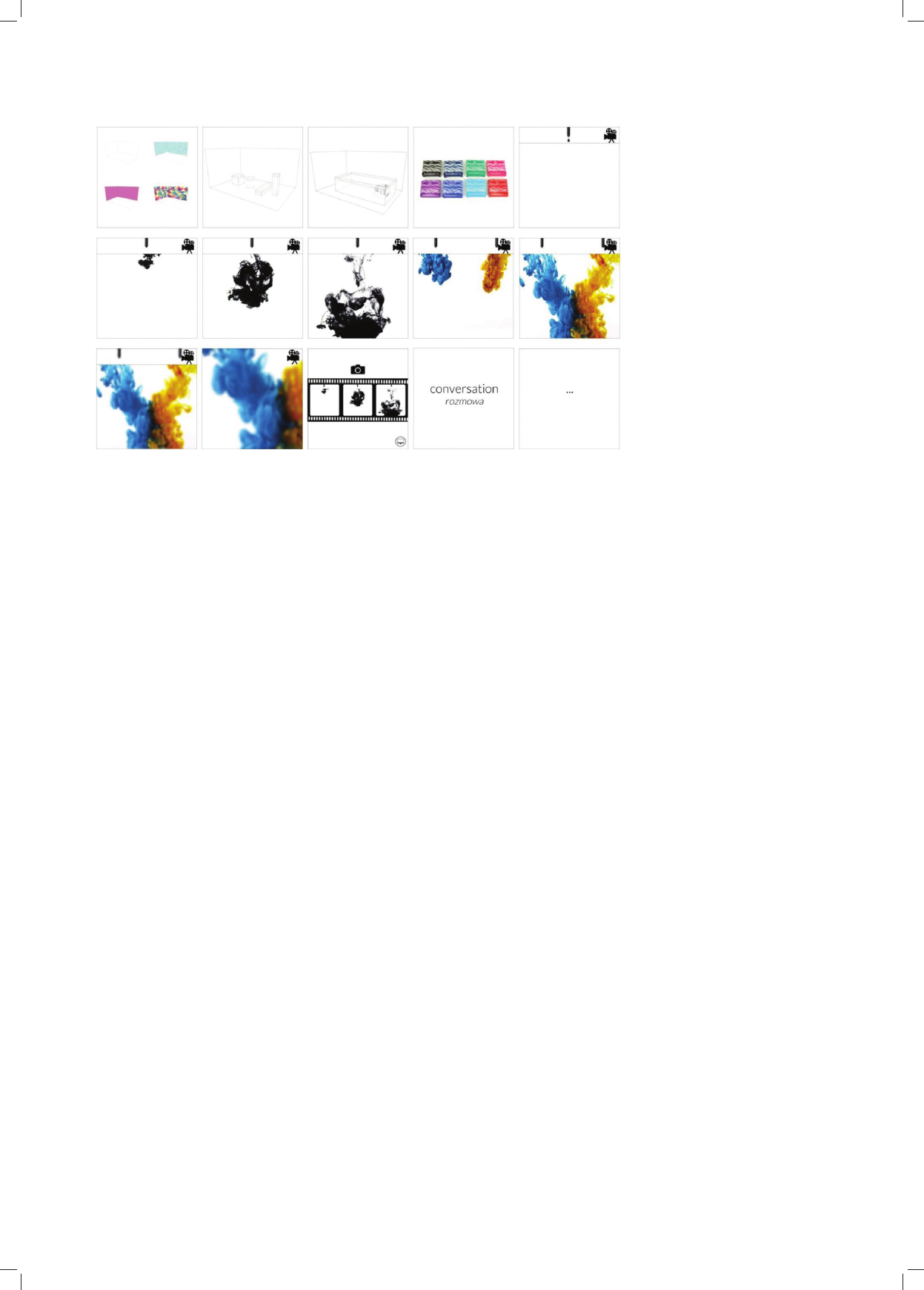
A successive figure demonstrates the updated storyboard
of the research simulation prototype scenario (Fig. 7).
It
can be compared with the same storyboard be fore the pro-
cess of parameter altering of the research simulation and
its subsequent changes. The difference between these two
figures can be easily seen.
Prototype of the research project
After simulations, a concept of the prototype was pre-
pared. As a result of these simulations, the initial idea of the
research simulation prototype was considerably modified.
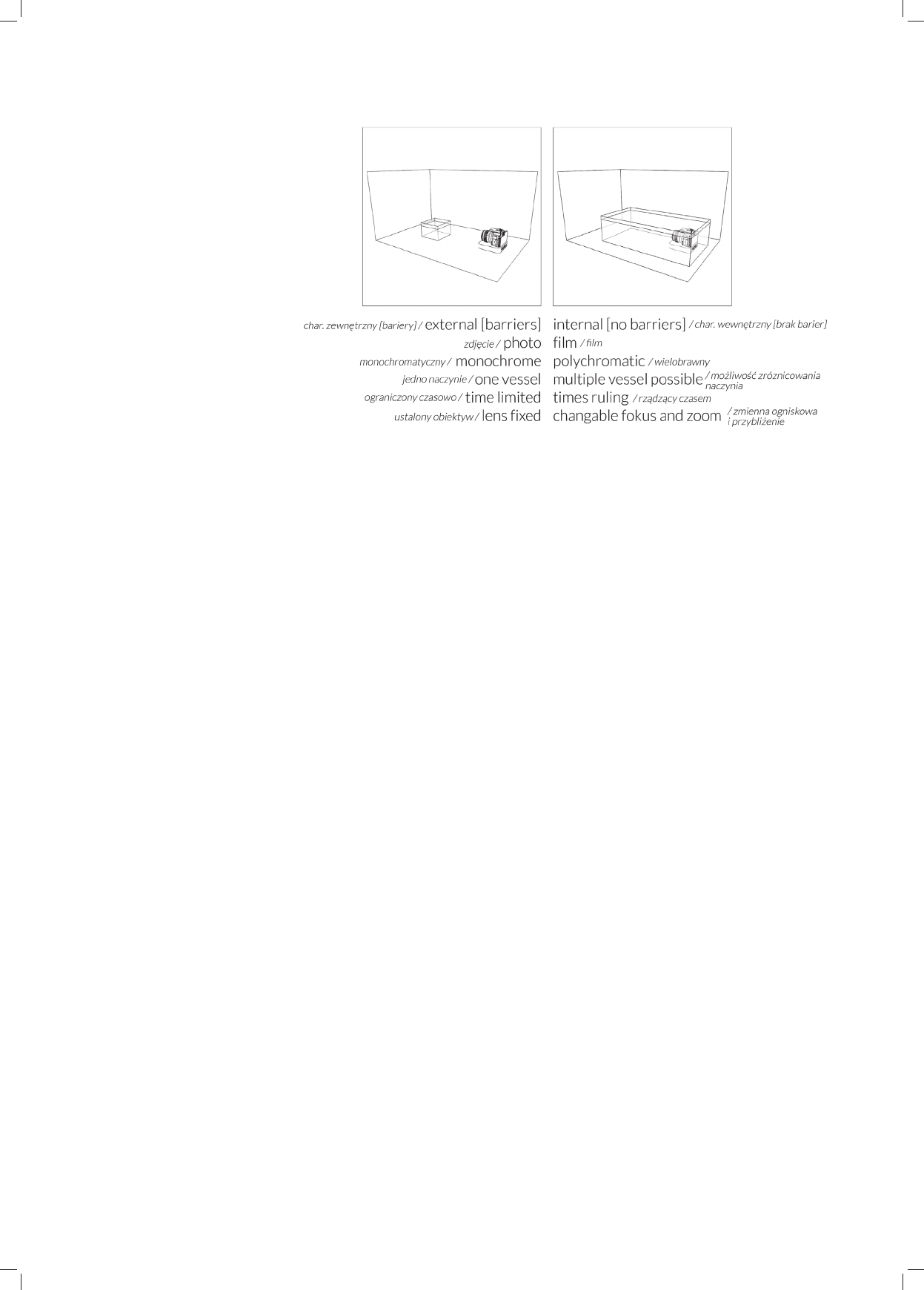
The new process of study: there is a big vessel filled
with water on a table; inside the vessel a waterproof mov-
ie camera is placed; the person tested is given ink – his or
her task is to pour the ink into the vessel; before releasing
the ink, the person tested turns on the camera; then he or
she operates the camera in his or her own way; additional
ink drops might be added and the vessel might be refilled
with fresh water if needed; the stage of filming ends when
the person tested decides to do so. Then the film is im-
ported to the computer and the person tested analyzes it;
while watching it there is a possibility to stop the film,
rewind it or even watch it frame by frame; when the per-
son sees a shape recalling a geometric or architectural
form, he or she exports the picture; the researcher asks
questions and take some notes; the whole procedure or its
parts can be repeated. The main idea of the research si mu
lation prototype procedures are presented in Figure 8.
gę percepcję budynków, elementem pełniącym funkcję
naczynia jest najbliższy zewnętrzny kontekst. Jedyną róż-
nicę stanowi skala oraz siła jego oddziaływania. Na tym
etapie metoda spectrum mapping okaza ła się najbardziej
twórcza i produktywna dla tego projektu.
Następnie wykonano symulacje związane z czasem,
w tym diagram ruchu, najgorszy scenariusz, pre mortem
i post mortem [21]. Po przygotowaniu szkiców diagramu
ruchu określono najgorszy scenariusz: osoba badana nie
jest w stanie „zobaczyć” czegokolwiek, pomimo wielu
prób. W przypadku symulacji badawczej oznacza to brak
możliwości kontynuacji eksperymentu. W przypadku per-
cepcji budynków może spowodować to nieporozumienia
i niezrozumienie budynku oraz jego idei. Aby uniknąć
całkowicie tego problemu w pierwszym przypadku, moż-
na wprowadzić możliwość wykonywania zdjęć w trybie
sekwencyjnym. W takiej sytuacji zdjęcia robiłby badacz,
zaś zadaniem osoby badanej byłaby późniejsza ich inter-
pretacja. Innym, łatwiejszym rozwiązaniem byłoby po-
nowne napełnienie naczynia czystą wodą i rozpoczęcie
eksperymentu na nowo. Zupełnie inaczej wygląda sytu-
acja w przypadku percepcji budynków. Wynika to między
innymi z faktu, że ciężko jest zmienić istniejący już budy-
nek lub też wprowadzić środki pozwalające na całkowite
cofnięcie wykonanej akcji i powrót do wcześniejszego
stanu. W tym wypadku najlepszym rozwiązaniem jest
edukacja i rozwój wrażliwości oraz wyobraźni osoby ob-
serwującej konkretny obiekt.
Kolejna zastosowana metoda, zwana pre mortem [21],
polega na zdefiniowaniu zagrożeń związanych ze scena-
riuszem symulacji badawczej. Wykryto kilka zagrożeń:
przeszkadzające czynniki zewnętrzne, niezdecydowanie
osoby badanej, nerwowość osoby badanej oraz zagroże-
nie – już wspomniane w najgorszym przypadku – osoba
testowana nie jest w stanie niczego „zobaczyć”. Można
sobie wyobrazić, że niechciane czynniki zewnętrzne mogą
zostać wyeliminowane poprzez udoskonalenie studia.
Trzy kolejne czynniki nie muszą być eliminowane – w ra-
zie wystąpienia mogą posłużyć za znaczącą część wnio-
sków badawczych. Czynniki te powinny być również do-
brze rozważone i opisane w trakcie badania zjawiska
per cepcji budynków.
Ostatnia wykorzystana metoda z grupy symulacji cza-
su nazywa się post mortem [21]. Jej celem jest określenie
ostatecznego upadku symulacji badawczej. W przypadku
tej konkretnej symulacji może to być utrata cierpliwości.
Jeśli do takiej utraty dojdzie, osoba badana nie będzie
chciała kontynuować pracy i symulacja się zakończy. Z tego
powodu symulacja powinna być łatwa do zrealizowania,
przyjazna w odbiorze i powinna dostarczać przyjemności
osobie badanej. Być może sytuacja ma się podobnie w przy-
padku architektury.
Następnie przeprowadzono kolejną symulację atrybu-
tów, zwaną misją niemożliwą [21]. Jej głównym celem
było znalezienie i rozwiązanie aspektu niemożliwego do
osiągnięcia (nieprawdopodobnego lub nierealnego) zwią-
zanego z funkcjonowaniem i wykonaniem projektu ba-
dawczego. W przypadku pierwszym problemem okaza
ło się naczynie – stanowiące barierę pomiędzy tuszem
a obiek tywem. Analizując zjawisko percepcji budynków,
Kropla: zjawisko percepcji form swobodnych/The Drop: phenomenon of free forms’ perception 27
Evaluation of the research project
The next step was to prepare the evaluation criteria for
each sequence of aim/circumstances/problem/idea of the
research project. The main goal of the evaluation of all
factors is to facilitate the interpretation of the research
simulation results. For every attribute, an independent cri-
teria of evaluation was specified: complexity, duration,
abundance, obviousness and sensitivity. Then for each of
them, two abstract qualities were added. Those parame-
ters may serve to describe these criteria. And so, thinking
of the attribute in the criteria of complexity, one can char-
acterize it as simple – this means similar to a studio, or
complex, composed of multiple different elements. The
aspect of time and its passage may be evaluate by the cri
teria of the duration and its parameters: short or long. The
action or process might be immediate, without reflec
tion
or awaited to the end. Reflecting Reflecting on the fact of
projection, it can be characterized by limited or luxuriant
abundance. In the case of interpretation the criterium of
ob viousness may be common, universal and widely under-
standable or unique, particular, individual for the given
subject. The last aspect – senses, may be judged on the
ba sis of sensitivity. The person tested may be able or un-
able to notice something (shapes, associations, meanings).
The person who conducts this evaluation is the re-
searcher. Based on the results of the assessment he or she
can draw some conclusions which may provide directions
for further analysis.
After carrying out the tests an important observation was
made – light plays a significant role in the whole process.
Among other things, it affects readability, clarity and ap-
pearance of the formed shapes. Depending on its intensity
change, the simulation results were completely different.
In effect, the conducted tests have shown another aspect
or attribute previously omitted – the light and illumination
play a crucial role in the process of perception. In order to
examine carefully their impact, further tests with various
lightning conditions were planned. The results of these new
simulations may serve as a set of important information
or even new hypotheses about the buildings’ perception.
zarówno obiekt, jak i obserwator znajdują się w tym
samym środowisku – powietrzu. Nie ma w tym wypadku
żadnych barier lub różnic. W trakcie dalszych rozważań
pojawił się więc pomysł użycia większego naczynia wy-
pełnionego wodą jako wspólnego środowiska, zaś wo-
doszczelny aparat zastąpić miał oko. Kolejna misja nie-
możliwa to kontrola czasu. W warunkach rzeczywistych
niemożliwe jest jego zatrzymanie lub cofnięcie. Można
jednak posłużyć się kamerą filmową w zastępstwie apara-
tu fotograficznego i eksportować wybrane klatki filmu
jako obrazy. W efekcie osoba badana może obserwować
klatka po klatce rozpuszczanie tuszu w wodzie. Niestety,
pomimo swojej użyteczności na potrzeby eksperymentu,
nie jest możliwe zaadaptowanie takiego rozwiązania w przy-
padku percepcji budynków. Być może zestaw zdjęć lub
film przygotowane przez profesjonalistów mogą w pew-
nym stopniu wpłynąć na sposób, w jaki obserwator po-
strzega dany obiekt. Mogłoby to posłużyć jako pewnego
rodzaju narzędzie edukacyjne. W obu przypadkach misji
niemożliwych rozwiązania oraz związane z nimi zmiany
miały znaczący wpływ na końcową formę symulacji ba-
dawczej (il. 6).
Kolejna grafika ukazuje uaktualniony storyboard sce-
nariusza prototypu symulacji badawczej (il. 7). Może on
zostać porównany ze swoją pierwotną wersją – przygoto-
waną przed przeprowadzeniem alteracji parametrów
i wprowadzeniem wynikających z nich zmian. Różnica
pomiędzy tymi dwoma grafikami jest bardzo łatwa do
zauważenia.
Prototyp projektu badawczego
Po przeprowadzeniu alteracji przygotowano koncepcję
prototypu. Jako rezultat wspomnianych symulacji począt-
kowa koncepcja prototypu została znacząco zmieniona.
Nowy proces badania: na stole znajduje się duże na-
czynie wypełnione wodą; wewnątrz naczynia umieszczo-
na jest wodoodporna kamera filmowa; osoba badana do-
staje tusz – jej zadaniem jest wpuszczenie tuszu do
naczynia z wodą; przed wypuszczeniem tuszu osoba ba-
dana włącza kamerę i uruchamia nagrywanie; następnie
Il. 6. Główne zmiany
w symulacji badawczej
(rys. B. Adamiczka)
Fig. 6. Main changes
in the research simulation
(drawn by B. Adamiczka)
28 Bartosz Adamiczka
prowadzi kamerę według własnego uznania; w ramach
potrzeby mogą zostać wpuszczone kolejne krople tuszu,
zaś woda w naczyniu wymieniona na czystą; etap fil
mowania kończy się, gdy osoba badana podejmie taką
decyzję. Następnie film importowany jest do komputera
i osoba badana analizuje go; w trakcie oglądania istnieje
mo żliwość zatrzymania obrazu, przewinięcia lub też
oglą dania klatka po klatce; kiedy osoba badana widzi
kształt przypominający geometryczną lub architektonicz-
ną formę, eksportuje obraz; badacz zadaje pytania i spo-
rządza notatki; cała procedura oraz jej części mogą ulec
powtórzeniu. Główna idea procedur prototypu symulacji
badawczej zaprezentowana została na kolejnej grafice
(il. 8).
Ocena projektu badawczego
Kolejnym krokiem było przygotowanie kryteriów
ewaluacji dla każdej sekwencji celu/okoliczności/proble-
mu/pomysłu w projekcie badawczym. Głównym celem
oceny wszystkich tych czynników miało być ułatwienie
późniejszej interpretacji wyników symulacji badawczej.
Dla każdego atrybutu określono niezależne kryterium
ewaluacji: złożoność, czas trwania, obfitość, oczywistość
i czułość. Następnie do każdego z nich dodano dwie abs-
trakcyjne właściwości. Parametry te służą jako elementy
opisujące wcześniej wyznaczone kryteria. I tak, myśląc
o kryterium złożoności, tło można scharakteryzować jako
proste – podobne na przykład do studia – lub skompliko-
wane, złożone z wielu różnych elementów. Aspekt czasu
i jego upływu może być oceniany poprzez kryterium trwa-
nia, zaś jego cechami charakteryzującymi byłby okres
krótki lub długi obserwacji. Analizując okoliczności pro-
jekcji – może ona być scharakteryzowana przez ograni-
czoną lub bujną zasobność. W przypadku interpretacji i kry-
terium oczywistości może być: powszechne, uniwersalne
oraz szeroko rozumiane lub też unikalne, szczególne, in-
dywidualne dla danego przypadku. Ostatni aspekt – zmy-
sły, może być oceniany na podstawie wrażliwości. Osoba
Test of the research project prototype
Based on the previously described prototype an ex-
periment which was to be a test was performed. The test
was performed on a group of five adults, but it was not
a representative sample.
The first step was to develop the material for the tested
persons. For this purpose, in the studio a few drops of ink
were let in to the water vessel and recorded. The con-
tainer with water and a camera was placed on a neutral
white background. The film was then processed in color
graphics (saturation, color, temperature) and tonal charac-
teristic to faithfully reflect the real color and lighting in
the studio. The film was then split into frames at 12 sec-
onds intervals and saved as static images and arranged
according to the growing complexity of the presented
shapes – a total of eleven frames. The next step was to add
white frames between the prepared early ones – so that
the person tested had time to make notes between the
frames and to make it possible to obliterate the memory
of the last image. The presentation timer was set to 20 se
conds. After a short instruction, the person tested watched
the prepared sequence, taking notes about his or her as-
sociations and observations.
After the test, frames from the sequence were shared
once more. In spite of all the different observations of the
same images – “tree”, “moose”, “castle”, during the con-
versation, each of the persons tested was able to success-
fully show other people the form he had noticed. More
over, in most cases it was so effective that the others were
surprised by the fact how they had not noticed it before.
However, during the study, the subjects recognized, in
the same image, forms that were significantly different
from
each other – only one frame – no. 7 had a similar form
for all who had participated in the test. It was defined as
“china dancers”, “two walking people with hands up” and
“giants holding a flat land with people on it”. In spite of the
different interpretations (details), each one can be reduced
to two humanoid silhouettes with their hands up (Fig. 9).
Il. 7. Nowy scenariusz
symulacji badawczej –
storyboard uaktualniony
(rys. B. Adamiczka)
Fig. 7. Research simulation new
scenario – updated storyboard
(drawn by B. Adamiczka)
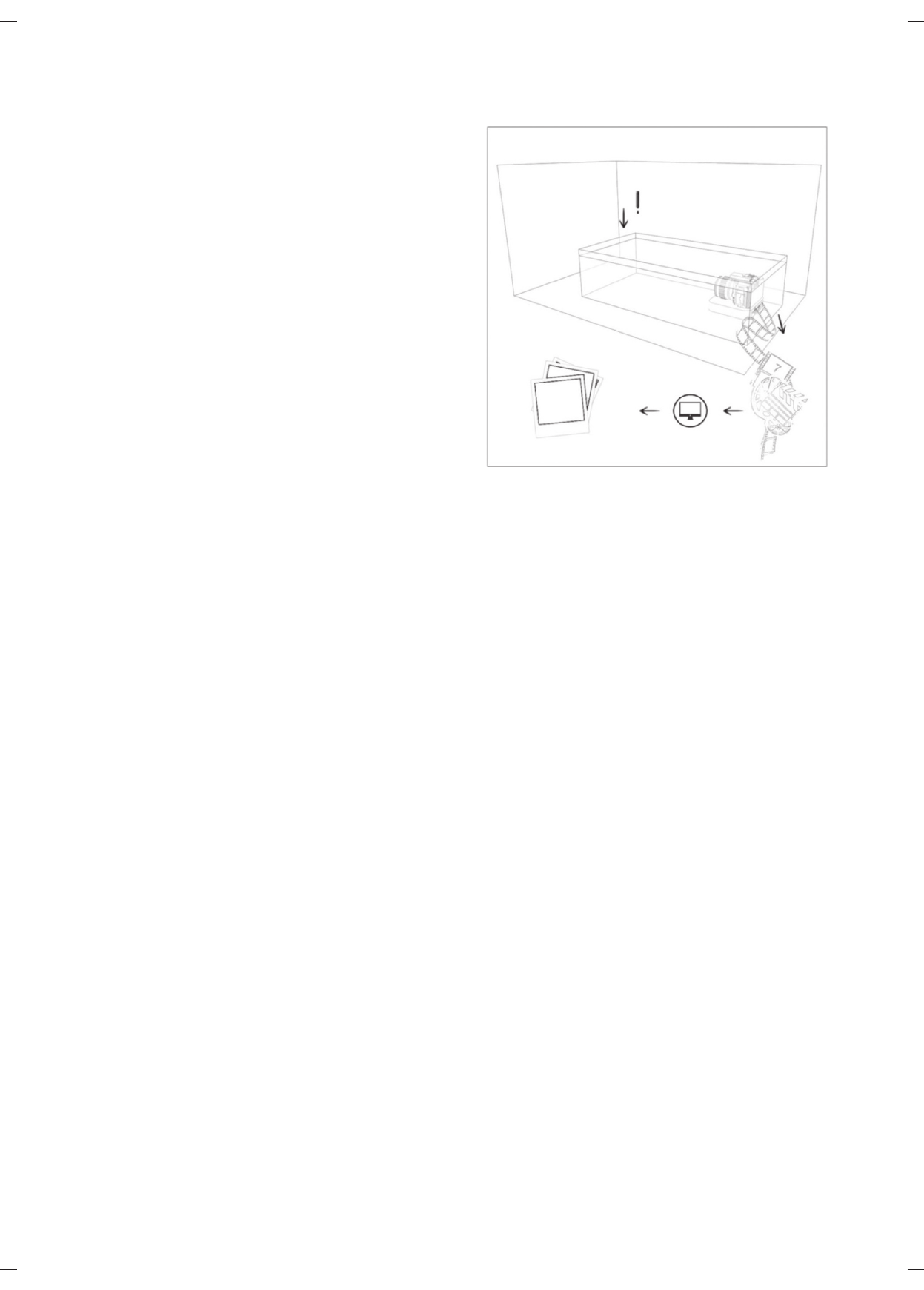
Kropla: zjawisko percepcji form swobodnych/The Drop: phenomenon of free forms’ perception 29
The most noticeable result of the test was that each
of the respondents stated that one of the images was
repeated in the sequence. Interestingly, each of them
pointed to a different pair of frames. The key was to find
a characteristic shape, which in fact in a similar, however
in a different form appeared in a successive different pic-
ture. As a result, the whole frame was perceived as iden-
tical (Fig. 10).
Conclusions
To sum up, the use of presented simulations permitted
the elimination of barriers which seemed to be impassable
at the beginning of the study on perception. Due to these
simulation, new aspects of the issue were discovered.
They allow you to gain a completely different perspective
in relation to it. It turned out that many features of the
research simulation prototype might be changed. The
main modifications referred to the properties and charac-
ter of the components. Initially the external system limited
by barriers was transformed into an internal system with
nobarriers included. The action of photo taking that was
limited by time was replaced by a movie recording which
allows in its particular way to control the time during
simulation. The characteristics that might still be devel-
oped are the diversity of the background and the lighten-
ing of the studio. The created prototype consisting of the
research simulation enabled the creation, to a large extend,
of an objective and complex tool to study the phenomenon
of the perception – in this case a free forms’ perception.
Most of the results and conclusions can refer to the issue
of the perception of the building. The prototype itself
gives an opportunity to a greater penetration of the issue
of searching for answers.
Il. 8. Schemat prototypu
(rys. B. Adamiczka)
Fig. 8. Diagram of the prototype
(drawn by B. Adamiczka)
badana może być zdolna lub niezdolna do zauważenia
cze goś (kształtów, skojarzeń, znaczeń).
Osobą przeprowadzającą ewaluację jest badacz. Na
podstawie wyników tej oceny może on wyciągnąć pewne
wnioski, które mogą dostarczyć wskazówek do dalszej
analizy.
Po przeprowadzeniu testów dokonano ważnej obser-
wacji – światło odgrywa kluczową rolę w całym proce
sie. Między innymi wpływa na czytelność, przejrzystość
i wy gląd uformowanych kształtów. Zależnie od zmiany
jego natężenia wyniki przeprowadzonych symulacji oka-
zywały się zupełnie inne.
W efekcie przeprowadzone testy uwidoczniły kolejny,
wcześniej pominięty, aspekt/atrybut – światło, w tym ilu-
minacja odgrywa kluczową rolę procesie percepcji. W celu
dokładniejszego zbadania ich wpływu zaplanowano ko-
lejne testy, zakładające wykorzystanie zmienności oświe-
tlenia. Wyniki nowych symulacji mogą posłużyć jako
zestaw istotnych informacji lub też nawet jako nowe
hipotezy dotyczące percepcji budynków.
Test prototypu projektu badawczego
Na podstawie opisanego prototypu przeprowadzono
eksperyment mający posłużyć jako test, niebędący jednak
próbą reprezentatywną. Test zrealizowano na grupie pię-
ciu dorosłych osób.
Pierwszym krokiem było opracowanie materiału dla
osób badanych. W tym celu w studio wykonano nagranie
kilku kropli wpuszczanych do wody. Naczynie z wodą i ka-
merą umieszczone zostało na neutralnym białym tle. Film
poddano następnie obróbce graficznej związanej z kolory-
styką (nasycenie, barwa, temperatura) oraz charakterystyką
tonalną obrazu w celu wiernego oddania rzeczywistej kolo-
rystyki i oświetlenia w studio. Następnie film podzielono na
klatki w odstępie 12 sekund, zapisano jako obrazy statyczne
i uszeregowano zgodnie z rosnącą komplikacją przedsta-
wionych kształtów – w sumie przygotowano jedenaście
klatek. Kolejnym krokiem było dodanie białych przeźroczy
pomiędzy przygotowanymi klatkami – tak aby osoba bada-
na miała czas na sporządzenie notatek pomiędzy klatkami
oraz aby możliwe było zatarcie wspomnienia ostatniego
obrazka. Chronometr prezentacji ustawiono na 20 sekund.
Po krótkim instruktażu osoba badana obserwowała przygo-
towaną sekwencję, zapisując skojarzenia i obserwacje.
Po badaniu udostępniono uczestnikom poszczególne
klatki z sekwencji. Pomimo całkowicie różnych spostrze-
żeń w trakcie doświadczenia w stosunku do tych samych
obrazków – „drzewa”, „łoś”, „zamek” – podczas rozmo-
wy każdy z badanych potrafił z sukcesem pokazać pozo-
stałym osobom formę, którą udało mu się zauważyć.
Ponadto w dużej części przypadków było to na tyle sku-
teczne, że pozostali dziwili się, jakim sposobem wcze-
śniej tego nie zauważyli. Jednak podczas eksperymentu,
osoby te rozpoznawały, w ramach tego samego obrazka,
formy zdecydowanie różne od siebie – jedynie w przy-
padku jednej klatki – nr 7 wszyscy zaobserwowali zbliżo-
ną formę. Określono ją m.in. jako: „porcelanowe tancer-
ki”, „dwie idące osoby z rękami w górze” oraz „giganty
trzymające płaską ziemię z ludźmi na niej”. Pomimo
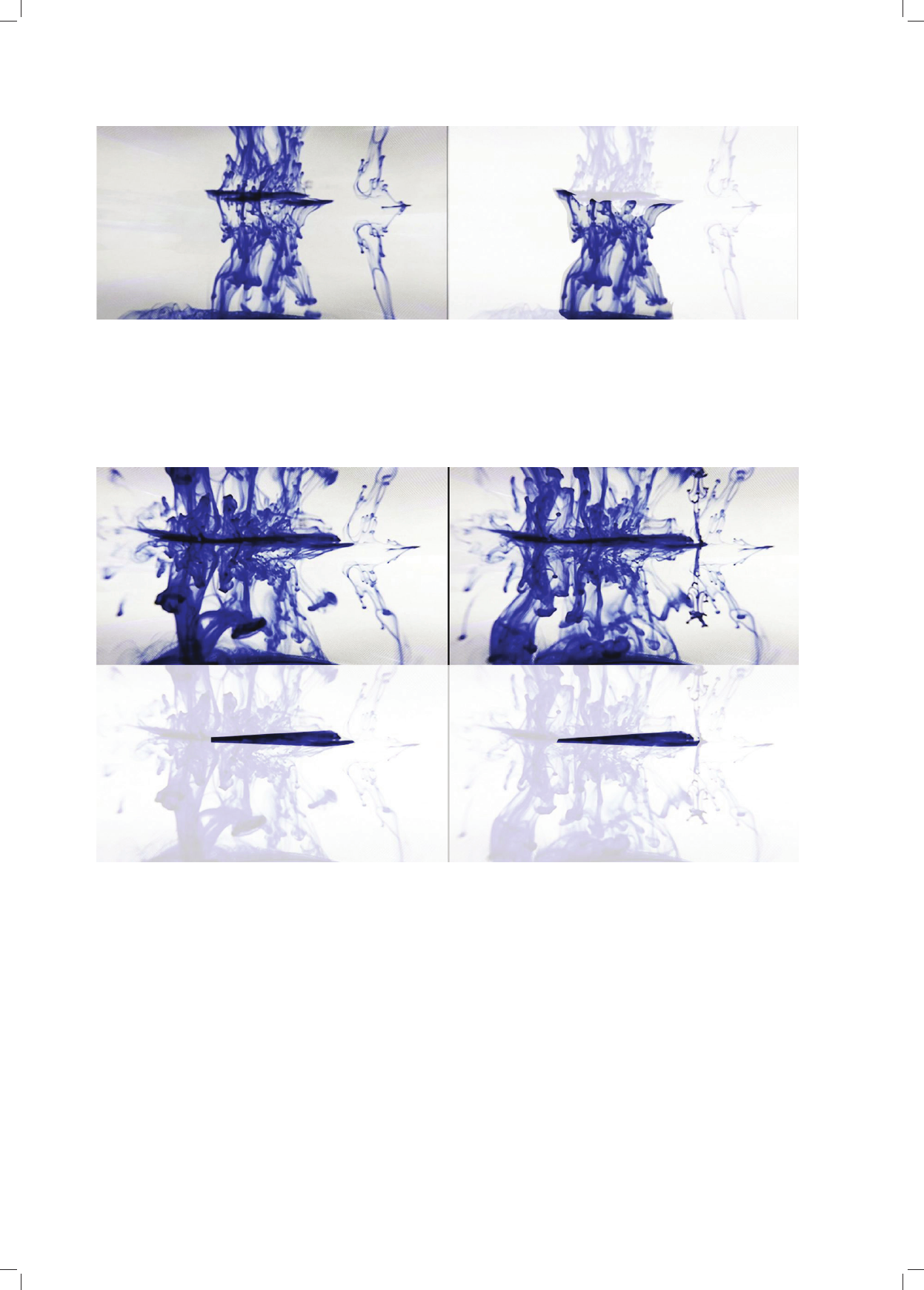
30 Bartosz Adamiczka
różnych interpretacji, każda z nich sprowadza się do
dwóch humanoidalnych sylwetek z rękoma w górze (il. 9).
Bardzo zauważalnym rezultatem testu było to, że każ-
da z osób badanych stwierdziła, iż w ramach sekwencji
jeden z obrazków się powtórzył. Co ciekawe, każda z nich
wskazała inną parę klatek. Kluczowe okazało się odnale-
zienie charakterystycznego dla nich kształtu, który fak-
tycznie w podobnej, choć już innej formie pojawił się na
kolejnym, innym już obrazku. W efekcie cała klatka od-
bierana była jako identyczna (il. 10).
The experiment itself allows us to control almost every
particular aspect. As a result, each of the elements may be
examined in order to determine its influence on the per-
ception. Also it is possible to imitate and simulate parti
cular examples from the reality and on this basis draw
conclusions on the perception of architecture. Subsequent
studies based on the experiment created during this
research, may show how the free form architecture is per-
ceived. Using the described process of perception control,
the creator may be able to freely design the form in a much
Il. 9. Klatka nr 7 z przygotowanej w ramach eksperymentu prezentacji – dwie humanoidalne sylwetki z rękoma w górze
jako czynnik łączący interpretację osób badanych
(rys. B. Adamiczka na podstawie testu prototypu projektu badawczego)
Fig. 9. Frame no. 7 from the presentation prepared as part of the experiment – two humanoid silhouettes with their hands up
as a common factor among tested people
(drawn by B. Adamiczka based on the test of the research project prototype)
Il. 10. Klatka nr 10 i 11 z przygotowanej w ramach eksperymentu prezentacji –
pędzący pociąg na torach jako element, który sprawia, że klatki są podobne w odbiorze
(rys. B. Adamiczka na podstawie testu prototypu projektu badawczego)
Fig. 10. Frames no. 10 and 11 from the presentation prepared as part of the experiment –
rushing train on the tracks as an element that makes frames similar in perception
(drawn by B. Adamiczka based on the test of the research project prototype)

Kropla: zjawisko percepcji form swobodnych/The Drop: phenomenon of free forms’ perception 31
Podsumowanie
Podsumowując, należy stwierdzić, że wykorzystanie za-
prezentowanych symulacji składowych pozwoliło na po-
konanie barier, które zdawały się nie do ominięcia w chwili
podjęcia badań nad percepcją. Dzięki tym symulacjom od-
kryto nowe aspekty głównego tematu. Pozwoliły na spoj-
rzenie na niego z zupełnie innej perspektywy. Okazało się,
że wiele cech prototypu symulacji badawczej może ulec
modyfikacjom. Główne zmiany dotyczyły właściwości i cha-
rakteru jej elementów składowych, m.in. wyjściowo sys-
tem o charakterze zewnętrznym, ograniczony barierami
został przekształcony w system o charakterze wewnętrz-
nym bez barier, działanie polegające na robieniu zdjęć, a więc
ograniczone przez czas, zostało zastąpione nagrywaniem
filmu, pozwalającym w szczególny sposób na kontrolę
czasu w trakcie symulacji. Ce chami, które w dalszym cią-
gu mogą być rozwijane, są m.in. różnorodność tła oraz
oświetlenie studia. Stworzony prototyp, składający się
z symulacji badawczej, pozwolił na przygotowanie w du-
żej mierze obiektywnego i złożonego narzędzia do analizy
zjawiska percepcji – w tym wypadku percepcji form swo-
bodnych. Prototyp sam w sobie daje możliwość zagłębie-
nia się w problemie w poszukiwaniu odpowiedzi.
Sam eksperyment pozwala na kontrolę niemalże każde-
go jego czynnika. W rezultacie każdy z elementów może
być przeanalizowany w celu określenia jego wpływu na
percepcję. Pozwala również na imitowanie i symulowanie
szczególnych przypadków z rzeczywistości – na tej pod-
stawie umożliwia wyciągnięcie wniosków dotyczących
percepcji architektury. Dalsze badania, bazujące na stwo-
rzonym w tym projekcie eksperymencie, mogą ukazać, jak
architektura typu free form jest postrzegana. Używając
opisanego procesu kontroli percepcji, twórca otrzymuje
możliwość swobodnego kształtowania formy
w jeszcze
bardziej efektywny sposób. Pozwala to na kontrolę lub
przewidzenie reakcji obserwatora na etapie projektowania
obiektu. Innymi słowy, umożliwia to tworzenie takiej for-
my architektonicznej, która będzie oddziaływać
na obser-
watora lub użytkownika w sposób założony przez twórcę.
Zarówno projekt badawczy, jak i prototyp symulacji
mogą posłużyć jako narzędzie lub klucz do dalszych roz-
ważań nad problematyką związaną z percepcją.
more efficient way. It may allow him to control or predict
the reactions of the observer at the stage of building de-
sign. In other words, it allows the creation of such an ar-
chitectural form that will influence the observer or the
user in the way the creator had assumed.
Both the research project and the simulation prototype
may serve as a tool or a clue to further studies on the
problem of perception.
Translated by
Bartosz Adamiczka
Bibliografia /References
[1] Miller R., Michalski W., Stevens B., The promises and perils of 21
st
century technology: an overview of the issues, [w:] 21
st
century
technologies. Promises and perils of a dynamic future, OECD Pub-
lishing, Paris 1998, 7–32.
[2] Kamerling M.W., Kocaturk T., An interdisciplinary approach to the
design of free-form buildings, [w:] F. Bontempi (ed.), System- based
Vision for Strategic and Creative Design, Swets & Zeitlinger B.V.,
Lisse 2003, Vol. 1, 563–569.
[3] Majowiecki M., Personal experiences in Structural Architecture:
from form finding to free form design, „Architectus” 2014, No. 4(40),
79–92.
[4] Gropius W., Pełnia architektury, Karakter, Kraków 2014.
[5]
Sławińska J., Ekspresja sił w nowoczesnej architekturze, Arkady, War
szawa 1969.
[6] Żórawski J., O budowie formy architektonicznej, Arkady, Warsza-
wa 1973.
[7] Arnheim R., Sztuka i percepcja wzrokowa: Psychologia twórczego
oka, Officyna, Łódź 2013.
[8] Rasmussen S.E., Odczuwanie architektury, Karakter, Kraków
2015.
[9] Wong J.F., The text of freeform architecture: qualitative study of
the discourse of four architects, „Design Studies” 2010, Vol. 31,
Iss. 3, 237–267.
[10] Wendland D., Modelbased formfinding processes: freeforms in
structural and architectural design, [w:] F. Levi, M.A. Chiorino,
C. Bertolini Cestari (ed.), Eduardo Torroja: from the philosophy of
structures to the art and science of building; international seminar
2000, Politecnico di Torino, Milano 2003.

32 Bartosz Adamiczka
Streszczenie
Artykuł przedstawia projekt badawczy dotyczący zjawiska percepcji. Głównym celem pracy było zdefiniowanie i scharakteryzowanie aspektów,
czynników oraz efektów percepcji form swobodnych, jako jednego z atrybutów w procesie powstawania formy architektonicznej. Przystępując do
badania, określono wstępne oczekiwania w zakresie jego wyników. Pierwszym i zarazem głównym zamysłem było zwiększenie własnej wiedzy
autora w zakresie zjawiska percepcji. Drugim problemem było stworzenie modelu symulacyjnego wyróżniającego instrumenty i cechy charaktery-
styczne, pozwalające opisać wpływ zjawiska percepcji na proces projektowania. Końcowym zadaniem była realizacja głównego, wcześniej już
wspomnianego celu pracy – rozpoznanie ciągu aspektów, czynników oraz efektów związanych ze zjawiskiem percepcji. Prace nad badaniem roz-
poczęto od określania ról pomiędzy twórcą i obserwatorem oraz ich wzajemnych relacji w ramach środowiska badawczego. Następnie zaprezento-
wano i rozwinięto zadania projektu badawczego – w tym celu przygotowano symulację grup faktów, związanych z nimi problemów oraz odpowia-
dających im pomysłów. Ostatnim elementem składowym opisującym model teoretyczny została intuicyjna grafika ukazująca rdzeń koncepcji
projektu badawczego. Kolejnym krokiem było przeprowadzenie alteracji podstawowych atrybutów związanych z samym rdzeniem koncepcji.
Następnie, aby wyróżnić i zbadać główne aspekty percepcji, przygotowano prototyp prostej symulacji badawczej. Pozwoliło to na obserwację pro-
cesu postrzegania oraz związanych z nią atrybutów, przy jednoczesnej możliwości kontroli czynników zewnętrznych oraz skoncentrowaniu uwagi
na wrażeniach osoby poddanej badaniu, również w odniesieniu do tych czynników. Przed przeprowadzeniem samej symulacji jej parametry podda-
no alteracji, w tym m.in.: symulacjom związanym z materiałem, przestrzenią, czasem, energią, czy też danymi. Celem przeprowadzonych alteracji
było rozwinięcie i wzbogacenie prototypu symulacji badawczej. Po przeprowadzeniu symulacji przygotowano i opisano koncepcję samego prototypu.
Słowa kluczowe: percepcja, formy swobodne, architektura
Abstract
The paper presents a research project referring to the phenomenon of perception. The main aim of this study was to define and characterize aspects,
factors and effects of the perception of free form as one of the attributes in the process of shaping the architectural form. There were several identi-
fied effects: the first and the main of the expected effects of the research project was to increase the author’s knowledge of perception itself. The
second one was to create a simulation model which distinguished instruments and characteristic traits which allowed describing the influence of the
perception phenomenon on the design process. The last assigment was to recognize the set of aspects, factors and effects related to the phenomenon
of perception. At the beginning the relation between the creator and the observer in the research reality and their roles were defined. Then the aims
of the research project were presented and developed – a simulation of the groups of facts, problems and ideas was prepared. As the last part of the
description of the theoretical model, an intuitive image of the concept’s nucleus of the research project was introduced. The next step was to make
alterations to the fundamental attributes of the concept nucleus itself. Furthermore to examine the main aspects of the perception, a simple prototype
of research simulation was prepared. This allowed observing the process of perception and its attributes at the same time controlling the external
factors and focusing on impressions of the person tested in combination with those factors. Before performing the research simulation, the process
of its parameter altering was executed. The parameter alteration include, inter alia, material simulations, spatial simulations, timesimulations, ener-
gysimulations and infosimulations of the concept nucleus. The purpose of these simulations was the development and enrichment of the target
research simulation prototype. After simulations, the concept of the prototype was prepared and described.
Key words: perception, free forms, architecture
[11] BonJour L., Epistemological Problems of Perception, [w:] Stan-
ford Online Encyclopedia of Philosophy, 2007, https://plato.stan-
ford.edu/entries/perceptionepisprob/ [accessed: 10.02.2016].
[12] Majowiecki M., Architecture & Structures: “Ethics in Free Form
De sign, New Shell and Spatial Structures”, [w:] New olimpics,
new shell and spatial structures. Proceedings of the International
Symposium IASS-APCS 2006, Committee on Spatial Structures.
China Civil Engineering Society, Association for Spatial Struc-
tures, China Steel Construction Society, Beijing University of
Te ch nology, Beijing, China, October 16−19, 2006.
[13] Pabjan T., W jaki sposób istnieją rzeczy?, [w:] W. Kowalski,
ks. S. Wszołek (red.), Ponad demarkacją, Biblos, Tarnów 2008,
115–132.
[14] Pallasmaa J., Myśląca dłoń: Egzystencjalna i ucieleśniona mądrość
w architekturze, Instytut Architektury, Kraków 2015.
[15] Szymańska B., Berkeley znany i nieznany, „Nauka dla Wszyst-
kich” 1987, Nr 407.
[16] Nowa Encyklopedia Powszechna, Wydawnictwo Naukowe PWN,
Warszawa 2005, t. 5, 669–670, 767, 974.
[17] http://www.merriamwebster.com/dictionary/perception [accessed:
10.02.2016].
[18] Tschimmel K., Design as a Perception-in-Action Process, [w:]
T. Taura, Y. Nagai (eds), Design Creativity 2010, Springer, London
2011, 223–230.
[19] Pendlebury M., The role of imagination in perception, „South
African Journal of Philosophy” 1996, Vol. 15, No. 4, 133–138.
[20] Zube E.H., Environmental perception, [w:] Environmental Geolo-
gy, Springer, 1999, 214–216, doi: 10.1007/1402044941_120.
[21] Kwiatkowska A., eArchitecture: The Game Strategies in Architec-
tural Design, Ph.D. program’s course at Wrocław University of
Technology, series of lectures, Wrocław 2015.