2019
3(59)
DOI: 10. /arc190301
Since the dawn of the printing press, books and print
were inextricably intertwined, with the fusion of illustration
and text being adjusted to a format similar to the conven-
tional book, predetermined and delimited in its spaces and
forms. Thus, illustrations and texts, different languages,
came to converge in a unique, hybrid and transdisciplinary
process, giving rise to a new creation: the artist’s book. The
two performed a function of diffusion – a characteristic
common to both media – as the images produced by the
artist facilitated the dissemination of the knowledge or text.
A fundamental aspect to address at this point is the de-
nition of the artist’s book in printmaking, as this concept
will permeate this text. The artist’s book in printmaking
entails a series of specic characteristics/singular features,
these including the crafting of the book through engraving
procedures (relief or intaglio), and/or stamping systems (li-
thography or screen printing); the complete (or almost) pro-
duction of the book by the artist; a limited number of copies,
signed by the artist himself; and, nally, the binding. Also
frequent is collaboration with a poet or writer who provides
his texts and/or poems, whereby the characteristics of the
artist’s book are expanded with a new aspect: typography.
The precursors the artistʼs books in printmaking
The selection of the artist’s books in printmaking to de-
scribe their evolution is not based on aesthetic afnity, but
rather how they served to transform subsequent creations.
Bethania Barbosa B. de Souza*
The evolution of the artist’s book
in printmaking and transdisciplinarity as its essence
Ewolucja książki artystycznej
w grafice i transdyscyplinarność jako jej esencja
The vast majority of print in the four centuries follow-
ing the advent of the production of xylographic print in
Europe, in the 14
th
century, were reproductions; that is,
copies of pre-existing images: paintings, drawings, etc.
It was with the emergence of photography, in 1839, and
photographic media, that original print ourished. While
reproduced or interpretative engraving corresponded to
a documentary and communicative iconography, original
or creative engraving stands as an independent work with
an aesthetic purpose. Between the 14
th
and 18
th
centuries,
however, nding artists who practiced engraving as an au-
tonomous plastic medium, without taking advantage of
the image of a painting or a drawing to adapt it into an en-
graving, is difcult. Nevertheless, we do nd some artists
who not only produced images exclusively created for the
graphic medium, but who also introduced innovations to
artist’s books in printmaking.
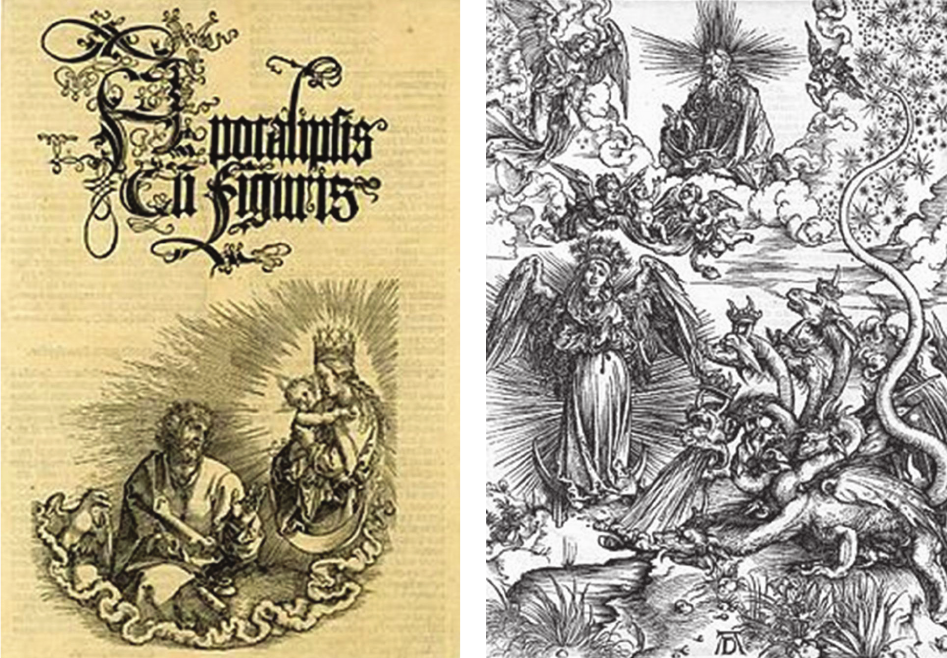
Apocalypse (1498) by Albrecht Dürer (1471–1528)
can be considered the rst artist’s book in printmaking,
this Incunable (xylographic books prior to 1501) featured
several aspects constituting innovations in the publishing
eld of the late 15
th
century. Specically, Dürer personal-
ly bore the cost of the book’s printing, when this was usu-
ally covered by a patron; the images/prints are located at
the front of the book, and the text in the back; and he was
also so condent in the power and quality of his images
that he did not feel the need to add colour, this being an
aspect that greatly increased publishing costs (Fig. 1, 2).
As José Manuel Mantilla points out:
The publication of Apocalypse as a book in 1498 brought
the young Albrecht Dürer, who at that time was just twenty-
* ORCID: 0000-0002-8580-4926. Faculty of Fine Arts, Drawing
Department, University of Granada (Spain).
4 Bethania Barbosa B. de Souza
seven years old, international success almost overnight.
[…] The young man was able to achieve this feat thanks to
the generous help that Anton Koberger, Dürer’s godfather
and a printer of the era, lent him to undertake it, mak-
ing available to the artist his printing presses, type sets,
text patterns […]. With a limited volume of just thirty-two
pages, it was also striking for its large format and its un-
usual composition for the reader of the time: its sugges-
tive carvings, which occupied the entire page, no longer
constituted mere illustrations. Transgressing the tradition
of the book, they appeared opposite the text; that is, the
typographical characters appeared on the left, while the
stamp was on the right page of the book, more important
from an optical point of view. It was also larger than the
box, and clearly dominated the overall image of the book’s
dual page spreads [1, p. 168].
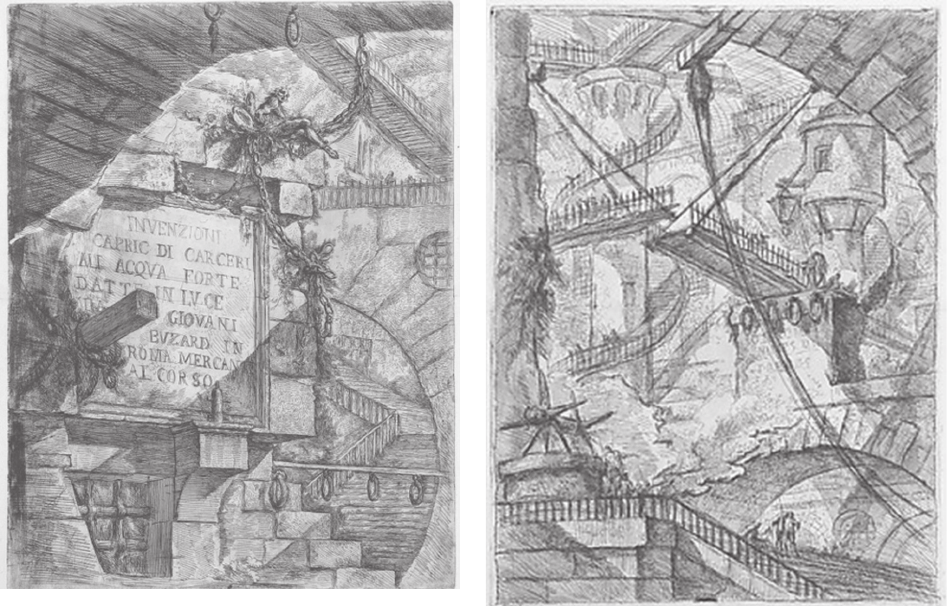
Le Carceri d’Invenzione (The Imaginary Prisons), by
Gio vanni Battista Piranesi (1720–1778), is a collection
com posed of fourteen etchings, in which Piranesi’s rich
ima gination transformed the architecture of Roman ruins
into prisons, as he envisioned the architecture in a dramatic
and fantastic way. His training as an architect and predilec-
tion for architecture is evident in all his etchings, but it is in
this work where Piranesi lets his imagination soar, depicting
non-existent spaces. His architectural studies endowed him
with exceptional training in drawing, enabling him to do so
with great skill and uidity. With an immense capacity for
work, he managed to produce over one thousand plates. He
was a printmaker – in addition to other trades – who managed
to make a living of the sale of his publications (Fig. 3, 4).
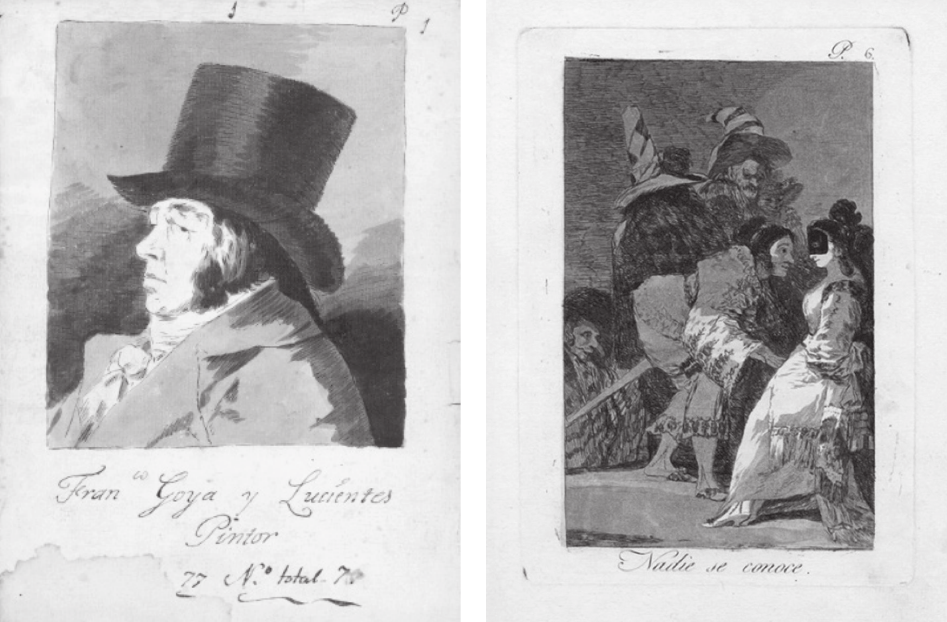
Francisco José de Goya y Lucientes (1746–1828),
better known as Goya, realised that his drawings could
easily be rendered into print that were widely popular.
His Caprichos (Whims) was devised as a collection, or,
it might be said, an artist’s book. The result of this cre-
ation are the eighty plates comprising the Caprichos pub-
lication. On Wednesday, February 6, 1799 the Diario de
Madrid newspaper announced the sale of Goya’s series of
engraving, Caprichos, with a text, probably written by his
friend Leandro Fernández de Moratín, in which he sought
to defend Goya from potential censure or attacks, due to
his critical images (Fig. 5, 6).
The text began as follows:
A collection of prints of whimsical matters, invented
and engraved, in aquatint, by Don Francisco de Goya.
[…] Since most of the objects represented in this work
are imaginary, it will not be fanciful to believe that their
defects might be largely forgiven by the discerning, upon
Fig. 1. Albrecht Dürer, The Virgin Appearing to Saint John,
no date – front page of The Apocalypse,
(source: The Metropolitan Museum– metmuseum.org)
Il. 1. Albrecht Dürer, Dziewica ukazująca się świętemu Janowi
– pierwsza strona Apokalipsy
(źródło: The Metropolitan Museum – metmuseum.org)
Fig. 2. Albrecht Dürer, The woman of the Apocalypse
and the seven-headed dragon (Latin Edition: 1511 – second edition,
source: The Metropolitan Museum – metmuseum.org)
Il. 2. Albrecht Dürer, Kobieta Apokalipsy i siedmiogłowy smok
(wydanie łacińskie: 1511 – drugie wydanie,
źródło: The Metropolitan Museum – metmuseum.org)
The evolution of the artist’s book / Ewolucja książki artystycznej 5
considering that their creator has not followed the exam-
ples of others, or copied much from nature.
And if imitating it is difcult to achieve as it is admira-
ble when attained, he should fail to merit some esteem he
who, distancing himself entirely from it, has had to expose
his eyes, a forms and manners hitherto existing only in the
human mind, obscured and confused by a lack of illustra-
tion, or blinded by unruly passions [2, p. 715].
Thus, it is clear that Goya used engraving as a means of
autonomous expression, with images that were designed
to be engraved. Iconographically, these were totally dif-
ferent from his paintings, a veritable haven for Goya’s
socio-political reections. This made him one of the few
creative engravers existing between the 15
th
century until
the 1
st
half of the 19
th
, during which engravers habitually
produced reproductions or interpretative print.
The rst three artists selected – Dürer, Piranesi and
Goya – present a correlation between their modus ope-
randi, even if they are separated by space and time. These
three artists conceived of their body of graphic work as an
inseparable whole, a single creation with a single theme,
the same procedure, and a sequential ordering of the
works that led to a reading of the images just as the artist
had intended; it should be noted that each of the print were
numbered so that their order was always the same, their
characteristics coinciding with those identied with the
execution of an artist’s book in printmaking.
We shall now proceed to analyse the work of an artist
representing a precursor to the transdisciplinary concept
associated with the artist’s book in the 18
th
century: the
transdisciplinary artist par excellence, an outlying artist
during his era; the engraver, sketch artist, painter, poet and
self-publisher William Blake.
Thus, it is essential here to clarify the concept of trans-
disciplinarity, the foundation upon which we believe that
artists were based, or the spirit that informed the construc-
tion of the artist’s book, even if, as creators, they were not
aware of it, as such. Transdisciplinarity is a concept intrin-
sic to the creative production of the artist’s book today, and
research has been done on artists of previous centuries, who
in one way or another also embraced transdisciplinarity.
Though absent, per se, from the frequent discussions
of the artist’s book over the course of history, the concept
still pervaded the conception of this type of artistic work.
We are, from the outset, faced with a question: what
does transdisciplinarity mean? “Trans” is the prex denot-
ing that transdisciplinary, as a term, suggests something
that transcends limits. Its essence, then, is going beyond
just one given discipline, whether it be drawing, engrav-
ing, painting, sculpture, architecture, computer science
(today) etc. It is an approach based on seeking, on defy-
ing the rigid connes of disciplines, where the multiple is
made one and, at the same time, the whole.
The term transdisciplinary appeared for the rst time
in the 1970s, in the works of the Swiss psychologist Jean
Fig. 3. Giovanni Battista Piranesi,
Carceri d’invenzione – Imaginary prisons, front page: 1749–1750
(source: The Metropolitan Museum – metmuseum.org)
Il. 3. Giovanni Battista Piranesi,
Carceri d’invenzione – Wyobrażalne więzienia, pierwsza strona, 1749–1750
(źródło: The Metropolitan Museum – metmuseum.org)
Fig. 4. Giovanni Battista Piranesi, The Drawbridge, 1749–1750
(source: The Metropolitan Museum – metmuseum.org)
Il. 4. Giovanni Battista Piranesi, Most zwodzony, 1749–1750
(źródło: The Metropolitan Museum – metmuseum.org)
6 Bethania Barbosa B. de Souza
Piaget, the Austrian astrophysicist Erich Jantsch, and the
French sociologist Edgar Morin, in which they agreed
that it was necessary to identify integrations or re ci pro-
cities between the different elds, and to situate these
connections within a total system, without xed bound-
aries.
One of the proponents of transdisciplinary thinking to-
day is Basarab Nicoluscu, a physicist and founder of the
International Center for Transdisciplinary Research and
Studies, who has stated that:
Transdisciplinarity, as its prex “trans” indicates,
deals with what lies between the disciplines and, at the
same time, permeates the different disciplines […] Its ob-
jective is to understand the current world, for which one
imperative is a unity of knowledge [3, p. 35].
We perfectly understand the transdisciplinary concept
when we think about the breakage of the old mercury
thermometers, and how the particles of mercury were dis-
persed in different drops, if we imagine each drop cor-
responding to a discipline, a fragment of human knowl-
edge. The disciplines grow more and more distanced from
each other, but, in reality, they are fragments of the same
whole, and, if they are brought closer to each other, they
connect once again.
Transdisciplinary thinking proposes and suggests tran-
scending “yes” or “no”, “it is” and “it is not”, and the pos-
sibility of surpassing certain limits. This thought is based
on the idea that, for the construction of a common body of
knowledge, and work, one should not necessarily be lim-
ited to a single discipline. However, let us not think that
transdisciplinary thinking isolates the singularity of the
disciplines, or that it does not aspire to consider all of them.
The artist’s book is the result of an aesthetic/plastic
process conceived, from the beginning, as a work of art in
itself. Its creator, the artist, has the power to decide over
the how and why of each of the materials, shapes, colours,
textures, spaces, structures, procedures and techniques
that will be used to produce his nal artwork. Hence, this
artistic medium constitutes one of the most transdisci-
plinary for the artist.
In the creation of an artist’s book, as in the transdisci-
plinary concept, the disciplines merge, with some pene-
trating the spheres of others. This concept of unity within
the complexity of the whole constitutes one of the most
obvious formal characteristics within the current produc-
tion of artist’s books, as the artistic eld is perfectly at-
tuned to this concept of unity and complexity between the
disciplines.
Fig. 5. Francisco de Goya y Lucientes,
Los Caprichos nº1, front page, 1797–1799
(source: Real Academia Bellas Artes San Fernando
– realacademiabellasartessanfernando.com)
Il. 5. Francisco de Goya y Lucientes,
Kaprysy, nr 1, pierwsza strona, 1797–1799
(źródło: Real Academia Bellas Artes San Fernando
– realacademiabellasartessanfernando.com)
Fig. 6. Francisco de Goya y Lucientes,
Los Caprichos nº 6 – Nadie se conoce, 1797–1799
(source: Real Academia Bellas Artes San Fernando
– realacademiabellasartessanfernando.com)
Il. 6. Francisco de Goya y Lucientes,
Kaprysy, nr 6 – Nikt nie zna samego siebie, 1797–1799
(źródło: Real Academia Bellas Artes San Fernando
– realacademiabellasartessanfernando.com)
The evolution of the artist’s book / Ewolucja książki artystycznej 7
Having established the importance of the concept of
transdisciplinarity in the eld of artist’s books in print-
making, we return to the transdisciplinary artist William
Blake, who employed and demonstrated this concept ex-
tensively, merging his poetic work into his own aesthet-
ic/plastic creations, including print, drawings and paint-
ings – an approach that was decidedly innovative for his
time, the 18
th
and early 19
th
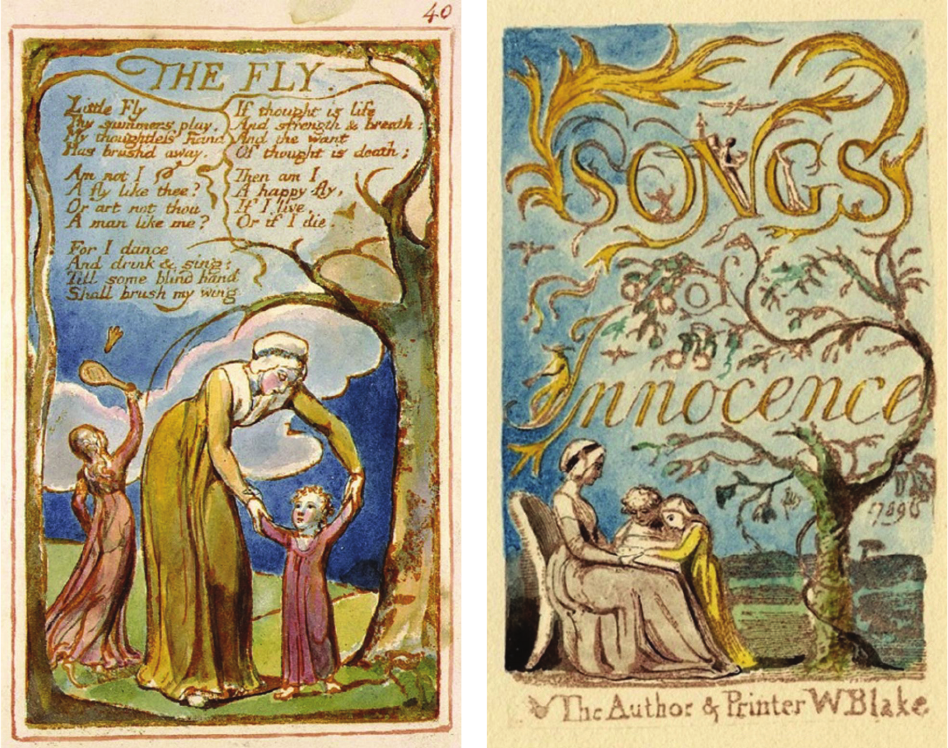
centuries. In his books he
combined arts of engraving and poetry, mainly, gener-
ating a new reective dimension in illustrated books, at
both the conceptual and technical levels. With regard to
the conceptual we can perceive how a poet creates his
texts and poems, as he himself illustrates it, endowing
his works with an aesthetic/plastic result different from
others. At a technical level, he produces his illustration
through relief etching, also innovating in the execution
of this technique, developing a new method based on en-
graving the copper plate with different heights, or levels,
to achieve his aim of producing print in relief, or, con-
versely, intaglio. In this way he was able to craft the plate
in both ways, incorporating on the same plate/mould both
texts and images, thereby rendering process less costly.
Blake’s technique transformed the nature and appearance
of illustrated books, opening them up to the possibility of
entirely new forms. The artist called these books “Illumi-
nated Prints”. A limited number have been selected, as the
list is quite extensive. There is Songs of Innocence and of
Experience (1789), and Europe: A Prophecy (1794); in
the same year he published the rst book of Urizen and,
one later, Songs of Los (1795).
William Blake elevated the artist’s book to another
creative and experimental dimension, melding multiple
disciplines, providing subsequent artists with a vision of
the creative amplitude that an artist’s book could feature,
without creational limits (Fig. 7, 8).
When creating an artist’s book today, this new dimen-
sion of great versatility liberates the creator from a spe-
cic technique or isolated discipline, a constraint that
formerly prevailed. It was in this liberal environment that
transdisciplinarity emerged, as a concept inherent to this
breadth of forms.
The artist, immersed in this context, enjoyed the pos-
sibility of transgressing the technical rules imposed by
predetermined spaces or techniques, the artist’s book
Fig. 7. William Blake, Songs of Innocence and of Experience
– The fly, 1789 (source: The William Blake Archive – blakearchive.org)
Il. 7. William Blake, Pieśni niewinności i doświadczenia, 1789
(źródło: The William Blake Archive – blakearchive.org)
Fig. 8. William Blake, Songs of Innocence, 1789
(source: Tate Modern – tate.org.uk)
Il. 8. William Blake, Pieśni niewinności, 1789
(źródło: Tate Modern – tate.org.uk)
8 Bethania Barbosa B. de Souza
granting him unlimited freedom in the conceptual realm.
The impetus behind these transgressions emerged from
the preceding three decades, during which society under-
went transitions never before imagined, and continued to.
Drastic changes encompassing every eld of knowledge
appeared in every area of society: science, technology,
culture, economics, communications, arts, etc. Fields
of knowledge related to the role of cause and effect ad-
vanced, and fed on each other, in an evolutionary process
subjecting humanity to a veritable whirlwind of rapid de-
velopment and great complexity.
Thus, every work of art, including that in question –
the artist’s book – reect the aesthetic dynamics of the
ideological and technical period during which it was pro-
duced, revealing, with or without the artist’s consent, his
consciousness, his conception of the world, his aesthetics
and the nature of his time. Much of the historical juncture
we now face is a consequence of globalisation, a dynamic
resulting from the scientic and technological advances
mentioned above. Globalisation reveals to us the hetero-
geneous aspects of the world, which, with the passage of
time, often become homogeneous, as we can easily per-
ceive in the most recent architectural constructions, when
we visit a big city, notice the people’s attire, their works of
art, or their codes and conduct.
Artistʼs books in printmaking evolution
produced by technical advances
and transdisciplinarity
Until the early 20
th
century these theoretical, artistic
and procedural codes were well demarcated, providing the
artist with a clear understanding of the knowledge that he
was to master in order to carry out his aesthetic/plastic
project, whatever it might be. With globalisation, and ad-
vances in new technologies, the technical procedures that
form part of the development of an artistic creation have
changed considerably.
The consequences of globalisation and transdiscipli-
narity also include the immediacy with which information
and knowledge are transmitted, the loss of borders, migra-
tory movements, the dissolution of space/time limits, etc.,
aspects present in the social reality and disciplines of the
different elds of knowledge. In the same way, these con-
sequences are reected in the transdisciplinary processes
employed in the artist’s book, in both its conceptual and
procedural contexts.
In the production of an artist’s book, it may be gener-
ally observed that, in relation to the development of aes-
thetic/plastic work, images are increasingly manipulated,
captured, metamorphosed, and digitalised, generating
a constructive process of fragmented, non-linear images
in various disciplines; with a result, nevertheless, of unity,
an entity, on the whole, a complex and hybrid transdis-
ciplinary process. In this procedural form of production
of the artist’s book, the transdisciplinary process does not
spurn the tradition of artistic procedure, as this is an essen-
tial aspect of the transdisciplinary process.
As we can appreciate in this image, the artist has ma-
nipulated, captured, metamorphosed and digitalised it, in
a process yielding a fragmented image, bridging the histo-
ry of art and engraving, but with a result of unity, an entity
resulting from a transdisciplinary process.
These are aspects that do not imply a rejection or in-
validation of traditional artistic techniques. Rather, the
artist’s book comes to occupy a privileged place for ex-
perimentation and the creation of new concepts existing
alongside pre-existing ones.
As we can see: the past, the present and the future, as-
sociated with transdisciplinary processes, spark the art-
ist’s interest in the transformative potential of the creative
and procedural aspects available, capable of producing
something superior.
In this way, the images developed by any aesthetic/
plastic activity may proceed from different elds and ar-
eas of knowledge, such as: drawing, photography, sculp-
ture, painting, metrics, architecture, medicine, biology,
zoology, physics, chemistry, astronomy, geology, etc.,
providing a benet never before imagined in artistic aes-
thetics: enabling their evolution.
Therefore, the artist has fused different images from
areas or elds of knowledge that once existed separately,
combining or transforming them out of a desire to gener-
ate new structures, objects, or, in our case, images. That
is, in the process of aesthetic/plastic creation the ways of
expressing, interpreting and understanding the creative
process are no longer rooted in a specic discipline or
technique, isolated from other disciplines, as used to be
the case. On the contrary, we nd ourselves with the op-
portunity to transgress the limits of technique and, con-
sequently, their respective restrictions. This process of
transgression and transformation enriches the creative
process, broadening creative horizons. Therefore, great
achievements are possible when one makes use of his
knowledge of his area, but while observing its problems
from different points of view, giving him a perspective
that draws on other elds of knowledge.
It is clear that the individual can only transgress the
boundaries of the technical procedures of a particular dis-
cipline if he understands them. With knowledge, he may
be able to solve their internal problems, but this will not
sufce to enrich them. It is only from a different perspec-
tive that he can expand his solution and creation possibil-
ities, making the discipline to which he is dedicated in-
creasingly transdisciplinary, with coexisting fundamental
concepts of hybridisation, contamination, appropriation,
miscegenation, crossing, etc.
The stress on transdisciplinary processes in aesthet-
ic/plastic production reects the frenetic era in which
we live, with a whole avalanche of factors affecting our
lives, socially, technologically, psychologically and onto-
logically, both with regard to contemporary concepts and
techniques and traditional ones.
These processes are generators of elements that are
borrowed, appropriations, contaminations and crosses
between the technical procedures and the aesthetic to be
developed, as they create forums for the coexistence of
known languages, engendering a perception of these ob-
jects totally differentiated from the way we perceive and
relate to traditional media or techniques.
The evolution of the artist’s book / Ewolucja książki artystycznej 9
To conclude, we believe that during periods of con-
ceptual revision, such as the one we nd ourselves living
in today, with transdisciplinary processes, creating a new
aesthetic in the production of artist’s books means being
able to understand and integrate what is understood on
a new artistic level of knowledge and internalization.
It means introducing new congurations, new forms, and
these new creations are born of the internal motivations of
each artist, which will make possible the linking of techni-
cal and technological knowledge with aesthetic joy and the
promotion of transdisciplinary processes in the aesthet
ic/
plastic creation of the artist’s book. The more unique imag-
es are produced, the more their aesthetics and procedures
are explored, the more the artist’s book will be the subject
of construction and deconstruction, these considerations
being the result of deeper reections on transdisciplinarity
and its contribution to the aesthetics of the artist’s book.
Translated by
Dolores Herrador Molina
References /Bibliografia
[1] Durero. Obras maestras de la Albertina, J.M. Mantilla (ed.), Museo
Nacional del Prado, Madrid 2005.
[2] Carrete J., Checa F., Bozal V., El Grabado en España (Siglos XV al
XVIII), Espasa-Calpe S.A. Summa Artis Historia General del Arte,
Madrid 1988.
[3] Nicolescu B., La Transdisciplinariedad. Maniesto, Ediciones Du
Rocher, 1996.
Abstract
This article deals with the aesthetic evolution of the artist’s book in printmaking and its close connection to the graphic procedures resulting from
the printing press and the current transdisciplinarity of the various areas of knowledge. Each stride of technical progress in the eld of graphic arts
spawned a transformation in the aesthetics of the images comprising books, as they served to enhance the graphic quality of the aesthetics presented.
Key words: artist’s book, transdisciplinarity, printmaking, print
Streszczenie
Artykuł dotyczy ewolucji estetycznej książek artystycznych i jej ścisłego związku z procedurami gracznymi oraz obecnej transdyscyplinarności
różnych dziedzin wiedzy. Każdy postęp techniczny w dziedzinie techniki warsztatowej powodował przemianę estetyki obrazów tworzących książkę,
przyczyniając się do poprawy jakości gracznej prezentowanych działań artystycznych.
Słowa kluczowe: książka artystyczna, transdyscyplinarność, graka warsztatowa, druk
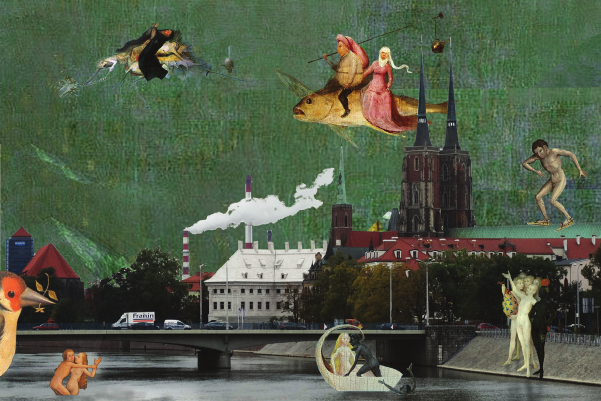
Kolaż autorstwa E. Tomczyk
Collage by E. Tomczyk