2026
1(85)
Dominika Cieplak*
The Lemko house – architecture of forgotten identity.
The traditional chŷža, its contemporary reinterpretations
and the role of architects in the transmission
of the Lemko heritage
DOI: 10.37190/arc260101
© by the Author/Authors. Licensee WUST.
Published in open access. CC BY-NC license.
Abstract
The article focuses on the redenition of the Lemko house in the context of post-war displacement and contemporary attempts to refer to the tradi-
tional architecture of the region. The home is understood here as a space deeply rooted in cultural, familial, and emotional dimensions of identity, the
meaning of which in the Lemko community signicantly changed after the World War II. Particular attention is paid to the concept of the chŷža – the
archetype of the Lemko house – and its contemporary reinterpretations in single-family housing.
The aim of the article is to identify the constitutive features of the modern Lemko house and the ways in which architecture can mediate the trans-
mission of heritage. The analysis considers both material aspects (form, proportions, details, materials) and immaterial aspects (language, traditions,
relationship with the environment), revealing the tension between delity to tradition and adaptation to the contemporary needs of the inhabitants.
The paper is based on interviews with representatives of the Lemko community and with architects who have designed buildings inspired by the
Lemko archetype, as well as on a comparative analysis of these realisations.
The design strategies outlined in the article range from the preservation of selected traditional features to their deliberate transformation. The role
of language, memory and landscape as co-creators of the sense of home is also highlighted. As a result, a denition of the contemporary Lemko house
is proposed as a space of cultural continuity – embedded in the region but open and dynamic, where tradition is realised not only through architectural
form, but also through the persistence of community, language and culture.
Key words: architectural heritage, Lemko house, chŷža, Lemkos/Rusyns, minority architecture
Introduction
The house – regardless of its location, construction, or
aesthetics – occupies an important place in the hierarchy of
human values (Bartmiński 2008, 56). It is associated with
family, community, or homeland, encompassing both build-
ings and the surrounding landscape with clearly dened
boundaries and characteristics. Human self-realisation is
achieved through the formation of bonds, relationships,
and surroundings – made possible by the ability to dwell
in and participate in a particular milieu (Heidegger 1970,
322, 323). The loss of the home therefore entails a loss of
belonging, a disruption of stability, and a weakening of
identity, depriving the individual of a sense of security and
of a place to which their memories are attached.
The Lemkos were displaced rst as part of the mutual
population exchange between Poland and the Soviet Un
-
ion (1944–1946) to the territories of the Ukrainian Soviet
Socialist Republic, and later through Operation “Vistula”
(1947–1950) to the so-called Recovered Territories. As
a result, they lost their homeland – the Lemko Region, an
ancestral space that constituted the foundation of their cul-
tural identity (Watral 2019, 53, 54). Forced displacement
resulted in alienation, disintegration of communities, and
diculties in rebuilding social life and culture (Wilk 2019,
224–315). Years of assimilation led to a transformation in
the denition of the Lemko house: for many, it no longer
existed as the traditional wooden house in the Lemko
* ORCID:
0009-0000-7967-9084. Doctoral School of the Krakow
University of Technology, Poland, e-mail: dominika.cieplak@doktorant.
pk.edu.pl
4 Dominika Cieplak
Region, but instead endured in the practice of religion,
rituals, language, and the memory of former ways of life,
forming a component of Lemko identity regardless of their
new, unfamiliar places of residence (Sitek 1996, 154–159).
This article aims to dene the characteristics of the
con temporary Lemko house through an analysis of recent
re sidential projects in the Carpathians inspired by the tra-
ditional Lemko house – chŷža. The article focuses on the
preservation and reinterpretation of elements of architec-
tural heritage within the context of contemporary function-
al and cultural needs. A distinction between the concepts
of “house” and “chŷža” is adopted from an identity-based
perspective, along with the identication of features con-
stitutive of Lemko residential architecture. Contemporary
architectural projects were analysed in terms of their formal
and spatial references to the chŷža archetype, as well as the
elements that have been adapted in response to broader so-
cial and technological changes. As a result of the conducted
research, a denition of the contemporary Lemko house is
proposed as a form of dynamic continuation of heritage,
combining enduring components of tradition with elements
shaped by the realities of the present day.
State of research
To understand what constitutes the contemporary Lemko
house, it is rst necessary to consider the universal mean-
ing of the concept of home as a symbolic and emotionally
charged space. Home is often described as a “psycho-spa-
tial entity and an emotional warehouse” (Easthope 2004,
134) as it accumulates human experiences. At the level of
visual representation, this concept is articulated through
a stable and recurrent set of elements, a pattern clearly re-
ected in children’s drawings. Children most often depict
a home according to a similar schema, typically including
windows, a door, a roof with a chimney, and a garden en-
closed by a wooden fence. Moreover, these illustrations
frequently portray not only the building itself, but also its
inhabitants, its surroundings, and even atmospheric condi-
tions (Niebrzegowska-Bartmińska 2017, 23).
In the context of migration, home becomes a synthesis
of the culture of the place of origin and the new context,
facilitating the preservation of tradition and identity (Ślu-
sarczyk, Pustułka 2017). In addition, home functions as
a place of shelter, security, and family bonds, which links it
to concepts of identity, belonging, and stability (Gatkowska
2016, 125, 126). From the perspectives of psychology and
sociology, home is perceived as an emotionally embedded
space that enables the expression of feelings and the reduc-
tion of tensions (Kubacka 2018, 201).
The Lemkos’ attachment to their homesteads in the Car-
pathian region is reected in the Lemko language, which
distinguishes between the terms “home/house” (дім/dim)
and “chŷža” (хыжа). Prior to displacement, these terms were
used interchangeably to refer to the same type of building
– a wooden house constituting the space of family life.
After
the war, these two concepts became dierentiated, and chŷža
came to symbolise the past, associated exclusively with the
lost Lemko Region. Under the new post-displacement con-
ditions, Lemkos no longer used the term chŷža to describe
their new dwellings in the so-called Recovered Territories.
Over time, however, as they formed ties to their new sur
-
roundings, these dwellings gradu ally came to be perceived
as a “home” (Misiak 2015, 68).
During the interwar period, research on the Lemko Re-
gion intensied with some attention given to the analysis of
traditional architecture (Udziela 1934; Falkowski, Paszny-
cki 1935; Pieradzka 1939; Reinfuss 1946, 1990). Accord-
ing to research, the traditional chŷža was characterised by
a wooden log construction and an elongated, rectangular
form set on a stone foundation (Smoczkiewicz 1968, 8). Win -
dows, small and divided into smaller panes, provided day-
light to the living interiors. The ratio of window area to
oor area in the main living room reached as much as 1:12,
which constituted a high level of daylight for houses dat-
ing from the turn of the 19
th
and 20
th
centuries (Tłoczek
1985, 75). Houses were covered with high, steeply pitched
roofs featuring a characteristic eaves overhang, initially
thatched with straw and later covered with wooden shingles
(Gosztyła, Mikrut 2017a, 207–210). In the eastern part of
Lemko Region, single-building farmsteads predominated
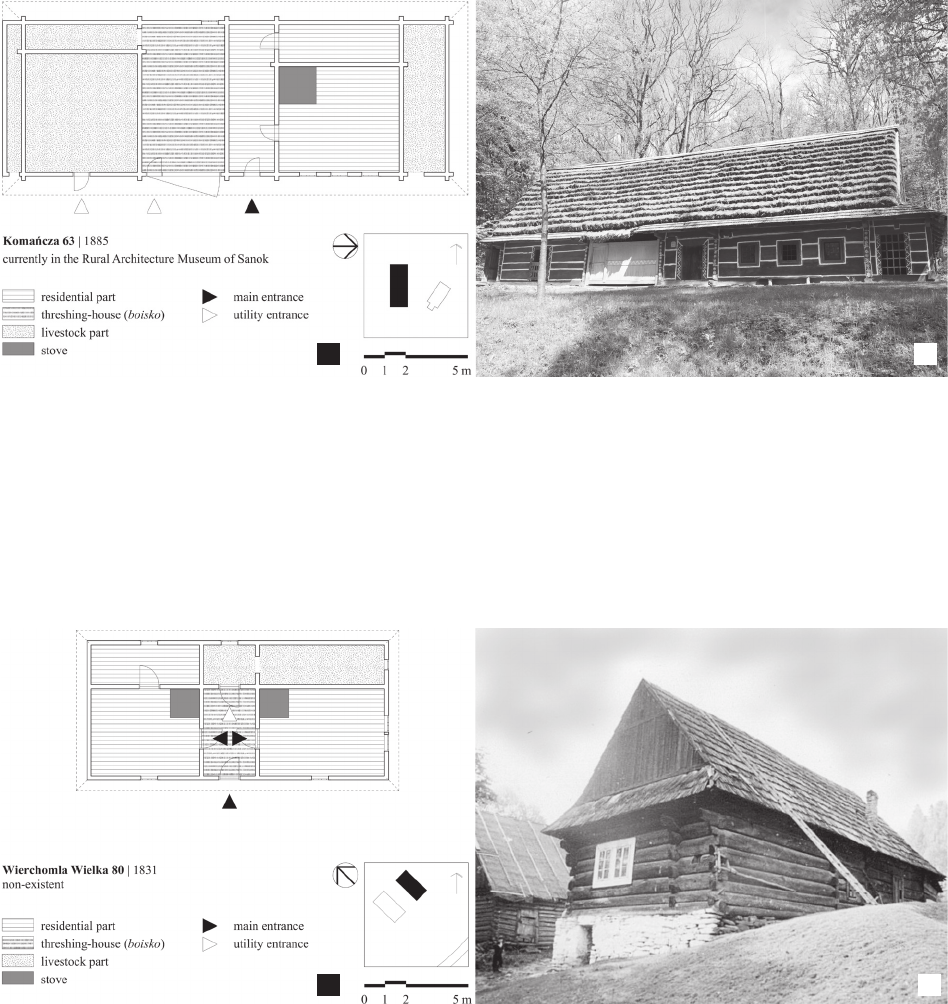
(Fig. 1) (Tłoczek 1985, 74, 75), whereas in the west res-
idential and farm functions were separated (Fig. 2) (Rein-
fuss 1946, 190, 191). The living area occupied one third or
up to one half of the livestock/utility part (Tłoczek 1985,
74). According to research, most residential buildings had
a one-and-a-half-bay layout (Prokopek 2019, 224; Gosz-
tyła, Mikrut 2017b). The residential part, accessed through
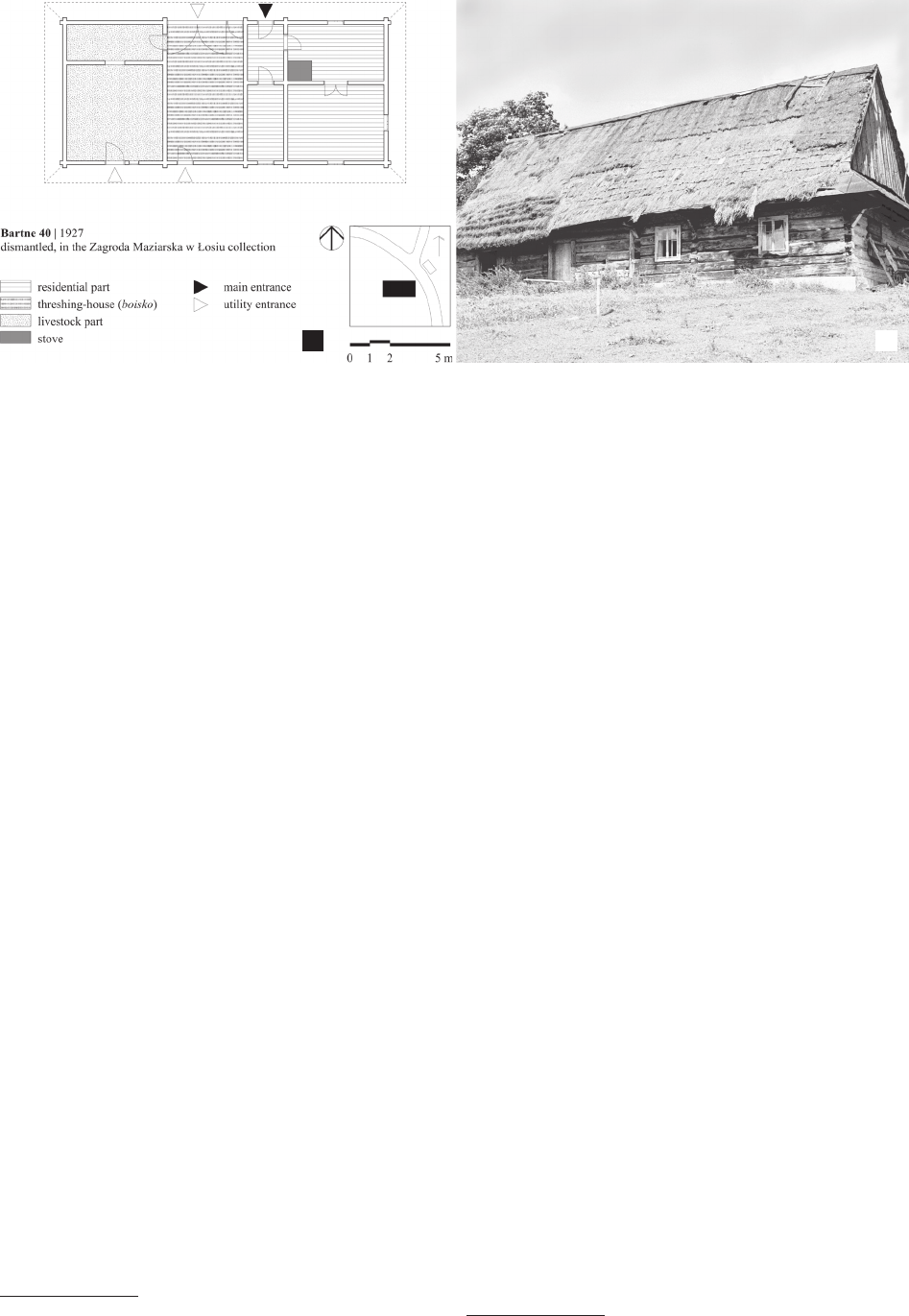
the entrance hall (sień), contained a stove that formed the
functional centre of the house (Fig. 3) (Kępa 1971, 25).
Larger houses featured interiors arranged in an enlade
(through-passage) layout. Traditional nishing materials
included wood, clay, and straw. Wooden oors were used
in the utility areas, while clay oors were applied in the
residential spaces (Priadka 2005, 14). The cottages were
decorated with limewash, with oral or geometric mo-
tifs painted around windows and doors (Gosztyła, Mikrut
2017a, 208–210; Ostrowińska 1986, 126–128). In the Lem-
ko–Boyko borderland, houses were painted in shades of red
(Falkowski, Pasznycki 1935, 60).
Thus far, research on Lemko architecture has focused
primarily on the historic fabric of chŷža dwellings and
Orthodox churches, while post-displacement transforma-
tions of Lemko architecture remain insuciently explored.
Analyses that consider the changing needs of the com-
munity and their impact on the contemporary form and
function of houses are largely lacking. As a result, there
is no clear denition of the contemporary Lemko house,
which makes it dicult to identify its characteristic fea-
tures and to assess its signicance within the cultural her-
itage of the region.
Methods
After Operation Vistula, between 1948 and 1958, only
a small number of Lemkos returned to their ancestral lands
in the Carpathians, where they encountered numerous dif-
culties. The lack of ocial consent for organised re-emi-
gration, along with conicts with new settlers arising from
cultural dierences and property disputes, signicantly hin-
TheLemkohouse–architectureofforgottenidentity 5
dered this process (Kalbarczyk 2005, 72). Return entailed
not only the reconstruction of the material and symbolic
home but also adaptation to a transformed social environ-
ment. Settlement took place primarily in the ruins of former
homesteads or through the construction of new, multi-sto-
rey houses that met contemporary standards (Koprowski
2016, 147, 206).
The redenition of the Lemko house, as a key element
of identity, thus became a necessity in the wake of post-war
resettlements. The destruction of traditional architecture,
together with diverse post-displacement experiences, has
led to contemporary variations in how the concept of home
is understood, reecting the unique trajectories and living
realities of the Lemko community. In order to examine the
Fig. 1. Chŷža from Komańcza 63 (Команча/Komanča) from 1885:
a) plan and orientation of the house (elaborated by D. Cieplak, source: The National Institute of Cultural Heritage, wooden house from Komańcza,
the green card, ref. no. PL.1.9.ZIPOZ.NID_N_18_BK.20641, PL.1.9.ZIPOZ.NID_E_18_BK.217622),
b) contemporary view, house in the collection of the Museum of Folk Architecture in Sanok (photo by D. Cieplak)
Il. 1. Chyża z Komańczy 63 (Команча/Komanča) z 1885 r.:
a) rzut i usytuowanie chyży (oprac. D. Cieplak, źródło: Narodowy Instytut Dziedzictwa, chałupa z Komańczy,
karta zielona, sygn. PL.1.9.ZIPOZ.NID_N_18_BK.20641, PL.1.9.ZIPOZ.NID_E_18_BK.217622),
b) zdjęcie współczesne, budynek w kolekcji Muzeum Budownictwa Ludowego w Sanoku (fot. D. Cieplak)
a b
Fig. 2. Chŷža from Wierchomla Wielka 80 (Верxомля Велика/Verchomlja Velyka) from 1831:
a) plan and orientation of the house (elaborated by D. Cieplak, source: The National Institute of Cultural Heritage, wooden house no. 80,
the green card, ref. no. PL.1.9.ZIPOZ.NID_E_12_BK.383127),
b) archival photograph from 1965 (source: The National Institute of Cultural Heritage, wooden house no. 80,
the green card, ref. no. PL.1.9.ZIPOZ.NID_E_12_BK.383127)
Il. 2. Chyża z Wierchomli Wielkiej 80 (Верxомля Велика/Verchomlja Velyka) z 1831 r.:
a) rzut i usytuowanie chyży (oprac. D. Cieplak, źródło: Narodowy Instytut Dziedzictwa, dom (chałupa) nr 80, karta zielona,
sygn. PL.1.9.ZIPOZ.NID_E_12_BK.383127), b) zdjęcie archiwalne z 1965 r. (źródło: Narodowy Instytut Dziedzictwa, dom (chałupa) nr 80,
karta zielona, sygn. PL.1.9.ZIPOZ.NID_E_12_BK.383127)
a b
6 Dominika Cieplak
signer and owner of the house in Leszczyny; Norbert Mech
(NM), designer and owner of a house in Nowica.
Towards a redefinition of the Lemko house
after displacement
When dening the concept of home, the study partic-
ipants most frequently referred to security, intimacy, and
a place to which one returns. Home was also repeatedly de-
scribed as an element of identity that provides direction in
life (AC, ODF, NMN, DZ). According to Małecka-Nowak,
home connects history with the present – as a Lemko living
in a house with a Jewish past, she preserved symbols of
the former inhabitants, such as a mezuzah and a menorah,
and juxtaposed them with Lemko icons. She also noted that
while a house is inseparably linked to its location, it reects
the character of its inhabitants, their interests, passions, and
origins (NMN). Chlipała, on the other hand, emphasised
that the boundaries of the home extend beyond its walls,
encompassing both the surrounding landscape and the local
community (AC).
The respondents unequivocally associated chŷža with
the space of Lemko Region, while emphasising that the
Lemko house is constructed through language and culture
(ODF, DZ, MS). Małecka-Nowak also noted a clear dis-
tinction between her grandparents’ place of residence be-
fore displacement, a chŷža in Banica (Баниця/Banycja
2
)
near Izby (Ізбы/Izbŷ), and their home after returning to the
2
To emphasise the region’s cultural identity, the author uses Polish
place names supplemented with the original Lemko spelling in Cyrillic
and its Latin transliteration.
current meaning of a Lemko house, eight interviews were
conducted with individuals connected to the Lemko com-
munity
1
. The study involved the following participants:
Aleksandra Chlipała (AC), owner of a house inspired by
a chŷža in Uście Gorlickie; Olena Duć-Fajfer (ODF), pro-
fessor at the Jagiellonian University, Lemko literary and
language scholar, Lemko poet; Bogdan Kareł (BK), Lemko
woodcarver; Iwona Iskra-Krynicka (IIK), architect; Natalia
Małecka-Nowak (NMN), Lemko activist, president of the
Ruska Bursa Association and board member of the Lemko
radio station lem.fm; Michał Szymko (MS), PhD, Lemko
art historian; Agnieszka Stopka (AS), Lemko from Czarna
Woda; Dawid Zdobylak (DZ), Lemko painter and Doctor
of Fine Arts. The perspectives of the participants enriched
the analysis with cultural and identity-related dimensions.
The respondents reected on the general meaning of home,
the role of the traditional chŷža in the context of forced
displacement, and the characteristics that a contemporary
Lemko house should possess. This enabled a comprehen-
sive approach to the research problem. In addition, archi-
tects commented on their contemporary projects inspired
by the archetype of a Lemko house: Bartłomiej Homiński
(BH), PhD, designer of the studio in the Beskid Niski; Ma-
ciej Jagielak (MJ), PhD, specialist in ecological construc-
tion and designer of the house in Uście Gorlickie; Marcin
Janusz (MJan), designer and owner of the house in Oderne;
Piotr Krynicki (PK), Lemko architect and translator, de-
1
The interviews were conducted between 2023 and 2025, and the
collected research material is stored in the author’s archive. The study
was carried out with the approval of the Senate Ethics Committee of the
Cracow University of Technology (decision no. 11 of 13 May 2025).
Fig. 3. Chŷža from Bartne 40 (Бортне/Bortne) from 1927:
a) plan and orientation of the house (elaborated by D. Cieplak, source: The National Institute of Cultural Heritage, farmstead no. 40,
the white card, ref. no. PL.1.9.ZIPOZ.NID_N_12_ZE.58482, PL.1.9.ZIPOZ.NID_E_12_ZE.29004;
Muzeum Dwory Karwacjanów i Gładyszów in Gorlice. Conservation study. Elaborated by J. Rotko, 2021),
b) archival photograph (photo by W. Grzesik, source: Zagroda Maziarska w Łosiu, ref. no. N8-2-07-1)
Il. 3. Chyża z Bartnego 40 (Бортне/Bortne) z 1927 r.:
a) rzut i usytuowanie chyży (oprac. D. Cieplak, źródło: Narodowy Instytut Dziedzictwa, zagroda nr 40, karta biała,
sygn. PL.1.9.ZIPOZ.NID_N_12_ZE.58482, PL.1.9.ZIPOZ.NID_E_12_ZE.29004;
Muzeum Dwory Karwacjanów i Gładyszów w Gorlicach. Opracowanie konserwatorskie. Proj. J. Rotko, 2021),
b) zdjęcie archiwalne (fot. W. Grzesik, źródło: Zagroda Maziarska w Łosiu, sygn. N8-2-07-1)
a b

TheLemkohouse–architectureofforgottenidentity 7
Lemko Region, a house in Gorlice, which did not resemble
a chŷža, yet remained “Lemko” through the continued cul-
tivation of tradition (NMN). Duć-Fajfer and Zdobylak fur-
ther emphasised that in the Lemko language, the expression
“to go to the chŷža” (іти до хыж/ity do chŷž) carries the
same meaning as “to go home”, not necessarily to a dwell-
ing resembling the archetypal Lemko cottage. In Polish,
by contrast, this distinction is more clearly articulated for
them (ODF, DZ). Iskra-Krynicka, aware of this semantic
nuance, acknowledged that she associates chŷža primarily
with Lemko architecture from the pre-displacement period
(IIK). For some, the contemporary use of the term chŷža
to refer to one’s own home constitutes a conscious act of
reconstructing cultural identity (AS).
An interesting aspect of Lemko building practices in
the Western Borderlands, identied in the study by
Da wid
Zdobylak, is the more or less conscious referenc e to wood-
en cottages from the Lemko Region through decorative
ele ments. On masonry houses formerly inhabited by the
Ger man population, white-and-brown stripes appeared,
in spired by the lime-washed joints between wooden logs.
The addition of new rooms further resulted in the elonga-
tion of the building mass, bringing its proportions closer to
the chŷža archetype (DZ).
Contemporary projects inspired by chŷža
When working in the Lemko Region and engaging with
the local heritage, the architect is not merely a designer of
new forms, but also a mediator in the reconstruction of the
identity of place. In designing buildings inspired by the
past, the architect makes a conscious choice regarding how
deeply to draw on historical models and to what extent they
should be adapted to contemporary expectations (NM).
Each new project emerging within the Lemko landscape is
situated in a place marked by a complex history, where the
material traces of former culture have largely been erased
by forced displacement, changes in ownership, and years of
neglect. Architecture can thus become a tool for recovering
memory – not only by reproducing forms, but also by re-
interpreting them in ways that restore their meaning within
a contemporary context.
When asked to dene the contemporary Lemko house
and to identify its dening characteristics, the respondents
emphasised the complexity and multidimensional nature
of this concept. For many of them, the contemporary Lem-
ko house is not merely a building inspired by the tradition-
al chŷža, but above all a space that refers to local identity
– both materially and spiritually (ODF, NMN, DZ). Some
participants argued that a contemporary chŷža should con-
stitute an authentic interpretation of traditional forms with-
in new realities (BK, MJan), drawing on historic village
layouts (IIK, PK) as well as local materials such as wood,
stone, and clay (MJ). Janusz noted that a contemporary
home cannot be reduced to a stylistic quotation but rath-
er, it should express the spirit of its time by combining
traditional elements with modern technical and aesthetic
solutions (MJan). In spatial terms, such a home should
be located within the Lemko Region (MS), however, the
spiritual and identity-related dimensions of the Lemko
home can also be constructed beyond its geographical
boundaries (DZ).
For many, the contemporary Lemko house is above all
a space rooted in culture and language – a place where
values, traditions, and memory of the past are transmitted
(ODF, NMN, DZ, MS, PK). Duć-Fajfer emphasised that
a truly Lemko home is one in which the Lemko language
is spoken and family bonds are nurtured, and that its es-
sence lies deeper than architectural form alone (ODF). The
phenomenon of constructing buildings stylised as Lemko
chŷžas yet lacking an authentic connection to local culture,
often created for tourism or commercial purposes, was
also criticised (NMN). Małecka-Nowak further reected
on the problem of the disappearance of traditional archi-
tecture and the absence of systemic solutions supporting
building practices grounded in local heritage. Consequent-
ly, the contemporary Lemko home remains an open cat-
egory, oscillating between material references to the past
and a metaphorical understanding of home as a space of
cultural continuity.
Projects inspired by chŷža therefore constitute not only
an aesthetic reference to the past, but also an attempt to an-
chor new buildings within a place of strong identity. They
involve a balancing act between delity to tradition and the
need to adapt to a changing world, between material her-
itage and the requirements of contemporary users (MJan,
MS). While the role of the architect in this process is cru-
cial, many designers emphasise that the awareness of inves-
tors, who decide to build in areas of cultural and landscape
value, is equally important. It is the investors who initiate
the design process, articulate their expectations, and there-
by shape the direction of dialogue with the architect (MJan,
BH). Jagielak nevertheless pointed out that investors often
select from familiar and readily available solutions, and
that it is the architect’s task to propose alternatives rooted
in the culture of the region (MJ).
The analysis of selected projects made it possible to ex-
amine this process, including the ways in which traditional
forms are reinterpreted, the materials employed, functional
solutions, and the ideas that shape the contemporary archi-
tectural expression of the Lemko house.
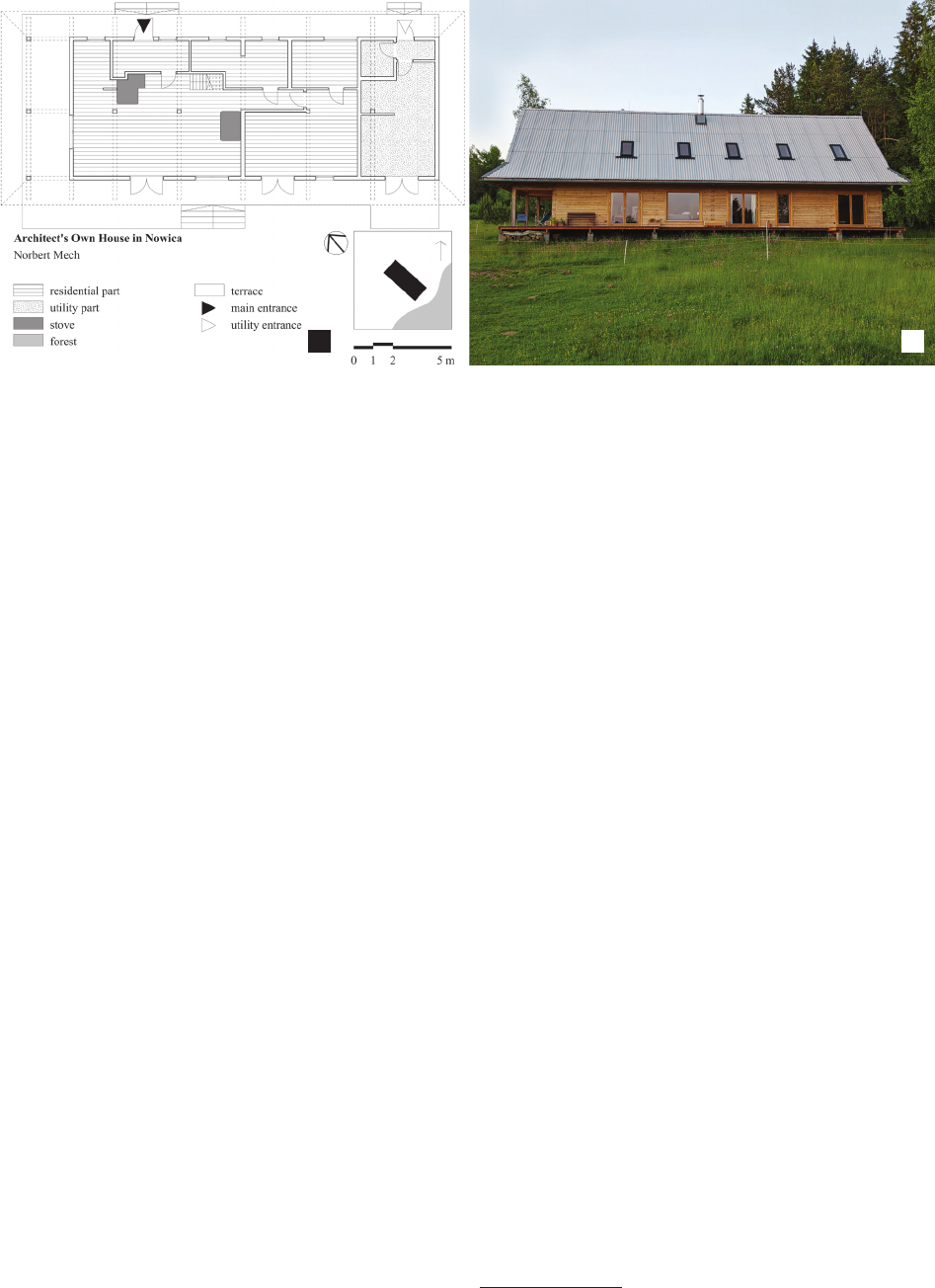
Architect’sownhouseinNowica
The house in the hamlet of Przysłup in Nowica (Нoвиця/
Novycja) designed by Norbert Mech
3
was built on the site
of a former Lemko farmstead, where the traditional chŷža
had stood prior to the displacements. The building was lo-
cated at a distance from the village centre, set back from
the road and oriented gable-end towards it, which repre-
sents a departure from the local tradition of Przysłup and
Nowica, where houses were most often positioned with
their long side facing the road (APP, AG, Dorf Nowica in
Galizien Jasloer Kreis, ref. no. 56/126/0/-/0897M).
3
Concept design: Małgorzata Kural-Mech, MSc Eng. Arch.; Nor-
bert Mech, MSc Eng. Arch. Architectural and construction project: Nor-
bert Mech, MSc Eng. Arch. (architecture); Łukasz Sekuła, MSc Eng.
(structural design); Marek Sadowski, MSc Eng. (electrical installations);
Iwona Hartung-Lenard, MSc Eng. (sanitary installations).
8 Dominika Cieplak
The architect consciously referred to the regional archi-
tecture still preserved within the fabric of the locality. Both
the choice of wood as the primary structural material and
the applied technical solutions draw on local carpentry tra-
ditions. The traditional Lemko house was constructed using
log construction, typically in its simplied form with project-
ing log ends (ostatki), extending beyond the corners. In the
case of this house, log construction was also employed, albeit
in a more compact form – without projecting ends, with the
corners nished using a dovetail joint. Although this solution
departs from the traditional technique used in the region,
it remains consistent with the principles of local carpentry
craftsmanship while also inuencing the building’s aesthet-
ics, giving it a more unied and contemporary character.
The proportions of the building (width/length = 0.35)
correspond to those of a Lemko house from Komańcza
(relocated to the Museum of Folk Architecture in Sanok),
although the threshing-house (boisko) was omitted in fa-
vour of enlarging the residential part. The house neverthe-
less includes a separate utility section with an independent
entrance. The ridge height exceeds that of the traditional
chŷža, as the upper oor has been adapted for residential use,
signicantly altering the character of the building through
the introduction of roof-lights and a projecting gable. The
protruding eaves, extending 125 cm, form a covered perim-
eter walkway and provide roong for a terrace raised above
ground level. The roof was covered with modern, environ-
mentally friendly Eternit (bre-cement roong), constitut-
ing a contemporary reinterpretation of a material widely
used in post-war adaptations of Lemko buildings. A gablet
roof (przyczółek), characteristic of Lemko architecture, was
incorporated into the design. The interior is bright due to
extensive glazing, while natural wood predominates in the
nishes. The central element of the living area is a stove
with integrated seating – a contemporary interpretation of
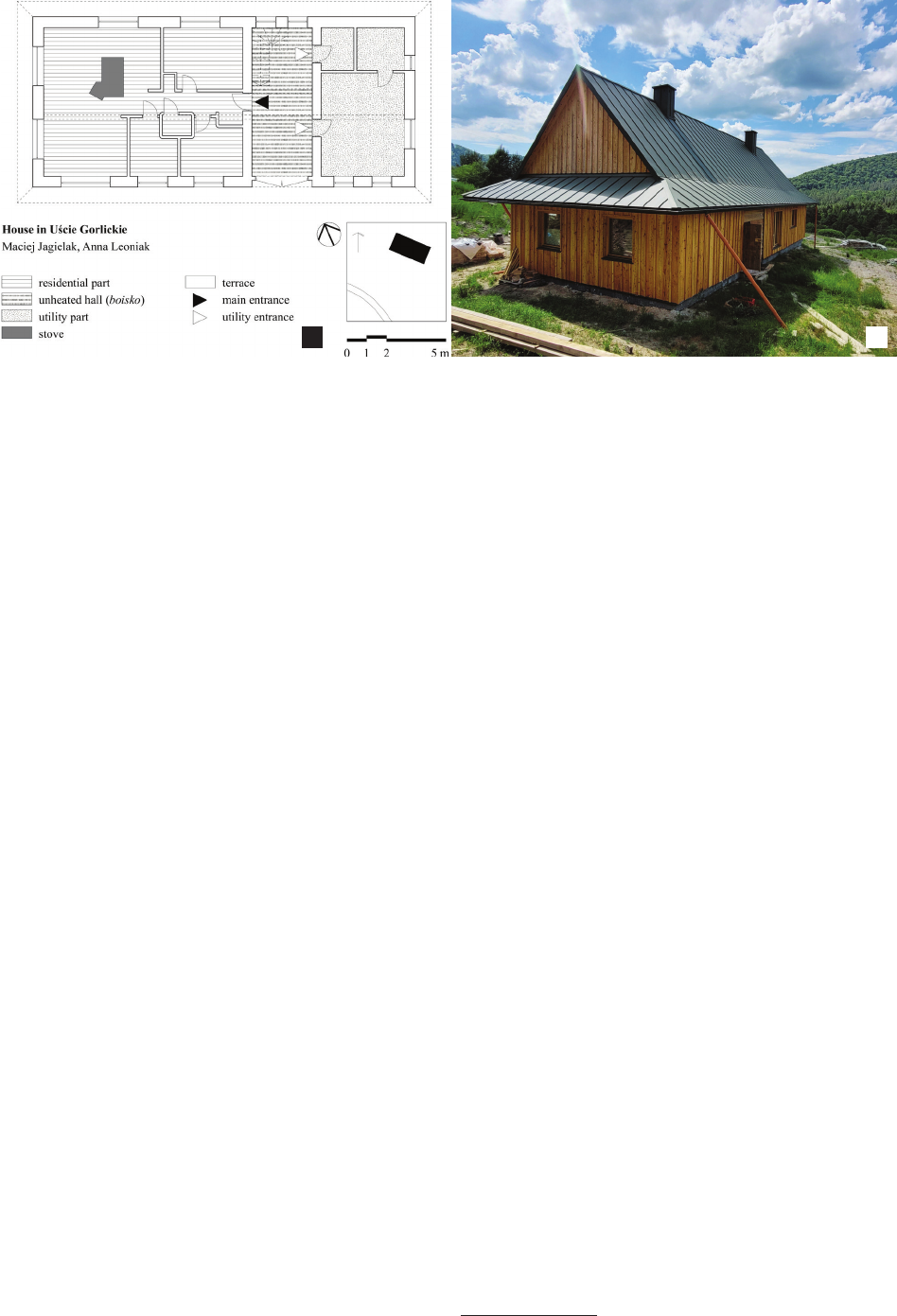
the traditional chimney-corner (zapiecek) (Fig. 4).
Although the project is not considered to be a direct re-
construction of a Lemko house, its form, spatial layout, and
structural logic clearly reference it. The owner does not re-
fer to the building as a chŷža itself, emphasising its contem-
porary character, however, he regards the use of this term as
a compliment, indicating that the house integrates well with
its surroundings and local tradition.
HouseinUścieGorlickie
The project in Uście Gorlickie (Устя Рускє/Ustja Rusk-
je), designed by Maciej Jagielak and Anna Leoniak
4
, is
a contemporary interpretation of the Lemko chŷža. The de-
sign combines inspiration drawn from the region’s historic
architecture with modern technological solutions and an
ecological approach. The building, characterised by an elon-
gated plan and a gable roof, refers to the traditional division
into residential and utility parts with a wide entrance hall
(sień), while not attempting to be a faithful reconstruction.
Its proportions (width/length = 0.45) reect the archetypal
features of the chŷža. The house was oriented parallel to
the road, contrary to the traditional gable-end orientation,
and set apart from compact village development, reecting
contemporary residential preferences (APP, AG, Dorf Uście
Ruskie in Galizien Jasloer Kreis, ref. no. 56/126/0/-/1725M).
The structural system of the house is based on a timber
frame, with the wall cavities inlled with straw bales. This
material choice results both from an intention to use nat-
ural and locally available resources and from the need to
achieve adequate insulation performance. Importantly, the
technology of straw-bale wall construction does not derive
from local tradition – rather, as the designers explain, it was
adopted from American models of natural building, indi-
cating a deliberate fusion of regional inspiration with glob-
al inuences. The ground oor of the building was slightly
4
Concept design: Maciej Jagielak, PhD Eng. Arch.; Anna Leoniak,
MSc Eng. Arch. (Marimo Architects). Architectural and construction
project: Joanna Maria Kornecka, MSc Eng. Arch., Maciej Jagielak, PhD
Eng. Arch. (architecture); Łukasz Kosecki, MSc Eng. (structural de-
sign); Wojciech Potoczek, MSc Eng. – Woinstal (sanitary installations);
Karol Liszka, MSc Eng. – KLK Projekt (electrical installations).
Fig. 4. Architect’s own house in Nowica: a) plan and orientation of the house (elaborated by D. Cieplak), b) contemporary view (photo by N. Mech)
Il. 4. Dom własny w Nowicy: a) rzut i usytuowanie domu (oprac. D. Cieplak), b) zdjęcie współczesne (fot. N. Mech)
a b
TheLemkohouse–architectureofforgottenidentity 9
temporary reinterpretation of the traditional Lemko house
5
.
The building was erected on the site of a former farm-
stead (APP, AG, Dorf Nowica in Galizien Jasloer Kreis,
ref.
no. 56/126/0/-/0897M), thereby embedding the project
within the historical settlement and landscape context of
the village. It is thus the only example discussed in the ar-
ticle of a contemporary house realised in situ. The building
is oriented parallel to the road, in accordance with the local
spatial pattern. It was constructed on a stone foundation,
allowing it to be adapted to the natural slope of the terrain.
Its elevated position in relation to the valley enhances the
exposure of the southern façade and strengthens the visual
opening towards the surrounding landscape.
The form of the building is based on a rectangular plan
and is covered with a gable roof with a 45° pitch, clad in
metal sheeting. A distinctive design feature is a porch-like
space running around the house along the line of the eaves.
When the sliding shutters are closed, it reads as a single,
compact volume with an eaves-less character. As a result, the
building appears to have dierent proportions when viewed
from the road than from the southern, terrace-oriented side.
This solution refers to the so-called zachata (or prychata)
– a storage space located between the roof edge and the
wall – and the priczyna – a type of external corridor or porti-
co conceived as a duplication of the external wall (Reinfuss
1936, 5; 1946, 195). The width-to-length ratio of the en-
closed volume is 0.63, while that of the actual external walls
of the residential part is 0.53. Unlike the archetypal Lemko
chŷža, which was a single-storey building, the project de-
scribed here incorporates a full-height usable upper oor.
The building’s elevations are distinguished by a dier-
entiated surface nish – dark, vertically arranged timber
cladding on the gable walls and light-coloured plaster on
the side elevations. This contrast lends the building a con-
temporary character while simultaneously referencing the
5
Concept design and architectural and construction project: Piotr
Krynicki, MSc Eng. Arch.
elevated above ground level, responding both to the site’s
topography and to the need for protection against moisture
– a solution characteristic of traditional rural buildings.
The gablet roof of the building and protruding eaves
extending 78 cm are covered with green metal sheeting.
Although this solution departs from the historic roong
materials traditionally used in Lemko houses, it represents
a compromise between contemporary technical require-
ments and the desire to reference regional aesthetics. Large
glazed openings, introduced at the owners’ request, provide
abundant daylight to the interior, creating a clear contrast
with the traditional chŷža, in which small and restrained
window openings predominated (Fig. 5).
The interior is maintained in a natural aesthetic, charac-
terised by the extensive use of wood and ecological mate-
rials. It reinterprets traditional Lemko interiors, in which
wood and earthen oors formed the basic elements of
nish. The central feature is a clay stove made by a local
stove-maker. Although the house draws on traditional form,
it represents a conscious reinterpretation adapted to con-
temporary needs. Ecological principles were fundamental
to the project – natural materials were used, and construc-
tion work was carried out partly by hand, with the involve-
ment of the owners and local craftsmen.
Both the location on a detached plot and the functional
character of the house depart from the historical, compact
village layout, which once fullled an important social
function. At the same time, the owners’ activities, such as
establishing an orchard and cultivating the land, refer to
the traditional relationship between people and their envi-
ronment. The design thus demonstrates not only a formal
transformation of the chŷža, but also a shift in its socio-cul-
tural function, aligning with the principles of permaculture
and natural building.
Architect’sownhouseinLeszczyny
The design of Piotr Krynicki’s own house in the village
of Leszczyny (Ліщыны/Liščŷnŷ) constitutes another con-
Fig. 5. House in Uście Gorlickie: a) plan and orientation of the house (elaborated by D. Cieplak), b) the house during construction (photo by M. Jagielak)
Il. 5. Dom w Uściu Gorlickim: a) rzut i usytuowanie domu (oprac. D. Cieplak), b) dom w trakcie budowy (fot. M. Jagielak)
b
a
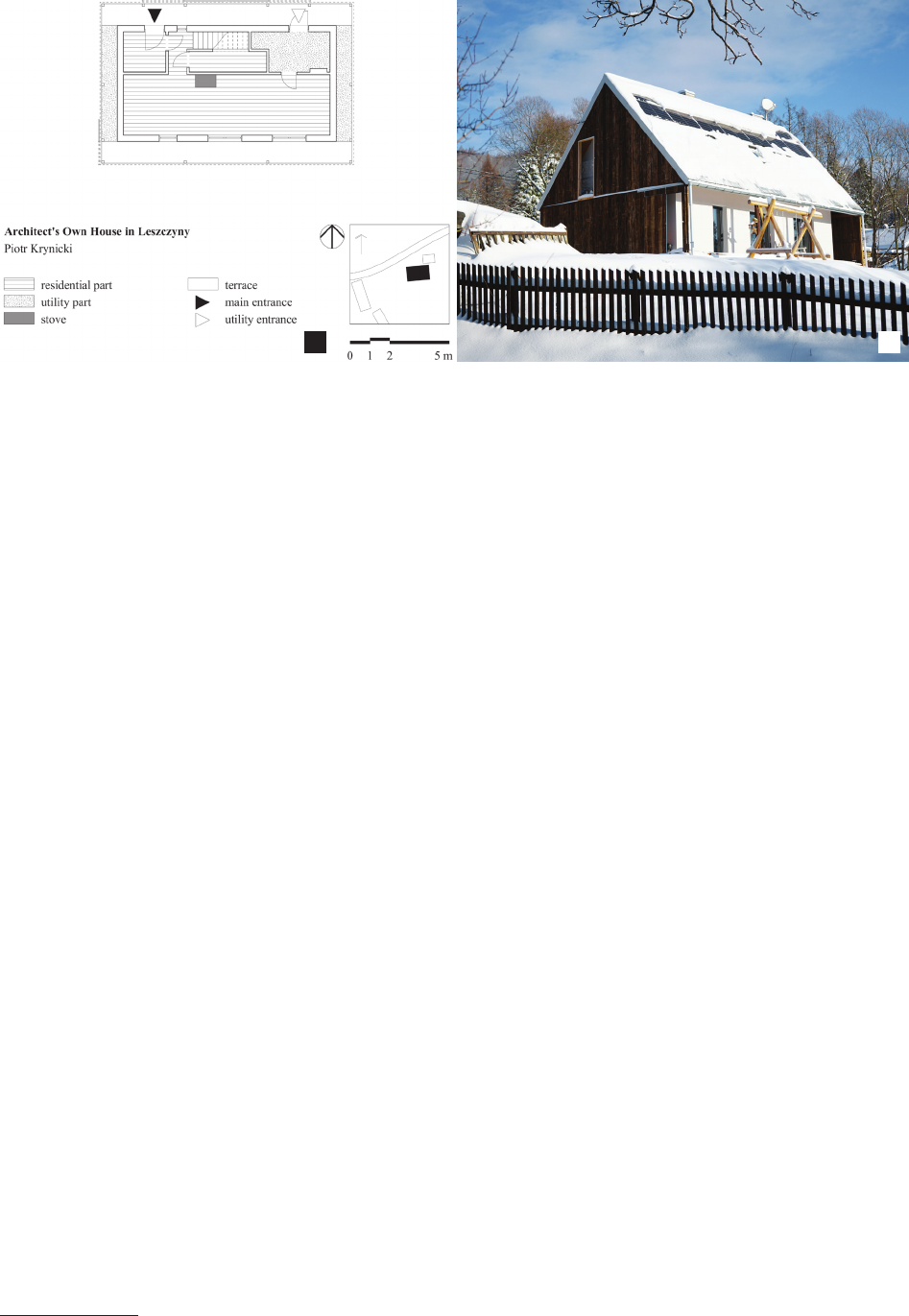
10 Dominika Cieplak
log-building tradition, in which natural timber was com-
bined with whitewashed joints. It constitutes a subtle evo-
cation of the aesthetic of the Lemko house, translated into
a modern architectural language.
The southern elevation is extensively glazed: three large
terrace windows open the interior towards the landscape
and provide daylight to the living area. On the northern
side, the entrance zone accommodates auxiliary rooms
and vertical circulation – a separate entrance to the utility
section is also provided. The living area is organised as an
open plan, where the kitchen, dining space, and living room
form a single spatial sequence, with a stove located at the
centre (Fig. 6).
Krynicki emphasised that a key intention of the project
was for the house to resonate with the village and its spatial
structure. The building was positioned at a point closing
a visual axis extending from the road, thereby becoming
a signicant landscape element within the local settlement
structure. Moreover, the designer is of Lemko origin, and
the Lemko language is used in the house in everyday life.
It is precisely this identity-based dimension – which, as the
architect himself noted, he considers sucient – that allows
the project to be regarded as a contemporary Lemko house.
In this sense, the design goes beyond formal references to
tradition, becoming an expression of cultural continuity and
of personal engagement in its contemporary persistence.
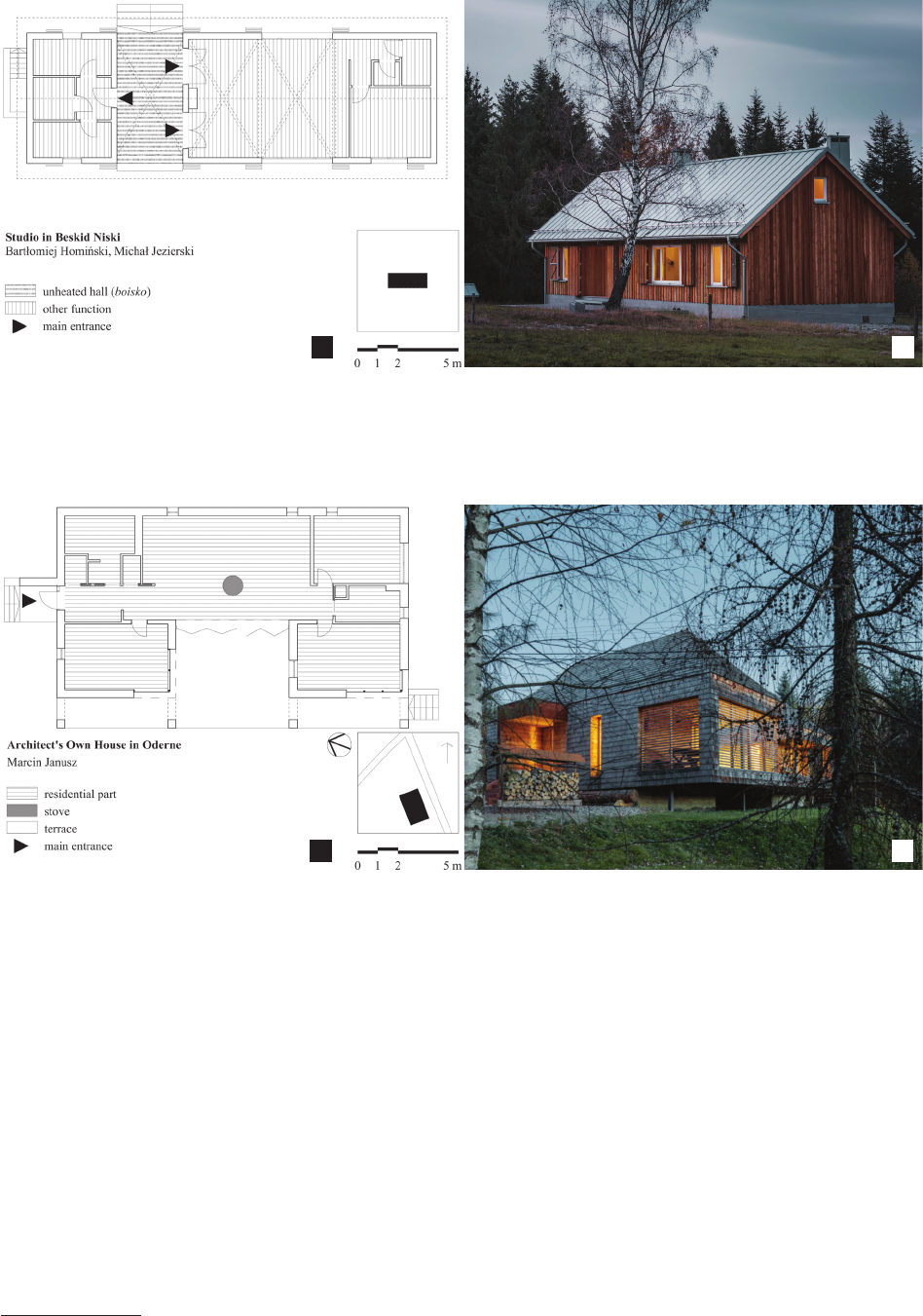
StudioinBeskidNiski
The studio project in the Beskid Niski by 9780 Architek-
ci
6
is composed of two building volumes connected by
a single roof and separated by an unheated entrance hall
(boisko). When the large shutters are closed, the building
appears as an almost windowless structure. Although the
6
Concept design and architectural and construction project: Bar-
tło miej Homiński, PhD Eng. Arch., and Michał Jezierski, MSc Eng.
Arch. (9780 Architekci). General contractor: BATPOL.
extensive glazing departs from the traditional Lemko house,
characterised by small windows, it responds to the needs of
contemporary users. Despite its formal inspiration drawn
from the Lemko chŷža, the building does not serve either
a residential or an agricultural function and instead, it is
conceived as a space dedicated to work.
Homiński emphasised that the site location had a deci-
sive inuence on the project, both in cultural and technical
terms. Dicult access to the plot, requiring the crossing
of a ford, determined the choice of timber as the primary
structural material due to its light weight and ease of trans-
port. The clay-rich, poorly permeable subsoil necessitated
raising the ground oor to protect the building from mois-
ture, a solution that recalls historical construction practices.
Due to the lack of precise locational data, it is not possible
to relate the building’s orientation to the traditional village
layout. The width-to-length ratio of the enclosed volume is
0.31, which corresponds more closely to eastern patterns of
Lemko architecture.
The selection of materials in the analysed building was
guided by criteria of durability and the reduction of main-
tenance requirements. The roof covering was made from
a single sheet of titanium–zinc metal, eliminating the risk
of leakage at joints. The eaves, with a projection of 75 cm,
were designed as part of a plain gabled roof without a gab-
let, a feature that distinguishes this project from both histor-
ical and contemporary interpretations of the Lemko house.
The façades are clad in untreated larch boards, whose sur-
faces undergo a natural patination process in accordance
with the design intent. The plinth and external paving were
executed in locally sourced sandstone, while the steel ele-
ments were left in their raw, galvanised nish, further mini-
mising the need for subsequent maintenance (Fig. 7).
The interior, like the external form, is characterised by
simplicity and functionality. The bright space, dominated by
timber, supports creative work, while large areas of glazing
open it towards the surrounding landscape. The design har-
moniously combines contemporary architectural language
Fig. 6. Architect’s own house in Leszczyny: a) plan and orientation of the building (elaborated by D. Cieplak),
b) contemporary view (photo by I. Iskra-Krynicka)
Il. 6. Dom własny w Leszczynach: a) rzut i usytuowanie domu (oprac. D. Cieplak), b) zdjęcie współczesne (fot. I. Iskra-Krynicka)
b
a
TheLemkohouse–architectureofforgottenidentity 11
with the principles of vernacular architecture, responding
to the current challenges of building in the Lemko Region.
Architect’sownhouseinOderne
The nal project discussed is the house designed by
Marcin Janusz
7
in the hamlet of Oderne (Одерне/Oderne),
located in the municipality of Uście Gorlickie in the Beskid
Niski region. The building represents a contemporary inter-
pretation of the traditional Lemko house. It retains the key
characteristics of vernacular architecture, reworked to meet
7
Concept design: Marcin Janusz, MSc Eng. Arch. Architectural
and construction project: Marcin Janusz, MSc Eng. Arch. (architecture);
Wolarek i Zatorowski (structural design). General contractors: Hażbud
Gorlice; El-Bud Gorlice; Dan-Ko.
the needs of contemporary users. The house serves a res-
idential function, with an unused attic and a large terrace
that opens the building towards the surrounding landscape
– an element absent from the traditional chŷža.
Its proportions (0.55) refer to those of smaller Lemko
houses. Originally conceived as an elongated rectangular
plan (0.25), the layout was ultimately formed into a U-shape,
allowing for the creation of an 80-square-metre internal ter-
race. The orientation of the gable towards the road recalls
the historical village layout (APP, AG, Dorf Uście Ruskie
in Galizien Jasloer Kreis, ref. no. 56/126/0/-/1725M). Al-
though the façades are clad in timber, they do not reproduce
the traditional log construction, and the roof, with a 45°
pitch, lacks the characteristic eaves. A reference to tradition
is provided by the use of wooden shingles – not only on the
roof but also on the façades (Fig. 8).
Fig. 7. Studio in Beskid Niski: a) plan and orientation of the building (elaborated by D. Cieplak),
b) contemporary view (photo by B. Kutniowski)
Il. 7. Pracownia w Beskidzie Niskim: a) rzut i usytuowanie pracowni (oprac. D. Cieplak), b) zdjęcie współczesne (fot. B. Kutniowski)
a b
Fig. 8. Architect’s own house in Oderne: a) plan and orientation of the house (elaborated by D. Cieplak),
b) contemporary view (photo by M. Grabowiecki, E. Mrozińska)
Il. 8. Dom własny w Odernem: a) rzut i usytuowanie domu (oprac. D. Cieplak),
b) zdjęcie współczesne (fot. M. Grabowiecki, E. Mrozińska)
a b

12 Dominika Cieplak
The central element of the interior is a replace, refer-
encing the traditional stove located in the main living room.
These adaptations highlight an eort to integrate regional
patterns with contemporary architectural solutions. While
this project departs most markedly in its form from the tra-
ditional Lemko chŷža, it remains consistent with the prin-
ciples of regional architecture through the use of natural
materials and its harmonious relationship with the Lemko
landscape.
Discussion
The analysis of contemporary projects inspired by the tra-
ditional Lemko house reveals a range of design approaches
that combine elements of the region’s architectural heritage
with the requirements of contemporary construction. The
table below (see Table 1) presents 23 features characteristic
of traditional Lemko houses and examines their presence
(“+”), absence (“−”) or partial/modied occurrence (“±”) in
Table 1. Comparison of the characteristics of the traditional Lemko chŷža and the degree of their presence in contemporary projects
(elaborated by D. Cieplak)
Tabela 1. Zestawienie cech tradycyjnej chyży łemkowskiej oraz stopnia ich obecności we współczesnych realizacjach
(oprac. D. Cieplak)
Analysed architectural features
Nowica
(1)
Uście
Gorlickie
(2)
Leszczyny
(3)
Beskid
Niski
(4)
Oderne
(5)
Location in the Lemko Region + + + + +
Residential function + + + – +
Separate utility function + + + – –
Residential function limited to the ground floor – – – – +
Orientation consistent with the archetypal village layout – – + – +
In situ location on the site of former buildings – – + – –
Unheated entrance hall (boisko) – + – + –
Timber construction + + – + +
Log construction + – – – –
Raised ground floor + + + + +
Stone foundation – – + + +
Elongated rectangular form (width/length = 0.3–0.6) + + ± + ±
Gable roof + + + + –
Roof covered with thatch or wooden shingles – – – – +
Roof with extended eaves + + + + –
Gablet roof (przyczółek) + + – – –
Side canopy (zachata) or porch (priczyna) – – + – –
Small windows – – – – –
Divided window glazing – – – – –
Decorative detailing around doors or windows – – – – –
Centrally located stove + + + ± ±
Wooden or clay interior + + + + +
Clay floor in the residential part – + – – –
Legend: (+) – feature present, (−) – feature absent, (±) – feature partially present or occurring in a modified form.
TheLemkohouse–architectureofforgottenidentity 13
ve selected case studies: Nowica (1), Uście Gorlickie (2),
Leszczyny (3), Beskid Niski (4) and Oderne (5).
The analysis reveals several distinct trends. All of the
contemporary projects discussed above are located within
the territory of the historical Lemko region, and the ma-
jority serve a residential function (1, 2, 3, 5), indicating
continuity in the original role of the chŷža. In many cas-
es, the separate utility section has been omitted (4, 5), al-
though in some projects it has been retained – in Nowica
and Uście Gorlickie – while in Leszczyny it takes the form
of a contemporary reinterpretation of the so-called zachata
and priczyna. In all of the analysed houses, the residential
function extends across both the ground oor and a usable
attic, with the exception of the house in Oderne, where it is
limited to the ground oor.
Orientation in relation to the traditional village layout
was preserved in only two cases (3, 5), while the remaining
projects (1, 2, 4) were located at a distance from the com-
pact settlement structure, often on plots of a recreational or
residential character. The house in Leszczyny is the only
one among the analysed examples that was built on the site
of a former chŷža.
From a constructional perspective, timber buildings pre-
dominate, however, log construction was employed only in
the Nowica project. The remaining examples are based on
timber-frame or hybrid structural systems. All of the houses
feature a raised ground oor, referencing solutions histor-
ically used in the region in response to high ground mois-
ture. Stone foundations are present in the buildings in
Od-
erne, Leszczyny, as well as in the studio in the Beskid Nis ki,
recalling the traditional foundations of Lemko houses.
The massing of each house is based on an elongated
rectangular plan, with width-to-length proportions ranging
from 0.3 to 0.6. An exceptional case is the project in Od-
erne, where the unusually long volume was articulated into
a U-shaped form, altering its proportions towards those
more closely associated with western architectural models.
Gable roofs are present in most of the analysed examples
(1, 2, 3, 4), although their material nishes vary. Traditional
wooden shingles were used only in Oderne, while in the re-
maining cases – metal roong (2, 3, 4) already encountered
prior to the post-war displacements – or Eternit sheets (1),
recalling the appearance of post-war altered Lemko houses,
were applied. Protruding eaves appear in four projects (1,
2, 3, 4), whereas the traditional gablet is present only in the
buildings in Uście Gorlickie and Nowica.
The interiors of the houses dier markedly from tradi-
tional examples in terms of daylighting. All of the analysed
projects abandon small windows in favour of large areas of
glazing, responding to contemporary expectations regarding
daylight and openness to the landscape. In two cases (3, 4),
sliding or operable shutters were employed, allowing the
large, glazed openings to be closed, which constitutes a mod-
ern reinterpretation of earlier practices aimed at protecting
interiors from cold and excessive light. Traditional window
glazing subdivisions were not retained in any of the build-
ings, nor were decorative details around doors and windows,
which have disappeared entirely from contemporary design.
The stove, as a key element of the Lemko house, appears
in the majority of the analysed projects: as a clay stove in
Uście Gorlickie, a stove with seating in Nowica, a replace
in Oderne, and a kitchen stove in Leszczyny. Its location
at the centre of the living area indicates the preservation of
its integrative and symbolic role. Interior nishes are most
often executed using natural materials, primarily timber
and clay, representing a continuation of traditional nishing
techniques.
From an identity-related perspective, the house in Lesz-
czyny stands out most clearly. Its designer is of Lemko ori-
gin, uses the Lemko language in everyday life, and regards
the building itself as a contemporary manifestation of a Lem-
ko house. In the remaining cases, cultural references are pri-
marily formal, structural, or landscape-based in character.
Conclusions
Contemporary projects inspired by the Lemko house de -
monstrate that the house is no longer merely a material
struc ture, but also a carrier of cultural, emotional, and iden-
tity-related meanings. In the examined examples, tra dition
is neither uncritically preserved nor entirely aban doned – in -
stead, it becomes the subject of conscious transformation,
a dialogue with the past, and a response to contemporary
needs. Architecture thus functions as a mediator between
memory and modernity, while the boundary between recon-
struction and reinterpretation becomes increasingly blurred.
The Lemko house in its contemporary interpretation is
not a closed category but assumes diverse forms depending
on the intentions of designers and inhabitants. For some,
its Lemko character resides in language, ritual, and family
narrative, for others, in the deliberate use of forms, pro-
portions, or materials rooted in local tradition. Regardless
of the strategy adopted, each of the analysed projects rep-
resents an attempt to renew the relationship with heritage
– both through its presence and through its transformation.
In light of the analysis conducted, the following deni-
tion may be proposed: a contemporary Lemko house is
a residential space rooted in the cultural context of the Lem -
ko Region, in which tradition and identity are articulated
through both architectural form and social, symbolic, and
linguistic relationships. It may assume diverse forms – from
material reinterpretations of the chŷža archetype to imma-
terial acts of cultural continuity – yet it invariably refers to
Lemko identity through its relationship with place, memo-
ry, and community.
The conclusions presented open up a broad research per-
spective, indicating the potential applicability of the adopted
methodology – combining an analysis of the house arche-
type, its symbolic meanings, and contemporary reinterpre-
tations – to other minority, ethnic, and refugee groups. Such
an approach makes it feasible to capture both the diverse
denitions of home within particular communities and the
role of contemporary architecture in processes of identity
reconstruction and the sustaining of cultural heritage.
In the Lemko context, this line of inquiry will be contin-
ued through research planned in Lower Silesia – a region
of post-war settlement for a signicant part of the Lemko
community. An analysis of this area will allow for an exam-
ination of the phenomenon of the “house in exile” and an as-
sessment of the extent to which elements of the Carpathian
14 Dominika Cieplak
Streszczenie
Łemkowski dom – architektura zapomnianej tożsamości.
Tradycyjna chyża, jej współczesne reinterpretacje oraz rola architektów w transmisji dziedzictwa Łemków
W artykule podjęto problem redenicji łemkowskiego domu w kontekście powojennych wysiedleń oraz współczesnych prób nawiązywania do tra-
dycyjnej architektury regionu. Dom rozumiany jest tu jako przestrzeń głęboko zakorzeniona w tożsamości kulturowej, rodzinnej i emocjonalnej, której
znaczenie w społeczności łemkowskiej uległo istotnym przekształceniom po drugiej wojnie światowej. Szczególna uwaga poświęcona została pojęciu
chyży – archetypu budownictwa mieszkalnego Łemków – oraz jego współczesnym reinterpretacjom w architekturze jednorodzinnej.
Celem autorki była identykacja cech konstytutywnych dla współczesnego domu łemkowskiego oraz rozpoznanie sposobów, w jakie architektura może
pośredniczyć w transmisji dziedzictwa. W analizie uwzględniono zarówno aspekty materialne (forma, proporcje, detale, materiały), jak i niematerialne
(język, tradycje, relacje z otoczeniem), ukazując napięcie między wiernością tradycji a adaptacją do współczesnych potrzeb mieszkańców. Podstawą opra-
cowania były wywiady z przedstawicielami społeczności łemkowskiej oraz z architektami projektującymi budynki inspirowane łemkowskim archetypem.
Zarysowane w artykule strategie projektowe rozpięte są między zachowaniem wybranych cech tradycyjnych a ich świadomym przekształceniem.
Podkreślona została także rola języka, pamięci i krajobrazu jako współtworzących sens domu. W rezultacie zaproponowana została denicja współcze-
snego domu łemkowskiego jako przestrzeni kulturowej ciągłości – osadzonej w regionie, lecz otwartej i dynamicznej, w której tradycja realizuje się nie
tylko poprzez formę architektoniczną, ale także poprzez trwanie wspólnoty, języka i kultury.
Słowa kluczowe: dziedzictwo architektoniczne, dom łemkowski, chyża, Łemkowie/Rusini, architektura mniejszości
archetype have been transferred, as well as how contempo-
rary projects engage with Lemko tradition when confronted
with the local, complex cultural context of Lower Silesia,
shaped by both pre-war heritage and post-war migrations.
These studies also have an applied dimension, as they may
provide a basis for formulating planning and design guide-
lines for rural areas inhabited by Lemkos. Understanding
contemporary strategies for reinterpreting tradition makes
it possible to identify architectural characteristics that not
only integrate into the cultural landscape but also support
processes of reconstruction and revitalisation of Lemko spa-
tial identity.
References
Archiwum Państwowe w Przemyślu [APP]. Archiwum Geodezyjne [AG],
ref. no. 56/126/0/-/0897M. Dorf Nowica in Galizien Jasloer Kreis,
1850. Accessed June 2, 2025, at https://www.szukajwarchiwach.gov.
pl/en/jednostka/-/jednostka/18051042.
Archiwum Państwowe w Przemyślu [APP]. Archiwum Geodezyjne [AG],
ref. no. 56/126/0/-/1725M. Dorf Uście Ruskie in Galizien Jasloer
Kreis, 1850. Accessed June 2, 2025, at https://www.szukajwarchiwach.
gov.pl/en/jednostka/-/jednostka/18051595.
Bartmiński, Jerzy. “Dom i świat – opozycja i komplementarność.” Post
scriptumPolonistyczne 1, no. 1 (2008): 55–68.
Easthope, Hazel. “A Place Called Home.” Housing,TheoryandSociety 21,
no. 3 (2004): 128–38. https://doi.org/10.1080/14036090410021360.
Falkowski, Jan, and Bazyli Pasznycki. Napograniczułemkowskoboj
kowskiem:zarysetnograczny. Towarzystwo Ludoznawcze, 1935.
Gatkowska, Izabela. “Dom w empirycznych sieciach leksykalnych.” Et
nolingwistyka.ProblemyJęzykaiKultury 28 (2016): 117–35. https://
doi.org/10.17951/et.2016.28.117.
Gosztyła, Marek, and Agata Mikrut. “Badania budownictwa ludowego na
wybranych przykładach historycznych miejscowości łemkowskich.”
CzasopismoInżynieriiLądowej,ŚrodowiskaiArchitektury 34, no. 64
(2017a): 205–12. https://doi.org/10.7862/rb.2017.206.
Gosztyła, Marek, and Agata Mikrut. “Wyniki badań przeprowadzonych
na wybranych planach łemkowskich chyż.” Czasopismo Inżynierii
Lądowej, Środowiska i Architektury 34, no. 64 (2017b): 39–48.
https://doi.org/10.7862/rb.2017.228.
Heidegger, Martin. Budować,mieszkać,myśleć.Esejewybrane. Czytelnik,
1970.
Kalbarczyk, Tomasz. “Powrót Łemków.” Biuletyn IPN 5, no. 1–2 (2005):
64–76.
Kępa, Elżbieta. “Urządzenie wnętrza mieszkalnego na Łemkowszczyźnie
w XIX i XX w.” MateriałyMuzeumBudownictwaLudowegowSa
noku, no. 13 (1971), 21–32.
Koprowski, Marek A. Łemkowie:losyzaginionegonarodu. Wydawnictwo
Replika, 2016.
Kubacka, Małgorzata. “Dom jako miejsce emocjonalne.” KulturaiSpo
łeczeństwo 62, no. 3 (2018): 191–208. https://doi.org/10.35757/KiS.
2018.62.3.10.
Misiak, Małgorzata. “Językowy obraz DOMU w etnolekcie łemkowskim.
Analiza danych słownikowych.” SlavisticaVilnensis 60 (2015): 61–73.
https://doi.org/10.15388/SlavViln.2015.60.9931.
Niebrzegowska-Bartmińska, Stanisława. “Jakie dane są relewantne etno-
lingwistycznie?” Etnolingwistyka. Problemy Języka i Kultury 29
(2017): 11–29. https://doi.org/10.17951/et.2017.29.11.
Ostrowińska, Anna. “U Rusinów przed półwieczem.” Magury 86 (1986):
122–26.
Pieradzka, Krystyna. Na szlakach Łemkowszczyzny. Komitet do Spraw
Szla chty Zagrodowej na Wschodzie Polski przy Towarzystwie Roz-
wo ju Ziem Wschodnich, 1939.
Priadka, Andrzej. Łemkowskaodyseja.
Andrzej Priadka
, 2005.
Prokopek, Marian. Etnograa:materialna kulturaludowaPolski natle
porównawczym. Państwowe Wydawnictwo Naukowe, 2019.
Reinfuss, Roman. Łemkowie:opisetnograczny. W.L. Anczyc i Spółka, 1936.
Reinfuss, Roman. “Próba charakterystyki etnogracznej Rusi Szlach tow-
skiej na podstawie niektórych elementów kultury materialnej.” Lud
37 (1946): 160–235.
Reinfuss, Roman. ŚladamiŁemków. PTTK Kraj, 1990.
Sitek, Wojciech, ed. Mniejszośćwwarunkachzagrożenia:pamiętnikiŁem
ków. Wydawnictwo Uniwersytetu Wrocławskiego, 1996.
Smoczkiewicz, Leszek. “Budownictwo Łemków zachodnich (analiza
kon strukcji wybranych obiektów).” MateriałyMuzeumBudownictwa
LudowegowSanoku 7 (1968): 5–14.
Ślusarczyk, Magdalena, and Paula Pustułka. “Transnarodowość w prze-
strzeni domowej polskich rodzin migracyjnych w Norwegii.” Studia
HumanistyczneAGH 16, no. 1 (2017): 23–37. https://doi.org/10.7494/
human.2017.16.1.23.
Tłoczek, Ignacy. Dom mieszkalny na polskiej wsi. Państwowe Wy daw-
nictwo Naukowe, 1985.
Udziela, Seweryn. Ziemiałemkowskaprzedpółwieczem:zapiskiiwspom
nieniazlat1888–1893. Towarzystwo Ludoznawcze, 1934.
Watral, Marta. “Czy Łemkowie mają ojczyznę poza Łemkowyną? Li te rac kie
al ternatywne modele ojczyzny w literaturze łemkow s kiej.” LitterariaCo
pernicana 30, no. 2 (2019): 51–63. https://doi.org/10.12775/LC.2019.019.
Wilk, Anna. Łemkowie:międzyintegracjąarozproszeniem(1918–1989).
Neriton, 2019.
