
Wojciech Brzezowski*
Ślązacy a teoria sztuki ogrodniczej od XVI do XVIII w. w świetle
zbiorów Biblioteki Uniwersyteckiej we Wrocławiu
The Silesians and theories of garden art from the 16
th
to the 18
th
century
with new research from the Wrocław University Library collection
2013
1(33)
Autor jednego z XVIII-wiecznych traktatów Julius
Bernhard von Rohr stwierdził lakonicznie: Was ein
Garten sey ist jedermann bekandt... [22, s. 759]. Wbrew
temu sądowi nasza wiedza o dawnych ogrodach jest częs-
to niezwykle skromna. Ulegały one nie tylko przeobraże-
niom, czy wręcz unicestwieniu w wyniku zmiany gustów,
ale padały także ofiarą zawieruch dziejowych lub po pro-
stu zaniedbania.
Stan ten jest szczególnie dotkliwy w przypadku Śląska,
gdzie nie przetrwało żadne założenie ogrodowe sprzed
XIX w., a równocześnie przekazy ikonograficzne, głów-
nie rysunki Friedricha Bernharda Wernera, dają świadec-
two wspaniałego stanu ogrodów śląskich w wieku XVIII
1
.
Ważnym uzupełnieniem tych przekazów, dających wyob-
rażenie o kształcie śląskich ogrodów, może być próba
okreś lenia stanu wiedzy ich twórców – zarówno inwesto-
rów, jak i wykonawców.
Wiadomości o sposobach tworzenia ogrodów zyskiwa-
no niewątpliwie podczas podróży i osobistych kontaktów,
*
Wydział Architektury Politechniki Wrocławskiej
/
Faculty of Archi-
tec ture, Wrocław University of Technology.
1
Rysunki umieszczone w manuskryptach opisujących Śląsk,
przecho wywanych w zbiorach Biblioteki Uniwersyteckiej we Wrocławiu
oraz Ge heimes Staatsarchiv Berlin-Dahlem. Werner Johann Bernhard,
Topo graphia oder Prodromus delineati Silesiae Ducatus, rkps, Biblioteka
Uniwersytecka we Wrocławiu; Werner Johann Bern hard, Topographia oder
Prodromus Silesiae, t. 3, rkps, Geheimes Staatsarchiv Berlin-Dahlem, sign.
XVII HA Nr 526, Werner Johann Bernhard, Topographia seu Compendium
Silesiae, rkps, Biblioteka Uniwersytecka we Wrocławiu, sygn. IV F 113b.
Julius Bernhard von Rohr, the author of an 18
th
century
gardening treatise, laconically states: Was ein Garten sey
ist jedermann bekandt... [22, p. 759]. However, in contra-
diction to this opinion, our present-day knowledge of
early gardens is quite limited. Gardens not only under-
went transformations or outright annihilation as a result of
changes in taste over the years, but also became the vic-
tims of history’s turmoil, or simply of negligence.
This situation is especially severe in the case of Silesia,
where no garden foundations preceding the 19
th
century
have survived. However, some iconographic works,
mainly the drawings of Friedrich Bernhard Werner, testify
to the magnificent condition of Silesian gardens in the
18
th
century
1
. An important supplement to this informa-
tion is for researchers to imagine the form of Silesian
gardens, which could act as an attempt to determine the
state of knowledge of the gardens’ creators; both of their
investors and executors.
1
The drawings are inserted in Werner’s manuscripts describing
Silesia, which are in the Wrocław University Library collection and in
Geheimes Staatsarchiv Berlin-Dahlem. Werner Johann Bernhard, Topo-
graphia oder Prodromus delineati Silesiae Ducatus, MS, University
Library in Wrocław (Biblioteka Uniwersytecka we Wrocławiu). Werner
Johann Bernhard, Topographia oder Prodromus Silesiae. Vol. 3, MS,
Geheimes Staatsarchiv Berlin-Dahlem, sign. XVII HA No. 526. Werner
Johann Bernhard, Topographia seu Compendium Silesiae, MS,
University Library in Wrocław (Biblioteka Uniwersytecka we Wroc-
ławiu), sign. IV F 113b.
DOI: 10.5277/arc130101

4 Wojciech Brzezowski
Knowledge on the methods used to create gardens was
undoubtedly acquired during travels, by personal con-
tacts, and from correspondence. As early as the 16
th
cen-
tury, the inhabitants of Wrocław possessed enthusiastic
contacts bound not only with botanical interests, but also
with an interest in garden art. An example of these con-
tacts, were the relations of Lau rentius Scholtz from
Wrocław, who was the owner and creator of a well-known
Renaissance garden. Scholtz had excellent contacts with
the intellectual élite of Europe [19, pp. 98–142].
Relations with a wide network of contacts also exis ted
at a later period. Paolo Boccone, the famous botanist, not
only corresponded with Christian Tralles, a medic
from
Wrocław, but with the Mayor, Johann Sigismund von
Haunold. Boccone not only sent him his own herbarium,
but also visited Wrocław in person in 1694 [27, p. 78].
Several Silesians were noticeably active abroad. One
of them was the author of a very popular and often repro-
duced publication of calendars, Johannes Colerus, who
was born near Złotoryja. On the title pages of his works,
Colerus describes himself as a berlinense but also as
Aureo montanus Silesius
2
. In a similar fashion, Melchior
Sebisch, who translated the works of Charles Estienne,
proudly presents himself on his title pages as Melchiore
Sebizio Silezio. Israel Volckmann from Legnica also
belonged to this group. His son, Georg Anton, who was
also connected to Legnica, later continued and published
the work of his father Phytologia magna.
These personal contacts only refer to quite a small
group of Silesians. Books had a much wider influence on
the level of knowledge connected with garden art, or
more generally, with agronomy.
A fairly large collection of works which were devoted
to agronomy, botany and garden art were published in the
16
th
, 17
th
and 18
th
centuries. These works can be found in
the Wrocław University Library, where after 1945, most
of the old prints from the Silesian libraries were assem-
bled. Property marks within these old prints suggest that
most of treatises were used in Silesia at that time, as they
originated from the collections of former Wrocław lib-
raries, or from Silesian monastic libraries. Interestingly,
there are also books in the collection which belonged to
private collectors. Despite the tragic consequences of
World War II with regard to many former collections, the
collection of books found in the former Wrocław libraries
is a fairly large one, and was probably originally even
larger. Of course, not all of the works that can be found in
the library at present come from Silesia. Some of them are
later antiquary acquisitions, as for instance Hortus
Palatinus, an attractive volume of Salomon de Caus [5].
In order to decipher some of the property marks, signa-
tures and certain other information which should be able
to reveal the history and the origin of particular co pies,
2
Johann Cöler (Colerus) born before end of 16
th
century in Silesia,
died in 1639. He lived in Rostock, later as a preacher in Mark
Brandenburg [1, pp. 402–404]. His first adviser Oeconomia oder
Hausbuch [...] appeared in 1539. Later modified editions appeared with
varied titles such as: Liber quodlibeticus and Calendarium perpetuum.
a także dzięki korespondencji. Już w XVI w. wrocławianie
utrzymywali ożywione kontakty wiążące się z zaintereso-
waniami nie tylko botanicznymi, ale także dotyczą cymi
sztuki ogrodowej. Przykładem mogą być związki wroc-
ławianina Laurentiusa Scholtza, właściciela i twór cy zna-
nego renesansowego ogrodu, z elitą intelektualną Eu ro py
[19, s. 98–142].
Związki takie istniały także w okresie póź-
niejszym. Słynny botanik Paolo Boccone nie tylko wymie-
niał korespondencję z wrocławskim medykiem Chris tia-
nem Trallesem i burmistrzem Jo hannem Sigis mundem von
Haunoldem, przesyłając temu ostat niemu swój zielnik,
ale także sam odwiedził Wrocław w 1694 r. [27, s. 78].
Kilku Ślązaków udzielało się też poza swą ojczyzną.
Należał do nich urodzony we Wrocławiu w 1634 r., a dzia-
łający
później w Lipsku botanik Paul Amman. Urodzony
pod Złotoryją Johannes Colerus, autor niezwykle popu-
larnych i wielokrotnie wznawianych kalendarzy, określał
się na stronach tytułowych swych dzieł nie tylko jako ber-
linense, ale także jako Aureomontanus Silesius
2
, podobnie
jak Melchior Sebisch, tłumacz dzieł Charles’a Estienne’a,
przedstawiał się dumnie na stronach tytułowych jako
Melchiore Sebizio Silesio. Do grona Ślązaków należał
także urodzony w Mikołajowicach pod Legnicą i potem
mieszkający w Legnicy Israel Volckmann. Z Legnicą
związany był też jego syn Georg Anton, który kontynuo-
wał i wydał drukiem dzieło ojca Phytologia magna.
Te osobiste kontakty dotyczyły jednak dość wąskiej
grupy Ślązaków. Znacznie większy wpływ na poziom ich
wiedzy związanej ze sztuką ogrodową, czy ogólniej
z agronomią, miały książki.
W Bibliotece Uniwersyteckiej we Wrocławiu, gdzie po
1945 r. skupiono większość starodruków z dawnych ślą-
skich bibliotek, znajduje się pokaźny, bo liczący okoł
o stu
pozycji zbiór dzieł poświęconych agronomii, botanice
i sztuce ogrodowej wydawanych w XVI, XVII i XVIII w.
Znaki własnościowe wskazują, że znaczna ich część była
w tym czasie w użyciu na Śląsku, pochodzą one bowiem
ze zbiorów dawnych bibliotek wrocławskich czy śląskich
bibliotek klasztornych, ale nie brakuje także takich, któ-
rych właścicielami były osoby prywatne. Biorąc pod
uwagę tragiczne dla wielu dawnych kolekcji następstwa
ostatniej wojny, jest to zbiór dość spory, a pierwotnie
mógł być znacznie większy. Oczywiście nie wszystkie
znajdujące się obecnie w bibliotece pozycje pochodzą
ze Śląska, część to późniejsze nabytki antykwaryczne, jak
na przykład efektowny tom Hortus Palatinus Salomona
de Causa [5]. Rozszyfrowanie niektórych wpisów włas-
noś cio wych, sygnatur i innych informacji, które mogłyby
precyzyjnie wyjaśnić dzieje i proweniencję poszczegól-
nych egzemplarzy, wymaga jeszcze badań, ale w wielu
wy padkach już obecnie mamy pewność, że były one
w użyciu na Śląsku niedługo po ich opublikowaniu.
2
Johann Cöler (Colerus) ur. przed końcem XVI w. na Śląsku, zm.
w 1639 r. Mieszkał w Rostocku, później jako kaznodzieja w Marchii
Brandenburskiej [1, s. 402–404]. Jego pierwszy poradnik zatytułowany
Oeconomia oder Hausbuch [...] ukazał się w 1539 r. Późniejsze mody-
fikowane edycje wydawane były pod różnymi tytułami jako Liber
quodlibeticus i Calendarium perpetuum.
Ślązacy a teoria sztuki ogrodniczej / The Silesians and theories of garden art 5
Wśród pierwotnych właścicieli występują między
in nymi wrocławskie klasztory: franciszkanów przy koś-
ciele św. Doroty, kanoników regularnych na Piasku, klasz-
tor cystersów w Lubiążu (il. 1), a także osoby prywatne,
jak na przykład kłodzki mieszczanin Leopold Junk, do
którego należał egzemplarz dzieła Da niela Rhagora
Erneuerter Pflantz-Garten [21], czy jeden z członków
osiadłego na Śląsku rodu von Hund najwyraźniej kolek-
cjonujący książki poświęcone sztuce ogrodniczej, o czym
świadczą okładki Nürnbergische Hesperides Volkamera
[30] oraz Instruction pour les jardins fruitiers et potagers
Jeana-Baptiste’a de la Quintinye, opatrzone herbem tej
rodziny [20].
W większości są to prace pisane po niemiecku albo na
ten język tłumaczone, ale nie brakuje też traktatów po
łacinie, a także dzieł włoskich i francuskich. Dla przykła-
du, jest traktat o agronomii Pietra de Crescenziego wyda-
ny w Bazylei w 1538 r. po łacinie [8], ale są także dwa
egzemplarze włoskojęzyczne opublikowane w Wene cji
w 1542 r. i we Florencji w 1605 r. Na Śląsku czytany był
też traktat Cassianusa Bassusa De re rustica, a jego nie-
miecki przekład zatytułowany Der Veldtbaw znajduje się
w zbio rach Biblioteki [3].
Sądząc po liczbie zachowanych egzemplarzy, dużą
popularnością cieszyły się dzieła Johanna Colerusa, nale-
żące publikacji określanych jako Hausvaterliteratur.
Wielokrotnie wznawiana Oeconomia ruralis et domesti-
ca [...] repre zentowana jest dziesięcioma tomami, a nie
mniej popularne Calendarium perpetuum to pięć egzem-
plarzy, w tym jeden opatrzony wpisem własnościowym
wroc ławskiego klasztoru franciszkanów przy kościele
św. Doroty [6].
O zawartości tego typu dzieł dobitnie informuje tytuł
jednego z poradników: Oeconomia ruralis et domesti-
ca to jest bardzo użyteczna domowa księga i krótkie opi-
sanie prowadzenia domu, uprawy winnicy, zbóż, kwiatów.
Jak też hodowli ptactwa dzikiego i domowego, bydła,
rybołówstwa, i ponadto zarządzanie dobrze prowadzo-
nego gospodarstwa mleczarskiego, i tego co do ogólnej
wiedzy o rolnictwie i prowadzeniu domu jest użyteczne
[...] prócz tego, jak nie tylko ludziom, bydłu, ogrodowi
kwiatowemu i roślinom uprawnym tanim kosztem i z po -
mocą bożą można pomóc. Znaleźć tam można również
po rady aptekarskie, przepisy kulinarne, wskazówki, jak
wykonać lampę czy łapać pchły, a także metody farbowa-
nia włosów oraz jak za pomocą witriolu, saletry, salmia-
ku i sadzy oblicze tak czarnym jak u murzyna uczynić [7,
s. 721].
Poradniki Colerusa miały wiele wydań za jego życia.
Co więcej, publikowano je i modyfikowano jeszcze dość
długo po jego śmierci, ale wówczas w odróżnieniu od
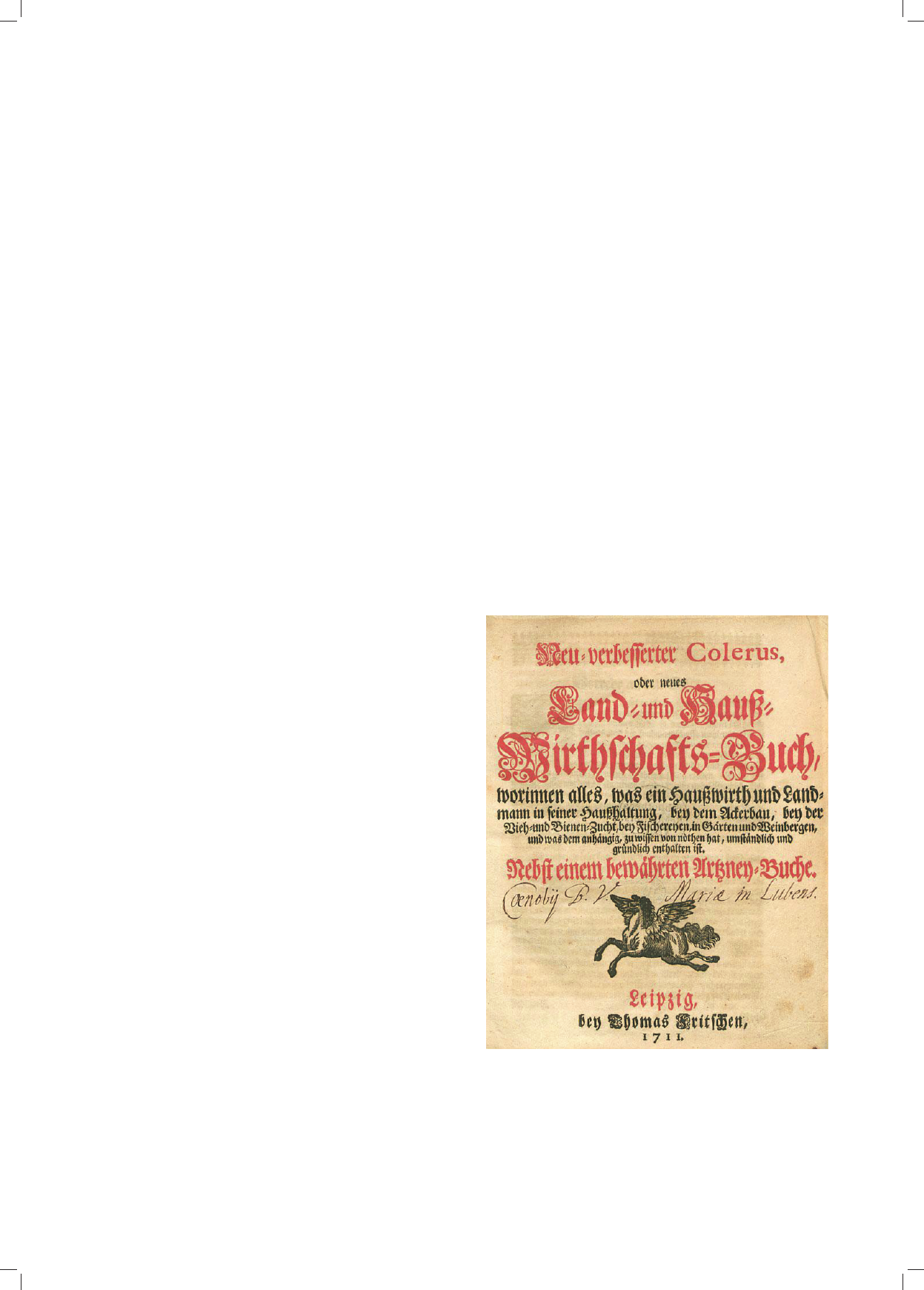
oryginałów opatrywane były tytułem Nowy Colerus. Taki
właśnie egzemplarz pochodzi z biblioteki cysterskiego
klasztoru w Lubiążu [18].
W zbiorach dwóch śląskich klasztorów: w Lubiążu
i we wrocławskim klasztorze kanoników regularnych na
Piasku znajdowało się dzieło Christopha Fischera
Fleissiges Herren-Auge [...] [10].
Popularne były także zielniki. Jedną z najwcześniej-
szych publikacji, z której Ślązacy mogli dowiedzieć się
these books still demand further investigation. However, in
numerous cases, we are now certain that this miscella-
neous information was used in Silesia not long after the
publications.
Some Wrocław monasteries are among the original
owners: the Franciscans from the church of St. Dorothy,
the Canons Regular from St. Mary on the Sand, the
Bernardines, the Cistercian monastery in Lubiąż (Fig. 1),
and also private persons as, for example, Georg Leopold
Junk, a burgher from Kłodzko, to whom the Erneuerter
Pflantz-Garten the work of Daniel Rhagor, belonged [21].
In addition to this, a member of the von Hund family who
was at the time living in Silesia, evidently collected works
devoted to garden art. This is evidenced by the covers of
Nürnbergische Hesperides of Volkamer [30] and Instruc-
tion pour les jardins fruitiers et potagers of Jean-Baptiste
de la Quintinye [20], which are both decorated with the
coat of arms of the von Hund family.
Most of these works were written in German, or they
were translated into this language but were originally
treatises written in Latin, Italian and French. For example,
a treatise on agronomy by Pietro de Crescenzi was pub-
lished in Latin in 1538 in Basel [8]. There are also two
examples in Italian of the same text, one published in
Venice in 1542, the other published in Florence in 1605.
Il. 1. Strona tytułowa poradnika Neu-verbesserte Colerus
z inskrypcją własnościową klasztoru w Lubiążu
(Biblioteka Uniwersytecka we Wrocławiu,
Oddział Starych Druków, sygn. 902298)
Fig. 1. Title page of Neu-verbesserter Colerus
with property inscription of Lubiąż monastery
(University Library in Wrocław,
Old Prints Department, signature 902298)

6 Wojciech Brzezowski
The treatise of Cassianus Bassus called De re rustica was
also read in Silesia and its German translation, entitled
Der Veldtbaw, is now in the Library collection [3].
One can judge by the number of surviving examples of
these works, that the texts by Johann Colerus were ex -
tremely popular. They were bound with publications
de fined as Hausvaterliteratur. Colerus’ Oeconomia rura-
lis was reprinted many times and is represented by ten
volumes. The Calendarium perpetuum was seemingly no
less popular, evidenced by the fact that we are now aware
of five remaining examples. There are volumes with
a pro perty inscription of the Wrocław Franciscan monas-
tery by the church of St. Dorothy, Canons Regular on the
Sand, and Mathias hospital. The title of one of the guides
gives distinct information on the contents of this type
of work:
Oeconomia ruralis et domestica is a very useful book
in the house and a short description on how to run
a house, cultivate a vineyard, corn and flowers [...] also
how to rear wild and domestic birds, cattle, fishing, and
also manage a well-planned milk farm as well as all that
is necessary in the general knowledge on agriculture and
running a house. As well as on how, with small cost and
the help of God, aid not only people but also cattle, the
flower garden and plant tillage.
It is also possible to find pharmaceutical advice, cook-
ing recipes, advice on how to construct a lamp or catch
fleas, and methods of dyeing hair as well as on how, with
the help of vitriol, saltpetre, sal-ammoniac and soot, to
make one’s countenance as black as a negro’s [7, p. 721].
The guides of Colerus were published many times dur-
ing his lifetime and were further edited and modified for
a long time after his death. In the posthumous format they
were, however, entitled the New Colerus in order to dif-
ferentiate from the original. Such an example comes from
the library of the Cistercian monastery in Lubiąż [18].
The work of Christoph Fischer called Fleissiges Herren-
-Auge
[...]
was found in the collection of two Silesian mona
-
steries,
one based in Lubiąż, the other based in the Wroc-
ław monastery of the Canons Regular on the Sand [10].
Herbariums were also popular. One of the earliest pub-
lications from which the Silesians were able to acquire
knowledge on citruses and their cultivation was the
Kreutterbuch [...] by Hieronimus Bock. Bock’s text was
found in the library of the Wrocław St. Bernardine church
and was published in 1595. The leather binding holds the
emblem of the coat of arms of Wrocław [4].
Alongside the increasing interest of garden art, there
appeared works in which this was the main theme, for
example, the treatise of Jan van der Groen entitled Le Jar-
dinier hollandois [...]. A copy of Der niederländische
Gärtner was published in Amsterdam in 1669, with the text
both in French and in German. This book was found in the
library of the Wrocław church of Mary Mag da lene [11].
With the advent of the vogue for French gardens, the
Silesians started to read French authors, such as the above
mentioned copy of the Instruction pour les jardins frui-
tiers et potagers by Jean-Baptiste de la Quintinye, who
belonged to the von Hund family. One of the copies of the
treatise of Augustin Charles D’Aviler, whose German
o cytrusach i sposobach ich uprawy, był znajdujący się
w bibliotece wrocławskiego kościoła św. Bernardyna
Kreuterbuch [...] Hieronimusa Bocka wydany w 1595 r.,
na którego skórzanej tłoczonej oprawie widnieje herb
Wrocławia [4].
Znane były także na Śląsku książki omawiające zioła
lecznicze, jak na przykład znajdujący się w bibliotece
wrocławskiego klasztoru kanoników regularnych tom
Deütsche Apothec [...] z 1649 r.
Wraz ze wzrostem zainteresowania sztuką ogrodniczą
pojawiły się dzieła, w których problematyka ta była głów-
nym tematem, jak na przykład traktat Jana van der
Groena Le Jardinier hollandois [...]. W bibliotece wroc-
ławskiego kościoła Marii Magdaleny znajdował się
eg zemplarz wydany w Amsterdamie w 1669 r., zawiera-
jący tekst francuski i niemiecki opatrzony tytułem Der
niederländische Gärtner [...] [11].
Wraz z nadejściem mody na ogrody francuskie Ślązacy
zaczęli czytać także francuskich autorów, o czym świad-
czy wspomniany powyżej egzemplarz Instruction pour
les jardins fruitiers et potagers autorstwa Jeana-
-Baptiste’a de la Quintinye. Natomiast jeden z egzempla-
rzy traktatu Augustina Charles’a D’Avilera, noszącego
w niemieckim tłumaczeniu tytuł Außführliche Anleitung
zu der gantzen Civil Baukunst [...], pochodzi z biblioteki
wrocławskiego kościoła Marii Magdaleny [9]. Inte re-
sowano się także historią ogrodów, czego przykładem jest
pochodzący z biblioteki gimnazjum przy wrocławskim
Hofkirche tom Les plans et les Description de deux des
plus belles Maisons de Campagne de Pline le Consul.
autorstwa Jeana François Felibiena.
Ślązacy byli nie tylko czytelnikami, ale także sami
przyczynili się do wzbogacenia literatury związanej ze
sztuką ogrodową i agronomią, a przykłady tej działalnoś-
ci można znaleźć w zbiorach Biblioteki Uniwersyteckiej.
Już w 1590 r. ukazało się dzieło poś
więcone agronomii
autorstwa Martina Grossera, proboszcza z podwrocław-
skiej miejscowości Szewce [12]. Do popularnych dzieł
z gatunku Hausvaterliteratur należy wydany we Wroc ła-
wiu w 1725 r. Neu-vermehrtes Schlesisches Hauß- und
Wirtschafts-Buch [...], zawierający – jak inne pozycje
tego typu – fragment poświęcony ogrodom.
W XVII w., wraz z coraz powszechniejszym zaintere-
sowaniem zakładaniem ogrodów pojawiają się publikacje
poś więcone wyłącznie temu zagadnieniu. W 1664 r. Jo -
hann Christof Hiebner, ogrodnik książęcy w Oławie,
wy dał dzieło zatytułowane Horticultura [...] (il. 2), dedy-
kując je swoim chlebodawcom: ks. Christianowi i ks.
Lud wi ce oraz ich sy nowi Jerzemu Wilhelmowi [16]. Roz-
prawa poświęcona jest zakładaniu ogrodu ozdobnego,
zawiera także obszerny, bo liczący 80 stron wykaz roślin
ogrodowych, wśród których wymienione zostały także
ziemniaki, określone jako Papas Indorum f. Adenes Vir gi-
niani oder Tartuffelen. Autor zawarł w swym dziele
nie tylko wiedzę zaczerpniętą z książek ogrodniczych, ale
za pew ne także osobiste doświadczenia.
W 1692 r. ukazało się dzieło innego śląskiego ogrodni-
ka Georga Herbsta, zatrudnionego na dworze księcia
Ulricha von Württemberga w Bierutowie, zatytułowane
Des Schlesischen Gärtners Lustiger Spatziergang/Oder
Ślązacy a teoria sztuki ogrodniczej / The Silesians and theories of garden art 7
nützlicher Garten-Diskurs, poświęcone zakładaniu ogro-
dów ozdobnych [15]. Rozpoczyna je dedykacja adreso-
wana do księcia i jego żony Sybilli. Autor sławi w niej
dokonania swego patrona w zakładaniu ogrodów. Re -
zultaty tych poczynań dokumentują ryciny ukazujące
ksią żęce ogrody w Bierutowie, Szczodrem i Gorzesławiu.
Dzieło to nie jest pozbawione chęci ubrania wywodu
w in teresującą formę literacką, albowiem tekst ma formę
dyskursu pomiędzy Lieben Gärtner i Edlen Garten-
-Liebhaber.
Nicolaus Henelius spore fragmenty swej Silesiographii
poświęcił agronomii i ogrodnictwu, a późniejsza edycja
tego dzieła z 1704 r. (Silesiographia renovata) uzupełniła
pierwotną wersję o dodatkowe informacje, w tym wykaz
najważniejszych istniejących wówczas śląskich ogrodów
[13], [14].
Na fali mody na ogrody francuskie Ferdinand Ludwig
von Breßler, członek wrocławskiej rady miejskiej, prze-
tł
umaczył dzieło Vallemonta Curiositez de la nature et de
l’art sur la végétation, które już w trzy lata po ukazaniu
się pa ryskiego oryginału zostało wydane we Wrocławiu
(1708 r.) pod tytułem Merckwürdigkeiten der Natur und
translation is entitled Auβ führ li che Anleitung zu der gan-
tzen Civil Baukunst [...] comes from the library of the
Mary Magdalene church in Wrocław [9].
The Silesians were not only avid readers but they also
enriched literature connected to garden art and agro nomy.
We are able to find examples of this type of activity in the
collections of the University Library. The work devoted to
agronomy by Martin Grosser, who was a parish priest from
Szewce near Wrocław, appeared as early as 1590 [12].
With the increase of interest in creating gardens, certain
publications that were concerned solely with this subject
started to appear in the 17
th
century. In 1664, Johann
Christof Hiebner, the ducal gardener from Oława, pub-
lished
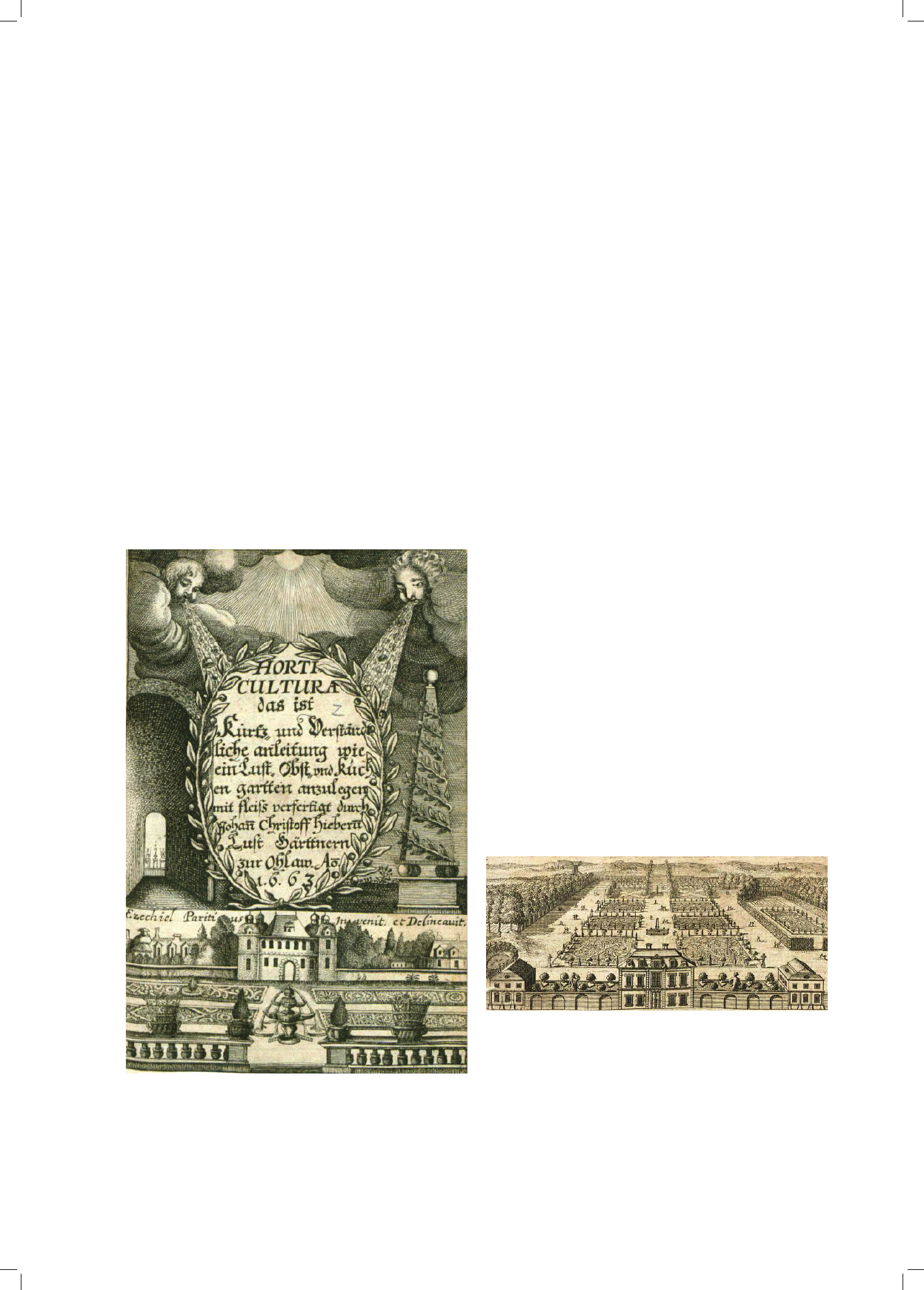
the work entitled Horticultura
[...] (Fig. 2),
which was
dedicated to his employers, Duke Christian and Duchess
Louise and their son Georg Wilhelm of Legnica [16]. This
treatise is devoted to the creation of a decorative garden.
The book contains an extensive eighty-page list of garden
plants amongst which there is also mention of potatoes
described as Papas Indorum f. Adenes Vir gi niani oder
Tartuffellen. The author based his work not only on his
knowledge from particular literature on garden works, but
very probably from his own personal experience.
In 1692, a work by Georg Herbst appeared. Herbst was
also a Silesian gardener, who was engaged to work at the
court of Duke Ulrich von Württemberg in Bierutów. His
manual was entitled Des Schlesischen Gärtners Lustiger
Spa tzier gang and was devoted to the creation of decora-
tive gardens [15]. The book begins with a dedication to
the Duke and his wife, Sybilla, in which the author prais-
es the performance of the Duke in the enterprise of creat-
ing gardens, which is documented by drawings which
show the ducal gardens in Bierutów, Szczodre and
Gorzesław. The work is written in a literary manner as it
has the form of a dialogue between Lieben Gärtner and
Edlen Garten-Liebhaber.
Nicolaus Henelius devoted large parts of his Silesio-
graphia to agronomy and gardening. The later edition of
this work, which was published in 1704 was called Sile-
Il. 2. Frontispis dzieła Christofa Hiebnera Horticultura [...]
wydanego w Brzegu w 1664 r. (Biblioteka Uniwersytecka
we Wrocławiu, Oddział Starych Druków, sygn. 314838)
Fig. 2. Frontispiece of Christof Hiebner’s Horticultura [...]
edited in Brzeg in 1664 (University Library in Wrocław,
Old Prints Department, signature 314838)
Il. 3. Widok ogrodu Neidhardtów w Krzykowie w dziele Pierre’a
le Lorrain de Vallemonta Merckwürdigkeiten der Natur
und der Kunst [...] wydanym we Wrocławiu w 1708 r.
(Biblioteka Uniwersytecka we Wrocławiu,
Oddział Starych Druków, sygn. 351882)
Fig. 3. View of the Neidhardt garden in Krzyków in Pierre
le Lorrain de Vallemont’s Merckwürdigkeiten der Natur
und der Kunst [...] edited in Wrocław in 1708
(University Library in Wrocław,
Old Prints Department, signature 351882)

8 Wojciech Brzezowski
siographia renovata. The 1704 work supplemented the
original version with additional information. In the midst
of this later work was a register of the Silesian gardens
which were extant at that time [13], [14].
As a result of the fashion for French gardens, Ferdinand
Ludwig von Breβler, a member of the Wrocław municipal
council, translated the work of Vallemont entitled Curio-
sitez de la nature et de l’art sur la végétation. Three years
after the Paris original was published it appeared in Wroc-
ław being published in 1708 under the title Merck würdig-
keiten der Natur und der Kunst [...] [28]. According to
information from Breβler in the introduction, the illustra-
tions in the book show Silesian gardens (Fig. 3).
Other Silesian publishers also propagated works which
were on the subject of garden art. The Wrocław Jesuits
edited the Praedium rusticum of Jacques Vanière, and
added a local accent in the form of a poem devoted to
Baron Lazarus Brunetti, who was described as Ruris
Amator Magno Silesiae Pani [29]
3
.
The Silesians also endeavoured to document in print
and in drawing their gardening achievements. Even such
an ephemeral event as a tulip bursting into bloom in the
garden of the mayor of Wrocław in January 1662 was
described in print with a rhyming commentary [2].
A local curiosity are the four editions of a description
of the foundation of a garden reported as the Breslauische
Wassergarten, which existed at the end of the 17
th
century
in the terrain in which the well-known Breslau garden of
Laurentius Scholtz was formerly located. The first two
editions of the Breslauische Wassergarten, which date
from 1682 and 1685, appeared as anonymous. However,
the next two prints, which date from 1689 and 1699, bear
the author’s name. The author was in fact the owner and
creator of this foundation, the Breslau lawyer, Wolfgang
Scharschmidt [23–26]. Over 140 waterworks are men-
tioned in his text, in addition to which there is a drawing
with a description of several mechanisms, and a transcrip-
tion of a hymn in honour of the garden, complete with
musical notation.
Amongst the artificial flowers and animals squirting
water, there were placed statues of antique gods and
heroes. These included a sculpture of Cleopatra with
a snake, Susanna bathing in water which flowed over her
from the eyes of peeping elders, and more prosaic scenes,
for example, of a woman carrying a goose and a basket
with eggs, from which water streamed. There was no lack
of obscenities, according to present-day representations,
as for example the figure of a naked woman who was
intended to be a personification of Nature, from whom
water flowed from each place assigned for this, or
a clown blowing his nose into a jug and a man with his
trousers lowered relieving himself whilst vomiting into
a bucket. At the same time, it was not thought as inap-
propriate to position the figure of St. George doing battle
with a dragon belching water nearby, or an effigy of the
Mother of God with a water aureole. A mechanical musi-
3
Baron Lazarus Brunetti was the nephew and successor of Bishop
Johannes Brunetti, owner of a splendid garden in Ostrów Tumski.
der Kunst [...] [28]. Według zawartej w przedmowie
informacji Breßlera zamieszczone tam ryciny mają uka-
zywać ogrody śląskie (il. 3).
Także inni śląscy wydawcy propagowali dzieła zwią-
zane ze sztuką ogrodową. Wrocławscy jezuici wydali
w 1727 r. dzieło Jacques’a Vanière’a Praedium rusticum,
dodając akcent lokalny w postaci poematu poświęconego
baronowi Lazarusowi Brunettiemu, który został określo-
ny jako Ruris Amator Magno Silesiae Pani [29]
3
.
Ślązacy starali się także o udokumentowanie w druku
i rycinie swych dokonań ogrodniczych. Nawet tak efeme-
rycznemu wydarzeniu, jakim było zakwitnięcie w stycz-
niu 1662 r. tulipana w ogrodzie wrocławskiego burmi-
strza, poświęcono ulotny druk z wierszowanym komenta-
rzem tego zjawiska [2].
Lokalną ciekawostką są cztery edycje opisu założenia
określonego jako Breslauische Wassergarten, jakie istnia-
ło w końcu XVII w. na terenie, na którym dawniej znaj-
dował się słynny wrocławski ogród Laurentiusa Scholtza.
Dwa pierwsze wydania z lat 1682 i 1685 ukazały się ano-
nimowo, ale w dwóch następnych z 1689 i 1699 r. ujaw-
nione zostało nazwisko autora, którym był właściciel
i zarazem twórca tego założenia wrocławski prawnik
Wolfgang Scharschmidt [23–26]. Wymieniono tam ponad
140 rozmaitych „sztuk wodnych”, zamieszczono również
rycinę objaśniającą działanie kilku mechanizmów, a także
hymn na cześć ogrodu opatrzony zapisem nutowym.
Wśród tryskaj
ących wodą sztucznych kwiatów i zwie-
rząt umieszczono posągi przedstawiające antycznych
bogów i herosów, ale także Kleopatrę z wężem, Zuzannę
w kąpieli, na którą spadały strumienie wody bijące z oczu
podglądających ją starców oraz bardziej prozaiczne przed-
stawienia,
jak chociażby niewiastę niosącą gęś i ko szyk
jaj, z których tryskała woda. Nie brakło także, według
współczesnych, obscenów, takich chociażby jak
figura
nagiej kobiety personifikująca Naturę, która wy puszcza
wodę ze wszystkich do tego przeznaczonych miejsc, bła-
zen wydmuchujący nos do dzbana, czy też mężczyzna
z opuszczonymi spodniami, który wypróżnia się i zara-
zem wymiotuje do kubła. Najwyraźniej nie uważano przy
tym za niestosowne umieszczenia nieopodal figury św.
Jerzego walczącego z ziejącym wodą smokiem albo wi -
ze runku Matki Boskiej w wodnej aureoli. Do atrakcji
ogrodu należał także mechaniczny grajek wykonujący na
szklanych dzwonkach kilka melodii tanecznych.
Warto dodać, że Scharschmidt w jednej ze swych bro-
szur powołuje się jako na źródło inspiracji na dzieła
Andreasa Boecklera Architectura curiosa nova i Theat-
rum
machinarum novum, które – jak z tego wynika – były
znane we Wrocławiu. Egzemplarze tych traktatów znajdu-
ją
się
obecnie w zbiorach Biblioteki Uniwersy tec kiej
,
a we
wrocławskim Muzeum Narodowym można obejrzeć swe-
go rodzaju ciekawostkę, jaką jest portret Scharschmid ta
zaopatrzony w mechanizm poruszający oczami
4
.
3
Baron Lazarus Brunetti był bratankiem i spadkobiercą biskupa
Johannesa Brunettiego, właściciela okazałego ogrodu na Ostrowie
Tumskim.
4
Muzeum Narodowe we Wrocławiu, nr inw. VIII-1508.

Ślązacy a teoria sztuki ogrodniczej / The Silesians and theories of garden art 9
Uznaniem współczesnych cieszył się także położony
na wrocławskim Przedmieściu Świdnickim ogród Caspara
Wilhelma Scultetusa [17]. Zapewne z inicjatywy właś-
ciciela wydano drukiem dokładny plan ze szczegółowymi
objaśnieniami dotyczącymi zarówno szaty roślinnej, jak
i tematyki znajdujących się w ogrodzie rzeźb. Do planu
został załączony – sporządzony przez Scultetusa – obszer-
ny wykaz roślin pochodzących z Włoch, głównie cytru-
sów, które uprawiane były na Śląsku, a także w większoś-
ci w jego ogrodzie. Rangę ogrodu podnosiła załączona do
planu alegoryczna rycina oraz objaśniający treść ryciny
wiersz. Autorem ryciny był Michael Renz, pozostający
w służbie hr. Sporcka w Kuks, a autorem wiersza-komen-
tarza do ryciny był okreś
lający się jako przyjaciel Scul-
tetusa sekretarz króla Augusta II Mocnego Gottfried Ben-
ja min Hancke. Osoby grafika i autora wiersza świadczą
nie tylko o koneksjach, ale także o ambicjach właściciela
ogrodu.
Okazała kolekcja dzieł dotyczących sztuki ogrodowej
przechowywana we wrocławskiej Bibliotece Uniwersy-
teckiej jest nie tylko świadectwem znacznego zaintereso-
wania tą dziedziną, ale może być także pośrednio źródłem
informacji o kształcie niezachowanych dawnych śląskich
ogrodów, gdyż Ślązacy zapewne stosowali w praktyce
wskazówki i porady zawarte w traktatach. Wypływające
z l
ektury traktatów wnioski mogą być szczególnie przy-
datne przy próbach rekonstrukcji kształtu wcześniejszych,
powstałych przed XVIII w., założeń ogrodowych, dla któ-
rych brakuje przekazów ikonograficznych i pisanych.
Ponadto konfrontacja XVIII-wiecznych ogrodów śląs-
kich, znanych głównie z rysunków Wernera, ze współczes-
nymi im traktatami świadczy o szybkim przyswajaniu
zaleceń teoretyków przez śląskich ogrodników i ich zle-
ceniodawców, co zaowocowało powstaniem wielu impo-
nujących założeń, mieszczących się w głównym nurcie
europejskiej sztuki ogrodowej okresu baroku.
cian who played several dancing tunes on glass bells was
also an attraction of the garden.
In addition, Scharschmidt, in one of his brochures,
cites the works of Andreas Boeckler, Architectura curiosa
nova and Theatrum machinarum novum as being the
sources of his inspiration, which show that they were
known in Wrocław. Copies of these treatises may now be
found in the collection of the University Library. In the
National Museum of Wrocław, however, it is possible to
examine a certain curiosity: the portrait of Scharschmidt
with a mechanism which moves the eyes
4
.
The garden of Caspar Wilhelm Scultetus which was
located in the suburbs of Wrocław, was acknowledged by
his contemporaries [17]. A precise plan with particular
explanations related to the plants and the sculptures
which were found in the garden, was published, probably
by the initiative of the owner. A long list of plants written
by Scutleus which came from Italy, served as a supple-
ment to the plan. The plants written about were mainly
citruses cultivated in Silesia and to a large extent in his
own garden. The garden’s rank was heightened by an
allegorical drawing added to the plan by Michael Renz, as
well as by a poem which described the contents of the
drawing. The author of the drawing was Michael Renz,
employed by Count Sporck in Kuks, while the author of
the poem/commentary connected to the drawing, was
Gottfried Benjamin Hancke, who described himself as
a friend of Scultetus, the secretary of King Augustus II the
Strong. The authors of the drawing and the poem attested
not only to personal influential connections of the owner
of the garden, but also to his ambitions.
An imposing collection of works devoted to garden art,
preserved in the Wrocław University Library, is not only
evidence of considerable interest in this sphere but may
also be, indirectly, a source of information on the shape of
one-time Silesian gardens not preserved at pre sent,
because Silesians most probably used in practice the
instruction and advice contained in the treateses. Con clu-
sions arising from reading these works may especially be
useful in attempts to reconstruct earlier shapes of garden
foundations which originated before the 18
th
century. For
which there is a lack of iconographic and written sources.
Furthermore, the confrontation of solutions shown in
Werner’s drawings of 18
th
century Silesian gardens with
their contemporary treatises, provides evidence to the
swift adoption of recommendations of theoreticians by
Sile sian gardeners and their employers. This led to a series
of imposing assumptions embraced by the main stream of
European garden art of the Baroque period.
Translated by
Marzena Łuczkiewicz
4
The National Museum in Wrocław (Muzeum Narodowe we
Wroc ławiu), Inventory No. VIII-1508.

10 Wojciech Brzezowski
Streszczenie
O randze, jaką nadawano ogrodom w okresie renesansu i baroku, świadczyć mogą nie tylko realizacje, ale także liczba poświęconych im traktatów.
W kolekcji starodruków Biblioteki Uniwersyteckiej we Wrocławiu znajduje się pokaźny zbiór dzieł poświęconych agronomii, botanice i sztuce
ogrodowej. Znaczna ich część była w użyciu na Śląsku w XVII i XVIII w., pochodzą one bowiem ze zbiorów dawnych bibliotek wrocławskich czy
śląskich bibliotek klasztornych. Ale Ślązacy byli nie tylko biernymi odbiorcami dzieł poświęconych ogrodom, mieli także swój udział w rozpow-
szechnianiu wiedzy o sztuce ogrodniczej. Już w 1590 r. ukazało się dzieło poświęcone agronomii autorstwa Martina Grossera, proboszcza z pod-
wrocławskiej miejscowości Szewce (Schewitz). W 1664 r. wydano w Brzegu traktat Johanna Christofa Hibnera, ogrodnika książęcego w Oławie,
zatytułowany Horticultura [...]. Znajduje się tam pierwsza w historii Śląska wzmianka o ziemniaku. Praca ta zawiera także wykaz roślin ogrodo wych
zajmujący ponad 40 stron. Wydaje się mało prawdopodobne, by w owym czasie wszystkie z wymienionych przez Hibnera roślin były uprawiane
w Śląs kich ogrodach i tekst ten jest raczej wyrazem idealnej wizji. Niemniej miał on niewątpliwy wpływ na rozpowszechnienie nowych tendencji
w sztuce ogrodowej. Podobną funkcję pełniło drugie z XVII-wiecznych dzieł śląskich ogrodników – opublikowany w 1692 r. traktat Georga Herbsta
Des Schlesischen Gärtners Lustiger Spatziergang. Autor pełnił funkcję ogrodnika księcia oleśnickiego Christiana Ulricha von Würtemberga.
Wydarzeniem wykraczającym poza teren Śląska było wydanie we Wrocławiu w 1708 r. niemieckiego tłumaczenia dzieła Curiositez de la nature
et de l’art sur la végétation, którego autorem był Pierre le Lorrain de Vallemont. Tłumaczem dzieła był członek wrocławskiej rady miejskiej
Ferdinand Ludwig von Breßler und Aschenburg. Wymienić tu także trzeba wydrukowane w 1727 r. w drukarni wrocławskiego kolegium jezuickiego
poświęcone ogrodnictwu dzieło Jacques’a Vanière’a Praedium rusticum. We wrocławskich zbiorach znajduje się obecnie także wiele innych trak-
tatów ogrodniczych. Znaki własnościowe i dawne numery inwentarzowe wskazują, że większość z nich należała do dawnych bibliotek śląskich,
a więc była tu znana i z całą pewnością oddziaływała na poziom sztuki ogrodniczej na Śląsku.
Słowa kluczowe: teoria, sztuka ogrodowa, Śląsk
Abstract
The importance endowed upon gardens in the period of the Renaissance and the Baroque may be witnessed not only in realizations but also in the
number of treatises devoted to them. In the collection of old prints of the Wrocław University Library there is a substantial collection of works
devoted to agronomy, botany and garden art. A considerable part of them was used in Silesia in the 17
th
and 18
th
centuries, as they originate from
collections of old Wrocław libraries or Silesian monastic libraries. But the Silesians were not only passive recipients of works devoted to gardens,
they also participated in propagating the knowledge of garden art. As early as 1590 there appeared a work devoted to agronomy, whose author was
Martin Grosser, a parish priest from Szewce (Schewitz) near Wrocław. The treatise of Johan Christof Hibner, Horticultura [...], was published in
1664. Hibner was a gardener of the duke of Oława. For the first time in the history of Silesia the potato was mentioned in this work. It also contains
a register of garden plants of over 40 pages. However, it seems hardly possible that at that time all the plants mentioned by Hibner were cultivated
in Silesian gardens and this text is more of an expression of an ideal vision, nevertheless, no doubt, it had an influence on spreading new tendencies
in the art of gardening. A similar function was performed by another 17
th
century work of Silesian gardeners – the treatise of Georg Herbst Des
Schlesischen Gartners Lustiger Spatziergang, published in 1692. The author performed the function of the gardener of duke Christian Ulrich von
Würtemberg. An event which went beyond the area of Silesia was the publishing in Wrocław in 1708 the German translation of the work called
Curiositez de la nature et de l’art sur la végétation, written by Pierre le Lorrain de Vallemont. The translation of this work was carried out by Ferdi-
nand Ludwig von Bresler und Aschenburg, a member of the Wrocław municipal counsel. The work of Jacques Vanière Praedium rusticum devoted
to gardening and published in 1727 by the printing house of the Jesuit College, should also be mentioned here. There are many other garden trea-
tises in the collections of Wrocław. Ownership signs and one-time inventory numbers indicate that most of them belonged to former Silesian librar-
ies and so this points to the fact that it was known and with all certainty influenced the art of gardening in Silesia.
Key words: theory, gardening, Silesia
Bibliografia/References
[1]
Allgemeine deutsche Biographie. 2. unveränderter Nachdruck der
Leipziger Ausgabe, Bd. 4. Leipzig 1876. Berlin 1968, 402–404.
[2] Andencken der Edlen Tulipan, [Breslau] 1662.
[3] Bassus C., Der Veldtbaw, Straßburg 1545.
[4] Bock H., Kreutterbuch [...], Straßburg 1595.
[5] Caus S. de, Hortus Palatinus, Francofurti 1620.
[6] Cöler (Colerus) J., Calendarium perpetuum, Wittenberg 1608.
[7]
Cöler (Colerus) J., Oeconomia ruralis et domestica [...], Mainz 1645.
[8] Crescenzi P. de, De agricultura, Basileae 1538.
[9] D’Aviler A.Ch., Außführliche Anleitung zu der gantzen Civil Bau-
kunst [...], Amsterdam 1699.
[10]
Fischer Ch., Fleissiges Herren-Auge, Franckfurt und Nürnberg 1690.
[11] Groen J. van der, Le Jardinier hollandois [...]/Der niederländische
Gärtner [...], Amsterdam 1669.
[12] Grosser M., Kurtze und gar einfeltige anleytung zu der Land wirt-
schaft, Görlitz 1590.
[13]
Henel von Hennelfeld (Henelius) N., Silesiographia, Francofurti 1613.
[14] Henel von Hennelfeld (Henelius) N., Silesiographia renovata,
Wratislaviae et Lipsiae 1704.
[15] Herbst G., Des Schlesischen Gärtners Lustiger Spatziergang/
Oder nützlicher Garten-Diskurs, Oels 1692.
[16]
Hiebner J.Ch., Horticultura das ist kurtz- und verständlich An leitung
wie ein Lust- Obst- und Küchen-Garte anzulegen, Brieg 1664.
[17] Jagiełło-Kołaczyk M., Ogród Caspara Wilhelma Scultetusa
(Scholza) na Przedmieściu Świdnickim we Wrocławiu i jego po -
wią zania artystyczne, [w:] E. Różycka-Rozpędowska, M. Cho-
row ska (red.), Nie tylko zamki, Oficyna Wydawnicza Politechniki
Wrocławskiej, Wrocław 2005.
[18] Neu-verbesserter Colerus, Leipzig 1711.
[19] Oszczanowski P., Wrocławski ogród Laurentiusa Scholtza St.
(1552–1599 ) – sceneria spotkań elity intelektualnej końca
XVI wieku, [w:] M. Hołub, A. Mańko-Matysiak (red.), Śląska
republika uczonych, Ofi cyna Wydawnicza ATUT, Wrocław 2004.
[20] Quintinye J.-B. de la, Instruction pour les jardins fruitiers et pota-
gers, Amsterdam 1697.
[21] Rhagor D., Erneuerter Pflantz-Garten, Basel 1669.
[22] Rohr J.B. von, Vollständiges Haußwirtschafts-Buch [...], Leipzig
1751, 759.
[23]
Scharschmidt W., Erzehlung aller Wasser-Künste [...], [Breslau]
1682.
[24] Scharschmidt W., Erzehlung aller Wasser-Künste [...], [Breslau]
1685.
[25]
Scharschmidt W., Breslauischer Wasser-Garten [...], Breslau 1689.
[26]
Scharschmidt W., Breslauischer Wasser-Garten [...], Breslau 1699.
[27] Schube T., Über die Phytologia magna von Israel und Georg
Anton Volckmann, [w:] Achtundsechszigster Jahres-Bericht der
Schle sischen Gesellschaft für vaterländische Cultur, Breslau
1891.
[28] Vallemont P. le Lorrain de, Merckwürdigkeiten der Natur und der
Kunst [...], Breslau 1708.
[29] Vanière J., Praedium rusticum, Breslau 1727.
[30] Volkamer J.Ch., Nürnbergische Hesperides, Nürnberg 1708.