
2015
3(43)
DOI: 10.5277/arc150307
Marta Rusnak*
Adaptacja budynków sakralnych na cele muzealne w Polsce.
Historia i skala zjawiska
Transformation of religious buildings into museums in Poland.
History and scale of the phenomenon
Wprowadzenie – kontekst europejski i polski
Adaptacja obiektów sakralnych na funkcje świeckie
jest obecnie często poruszanym tematem. Świadczą o tym
rozmaite inicjatywy kulturalne oraz konferencje dotyczą-
ce desakralizacji. W kontekście europejskim było to zja-
wisko omawiane między innymi podczas Kultur Kirchen
Konferenz
1
, Klöster – Potenziale für Kultur, Kirchen und
Tourismus. Spirituelle Orte in einer mobilen Gesellschaft
2
.
W Polsce również odbyło się kilka prelekcji na ten temat.
Uwagę niewątpliwie należy zwrócić na inicjatywy po -
dejmowane przez środowiska religijne (np. konferencję
zorganizowaną w 2012 r. przez Wydział Teologiczny Uni-
wer sytetu Śląskiego w Katowicach), a także na polsko-
-norweski projekt „Ny arv/Nowe dziedzictwo” oraz na
zwią zaną z nim konferencję „Świątynia wieczne sac rum”
3
.
Jednak jak zauważyli chociażby uczestnicy tej os tatniej,
prezentowane badania dotyczą zazwyczaj jed nost kowych
obiektów lub skali miasta i regionu.
W Stanach Zjednoczonych oraz w krajach Europy Za -
chodniej i Północnej, a szczególnie w Holandii, Niem-
* Wydział Architektury Politechniki Wrocławskiej/Faculty of
Architecture, Wrocław University of Technology.
1
Konferencja była zorganizowana już kilkakrotnie przez stowa-
rzyszenie Freunde der Künste.
2
Konferencja organizowana przez Thomas-Morus-Akademie
Bens berg und der Katholischen Arbeitsgemeinschaft Freizeit und Tou-
rismus (KAFT) w Europapark Russ.
3
Odbyła się 12–13 września 2014 r. w Gdańsku. Celem projektu
jest utworzenie sieci kościołów rewitalizowanych na potrzeby kultury.
Introduction – European and Polish context
The process of adaptation of sacred objects to secular
functions is a topic quite often discussed nowadays. This
is evidenced by various cultural initiatives and confer-
ences on desacralisation. In the European context this
phenomenon was discussed, inter alia, during the Kultur
Kirchen Konferenz
1
, Klöster – Potenziale für Kultur,
Kirchen und Tourismus. Spirituelle Orte in einer mobilen
Gesellschaft
2
. Several lectures on this subject were also
delivered in Poland. Undoubtedly, attention should be
paid to the initiatives undertaken by the religious environ-
ments (e.g. a conference organized by the Faculty of
Theology, the University of Silesia in 2012) as well as to
the Polish-Norwegian project “Ny arv/New Heritage” and
the related conference “A Temple – Eternal Sacrum”
3
.
How ever, as it was noted even by the participants of the
latter, the presented research usually refers to individual
structures or to the scale of a city and a region.
In the United States and the countries of Western and
Northern Europe, particularly in the Netherlands, Ger ma-
ny, Finland and Norway desacralization of architecture
1
The conference was organized by Freunde der Künste Association
several times.
2
The conference was organized by Thomas-Morus-Akademie
Bens berg und der Katholischen Arbeitsgemeinschaft Freizeit und Tou-
rismus (KAFT) in Europapark Russ.
3
It took place on 12–13 September 2014 in Gdańsk. The purpose
of the project is to create a network of churches revitalized for the needs
of culture.

76 Marta Rusnak
czech, Finlandii czy Norwegii desakralizacja architektury
jest już powszechna. Bardzo często budynki są przystoso-
wywane do pełnienia funkcji dającej możliwość obcowa-
nia ze sztuką, stając się muzeami, galeriami, salami kon-
certowymi i widowiskowymi. Interesującym przykładem
jest Muzeum Sztuk Pięknych w Montrealu, na którego po -
trzeby zaadaptowano i rozbudowano w 2011 r. duży neo -
romański
kościół w centrum miasta. Nieużytkowane świą-
tynie stają się obecnie nie tylko obiektami kulturalnymi,
ale również szkołami, przedszkolami, mieszkaniami, ho -
telami, dyskotekami, restauracjami, barami, a na wet tak
jak w M
aastricht parkingami dla rowerów [1].
Ze względu na brak znajomości szerszego kontekstu
ekonomicznego, prawnego czy religijnego, proces dekon-
sekracji wydaje się wielu osobom w Polsce, szczególnie
środowiskom konserwatywnym, niezrozumiały i bezpod-
stawny. Znacznie łatwiej jest promować kulturową trans-
formację pałacu, fabryki czy dworca, gdyż nie wiąże się
to z różnicami w społecznym postrzeganiu świętości.
Badania prowadzone przez Główny Urząd Statystycz-
ny (GUS) oraz Instytut Sta tystyki Kościoła Katolickiego
– Stowarzyszenie Apos tolstwa Katolickiego w Polsce [2],
[3] wykazują, iż coraz mniej Polaków deklaruje aktywne
uczestnictwo w życiu wspólnoty kościelnej. Jeśli ta ten-
dencja się utrzyma, to w najbliższych dziesięcioleciach
będziemy musieli coraz częściej odpowiadać na pytania
o dalsze losy budynków kościelnych. Problem poszuki-
wań funkcji dla opuszczonych przestrzeni sakralnych bę -
dzie tym większy, im dłużej Kościół będzie hołdował stra
-
te gii inwestowania w no we, nierzadko wielkokubaturowe
obiekty o przeznaczeniu religijnym. W 2007 r. Koś ciół
ka tolicki w Polsce zarządzał 10 082 parafiami. W ciągu
sześciu lat liczba ta wzrosła do 10 154 parafii [4], [5].
Chcąc sprowokować niepodejmowaną publicznie dys-
kusję nad [...] życiem architektury, kiedy architekt nie ma
wpływu na swoje dzieło [6], fotograf Nicolas Grospierre
i grafik Kobasa Laksa stworzyli fotomontaże zaprezento-
wane na 11. Biennale Architektury w Wenecji. Wysta wa
„Hotel Polonia. Budynków życie po życiu” zawierała
spe cyficz ny przekaz. Połączenie poczucia humoru oraz
surrea listycznego podejścia sprawiło, że artyści oraz ku -
ra torzy wystawy Grzegorz Piątek i Jarosław Trybuś zos-
tali nagrodzeni Złotym Lwem. Jednym z najbardziej
prowokacyjnych przedstawień była wizja „Co stanie się
z sanktuarium w Licheniu, gdy nawet Polacy przestaną
chodzić do kościoła?” [6]. O ile dotychczas nie urządzono
w kościele aquaparku, co byłoby osobliwe zarówno pod
względem formy, jak i funkcji, o tyle Polacy już kil ka -
dziesiąt razy musieli odpowiadać na tożsame pytania nie
tylko w formie graficznej i intelektualnej zabawy. Przed-
stawiona chronologia pokazuje, że problem ożywienia
daw ne go kościoła funkcją ekspozycyjną nie jest, nawet
w Pol sce, zjawiskiem rzadkim.
Cel i zakres pracy
Celem pracy jest ukazanie przebiegu zjawiska adapta-
cji zabytkowych obiektów sakralnych na potrzeby muze-
alne w Polsce. Praca dotyczy jedynie powojennych
doświadczeń muzealnych transformacji historycznych
has already become prevailing. Buildings are very often
adapted to perform the function which will provide an
oppor tunity to commune with art by being turned to
museums, galleries, concert and performance halls. An
interesting example is the Museum of Fine Arts in Mon-
treal, for the needs of which a large Neo-Romanesque
church in the city centre was adapted and expanded in
2011. Unused temples are now becoming not only cultu-
ral facilities, but also schools, kindergartens, apartments,
hotels, discos, restaurants, bars, and even a parking space
for bicycles as it is in Maastricht [1].
Due to lack of knowledge about a broader economic,
legal or religious context, the process of de-consecration
seems incomprehensible and unfounded to many people in
Poland, especially to conservative circles. It is much easier
to promote a cultural transformation of a palace, factory
or railway station since this process is not connected with
differences as regards the social perception of holiness.
The research carried out by the Central Statistical
Office of Poland (CSO) and the Institute of Statistics of the
Catholic Church – the Society of the Catholic Apo sto late
in Poland [2], [3] shows that fewer and fewer Poles declare
active participation in the life of the church community. If
this tendency continues, in the next few de cades we will
increasingly have to answer questions about the future
fate of church buildings. The problem of searching func-
tions for abandoned sacred spaces will be on the increase
as long as the Church keeps on being involved in strate-
gies of investing in new, not infrequently large-sized build-
ings of religious purposes. In 2007 the Catholic Church in
Poland managed 10 082 pa rishes. Within six subsequent
years this number grew to 10 154 parishes [4], [5].
In order to provoke a discussion that was avoided by
the public on [...] the life of architecture when an architect
has no influence on his work [6], photographer Nicolas
Grospierre and graphic artist Kobasa Laksa made photo-
montages which were presented at the 11 Venice Biennale.
The exhibition “Polonia Hotel. The Afterlife of Buildings”
contained a specific message. A combination of a sense of
humour and a surreal approach resulted in the fact that the
artists and the curators of the exhibition – Grzegorz Piątek
and Jarosław Trybuś – were awarded the Golden Lion.
One of the most provocative performances was a vision
entitled “What will happen to the sanctuary in Licheń,
when even the Poles stop going to church?” [6]. Although
no water park has been arranged in a church so far, which
would be bizarre both in terms of the form and function,
the Poles already had to answer dozens of times similar
questions not only in the form of a graphic or intellectual
play. The presented chronology shows that the problem of
reviving a former church through an exhibition function
is not a rare phenomenon even in Poland.
The goal and the scope of work
The purpose of this study is to show the course of the
phenomenon of historical building adaptations for the
museum needs in Poland. The study refers only to the
post-war experiences of museum historical transforma-
tions of church properties with the exception of objects of

Adaptacja budynków sakralnych na cele muzealne w Polsce /Transformation of religious buildings into museums in Poland 77
majątków kościelnych z wyłączeniem obiektów o charak-
terze skansenu. Pierwszym kryterium doboru przykładów
była lista Narodowego Instytutu Muzealnictwa i Ochrony
Zbiorów (NIMOZ), tzw. Baza Muzeów w Polsce [7].
Kolejną badaną grupę, choć nieco inną strukturalnie, sta-
nowią ekspozycje będące niejako kontynuacją kościel-
nych repozytoriów służących zachowaniu dziedzic twa
sztuki religijnej. Istnieje wiele rodzajów tych kolekcji. Ze
względu na odmienny status ekspozycje o randze archi-
diecezjalnej, diecezjalnej, parafialnej, a także wystawy
w ka tedrach, przyklasztorne i misyjne mają przeróżne
ska le, zróżnicowane modele organizacyjne i indywidual-
ny charakter.
Funkcja ekspozycyjna w obiektach kościelnych
przed II wojną światową. Krótki rys historyczny
Desakralizacja musiała być w przeszłości wielokrotnie
przeprowadzana w wyniku klęsk żywiołowych, wojen,
epi demii, w związku z migracjami ludności, zmianami
us tro jowymi lub represjami politycznymi. Kościoły naj-
częściej stawały się czasowymi szpitalami, stajniami lub
ma ga zynami broni. Jednak dopiero w porewolucyjnej
Francji doszło do pełnego muzealnego przekształcenia
przestrzeni sakralnej. Pierwszym takim wnętrzem stał się
klasztor des Petits-Augustins
4
. Inne obiekty sakralne oka-
zywały się znakomitymi przestrzeniami dla rodzącego się
XIX-wiecznego uprzemysłowienia, sprzyjała temu XVII-
i XIX-wieczna sekularyzacja dóbr kościelnych. Klasztory
w Fontaine-Daniele i Ourscamp stały się idealnymi zaląż-
kami włókienniczych kompleksów fabryczno-mieszka-
niowych [8].
Przed II wojną światową na terenach obecnie zajmo-
wanych przez Polskę istniały już obiekty o religijnej prze-
szłości przystosowane do prezentowania wystaw. Wśród
nich znajduje się muzeum w Raciborzu oraz Oddział
Sztu ki Dawnej Muzeum Narodowego w Gdańsku miesz-
czące się w siedzibie byłego Stadtmuseum i Provinzial-
-Kunstgewerbemuseum [9]. Gmach główny gdańskiego
muzeum to adaptowany późnogotycki klasztor francisz-
kański. Z kolei w 1879 r. utworzono muzeum w Legnicy,
lokując zbiory w klasztorze pocysterskim [9]. Również na
Dolnym Śląsku w Sobótce 1926 r. w dawnym domu opa-
ta, późniejszym gotyckim szpitalu augustiańskim [10]
urzą dzono Heimatmuseum. W 1948 r., pomimo rozprosze-
nia i zniszczenia zbiorów, w tym samym miejscu otworzo-
no Muzeum Ślężańskie im. Stanisława Dunajewskiego.
Na fali ogólnoeuropejskiej XIX-wiecznej fascynacji hi -
storią sztuki oraz konserwacją zabytków powołano bardzo
liczne muzea kościelne i cerkiewne: w Tarnowie (1888,
w seminarium
5
), w Poznaniu (1902, w Akademii Bi sku pa
Lubrańskiego), w Przemyślu (1902, w pojezuickim orato-
rium
6
), Sandomierzu (1903, w tzw. Domu Dłu gosza,
dawnej siedzibie księży misjonarzy), a przed I wojną
4
Musée des Monuments Français, ustanowione w 1795 r.
5
Obecnie ekspozycja tarnowskiego muzeum mieści się w kilku
ka mieniczkach.
6
Obecnie ekspozycja ta mieści się w dwóch kamieniczkach przy
placu Katedralnym.
an open-air museum character. The first criterion when
selecting the particular examples was the list of the Na -
tional Institute of Museology and Protection of Collections
(NIMOZ), the so called Base of Museums in Poland [7].
Another discussed group, although slightly different stru-
c turally, constitutes exhibitions that are a specific contin-
uation of church repositories serving the purpose of pre-
serving the religious art heritage. There are many ty pes of
these collections. Due to their various status, the ex -
hibitions of archdiocese, diocese, and parish rank, as well
as those that are held in cathedrals, monasteries and mis-
sions have different scales, diversified organizational
models and unique characters.
Exhibition function in church buildings
before World War II. A brief historical overview
In the past desacralization has been repeatedly carried
out as a result of natural disasters, wars, epidemics, and
also due to migrations of people, political changes or
political repressions. Most frequently churches became
temporary hospitals, stables or warehouses of weapons.
However, only in post-revolutionary France did a full mu -
seum transformation of the sacred space take place. The
first interior of this type was
Petits-Augustins Monaste -
ry
4
. Other sacral buildings turned out to be excellent
spaces for the emerging 19
th
-century industrialization,
which was strengthened by the 17
th
- and 19
th
-century se -
cularization of church properties. Monasteries in Fontaine-
Daniele and Ourscamp became perfect origins of factory
and residential textile complexes [8].
Before World War II in the areas which now belong to
Poland there were already buildings of the religious back-
ground adapted for presenting exhibitions. Among them
there is a museum in Racibórz and the Old Art Department
of the National Museum in Gdańsk located in the former
Provinzial-Kunstgewerbemuseum [9]. The main building
of the Gdańsk Museum is an adapted late Gothic Fran-
ciscan monastery. Then in 1879 in Legnica a museum was
established with its collections located in the Cistercian
monastery [9]. In 1926 also in Lower Silesia in Sobótka
in the former house of the abbot and later Gothic Augu-
stinian hospital [10] Heimatmuseum was arranged. In
1948 in spite of the dispersion and destruction of collec-
tions, the Stanisław Dunajewski Ślężańskie Museum was
opened in the same place.
Due to the Europe-wide wave of the 19
th
-century fascina-
tion with art history and restoration of monuments, numer-
ous church and Orthodox Church museums were estab-
lished, namely, in Tarnów (1888, in the seminar
5
), in Poznań
(1902, in Bishop Lubrański Academy), in Prze myśl (1902,
in the post-Jesuit oratory
6
), in Sandomierz (1903, in the so
called Długosz Dom, the former seat of missionary priests)
and before World War I also in Cra cow (1906, two colleges),
4
Musée des Monuments Français, established in 1795.
5
At present, the Tarnów Museum exhibition is housed in several
small tenement houses.
6
At present, this exhibition is in two small tenement houses in Plac
Katedralny (Cathedral Square).

78 Marta Rusnak
świa tową także w Krakowie (1906, dwa kolegia), we
Lwo wie (1909, fragment klasztoru) i Warszawie. Na te re-
nach poza Rzeczpospolitą także we Wrocławiu (1903,
sala domu kapitularnego) [11].
W okresie dwudziestolecia międzywojennego w Pols-
ce można odnotować powstanie kilku muzeów zarzą dza-
nych przez środowiska religijne: w Lublinie (1920), Ja -
nowie Podlaskim
7
(1920), Kielcach (1922), Pelplinie
(1928), Łodzi (1937) [10] oraz Ormiańskiego Muzeum
Ar chidiecezjalnego we Lwowie (1932, siedziba kapituły).
Części ważnych z historycznego punktu widzenia miejsc
nie podano, gdyż znajdowały się w nowo wznoszonych
obiektach, tym samym nie są tematem pracy. Do tej grupy
na leżą między innymi Muzeum Diecezjalne w Płocku
(1903
8
) i Muzeum Archidiecezjalne im. Jana Długosza
we Lwowie (1916
9
[12]).
Muzea rejestrowe w kościołach
otwarte w latach 1945–2014
Po II wojnie światowej wiele zniszczonych lub opusz-
czonych budynków sakralnych zostało przeznaczonych
na funkcje ekspozycyjne. Obecnie 45 muzeów rejestro-
wych znajduje się w takich obiektach
10
. Oznacza to, że
5% spośród 901 budynków
11
ekspozycyjnych muzeów
i ich oddziałów widniejących w rejestrze NIMOZ zostało
zlokalizowanych w obiektach o sakralnej przeszłości
[7]
12
. W tej grupie znajduje się 16 klasztorów i mo -
nasterów, 10 kościołów i kaplic, 9 synagog, 4 wieże koś -
cielne, 2 dzwonnice, dom talmudyczny, dom kahalny,
dom modlitwy oraz dom przedpogrzebowy
13
.
Statystyka wydaje się nieco bardziej okazała, jeżeli na
potrzeby badań definicję obiektu sakralnego poszerzymy
o te dawne majątki kościelne, które w istotny sposób to -
warzyszyły działaniu wspólnot religijnych, i nazwiemy je
obiektami poreligijnymi. W ich poczet można zaliczyć
ple banie, seminaria, kolegia, pałace i rezydencje kościel-
ne. Dyskusyjne w tej klasyfikacji są zamki krzyżackie,
7
Przeniesione w 1922 do Siedlec.
8
Dopiero w 2008 r. muzeum zaczęło użytkować pomieszczenia
w dawnym opactwie benedyktyńskim.
9
Oficjalne otwarcie nastąpiło dopiero w 1939 r.
10
W obliczeniach nie uwzględniono obiektów o charakterze skan-
senu, w których mieści się 17 cerkwi oraz 18 kościołów. Obiekty te
same w sobie stanowią eksponaty i poza zabiegami konserwatorskimi
nie podlegają zmianom strukturalnym lub estetycznym.
11
Obliczenia wykonane na podstawie własnych badań i analiz
sporządzonych w oparciu o listę NIMOZ. Liczba budynków jest różna
od tej po danej w raporcie GUS o „Działalności Instytucji Kultury
w Pols ce w 2013 r.” (liczba muzeów i ich oddziałów podana w tym
dokumencie to 822).
12
Lista NIMOZ nie obejmuje wszystkich obiektów o charakterze
mu zealnym. Kilka prywatnych muzeów nie znajduje się w tym rejestrze
np. Muzeum Zamek w Kwidzynie, Muzeum na zamku w Golubiu. W re j
e-
strze nie odnajdziemy również obiektów o funkcjach mieszanych, przy-
k ła do wo – łączących galerię sztuki z salą koncertową czy bib lioteką.
13
Warto zauważyć, iż na liście nie ma ani jednej cerkwi. Wszyst-
kie zarejestrowane w NIMOZ znajdują się na terenach skansenów lub
jako takie są w ten sposób traktowane. Obiekty skansenowskie nie są
poddawane przekształceniom architektonicznym wymuszającym kom-
promis pomiędzy zabytkiem a nową funkcją, stąd nie są włączone
w badaną grupę.
in Lviv (1909, a fragment of the monastery) and in War -
saw, whereas in the areas beyond the Republic of Po land,
also in Wrocław (1903, a room of the chapter house) [11].
In the interwar period in Poland we can note the estab-
lishment of several museums managed by religious en -
vironments, i.e. in Lublin (1920), in Janów Podlaski
7
(1920), in Kielce (1922), in Pelplin (1928), in Łódź
(1937) [10] and the Armenian Archdiocese Museum in
Lviv (1932, seat of the chapter).
Some of the places important from the historical point
of view are not included here since they were situated in
newly erected building and hence they are beyond the
scope of this study. This group comprises, inter alia, the
Diocese Museum in Płock (1903
8
) and the Jan Długosz
Archdiocese Museum in Lviv (1916
9
[12]).
Registered museums in churches
opened in the years 1945–2014
After the World War II many destroyed or abandoned
sacral buildings were intended for exhibition functions.
At present, there are 45 registered museums in such build-
ings
10
. This means that 5% of 901 museum exhibi -
tion buildings
11
and their departments, which are in the
NIMOZ register, were located in the buildings with sacral
history [7]
12
. In this group there are 16 convents and
mo nasteries, 10 churches and chapels, 9 synagogues,
4 church towers, 2 bell towers, a Talmudic house, a Kahal
house, a house of prayer and a pre-funeral house
13
.
This statistics will be even more impressive if, for the
needs of our research, we extend the sacral building defi-
nition by including those old church properties which
significantly accompanied actions of religious communi-
ties and we refer to them as post-religious buildings. They
will comprise parsonages, seminaries, colleges, palaces
and church residences. Castles of the Teutonic Order are
controversial in this classification because their religious
function was as important as the representative and defen-
7
Moved to Siedlce in 1922.
8
Only in 2008 did the museum begin to use the rooms in the
former Benedictine Abbey.
9
The official opening took place only in 1939.
10
This calculation does not take into account the structures of an open-
air museum character, in which there are 17 Orthodox Churches and 18
churches. These structures themselves constitute exhibits and apart from
some restoration works they are not subject to structural or aesthetic changes.
11
Calculations made on the basis of our own research and analyses
carried out on the basis of the NIMOZ
list. The number of buildings is
different from that given in the CSO report on “The Activity of Cultural
Institutions in Poland in 2013” (the number of museums and their
departments presented in this document is 822).
12
The NIMOZ list does not include structures of a museum char-
acter.
Several private museums are not comprised by this registry, e.g.
the Kwidzyn Castle Museum, the Museum in Golub Castle. The registry
also does not include structures with mixed functions, for example, con-
necting an art gallery with a concert hall or a library.
13
It is worth noting that there is not a single orthodox church in
the list. All the registered orthodox churches in NIMOZ are located in
the areas of open-air museums or they are treated as such. Open-air
museum structures are not subjected to architectural transformations
which would force a compromise between an architectural monument
and a new function, hence they are not included in the study group.

Adaptacja budynków sakralnych na cele muzealne w Polsce /Transformation of religious buildings into museums in Poland 79
których funkcja zakonna była równie ważna co repre-
zentacyjna i obronna. Łącznie tych wszystkich obiek tów
jest 18. Wśród nich widnieje 11 rezydencji kościel nych,
2 ka nonie, konwikt, zamek krzyżacki, seminarium, ere-
mi to rium i plebania.
W myśl tak rozbudowanej definicji muzeum stało się
nową funkcją dla 63 obiektów. Są to wyłącznie budynki
znajdujące się w wojewódzkich rejestrach zabytków. Dla
tej zwiększonej grupy muzea w obiektach poreligijnych
stanowią 6,9% ogółu obiektów muzealnych w Polsce.
Z prześledzenia liczby muzeów o dawnej funkcji reli-
gijnej wynika, że przez ostatnie 69 lat w Polsce przyby-
wało prawie po jednym rejestrowym muzeum na rok.
Je żeli przyjmiemy, że w naszym kraju od wojny reakty-
wowano lub otwarto 822 muzea i oddziały muzealne
(przynajmniej 901 budynków), to oznacza, że każdego
ro ku otwierano średnio 12 muzeów (13,6 obiektu). W tym
świet le jeden obiekt poreligijny rocznie nie jest wynikiem
im po nującym, ale znaczącym.
Tempo rozwoju adaptacji obiektów sakralnych nie
było jednostajne. Po wojnie władze potrzebowały trzech
lat, aby zorganizować pierwsze ekspozycje. Były to wy -
sta wy kontynuujące tradycje przedwojennych muzeów
i izb pa mięci (Racibórz, Gdańsk i Frombork). Analizując
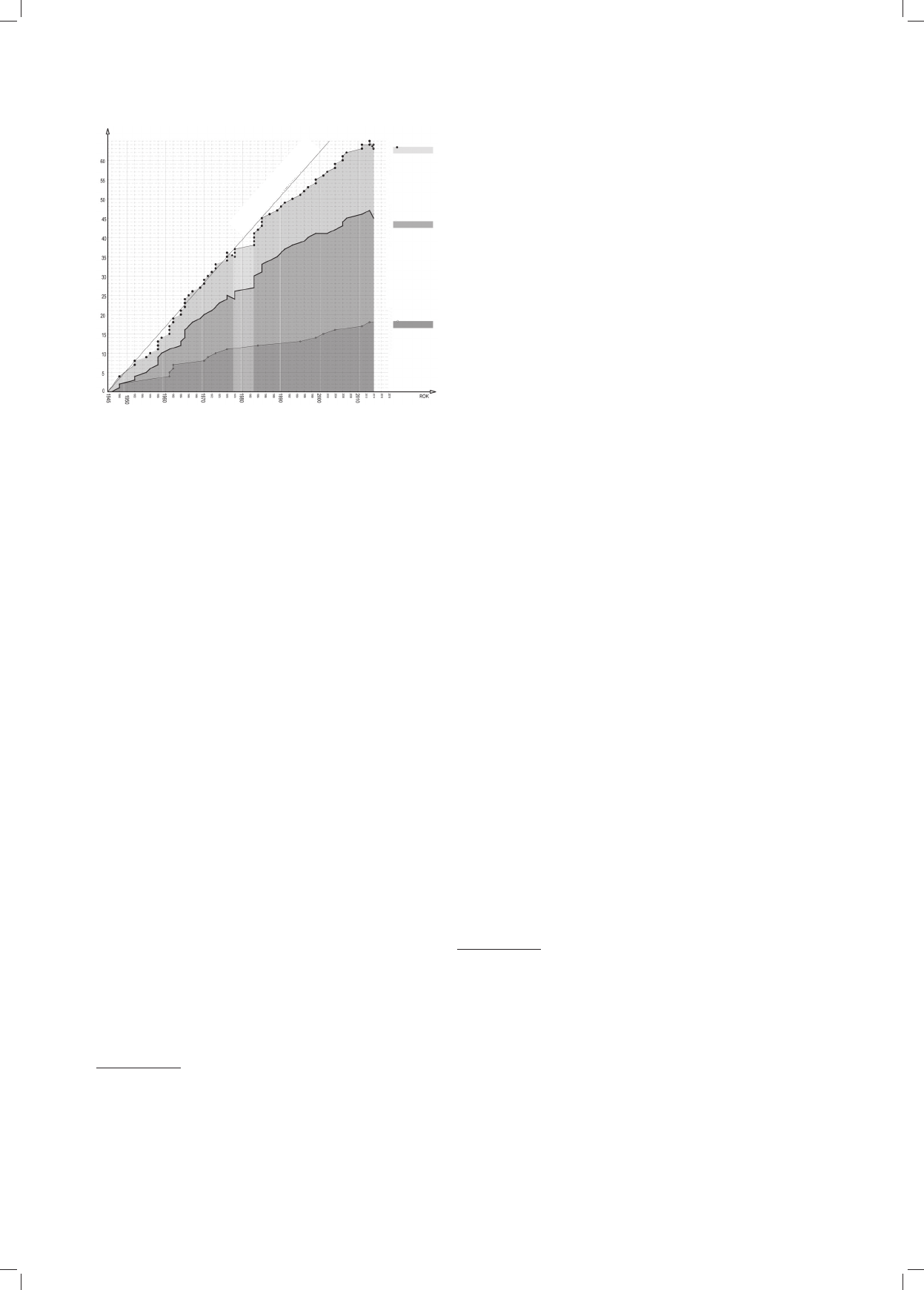
ilu strację 1, można zaobserwować praktycznie jednostaj-
ny przyrost liczby adaptacji w latach 1948–1975, a na -
stęp nie prze stój od 1976 do 1983, związany z trudną sy -
tuacją
gospodarczą kraju oraz stanem wojennym. Później
mamy do czynienia z gwałtownym przyrostem trwającym
dwa lata, do roku 1985. W tym czasie otwarto osiem od -
działów muzealnych w dawnych obiektach religijnych,
wyrównując niejako zaległości z ok resu przestoju. Uśred-
nione tempo rozwoju przed stanem wojennym i po nim
jest różne i wynosi odpowiednio 1,19 muzeum na rok
w la tach 1945–1978 oraz 0,84 mu zeum na rok w latach
1983–2014.
Na przedstawionej ilustracji 1 widać trzy zakłócenia.
W ciągu badanych 69 lat trzykrotnie zdarzyło się, że
obiekt przystosowany do pełnienia funkcji ekspozycyjnej
został odzyskany przez wspólnotę religijną. Pierwszym
przy kładem jest oddział Muzeum Regionalnego w Ra do-
miu, któremu w 1964 r. przyznano budynek dawnego
koś cioła św. Wacława. Po remoncie przeniesiono tam
część zbiorów archeologicznych, zorganizowano także
pra cow nię konserwatorską. Kiedy w 1978 r. budynek
prze kazano z powrotem na potrzeby sakralne, zbiory ar -
cheo logiczne przeniesiono do magazynów muzealnych.
Drugie zakłócenie w tempie rozwoju dotyczy barokowej
synagogi odremontowanej w latach 1983–1990 przez
Muzeum Za mek w Łańcucie. Gmina żydowska ubiegała
się o odzyskanie tego obiektu od 2002 r., zgodnie z prze-
pisami uw łasz czeniowymi zmienionymi w 1997 r. Osta-
tecznie muzeum musiało opuścić synagogę w 2014 r.
Wnętrze jest w dalszym ciągu udostępniane zwiedzają-
cym, ale nie prowadzi się już tam badań będących jedną
z cech ustawowo charakteryzujących muzeum [13].
Ostatnim przykładem jest synagoga w Łęcznej. W 1966 r.
przekształcono ją na siedzibę Muzeum Regionalnego,
ale w 2014 r., po długich staraniach, przejął ją pierwotny
właściciel.
sive one. In total, there are 18 buildings. Among them
there are 11 church residences, 2 canonries, a boarding
monastery school, a castle of the Teutonic Order, a semi-
nary, a hermitage and a parsonage.
In accordance with that extended definition, the muse-
um became a new function in the case of 63 objects.
These are exclusively buildings which are in the district
historical monument register. For this extended group,
museums in the post-religious structures constitute 6.9%
of all museum buildings in Poland.
By analysing the number of museums with a former
religious function, it can be shown that in Poland during
the last 69 years almost one registered museum appeared
each year. If we assume that in our country 822 museums
and museum departments (at least 901 buildings) were
opened or reactivated since the war, this means that each
year 12 museums were opened on average (13.6 facilities).
We can conclude that one post-religious facility a year is
not an impressive result, however, it is quite significant.
The pace of adaptation of sacral buildings was not
steady. After the war, it took three years for the authorities
to organize the first exhibitions. These exhibitions contin-
ued the tradition of the pre-war museums and places of
memory (Racibórz, Gdańsk and Frombork). Analysing
illustration 1, we can observe a practically constant in -
crease in the number of adaptations in the years 1948–
1975, and then a standstill from 1976 until 1983 co nnected
with a difficult economic situation of the country and with
introduced later Martial Law. Then we deal with a rapid
growth that lasted two years until 1985. At that time eight
museum departments were opened in former religious
buildings in this way catching up on the standstill time.
The averaged progress rate before and after Martial Law
respectively was 1.19 museum a year in years
1945–1978
and 0.84 museum a year in 1983–2014.
In Figure 1 we can see three disturbances. During 69
years comprised by our research it happened three times
that the object adapted to perform the exhibition function
was regained by a religious community. The first example
is a department of the Regional Museum in Radom,
which took over the building of the former St. Wenceslaus
Church in 1964. After the renovation a part of archaeo-
logical collections was moved there and a restoration
workshop was also organized at that place. When the
building started to be used for religious needs again in
1978, the archaeological collections were transferred to
the museum warehouses. The second disturbance in the
pace of the development refers to the Baroque synagogue
which was renovated in the years 1983–1990 by the
Castle Museum in Łańcut. The Jewish community applied
for the recovery of this building in 2002 in accordance
with the enfranchisement provisions which were changed
in 1997. Eventually, the museum had to leave the syna-
gogue in 2014. The interior is still available for visitors
but research activities, which are one of the features char-
acterizing the museum statutorily, are no longer carried
out there [13]. The last example is presented by the syna-
gogue in Łęczna. In 1966 it was transformed into the seat
of the Regional Museum, but in 2014 after considerable
efforts it was taken over by its original owner.
80 Marta Rusnak
Niepewny był los synagogi w Lesznie. Po wpisaniu jej
w 1991 r. do rejestru zabytków zdecydowano się zorgani-
zować w niej ekspozycję. Prace badawcze, a następnie
konserwatorskie trwały aż do 1999 r., gdy Gmina Wyz na-
nio wa Żydowska we Wrocławiu wystąpiła o odzyskanie
swo jej własności. Ostatecznie Sejmik Wojewódz twa Wiel-
ko polskiego wypłacił Gminie odszkodowanie, nie zwra -
ca jąc własności, a tym samym nie tracąc zainwestowa-
nych w prace adaptacyjne 2 mln złotych. Ta sama zmiana
prawa opóźniła proces transformacji synagogi w Płocku,
gdzie w 1997 r. tamtejsza Gmina odzyskała od Skarbu
Państwa tę nieruchomość, aby odsprzedać ją później mia-
stu. Po perturbacjach Dział Muzeum Żydów Polskich ot -
warto dopiero w 2013 r.
Całość procesu adaptacji obiektów sakralnych na mu -
zea rejestrowe w Polsce po 1945 r. można prześledzić na
umieszczonej poniżej zbiorczej chronologii odnotowują-
cej moment otwarcia ekspozycji
14
(tab. 1).
Obecna lokalizacja muzeów rejestrowych
w obiektach poreligijnych w Polsce
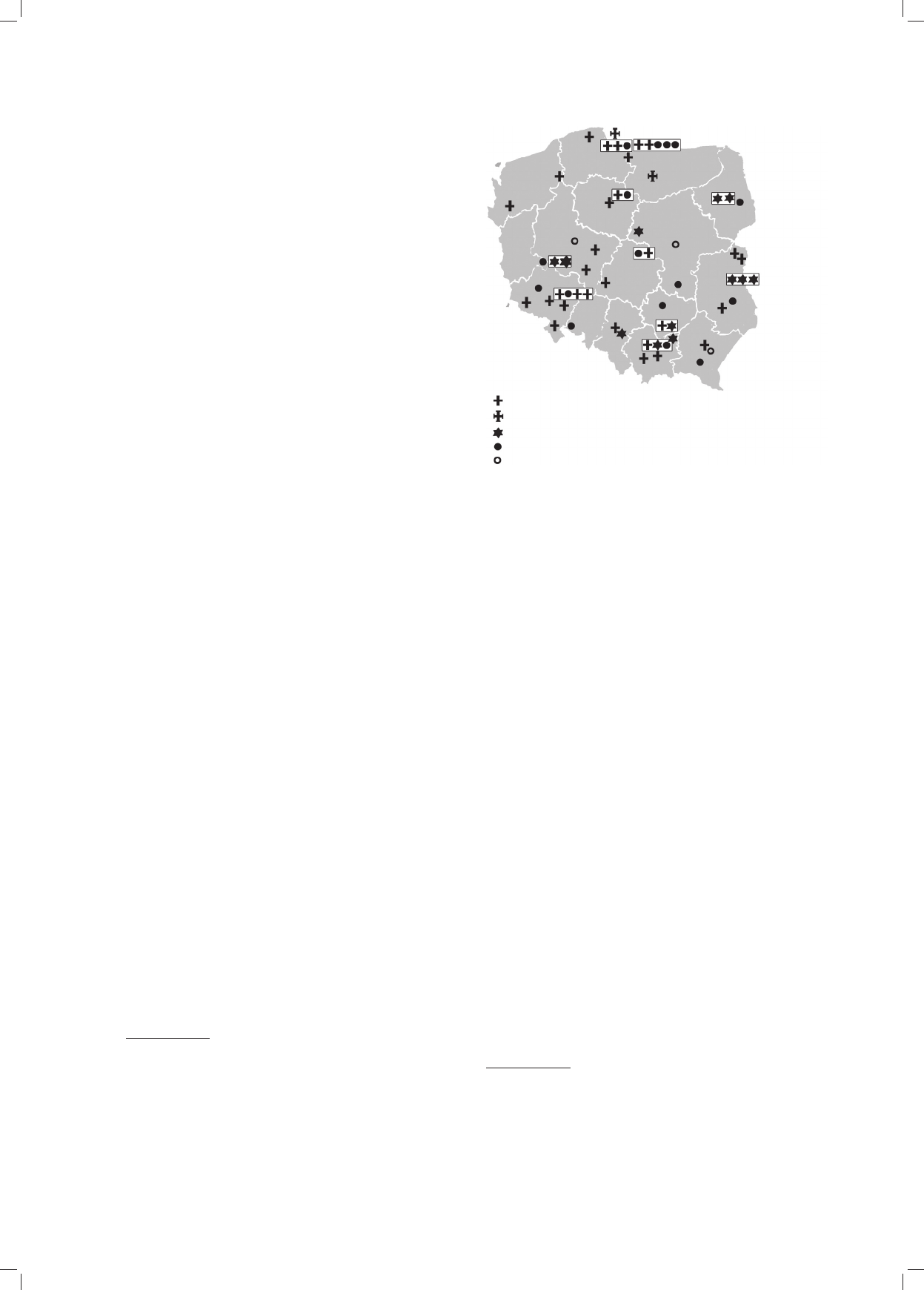
Muzea w obiektach sakralnych, które widnieją w reje-
strze NIMOZ, są rozmieszczone bardzo nierównomier-
nie (il. 2). Na Dolnym Śląsku i w Wielkopolsce relatyw-
nie duża liczba adaptacji pokrywa się z największą
w kra ju liczbą wpisanych do rejestru zabytków sakral-
nych
15
. Niewielką aktywność można zauważyć w woje-
14
Opracowanie sporządzono na podstawie listy NIMOZ, informa-
cji umieszczonych na oficjalnych stronach muzeów oraz wywiadów
i badań prowadzonych w latach 2013–2014.
15
Dolnośląskie – 1438, kujawsko-pomorskie – 509, lubelskie – 822,
lubuskie – 549, łódzkie – 572, małopolskie – 1021, mazowieckie – 1046,
opolskie – 660, podkarpackie – 1052, podlaskie – 524, pomorskie – 517,
śląskie – 599, świętokrzyskie – 499, warmińsko-mazurskie – 1128,
zachodniopomorskie – 869, [za:] Tabelaryczne zestawienie różnych
The fate of the synagogue in Leszno was uncertain.
After it was entered in the monument registry in 1991,
a de cision was made to organize the exhibition there. The
research actions and afterwards restoration works lasted
until 1999 when the Jewish Religious Community in
Wroc ław demanded to regain its property. Finally, the
Greater Poland Regional Assembly paid the Community
a compensation, not giving the property back and thus not
losing two million zlotys invested in the adaptation
works. The same modification of the law delayed the pro-
cess of transformation of the synagogue in Płock where in
1997 the City Council regained this property from the
State Treasury in order to resell it later to the city. After
some perturbations the Department of the Polish Jews
Museum was opened only in 2013.
The whole process of adaptation of sacral buildings to
registered museums in Poland after 1945 is presented in
the collective chronology shown below indicating the
time of opening a particular exhibition
14
(Table 1).
Current location of registered museums
in post-religious buildings in Poland
Museums in sacral objects that appear in NIMOZ regis-
ter are distributed in a very irregular way (Fig. 2). In Lo wer
Si lesia and Wielkopolska a relatively large number of adap-
tations coincides with the country’s largest number of re gi-
stered sacral monuments
15
. Little activity can be ob served
in the following provinces: Mazowieckie, Pod kar
pac kie
and Zachodniopomorskie. No adaption of a church for the
needs of a museum took place in Lubel skie (Lub lin) pro-
vince at all, whereas in Opolskie province there is only
one building of this type. In the provinces of eastern
Poland the focus was on setting up open-air museums.
However, another geographical feature seems to be
more significant than the assignment to the region. Fif-
teen out of sixty buildings (23%) are located in cities
which are inhabited by more than 100 000 residents.
Thirty five buildings (56%) are in small towns with fewer
than 20 000 inhabitants. Thus, it can be concluded that
these buildings are of greater significance for small com-
munities and often are one of the dominant elements of
the cultural background of a given town. This is a feature
which distinguishes this group of transformed post-reli-
gious monument buildings from among other museum
14
This study was prepared on the basis of NIMOZ list, the infor-
mation presented on official websites of museums and our own research
conducted in years 2013–2014.
15
Dolnośląskie (Lower Silesian Province) – 1438,
Kujawsko-Po-
morskie (
Kujawy-Pomerania Province) – 509,
Lubelskie (
Lublin Pro-
vince) – 822, Lubuskie (Lubuskie Province) – 549, Łódzkie (Łódzkie
Province) – 572, Małopolskie (Małopolska Province) – 1021, Mazo-
wieckie (Mazovia Province) – 1046, Opolskie (Opole Province) – 660,
Podkarpackie (Podkarpackie Province) – 1052, Podlaskie (Podlasie
Province) – 524, Pomorskie (Pomerania Province) – 517, Śląskie (Si le-
sia Province) – 599, Świętokrzyskie (Świętokrzyskie Pro vince) – 499,
Warmińsko-Mazurskie (Warmia-Masuria Province) – 1128, Zachodnio-
pomorskie (West Pomerania Pro vince) – 869, [in:] Tabelaryczne zesta-
wienie różnych typów zabytków nieruchomych wpisanych do rejestru
zabytków w podziale na województwa, taken from NIMOZ website
[accessed: 6.10.2014].
Il. 1. Przyrost liczby muzeów w obiektach poreligijnych
w latach 1945–2014
Fig. 1. Increase in the number of museums in postreligious buildings in
years 1945–2014
wszystkie
obiekty
przyrost 1,19 muzeum/rok
increase 1.19 museum/year
obiekty
sakralne
inne
obiekty
religijne
all
buildings
sacral
buildings
other
buildings

Adaptacja budynków sakralnych na cele muzealne w Polsce /Transformation of religious buildings into museums in Poland 81
Rok/Year Muzeum/Museum
1948
Muzeum w Raciborzu (w kościele św. Ducha, przed wojną ówczes ne muzeum funkcjonowało razem z Biblioteką Miejską od 1927 r.)/
Museum in Racibórz (in the Holy Spirit Church, before the war the museum functioned along with the City Library from 1927)
Muzeum Narodowe w Gdańsku (pofranciszkański klasztor, kontynuacja dawnego Stadtmuseum, pełna adaptacja w latach 1867–
1871)/National Museum in Gdańsk (post-Franciscan monastery, continuation of the Stadtmuseum, full adaptation in 1867–1871)
Muzeum Mikołaja Kopernika we Fromborku (dwie kanonie, kontynuacja izby pamięci założonej w 1912 r.)/Mikołaj Kopernik
Museum in Frombork (two Canonries, continuation of the memory chamber founded in 1912)
1952
Muzeum w Łowiczu (kompleks klasztorny i seminarium duchowne)/Museum in Łowicz (monastery complex and theological seminary)
1955 Muzeum Okręgowe w Rzeszowie (klasztor popijarski)/District Museum in Rzeszów (post-Piarist monastery)
1956
Muzeum Władysława Łęgi w Grudziądzu (opactwo benedyktynek)/Władysław Łęga Museum in Grudziądz (Benedictine nuns abbey)
1958
Stara Synagoga – Oddział Muzeum Historycznego Miasta Krakowa/
Old Synagogue – Historical Museum Department
of the City of Cracow
Muzeum Regionalne w Szczecinku (wieża zniszczonego kościoła)/Regional Museum in Szczecinek (the tower of the destroyed church)
Muzeum Józefa Ignacego Kraszewskiego w Romanowie (kaplica w kompleksie dworskim)/Józef Ignacy Kraszewski Museum
in Romanów (the chapel in the manor complex)
1959
Muzeum w Bochni im. Prof. Stanisława Fischera (klasztor dominikanów)/Prof. Stanislaw Fischer Museum in Bochnia (Dominican Monastery)
1961
Muzeum Zamkowe w Malborku (zamek krzyżacki, w kompleksie z kościołem zamkowym)/Castle Museum in Malbork
(Teutonic castle in the complex with the castle church)
Muzeum Regionalne im. Dzieci Wrzesińskich we Wrześni (szkoła katolicka)/Dzieci Wrzesińskich Regional Museum in Września
(Catholic School)
Galeria EL w Elblągu (kościół)/EL Galeria in Elbląg (the church)
1962
Muzeum Miedzi w Legnicy (pałac opatów cysterskich)/Museum of Copper in Legnica (Cistercian abbots’ palace)
Muzeum Ślężańskie im. Stanisława Dunajewskiego w Sobótce (dom opata, kontynuacja przedwojennej siedziby Heimatmuseum
od 1926 r.)/Stanisław Dunajewski Ślężańskie Museum in Sobótka (abbot’s house, continuation of the pre-war seat
of Heimatmuseum since 1926)
1964
Muzeum Regionalne w Radomiu (kościół)/Regional Museum in Radom (the church)
Muzeum Regionalne w Jaworze (kompleks klasztorny)/Regional Museum in Jawor (the monastery complex)
1965
Muzeum Architektury we Wrocławiu (kompleks klasztorny wraz z kościołem)/Museum of Architecture in Wrocław
(monastery complex along with a church)
Muzeum Historii Miasta Bytowa (wieża kościelna)/Museum of the City of Bytów History (the church tower)
1966 Muzeum w Łęcznej (synagoga)/Museum in Łęczna (the synagogue)
1967 Muzeum Archeologiczne w Krakowie (klasztor)/Museum of Archaeology in Cracow (the monastery)
1969 Muzeum Ziemi Wieluńskiej (klasztor)/Museum of Ziemia Wieluńska (the monastery)
1970
Pałac Opatów – oddział Sztuki Nowoczesnej Muzeum Narodowego w Gdańsku/Abbots’ Palace – Department of the National
Museum of Modern Art in Gdańsk
Muzeum Regionalne w Pińczowie (klasztor)/ Regional Museum in Pińczów (the monastery)
1971
Muzeum Narodowe w Kielcach (pałac biskupi)/National Museum in Kielce (the Bishop Palace)
1972
Muzeum Rybołówstwa w Helu, oddział Narodowego Muzeum Morskiego w Gdańsku (kościół ewangelicki)/Museum of Fishing
in Hel, Department of the National Maritime Museum in Gdańsk (the Evangelical Church)
1973
Muzeum im. Mikołaja Kopernika we Fromborku (pałac biskupi, dzwonnica katedralna)/Mikołaj Kopernik Museum in Frombork
(the Bishop Palace, the Cathedral belfry)
1974 Galeria Dawna Synagoga w Nowym Sączu/Old Synagogue Gallery in Nowy Sącz
1976
Muzeum im. Jacka Malczewskiego w Radomiu (zespół klasztorny)/Jacek Malczewski Museum in Radom (the monastery complex)
Muzeum Regionalne w Kraśniku (skrzydło klasztoru)/Regional Museum in Kraśnik (the monastery wing)
Muzeum Regionalne w Krasnymstawie (kolegium jezuickie)/Regional Museum in Krasnystaw (the Jesuit College)
1978
Muzeum w Tykocinie, oddział Muzeum Okręgowego w Białymstoku (synagoga i dom talmudyczny)/Museum in Tykocin,
Department of the District Museumin Białystok (the synagogue and the Talmudic house)
przywrócenie kościoła w Radomiu do funkcji sakralnej/the church in Radom has its religious function restored
1979
Muzeum Pojezierza Myśliborskiego w Myśliborzu (kaplica św. Ducha)/Museum of Pojezierze Myśliborskie in Myślibórz
(the Holy Spirit Chapel)
1983
Muzeum Południowego Podlasia w Białej Podlaskiej (kaplica w kompleksie pałacowym)/
Museum of Południowe Podlasie
in Biała Podlaska (the chapel in the palace complex)
Muzeum Pojezierza Łęczyńsko-Włodawskiego we Włodawie (dwie synagogi i dom kahalny)/Museum of Pojezierze
Łęczyńsko-Włodawskie in Włodawa (two synagogues and the Kahal house)
1984
Muzeum w Nysie (pałac biskupi)/
Museum in Nysa (the Bishop Palace)
Tabela 1. Chronologia powstawania muzeów w obiektach poreligijnych (zgodnie z aktualnym rejestrem NIMOZ)
Table 1. Chronological order of establishing museums in post-religious buildings (in accordance with the current NIMOZ registry)

82 Marta Rusnak
Rok/Year Muzeum/Museum
1985
tzw. Salon wystawowy Muzeum Budownictwa Ludowego – Park Etnograficzny w Olsztynku (kościół ewangelicki)/
the so called
Showroom of the Folk Construction Museum – Ethnographic Park in Olsztynek (the Evangelical Church)
Muzeum Ziemi Pyzdrskiej w Pyzdrach (klasztor)/Museum of Ziemia Pyzdrska in Pyzdrach (the monastery)
Muzeum Historii Miasta Bytowa, oddział Muzeum Zachodniokaszubskiego w Bytowie (wieża zrujnowanego kościoła)/Museum of
the City of Bytów History, Department of Zachod nio kaszubskie Museum in Bytów (the tower of the destroyed church)
1986 Muzeum Ziemi Kłodzkiej w Kłodzku (konwikt)/Museum of Ziemia Kłodzka in Kłodzko (the boarding monastery school)
1987
Muzeum Regionalne im. Hieronima Ławniczaka w Krotoszynie (zakon trynitarzy)/Hieronim Ławniczak Regional Museum
in Krotoszyn (Trinitarian Order)
1989 Muzeum Regionalne w Pińczowie (synagoga)/Regional Museum in Pińczów (the synagogue)
1990 Muzeum – Zamek w Łańcucie (synagoga)/Museum – Castle in Łańcut (the synagogue)
1991
oddział Muzeum Mikołaja Kopernika we Frombork, szpital św. Ducha – dział historii medycyny (kaplica św. Anny)/Mikołaj
Kopernik Museum Department in Frombork – the Holy Spirit Hospital – department of medical history (St. Ann Chapel)
1993
Galeria Sztuki Muzeum Okręgowego w Lesznie (dom przed pogrzebowy na terenie dawnego cmentarza żydowskiego)/Regional
Museum Art Gallery in Leszno (the funeral house in the territory of the former Jewish cemetery)
1995
Muzeum Podkarpackie w Krośnie (pałac biskupi)/Podkarpackie Museum in Krosno (the Bishop Palace)
1996
Muzeum Zegarów Wieżowych, oddział Narodowego Muzeum Morskiego w Gdańsku (wieża kościoła)/Tower Clock Museum,
Deaprtment of the National, Maritime Museum in Gdańsk (the church tower)
1997 Muzeum Lubelskie w Lublinie (Kaplica Trójcy Świętej)/Lubelskie Museum in Lublin (the Holy Trinity Chapel)
1999
Galeria Sztuki Muzeum Okręgowego w Lesznie (synagoga)/Regional Museum Art Gallery in Leszno (the synagogue)
Galeria Erazma Ciołka, Oddział Muzeum Narodowego w Krakowie (pałac biskupi)/Erazm Ciołek Gallery, the National Museum
Department in Cracow (the Bishop Palace)
2000
Centrum Ż
ydowskie w Oświęcimiu (synagoga i dom wspólnoty)/Auschwitz Jewish Centre (the synagogue and
the community house)
2001
Muzeum Regionalne w Handzlówce (stara plebania)/Regional Museum in Handzlówka (the former parsonage)
2002 Muzeum Ziemi Wiśnickiej (dzwonnica kościelna)/Museum of Ziemia Wiśnicka (the church bel fry)
2004
Muzeum Drukarstwa i Papiernictwa Grębocinie k. Torunia (kościół)/Museum of Printing and Paper Industry in Grębocin near
Toruń (the church)
Muzeum Etnograficzne, oddział Muzeum Narodowego we Wrocławiu (pałac biskupów)/Ethnographic Museum, the National
Museum Department in Wrocław (the Bishop Palace)
Muzeum Browaru Tychy, obecna nazwa Browarium Tyskie (kaplica w kompleksie browaru)/Brewery Museum
in Tychy, the present name Bro wa rium Tyskie (the chapel in the brewery complex)
2006
Muzeum Ikon w Supraślu, oddział Muzeum Podlaskiego w Białymstoku (monaster)/Museum of Icons in Supraśl,
Museum Podlaskie Department in Białystok (the monastery)
Nadbałtyckie Centrum Kultury Gdańsk, oddział Centrum św. Jana (kościół)/Baltic Sea Culture Centre Gdańsk,
St. John Centre Department (the church)
2007
Muzeum Ziemi Koszyckiej im. Stanisława Boducha w Koszycach (synagoga)/Stanisław Boduch Museum of Ziemia Koszycka
in Koszyce (the synagogue)
2011
Dom modlitwy, obiekt pod zarządem Muzeum Zagłębia w Będzinie/House of Prayer, the building under the management
of Zagłębie Museum in Będzin
Muzeum Uniwersytetu Kardynała Stefana Wyszyńskiego w Warszawie (eremitorium)/Cardinal Stefan Wyszyń
ski University Museum
in Warsaw (the hermitage)
2013
Muzeum Ziemi Wschowskiej (rezydencja jezuicka)/Museum of Ziemia Wschowska (the Jesuit residence)
Muzeum Przyrodnicze w Jeleniej Górze (pocysterski klasztor)/Museum of Nature in Jelenia Góra
(the post-Cistercian monastery)
Dział Muzeum Żydów Mazowieckich w Muzeum Mazowieckim w Płocku (synagoga)/Museum Department of Mazovian Jews
in Mazovian Museum in Płock (the synagogue)
2014
przejęcie synagogi w Łańcucie przez Związek Wyznaniowy Żydowski/the synagogue was taken over by the Jewish Religious
Association in Łańcut
przejęcie synagogi w Łęcznej przez Związek Wyznaniowy Żydowski/the synagogue was taken over by the Jewish Religious
Association in Łęczna
Tabela 1. Chronologia powstawania muzeów w obiektach poreligijnych (zgodnie z aktualnym rejestrem NIMOZ) cd.
Table 1. Chronological order of establishing museums in post-religious buildings (in accordance with the current NIMOZ registry) cont.
W tabeli użyto następujących oznaczeń:/The following markings are used in the Table:
Kursywa – obiekty to warzyszące, otwarcie jednostki znaj dującej się w rejestrze NIMOZ/Italics – accompanying objects, opening the unit which is
entered in the register NIMOZ
Podkreślony – utrata statusu muzeum w rejestrze NIMOZ/Underlined – deprived of the museum status in NIMOZ register
Spacjowany – otwarcie jednostki niewidniejącej w rejestrze NIMOZ/Spacing – opening the unit which is not entered in NIMOZ register
Adaptacja budynków sakralnych na cele muzealne w Polsce /Transformation of religious buildings into museums in Poland 83
wództwach: mazowieckim, podkarpackim i zachodnio-
pomorskim. Do adaptacji kościoła na potrzeby muzeum
w ogóle nie doszło w województwie lubuskim, a w wo -
je wództwie opolskim jest tylko jeden taki obiekt. W woje -
wództwach wschodniej Polski skupiono się na tworzeniu
skan senów.
Jednak inna cecha geograficzna wydaje się bardziej
znacząca niż przyporządkowanie do regionu. Piętnaście
z sześćdziesięciu obiektów (23%) znajduje się w mia-
stach, które zamieszkuje więcej niż 100 tysięcy ludzi.
Trzydzieści pięć obiektów (56%) znajduje się w małych
miejscowościach, poniżej 20 tysięcy mieszkańców. Moż-
na z tego wnioskować, iż obiekty te mają większe znacze-
nie dla małych społeczności i często stanowią jeden
z dominujących elementów zaplecza kulturowego danej
miejscowości. Jest to cecha wyróżniająca tę grupę trans-
formowanych poreligijnych obiektów zabytkowych po -
śród innych adaptacji muzealnych. Przykładowo około
80% zabytków poprzemysłowych przystosowywanych
do potrzeb ekspozycji znajduje się w dużych miastach
[14], [15]. Również nowo projektowane gmachy lokali-
zuje się obec nie głównie w dużych aglomeracjach: War-
szawie, Gdańsku, Kato wi cach i Krakowie.
Niewidniejące w Bazie Muzeów w Polsce NIMOZ
adaptacje obiektów sakralnych
na potrzeby ekspozycyjne
Ilustracja 1 oraz wcześniejsza analiza lokalizacji wy -
glądałyby z pewnością nieco inaczej, jeśli uwzględnio-
no by w nich wszystkie prywatne przedsięwzięcia, nie
tylko te zgłoszone do NIMOZ. Kompletna lista obiek-
tów religijnych, które nie są muzeami, a pełnią funkcje
ekspozycyjne, jest trudna do prześledzenia
16
. Z tego po -
wodu je dynie sygnalizuję kilka odnalezionych lokaliza-
cji. Wśród nich znajdują się Galeria EL w Elblągu (ko-
ściół, adaptacja – 1961 r., przebudowa – 2007–2013 [16]),
Centrum Ży dowskie w Oświęcimiu (synagoga i dom
wspólnoty, 2000), Tyskie Browarium (kaplica ewange-
licka na terenie Bro waru Ksiażęcego, 2004) [17], a także
wielofunkcyj ne wnętrze oddziału Nadbałtyckiego Cen-
trum Kultury Gdańsk, Centrum św. Jana (kościół, ada-
ptacja i przebudowa 1995–2006)
17
[9]. Równie dużo
współczesnych kulturalnych wątków wpleciono w struk-
turę funkcjonowania Synagogi pod Białym Bocianem we
Wrocławiu (2006). Planowane jest również ekspozycyj-
ne przekształcenie synagogi w Chmielniku, według na -
kierowanego na multimedia projektu biura Nizio Design
Inter national. Ma ona pełnić funkcję muzeum i ośrodka
edukacji.
typów zabytków nieruchomych wpisanych do rejestru zabytków w po -
dziale na województwa, ze strony nimoz.pl [data dostępu: 6.10.2014].
16
Wyszukiwanie wszystkich instytucji zarejestrowanych jako ga -
leria lub muzeum zgodnie z numerem Regon jest możliwe, jednak
odmówiono w GUS udostępnienia listy nazw tych jednostek. W Bazie
Muzeów NIMOZ nie widnieją również jednostki zlikwidowane, co
może zakłamywać rys historyczny.
17
Obiekt nie uległ dekonsekracji. Centrum podpisało z biskup-
stwem 50-letnią umowę dzierżawy. W dalszym ciągu od czasu do czasu
są tam odprawiane msze.
adaptations. For example, about 80% of post-industrial
mo numents which have been adapted for the needs of ex -
hi bitions are in big cities [14], [15]. Also newly de signed
edifices are at present situated mainly in large agglomera-
tions such as Warsaw, Gdańsk, Katowice and Cracow.
Adaptations of sacral buildings
for exhibition needs which are not entered
in the NIMOZ Base of Museums in Poland
Figure 1 as well as the previous analysis of the loca tion
would certainly look slightly different if all private enter-
prises, and not only the ones reported to NIMOZ, had
been taken into consideration. It is difficult to track down
a complete list of religious buildings that are not muse-
ums but perform exhibition functions
16
. For this reason,
I only indicate several rediscovered locations. Among
them there is EL Gallery in Elbląg (the church, adapta tion
– 1961, reconstruction – 2007–2013 [16]), the Jewish
Centre in Oświęcim (the synagogue and the community
house, 2000), Tyskie Browarium (Bre we ry, the Evan-
gelical chapel in the territory of Ksią żęcy Brewery, 2004)
[17] as well as the multifunc tio nal in terior of the Bal tic
Sea Culture Centre Gdańsk, St. John Centre (the church,
adaptation and reconstruc tion 1995–2006)
17
[9]. An equal-
16
Searching all institutions registered as galleries or museums in
accordance with Regon Number is possible, however, the Central Sta-
tistical Office refused to provide a list of names of those entities. There
are no liquidated units in the NIMOZ Museum Base either, which might
falsify the historical truth
.
17
The building was not deconsecrated. The Centre signed
a 50-year lease agreement with the Bishopric. The Holy Masses are still
celebrated there from time to time.
Il. 2. Lokalizacje muzeów rejestrowych w obiektach poreligijnych
w Polsce (2014)
Fig. 2. Listed museums in postreligious buildings
in Poland (2014)
kościoły i zakony churches and monasteries
kościoły protestanckie Protestant churches
synagogi, domy talmudyczne
synagogues, Talmudic houses
rezydencje opatów/biskupów abbots/bishops stately homes
inne: plebanie, seminaria, szkoły others: rectorys, schools

84 Marta Rusnak
Muzea kościelne
w zabytkowych obiektach
otwarte w latach 1945–2014
Zbadanie wszystkich nawet najmniejszych ekspozycji
kościelnych zorganizowanych w Polsce jest praktycznie
niewykonalne
18
. Na szczęście różnorodność ich rozmia-
rów i sposobu organizacji uniemożliwia rozpatrywanie
ich w jed nej kategorii. Dlatego w artykule omówione zo -
staną wyłącznie ekspozycje o wysokiej randze, które nie
tyl ko nazwano muzeum, ale również działają jak mu zeum.
Z pewnością jednak należy wspomnieć o miejs cach, które
mają charakter nie tylko regionalny, ale po sia dają status
Pomnika Narodowego. Do tej grupy zaliczyć należy klasz-
tor na Jasnej Górze, katedrę na Wa welu, kościół Mariacki
czy katedrę w Gnieźnie
19
, które same w sobie nie są mu -
zeami, ale otoczone są opieką konserwatorsko-muzealną.
Każde większe miasto posiada historyczne przestrzenie
sakralne udostępniane turystom. Ich dominującą funkcją
pozostaje jednak sprawowanie kultu i nie zostaną włączo-
ne do opracowania.
Szczególnie w ostatnim dziesięcioleciu, już w suwe-
rennej Rzeczypospolitej, powstały liczne muzea kościel-
ne
20
.
W 40 obecnych diecezjach są 24
21
muzea archi-
diecezjalne lub diecezjalne [10]. Pośród tych muzeów
die cezjalnych tylko 14 spełnia warunki włączenia do op ra-
co wania
, pozostałe nie są prawnie uznane za zabyt ki bądź
zaprojektowano je od podstaw na potrzeby ekspo zycyjne.
W tej grupie widnieją cztery klasztory i opactwa, dzwon-
nica i wieża kościelna oraz dziewięć
22
innych budynków,
które funkcjonalnie były ściśle połączone z działaniem
wspólnoty Kościoła (tab. 2).
Analiza zbiorcza
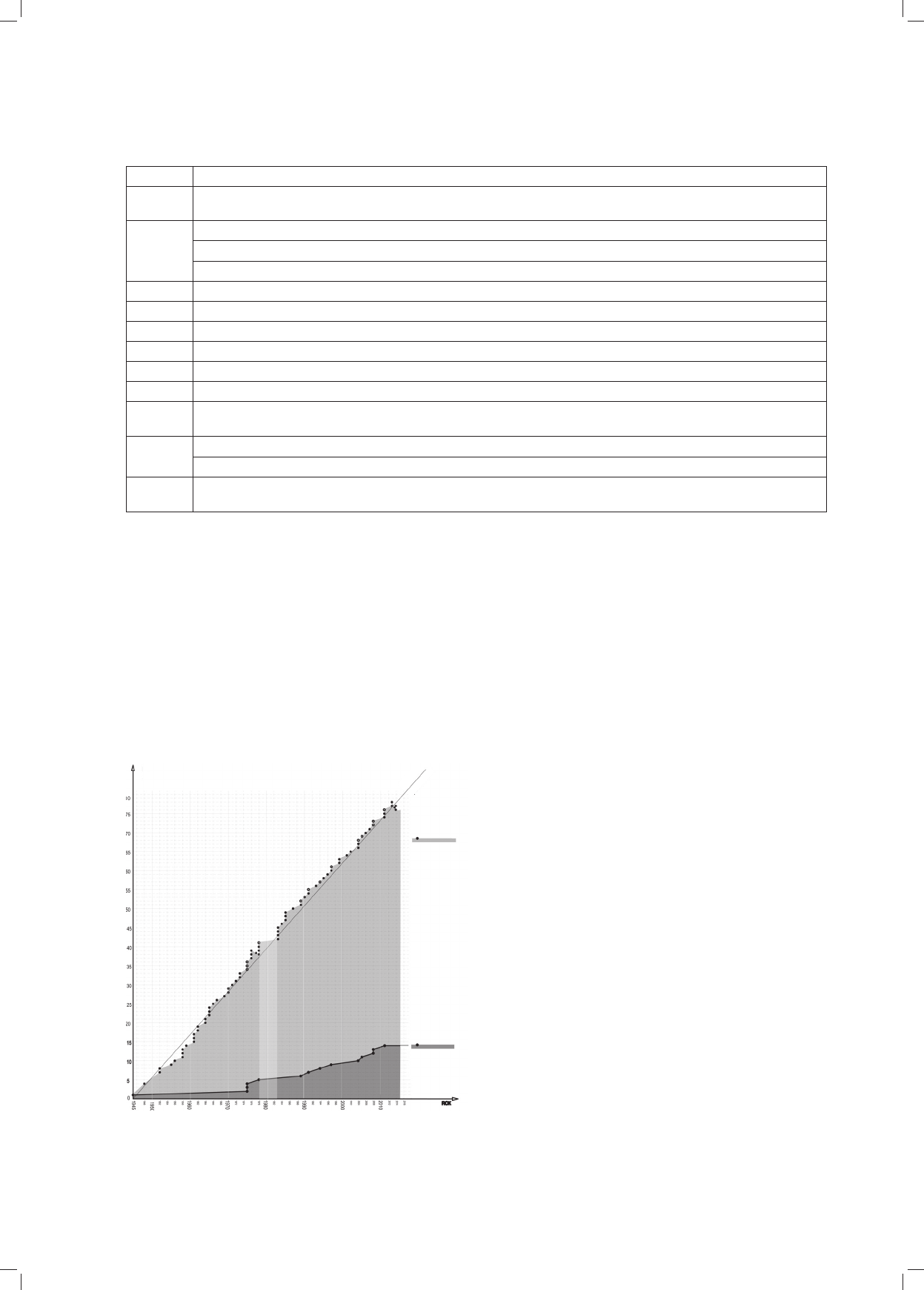
Przedstawione muzea stały się nową funkcją dla 77 bu -
dynków będących pozostałościami po kulturze material-
nej różnych religii w Polsce. Na zbiorczym wykresie
chronologii obu grup można zauważyć, że od roku 1975
dzięki zaangażowaniu Kościoła ponownie zdynamizo-
wało się tempo opisywanego zjawiska (il. 3). Rozwój
koś ciel nego muzealnictwa został zainicjowany przez do -
kument Epi skopatu Polski z 1973 r. wdrażającego sfor-
mułowane dwa lata wcześniej wytyczne Stolicy Apo-
stolskiej. W 1979 r. Episkopat rozwinął prawny as pekt
funkcjonowania tych ekspozycji, wskazując nawet, [...]
aby każda diecezja, o ile to możliwe, posiadała własne
mu zeum diecezjalne [10, s. 62–63]. Na wykresie nie za -
uważa się szybkich skutków wprowadzenia tej uchwały.
18
Pod względem metodologicznym trudno stwierdzić komplet-
ność takiego zbioru.
19
W Częstochowie istnieje wiele wystaw dotyczących nie za -
gadnień religii, ale świętości w rozumieniu obrony ojczyzny czy działań
pro spo łecznych i charytatywnych (w Arsenale, w Kaplicy, w nowym
budynku).
20
W wyniku badań odnalazłam dotychczas blisko 70 muzeów
koś cielnych.
21
Do tej pory odnalazłam ponad 65 miejsc, w których wspólnoty
kościelne zorganizowały muzeum (il. 4).
22
Liczymy nie muzea, a adaptowane budynki.
ly significant number of contemporary cultural motifs can
also be noticed in the functional structure of the White
Stork Synagogue in Wrocław (2006). There are also plans
to transform a synagogue in Chmielnik according to
a multi-media ex hibition design of Nizio Design In ter-
national Studio. This building is intended to serve the pur-
pose of a museum and educational centre.
Church museums in historical buildings
opened in the years 1945–2014
It is practically impossible to track down all the church
exhibitions that were organised in Poland, including even
the smallest ones
18
. Luckily, the variety of their sizes and
methods of organisation does not allow us to consider
them as a single category. Therefore, we are exclusively
focusing on the high-rank exhibitions that are not only
museums by name, but are actually used as museums. We
must mention the objects that are not limited to a particu-
lar region, but have the status of National Monuments.
This group comprises the monastery in Jasna Góra, the
Wawel Cathedral, St. Mary’s Basilica in Cracow or the
Cathedral in Gniezno
19
, which are not museums as such,
but are under the conservation protection like museums.
Every major city has historical sacral spaces which are
made available to tourists. Their predominant function,
however, remains the worship purpose and therefore, they
will not be included in this study.
Especially during the last decade, already in the sover-
eign Republic of Poland, numerous church museums
were founded
20
. In the currently existing 40 dioceses
there are 24
21
archdiocesan or diocesan museums [10].
Among these diocesan museums only 14 meet the re qui-
rements of inclusion in the study, whereas the remaining
ones are not legally recognized as monuments or they
were designed from scratch for the exhibition needs.
In this group there are four monasteries and abbeys,
a belfry and a spire as well as other nine
22
buildings
which were closely connected with the activities of the
Church community as to their function (Table 2).
Collective analysis
The museums presented in this study became a new
function for 77 buildings which were the remnants of the
material culture of various religions in Poland. In the col-
lective chart of the chronology of the two groups it can be
noted that since 1975, thanks to the commitment of the
Church, the pace of the described phenomenon has be -
come more dynamic again (Fig. 3). The development of
18
In terms of methodology, it is difficult to confirm the complete-
ness of this type of collection.
19
In Częstochowa there are many exhibitions which do not refer
to religion issues but to holiness understood as the defense of the moth-
erland or pro-social and charity activities (in the Arsenal, in the Chapel,
in a new building).
20
As a result of research, I have found nearly 70 church museums so far.
21
So far I have found over 65 places where church communities
organized museums (Fig. 4).
22
We do not include museums here, but adapted buildings.
Adaptacja budynków sakralnych na cele muzealne w Polsce /Transformation of religious buildings into museums in Poland 85
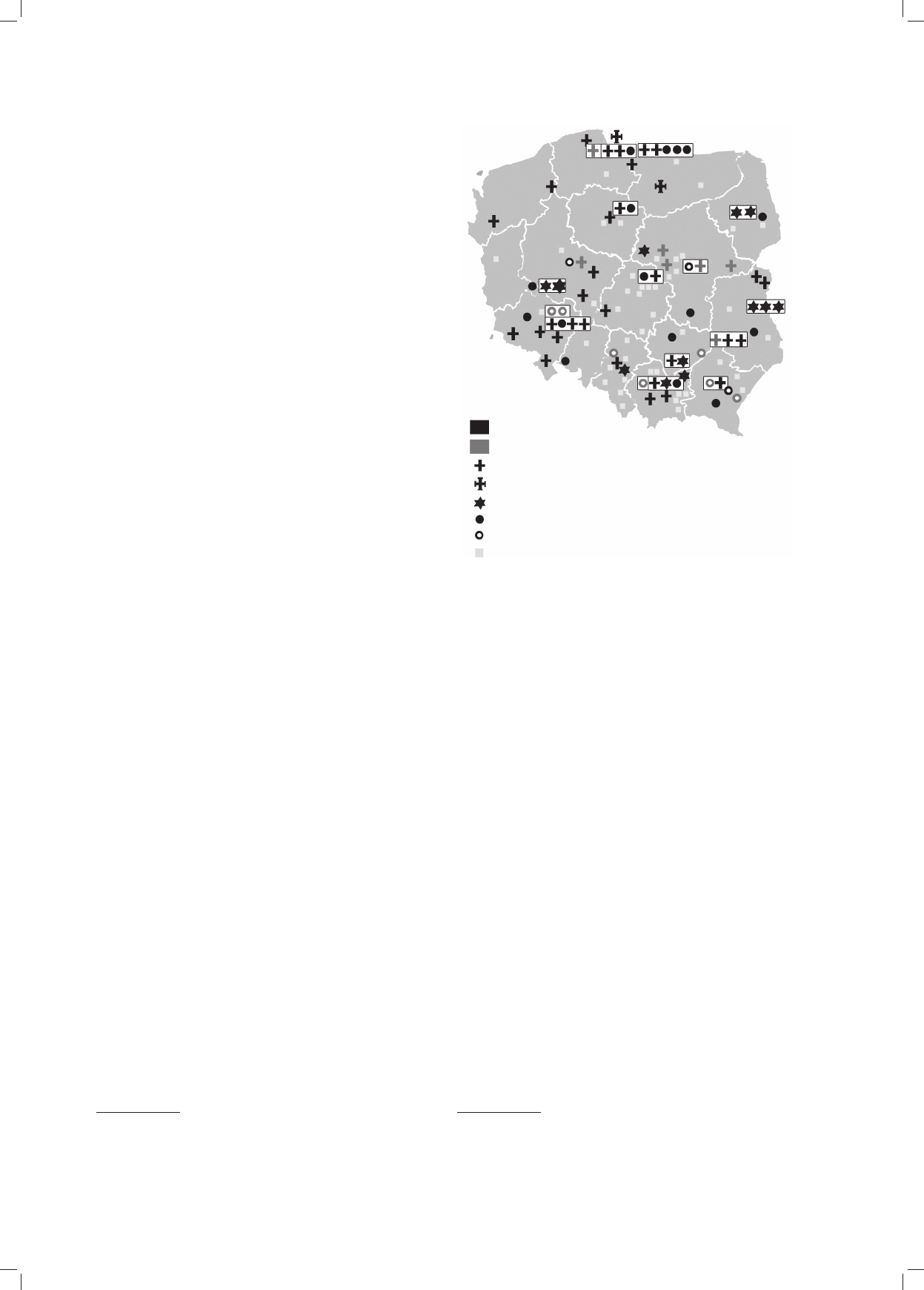
Rozszerzenie liczby rozpatrywanych muzeów uwy-
pukla odnotowane wcześniej dysproporcje pomiędzy róż-
nymi regionami kraju. Najczęściej transformowane były
majątki poreligijne w województwie dolnośląskim (10
obiektów), warmińsko-mazurskim (8), małopolskim (7).
Liczne muzea można też odwiedzić w województwie lu -
the church museology was initiated by the Polish
Episcopate’s document issued in 1973 which implement-
ed the guidelines of the Holy See formulated two years
earlier. In 1979 the Episcopate developed the legal aspect
of the func tioning of these exhibitions, even indicating
that [...] every diocese, as far as possible, should have its
own dio cese museum [10,
pp. 62–63]. The quick effects of
introducing this resolution cannot be seen in the chart.
Increasing the number of the investigated museums
emphasizes the previously noted disproportions between
different regions of the country. Post-religious properties
were most often transformed in Lower Silesia province
(10 buildings), in Warmińsko-Mazurskie (8), Małopolskie
(7). Numerous museums can be also visited in Lublin (6)
and Pomeranian provinces (6). The north-western part of
Poland is almost empty (Fig. 4).
Extending the group of the researched locations makes the
growth rate of museums over time practically steady. Due to
the fact that the most important collections were placed in
diocese capitals, also the proportion of museums lo cated in
big and small cities was changed and it drew closer
to the
national average. Cities which come first in this com petition
are Gdańsk, Wrocław, Frombork, Cracow and Lublin.
Conclusions
The museums located in the buildings performing reli-
gious functions in the past constitute nearly 7% of the
total national museum resource in Poland. This trend is
also developing thanks to the Church itself, although
mainly as an element accompanying a sacral function,
e.g. a pilgrimage function.
Il. 3. Przyrost liczby muzeów diecezjalnych
w obiektach poreligijnych w latach 1945–2014
Fig. 3. Increase in the number of diocesan museums
in postreligious buildings in years 1945–2014
Tabela 2. Chronologia powstawania muzeów kościelnych w Polsce
Table 2. Chronology of establishing church museums in Poland
Rok/Year Muzeum/Museum
1936–1937
Muzeum Diecezjalne w Sandomierzu (mansjonaria, tzw. Dom Długosza)/Diocesan Museum in Sandomierz (vicars’ house,
so called Długosz House)
1975
Muzeum Archidiecezjalne w Gdańsku (klasztor)/
Archdiocesan Museum in Gdańsk (the monastery)
Muzeum Archidiecezjalne w Katowicach (dawna kuria)/
Archdiocesan Museum in Katowice (the former curia)
Muzeum Archidiecezjalne Sztuki Religijnej w Lublinie (dzwonnica)/Archdiocesan Museum of Religious Art in Lublin (the belfry)
1978 Muzeum Archidiecezji Warszawskiej (klasztor trynitarzy)/Museum of Warsaw Archdiocese (the Trinitarian Monastery)
1989
Muzeum Archidiecezjalne we Wrocławiu (budynek kapituły)/Archdiocesan Museum in Wrocław (the Chapter building)
1991 Muzeum Archidiecezjalne w Gnieźnie (kolegiata)/Archdiocesan Museum in Gniezno (the collegiate)
1994
Muzeum Archidiecezjalne w Krakowie (dwie kanonie z kaplicami)/Archdiocesan Museum in Cracow (two canonries with chapels)
1997
Muzeum Diecezjalne w Rzeszowie (dawna kuria)/Diocesan Museum in Rzeszów (the former curia)
2004 Muzeum Diecezjalne w Drohiczynie (pofranciszkański klasztor)/Diocesan Museum in Drohiczyn (the post-Franciscan monastery)
2005
Włocławskie Muzeum Diecezjalne (rezydencja biskupa, potem kolegium wikariuszy)/Włocławek Diocesan Museum
(the Bishop residence, later the vicars’ college)
2008
Muzeum Archidiecezjalne w Przemyślu (pojezuickie oratorium)/Archdiocesan Museum in Przemyśl (the post-
Jesuit oratory)
Muzeum Diecezjalne w Płocku (opactwo benedyktyńskie)/Diocesan Museum in Płock (the Benedictine Abbey)
2011
Muzeum Diecezjalne w Łowiczu (fragment kościoła, w tym wieża)/Diocesan Museum in Łowicz (a fragment of the church,
including the tower)
W tabeli użyto następujących oznaczeń:/The following markings are used in the Table:
Kursywa – obiekty to warzyszące, otwarcie jednostki znaj dującej się w rejestrze NIMOZ/Italics – accompanying objects, opening the unit which
is entered in the register NIMOZ
wszystkie
muzea
NIMOZ
oraz diecezjalne
muzea
diecezjalne
diocesan
museums
museums
listed in
NIMOZ
and diocesan
museums
przyrost 1,19 muzeum/rok
increase 1.19 museum/year
86 Marta Rusnak
The steady rate of the presented adaptations of church-
es does not fit the general architectural and museum
slowdown observed in the years 1998–2008 as well as the
boom in the years 2008–2013 [14], [18]. The aforemen-
tioned five-year boom of museology referred to
a par ti cu-
larly large number of post-industrial buildings which in -
creased the resource of registered museums [15]
23
.
In addition, many actions were taken in order to revive
the places of worship by means of other forms of artistic
and service activities. Theatres, art galleries, concert
halls, and libraries function in them. It is possible that the
traditional understanding of the museum-treasury will in
time cease to be a function which can revitalize churches
and religious properties. The perspective of the continuous
growth in the number of visitors to museums can seem
quite comforting
24
. In 2007 it was 20.3 million, whereas
in 2013 it was already 29.0 million people [14]. The num-
ber of museums also increased from 720 departments
(785 buildings) in 2007 to 822 departments (901 build-
ings) in 2013. According to the data from the CSO report,
statistically in each unit the attendance increased by 26%.
Private realisations which are not registered in NIMOZ
indicate a clear tendency to include art galleries and his-
torical exhibitions in a wider service and artistic program.
23
This general tendency is confirmed by CSO Reports on The
activities of cultural institutions
in the years 2007–2013. At that time,
the number of all museum departments increased by 102 units.
24
Many researchers doubt the research results on attendance,
among others Dorota Folga-Januszewska [18].
belskim (6) i pomorskim (6). Prawie pusta jest północno-
-zachodnia cześć Polski (il. 4).
Powiększenie grupy badanych lokalizacji sprawiło, że
tempo przyrostu muzeów w czasie jest praktycznie jedno-
stajne. Ze względu na umieszczanie najważniejszych ko -
lekcji w stolicach diecezji zmianie uległa też propor cja
muzeów zlokalizowanych w dużych i w małych mias tach,
zbliżając się do średniej krajowej. W rywalizacji miast
prym wiedzie Gdańsk, Wrocław, Frombork, Kraków
i Lublin.
Wnioski
Muzea w obiektach pełniących w przeszłości funkcje
religijne stanowią niemal 7% całego państwowego zaso-
bu muzealnego w Polsce. Nurt ten rozwija się również
dzięki samemu Kościołowi, choć głównie jako element
towarzyszący funkcji sakralnej np. pielgrzymkowej.
Jednostajne tempo przedstawionych adaptacji kościo-
łów nie przystaje zarówno do ogólnego architektoniczno-
-muzealnego spowolnienia zaobserwowanego w latach
1998–2008, jak i boomu z lat 2008–2013 [14], [18].
Wspom niany pięcioletni rozkwit muzealnictwa dotyczył
szcze gólnie dużej liczby obiektów poprzemysłowych, któ -
re powiększyły zasób muzeów rejestrowych [15]
23
.
Dodatkowo podjęto już wiele działań ożywiających
miejsca kultu innymi formami aktywności artystycznej
i usługowej. Funkcjonują w nich teatry, galerie sztuki,
sale koncertowe, biblioteki. Możliwe, że tradycyjnie ro -
zu miane muzeum-skarbiec z czasem przestanie być funk-
cją, która może rewitalizować kolejne kościoły i majątki
religijne. Pocieszająca może być perspektywa ciągłego
wzrostu liczby odwiedzających muzea
24
. W 2007 r. było
to 20,3 mln, a w 2013 już 29,0 mln osób [14]. Zwiększyła
się również liczba muzeów z 720 oddziałów (785 budyn-
ków) w 2007 r. do 822 oddziałów (901 budynków)
w 2013 r. Dla danych z raportu GUS statystycznie w każ-
dej jednostce frekwencja wzrosła o 26%.
Prywatne realizacje niezarejestrowane w NIMOZ sy -
gnalizują czytelną tendencję włączania galerii sztuki oraz
ekspozycji historycznych w szerszy program usługowy
i artystyczny. Jest to jeden ze sposobów na obniże -
nie wydatków na utrzymanie obiektu. Wydaje się, że ze
względów ekonomicznych musi on być kontynuowany.
Kultura bez dotacji i bez powiązania z sektorem usług
niestety nie ma szansy na przetrwanie, czego wyraz od -
najdziemy między innymi w artykule profesora Marka
Pabicha pod tytułem Ekonomika architektury i przestrzeni
muzealnej [19], [20].
Tym samym należy się spodziewać wielorakich prze-
mian w odniesieniu do ożywiania dawnych przestrzeni
aktywności religijnej. Z tego powodu w najbliższej przy-
szłości należy zadbać o zawiązanie współpracy środo-
wisk religijnych i naukowych. Efektem dyskusji powinna
23
Ogólną tendencję potwierdzają Raporty GUS o Działalności
instytucji kultury w latach 2007–2013. W tym czasie liczba wszystkich
oddziałów muzealnych wzrosła o 102 jednostki.
24
Badania dotyczące frekwencji podaje w wątpliwość wielu bada-
czy, m.in. Dorota Folga-Januszewska [18].
Il. 4. Lokalizacje muzeów w różnych obiektach poreligijnych
w Polsce (2014)
Fig. 4. Museums in different postreligouis buildings in Poland (2014)
muzeum (archi)diecezjalne (arch)diocesan museum
kościoły i zakony churches and monasteries
zbory ewangelickie Evangelical churches
synagogi, domy talmudyczne
synagogues, Talmudic houses
rezydencje opatów/biskupów abbots/bishops stately homes
inne: plebanie, seminaria, szkoły others: rectorys, schools
niezakwalifikowane muzea kościelne
non-classified church museums
muzeum rejestrowe registered museum

Adaptacja budynków sakralnych na cele muzealne w Polsce /Transformation of religious buildings into museums in Poland 87
It is one of the methods to reduce the costs of mainte-
nance of the building. It seems that due to economic rea-
sons it must be continued. The culture without funding
and without any connection with the services sector,
un for tunately, has no chance of survival, which was ex -
pressed, inter alia, in the article entitled Ekonomika ar chi-
tektury i przestrzeni muzealnej (Economics of Archi tec-
ture and Museum Space) written by Professor Marek
Pabich [19], [20].
Thereby, we should expect diversified transformations
in relation to the revival of the former religious activity
spaces. That is why we ought to consider ways of starting
cooperation of religious and scientific environments in
the nearest future. This discussion should result in the ex -
change of experiences and arriving at an outline of accept-
able adaptation measures. Without defining the method of
supervising the quality and the function adequacy required
in Canon Law [21]
25
, after including these buildings in
the free market mechanisms, it will be very difficult to
control this phenomenon. Without constructing a com-
munication thread, colourful spiral slides and swimming
pools situated inside the basilica in Licheń,
shown at
11 Ve nice Biennale of Architecture, may in time turn out to
be something more than just an artistic experiment. At pre-
sent, the number of abandoned churches is relatively low
but still some primitive provocations did take place. For
example, in a church in Wieldządz a nightclub with strip
tease was arranged. This topic was so interesting that in
2002 the Polish Television made a documentary entitled
Holy Sin [22]. A similar feeling of disgust can be aroused
by the main attraction of the bar opened in a former church
in Edinburgh, i.e. from the coffin situated in the middle
part of the bar a figure of the film monster Frankenstein
emerges from time to time and walks around the place.
As part of a call for more frequent generating and sti-
mulating a discussion on artistic patrimony of the Church,
we can mention a statement made by Rev. Pro fessor
R. Kna piński during the Conference “Museum and Mo -
nument. Conflict or Harmony?”. His comment referring
to the museum Het Catherijnecevert in Utrecht was worth
remembering: This is a religious Art museum. When I was
there, I felt that although everything was in its place as
before secularisation, in fact God moved out of this con-
vent, this church and this monastery... [23, pp. 145–146].
This observation is sad but it is true. In parallel with the
secularisation of the society, holiness leaves the buildings
which were erected over the years. In the light of this
statement, it seems that the only remedy for making God
stay in churches and at the same time preserving their
structure in the best possible way along with their full
semantic context, is to make sure that practising Catholics
will not be leaving religious communities.
Translated by
Bogusław Setkowicz
25
Canon 1222 – § 1: If a church cannot in any way be used for
divine worship and there is no possibility of its being restored, the dioc-
esan Bishop may allow it to be used for some secular but not unbecom-
ing purpose [21].
być wymiana doświadczeń oraz stworzenie zarysu do -
puszczalnych działań adaptacyjnych. Bez wyznaczenia
sposobu nadzorowania jakości i wymaganej w Prawie
Ka nonicznym adekwatności funkcji [21]
25
, po włączeniu
tych obiektów w mechanizmy wolnego rynku, kontrola
tego zjawiska będzie bardzo trudna. Bez zbudowania nici
porozumienia kolorowe kręcone zjeżdżalnie i baseny
umieszczone we wnętrzu bazyliki w Licheniu, pokazane
na 11. Biennale Architektury w Wenecji, mogą z czasem
okazać się czymś więcej niż tylko artystycznym ekspery-
mentem. Obecnie liczba opuszczonych świątyń jest rela-
tywnie niewielka, a i tak dochodzi do prymitywnych
pro wokacji. W kościele w Wieldządzu urządzono klub
noc ny ze striptizem. Temat był na tyle interesujący, że
w 2002 r. Telewizja Polska zrealizowała film dokumental-
ny pod tytułem Święty grzech [22]. Podobnie niesmak
mo że budzić główna atrakcja baru otwartego w dawnym
kościele w Edynburgu: z trumny zamocowanej na środku
lokalu co jakiś czas wyłania się i spaceruje figura filmo-
wego potwora Frankensteina.
Wołaniem o częstsze podejmowanie i pogłębianie dys-
kusji na temat artystycznego patrymonium Kościoła była
wypowiedź ks. prof. Ryszarda Knapińskiego w czasie kon-
ferencji
„Muzeum a zabytek. Konflikt czy harmonia?”.
God na zapamiętania była wypowiedź odnosząca się do
mu zeum Het Catherijnecevert w Utrechcie: Jest to mu -
zeum Sztuki religijnej. Kiedy tam byłem, poczułem, że choć
wszystko pozostało tak, jak było przed sekularyzacją, to
jednak Bóg wyprowadził się z tego konwentu, z koś cioła
i z klasztoru... [23, s. 145–146]. Spostrzeżenie jest smut-
ne, ale prawdziwe. Równolegle z laicyzacją społeczeń-
stwa świętość opuszcza wznoszone przez lata budynki.
W świetle tej wypowiedzi wydaje się, że jedynym reme-
dium na pozostawienie Boga w świątyniach, a tym sa -
mym przypuszczalnie najlepsze zachowanie ich struktury
wraz z pełnym kontekstem znaczeniowym, jest za d ba-
nie, aby praktykujących wiernych nie ubywało ze wspól -
not religijnych.
25
Kanon 1222 – § 1: Jeśli jakiś kościół nie nadaje się już w żaden
sposób do sprawowania w nim kultu Bożego i nie ma możliwości odre-
staurowania go, może być przeznaczony przez biskupa diecezjalnego do
użytku świeckiego, ale nie niewłaściwego [21].

88 Marta Rusnak
Streszczenie
Czy desakralizacja obiektów zabytkowych i tworzenie w nich ekspozycji to w Polsce zjawisko o marginalnym znaczeniu? Fakt, iż w powojennej
Polsce odnotowano przynajmniej 84 podobne realizacje, sugeruje coś zgoła innego. W artykule przedstawiono chronologię, zasięg oraz strukturę
zbioru obiektów adaptowanych. Spróbowano dotrzeć do przyczyn braku zmian w tempie rozwoju tego zjawiska, pomimo wzrastającego zaintere-
sowania zarówno tematyką desakralizacji, jak i tworzeniem alternatywnych przestrzeni eksponowania sztuki.
Pośrednim celem poszukiwań było
odnalezienie jak największej liczby kościołów, synagog i klasztorów, które posłużą do dalszych badań, co z kolei pozwoli w przyszłości na formu-
łowanie bardziej szczegółowych wniosków.
Słowa kluczowe: adaptacja zabytku, muzeum, kościół, desakralizacja
Abstract
In Poland the desacralization of buildings for exhibition purposes may at first seem a marginal phenomenon. However, the fact that at least 84 such
transformations have been carried out in Poland since World War II suggests something different. This paper aims at depicting the chronological
development of this phenomenon, its scale and its architectural structure, i.e. the sort of buildings that have become adapted. It also tries to pinpoint
the reasons why the pace of this process does not change even though nowadays both desacralization and search for new exhibition spaces are
widely discussed topics. Yet another goal of this study was to find churches, synagogues and monasteries that could be used for further research,
which in time may allow to form more detailed conclusions.
Key words: historical monuments transformation, museum, church, desacralisation
Bibliografia /References
[1] Kuśnierz-Krupa D., Krupa M., Nowe życie średniowiecznych
kościołów w Maastricht, „Wiadomości Konserwatorskie” 2008,
nr 24, 103–106.
[2] Dominicantes 1992–2010 – wykresy, dane statystyczne Instytutu
Sta tystyki Kościoła Katolickiego – Stowarzyszenia Apostolstwa
Ka tolickiego w Polsce, http://iskk.pl/badania-diecezji.html [acces-
sed: 10.10.2014].
[3] Dominicantes 2013, dane statystyczne Instytutu Statystyki Koś-
cioła Katolickiego – Stowarzyszenia Apostolstwa Katolickiego
w Polsce, http://iskk.pl/badania-diecezji.html [accessed: 10.10.2014].
[4] Wierni i parafie 2007, Raport Instytutu Statystyki Kościoła Kato-
lickiego – Stowarzyszenia Apostolstwa Katolickiego w Polsce,
http://iskk.pl/badania-diecezji.html [accessed: 10.10.2014].
[5] Wierni i parafie 2012, Raport Instytutu Statystyki Kościoła Ka to-
lickiego – Stowarzyszenia Apostolstwa Katolickiego w Polsce,
http://iskk.pl/badania-diecezji.html [accessed: 10.10.2014].
[6] Wasieczko A.M., Budynków życie po życiu. Pawilon polski na
Biennale Architektury w Wenecji, „OBIEG” – wydanie online,
http://obieg.pl/recenzje/4200 [accessed: 11.10.2014].
[7] Baza Muzeów w Polsce, http://www.nimoz.pl [accessed: 9.10.2014].
[8] Walczak B.M., Zespoły fabryczno-mieszkalne w europejskim prze-
myśle włókienniczym, Politechnika Łodzka, Łódź 2010.
[9] Berent I., Szczepański J., Kościół Św. Jana w Gdańsku, Nadbał-
tyckie Centrum Kultury, Gdańsk 2013.
[10] Mrozowski P., Muzea kościelne, [w:] D. Folga-Januszewska (red.),
Polskie muzea, BOSZ, Kraków 2012, 32, 63.
[11] ks. Pater J., 100 lat Muzeum Archidiecezjalnego we Wrocławiu,
Muzeum Archidiecezjalne, Wrocław 1999.
[12] o. Dmytruch S., Grekokatolickie Muzeum Archidiecezjalne we
Lwo wie, „Muzealnictwo” 2008, nr 48, 148–156.
[13] Ustawa z dnia 21 listopada 1996 r. o muzeach, http://isap.sejm.gov.
pl/DetailsServlet?id=WDU19970050024 [accessed: 10.01.2015].
[14] Działalność instytucji kultury w Polsce, Raporty GUS, 2007–2013,
http://stat.gov.pl/obszary-tematyczne/kultura-turystyka-sport/kul-
tura/dzialalnosc-instytucji-kultury-w-polsce-w-2013-r-,3,5.html
[accessed: 12.01.2015].
[15] Rusnak M., Adaptacja wybranych obiektów dziedzictwa techniki
na funkcje muzealne i ekspozycyjne w Polsce po 1990 roku, praca
doktorska, Wrocław 2012, 245.
[16] Historia Galerii EL, http://www.galeria-el.pl/historia-galerii-el.
html [accessed: 19.01.2015].
[17] Rusnak M., Śląskie muzea browarnictwa: różne modele rewitali-
zacji, [w:] J.L. Dobesz, A. Gryglewska, M.M. Rudnicka-Bogusz
(red.), Nie tylko trony. Księga jubileuszowa ofiarowana profesoro-
wi Ernestowi Niemczykowi, Oficyna Wydawnicza PWr, Wrocław
2012, 353–367.
[18] Folga-Januszewska D., Muzea w Polsce. Stan, zachodzące zmiany
i kierunki rozwoju muzeów w Europie oraz rekomendacje dla
muzeów w Polsce, Warszawa 2008, 9, http://www.kongreskultury.
pl/library/File/RaportMuzea/ [accessed: 10.11.2014].
[19] Pabich M., Ekonomika architektury i przestrzeni muzealnej, [w:]
D. Folga-Januszewska, B. Gutkowski (red.), Ekonomia muzeum,
Universitas, Kraków–Warszawa 2011, 69–75.
[20] Czyżewska L., Uwagi dotyczące problemów adaptacji obiektów
zabytkowych do współczesnych funkcji, [w:] B. Szymgin (red.),
Adaptacja obiektów zabytkowych do współczesnych funkcji użytko-
wych, Polski Komitet Narodowy ICOMOS, Muzeum Pałac w Wila-
nowie, Politechnika Lubelska, Warszawa–Lublin 2009, 19–28.
[21] Kodeks prawa kanonicznego, Księga IV: Uświęcające zadanie
Kościoła, Część III – Miejsca i czasy święte, Tytuł I – Miejsca
święte, Rozdział I – Kościoły, Tytuł II – Kościoły, kanon 1222, § 1,
http://www.kuria.lomza.pl/sad/index.php?wiad=79 [accessed:
2.02.2015].
[22] Święty grzech [film], scen. i reż. B. Januchta, TVP 2002.
[23] Dyskusja uczestników konferencji, [w:] W. Ba łus, Z. Gołubiew,
W. Marcinkowski, J. Popiel (red.), Muzeum a zabytek. Konflikt czy
harmonia?, Muzeum Narodowe, Kraków 2013, 145–186.