
2018
4(56)
DOI: 10.5277/arc180403
Małgorzata Milecka*
Przekształcenia ogrodów przy klasztorze oo. bernardynów
w Piotrkowie Trybunalskim
Transformations of gardens at Bernardine monastery
in Piotrków Trybunalski
Wprowadzenie
Współczesne tereny zieleni miejskiej często zawiera-
ją w sobie relikty wcześniejszych założeń, które w cią-
gu wieków uległy dezintegracji. Należą do nich ogrody
klasztorne, jedne z pierwszych „zielonych” przestrzeni,
jakie pojawiły się w obrębie miast średniowiecznych.
Ich rozwój bezpośrednio był związany z losami zakonów
i gdy w XIX w. przyszła fala kasat, znacznie zmieniła
układy przestrzenne miast, rugując z nich klasztory, a tym
samym towarzyszące im ogrody. Jak wskazują wyniki ba-
dań źródłowych i terenowych, ślady tych założeń wciąż
jed nak są obecne w układach urbanistycznych. Trzeba je
ziden tykować i udokumentować.
We współczesnym gospodarowaniu zasobami zieleni
ważna jest znajomość ewolucji krajobrazu, jego przyna-
leżność kulturowa i symbolika. Dzięki niej można roz-
począć programy rewitalizacji chroniące tradycję miejsca
i uczytelniające historyczne relikty. Niniejszy artykuł po-
święcono ogrodowi klasztornemu bernardynów w Piotr-
kowie Trybunalskim – do wybuchu II wojny światowej
bardzo popularnemu miejscu wypoczynku mieszkańców
miasta, w czasach współczesnych właściwie skazanemu
na niebyt. W ocenie autorki uwypuklenie rangi ogrodu
bernardynów ważne jest dla kształtowania krajobrazu kul-
turowego Piotrkowa, albowiem tradycja tego miejsca jest
Introduction
Contemporary urban green areas often encompass rel-
ics of earlier layouts which have been subject to disinte-
gration throughout centuries. They include monastery
gardens, one of the first “green” spaces that appeared
within the areas of medieval towns. Their development
was directly related to the history of religious orders and
when a wave of dissolution of monasteries came in the
19
th
century, it significantly changed the spatial arrange-
ments of cities, eliminating monasteries from them, and
thus the gardens that accompanied them. As the results of
source and field research show, the traces of these gardens
are still present in urban layouts. However, they must be
identified and documented.
In the modern management of green resources, it is im-
portant to have knowledge about the landscape evolution
as well as its cultural affiliation and symbolism. Thanks to
this knowledge, it is possible to start revitalization pro-
grams which protect tradition of a place and make histori-
cal relics more known. This article is devoted to the mo
nastery garden of the Bernardines in Piotrków Trybunalski
– which until the outbreak of World War II was a very
popular
place of relaxation for the inhabitants of the city,
whereas in modern times it is virtually doomed to nonexi
stence. In the author’s opinion, emphasizing the rank of the
Bernardines’ Garden is significant for shaping the cultural
landscape of Piotrków Trybunalski because the tradition of
this place is strong and important. It should be documented
and, consequently, it ought to be made more distinct in the
mo dern development of the historical centre of
the city.
* Wydział Ogrodnictwa i Architektury Krajobrazu Uniwersytetu
Przyrodniczego w Lublinie/Faculty of Horticulture and Landscape Ar
chi tecture, University of Life Sciences in Lublin.

32 Małgorzata Milecka
silna i ważna. Powinna być udoku mentowana, a w konse-
kwencji uczytelniona we współczes nym zagospodarowa-
niu historycznego centrum miasta.
Materiały i metody
W oparciu o bogaty materiał źródłowy autorka przed-
stawiła losy ogrodu klasztornego, czyniąc to w kontekście
historii miasta. Następnie przedstawiła zasób współcze-
sny dawnego ogrodu bernardynów i określiła stan zacho-
wania historycznego zasobu. To pozwoliło na zrekonstru-
owanie ewolucji założenia i wyprowadzenie wniosków
na temat ochrony dziedzictwa ogrodowego, a następnie
sformułowanie zaleceń dotyczących kształtowania krajo-
brazu historycznego centrum Piotrkowa.
Szczegółowa analiza przekształceń założenia ogrodo
wego bernardynów możliwa była dzięki zachowaniu
licznych planów miasta [1, s. 16–22]. Najistotniejsze dla
przeprowadzonych badań są plany przedstawione w ar-
tykule oraz najwcześniejszy ze znanych planów zespołu
bernardyńskiego w Piotrkowie z 1657 r., umieszczony
na sztychu Eryka J. Dahlbergha, sporządzonym do dzieła
Samuela Pufendorfa: De rebus a Carolo Gustavo [...] ge-
stis commentoriorum libri septem (Norymberga 1696) [2,
s. 174]. Na uwagę zasługuje pierwszy z prezentowanych
w artykule planów Dominika Merliniego z 1786 r., uka-
zuje bowiem miasto średniowieczne ze wszystkimi zgro-
madzeniami klasztornymi we wzajemnych powiązaniach
przestrzennych (il. 1) [3].
Rys historyczny
Piotrków Trybunalski to miasto historyczne, z wy-
kształconym w średniowieczu (XIII–XV w.) układem
urbanistycznym, leżące nad rzeką Strawą, dopływem Pili-
cy. W wielu publikacjach określany jest mianem „małego
Krakowa”, co należy wiązać z niezwykłym jego rozwo-
jem za panowania Jagiellonów, kiedy to pełnił nieformal-
ną funkcję drugiej stolicy Polski. Dziś, po krótkim epi-
Materials and methods
On the basis of the rich source material, the author
presented the history of the monastery garden, doing it in
the context of the city’s history. Then she presented the
contemporary resource of the former Bernardine Garden
and defined the state of preservation of the historical re-
source. This enabled us to reconstruct the evolution of the
layout and to draw conclusions about the protection of
the garden heritage, and then to formulate recommenda-
tions for shaping the historical cityscape of the centre of
Piotrków.
A detailed analysis of transformations of the garden
layout of Bernardines was possible thanks to the fact that
numerous city plans were preserved [1, pp. 16–22]. The
most important for the research carried out are the plans
presented in the article and the earliest of the known
plans of the Bernardine complex in Piotrków from 1657,
which was placed on Erik J. Dahlbergh engraving and
prepared as part of Samuel Pufendorf’s work De rebus
a Carolo Gu stavo [...] gestis commentoriorum libri sep-
tem (Nuremberg 1696) [2, p. 174]. Noteworthy is the first
of Dome nico Mer lini’s plans from 1786, which are pre-
sented in the article, as it shows the medieval city with all
the monastic buildings in mutual spatial connections
(Fig. 1) [3].
Historical outline
Piotrków Trybunalski is a historical city with an urban
layout from the Middle Ages (13
th
–15
th
centuries) and
located on the River Strawa, a tributary of Pilica. In many
publications, it is referred to as “little Cracow”, which
should be associated with its extraordinary development
during the reign of the Jagiellonians, when it served the
informal function of the other capital of Poland. Today,
after a short episode, when it was the central town of
a province (voivodship), it fell to the rank of a county
town.
The first of the known written references to Piotr
ków
Il. 1. Fragment planu miasta
D. Merliniego z 1786 r.
(kolorem czerwonym zaznaczono
teren klasztoru i jego ogrodów)
(źródło: [3])
Fig. 1. Fragment from the plan
of the city by D. Merlini from
1786 (the area of the monastery
and its gardens was marked red)
(source: [3])

Przekształcenia ogrodów przy klasztorze oo. bernardynów/Transformations of gardens at Bernardine monastery 33
zodzie, gdy był ośrodkiem wojewódzkim, spadł do rangi
powiatowego. Pierwsza ze znanych obecnie pisanych
wzmianek źródłowych o Piotrkowie pochodzi z 1217 r.
W jej myśl założycielem miasta był Piotr Włast Dunin,
który ufundować miał tu pierwszą świątynię [4, s. 13]. Za-
mierzchła historia grodu znajduje potwierdzenie w wielu
podaniach odnoszących się jeszcze do czasów pogań-
skich, a badania archeologiczne pozwalają przypuszczać,
że najstarsze ślady osadnictwa pochodzą z VIII w. Należy
przyjąć, że regularne rozplanowanie Piotrkowa według
zasad średniowiecznych powstało w końcu XIII w., tj.
w czasie domniemanego pierwszego przywileju lokacyj-
nego. Przywilej lokacyjny Władysława Jagiełły na pra-
wie magdeburskim zakończył proces krystalizacji orga-
nizmu miejskiego. Był jednocześnie początkiem bujnego
rozwoju Piotrkowa jako miejsca zwo ływania wieców
książęcych i królewskich zjazdów dzielnicowych oraz
generalnych synodów kościelnych prowincji gnieźnień-
skiej, a następnie od 1493 r. sejmów walnych koronnych,
m.in. elekcyjnych [5]. Wiek XVII przyniósł ogromne
zniszczenia na skutek działań wojennych, wzbogacił on
jednak Piotrków o nowe, bardzo ważne dla rozwoju kul-
tury funkcje kościelnoklasztorne. W 1624 r. przybyli
tu pierwsi bernardyni, którzy przystąpili do wznosze-
nia tymczasowej drewnianej świątyni na podmiejskim
wzgórzu łysogórskim (tj. poza murami średniowieczne-
go miasta i bramą od strony zachodniej). W 1632 r. po
kilkuletnich przygotowaniach położono kamień węgielny
pod mury dużego kościoła i klasztoru. Roboty te dobie-
gły końca w 1643 r. dzięki pomocy nansowej wojewody
mazowieckiego Stanisława Warszyckiego [1]. Niestety
nie są znane żadne przekazy z tego okresu na temat ogro-
dów, można się jedynie domyślać, że były to „plantacje”
roślin użytkowych (czyli ogrody kuchenne i sady) oraz
na południe od klasztoru położony cmentarz, zaś w sercu
układu klasztornego tradycyjny w swej formie prostokąt-
ny wirydarz. O pewnym istnieniu ogrodu świadczy do-
piero XVIIIwieczna mapa Merliniego, na której wyraź-
ny jest jego układ i zasięg w części najbliższej murom
średniowiecznego Piotrkowa, część zachodnia bowiem na
mapie tej nie została udokumentowana (il. 1).
Powolny upadek piotrkowskiego klasztoru bernardy-
nów datuje się od chwili, gdy w 1813 r. wojska rosyjskie
zniszczyły poważnie jego zabudowania, powodując za-
chwianie się stabilizacji gospodarczej, której już nigdy nie
zdołano przywrócić. W nocy z 27 na 28 listopada 1864 r.
na mocy rozporządzenia władz carskich nastąpiła kasata
piotrkowskiego zgromadzenia. Aktu tego rosyjskie wła-
dze dokonały w oparciu o najwyższy ukaz, wydany przez
cara 8 listopada 1864 r. Zgodnie z postanowieniem za-
borcy majątek zgromadzenia oddany został tymczasowo
„pod zawiadywanie” miejscowego magistratu, z wyjąt-
kiem kościoła – do zarządzania nim wyznaczono wikariu-
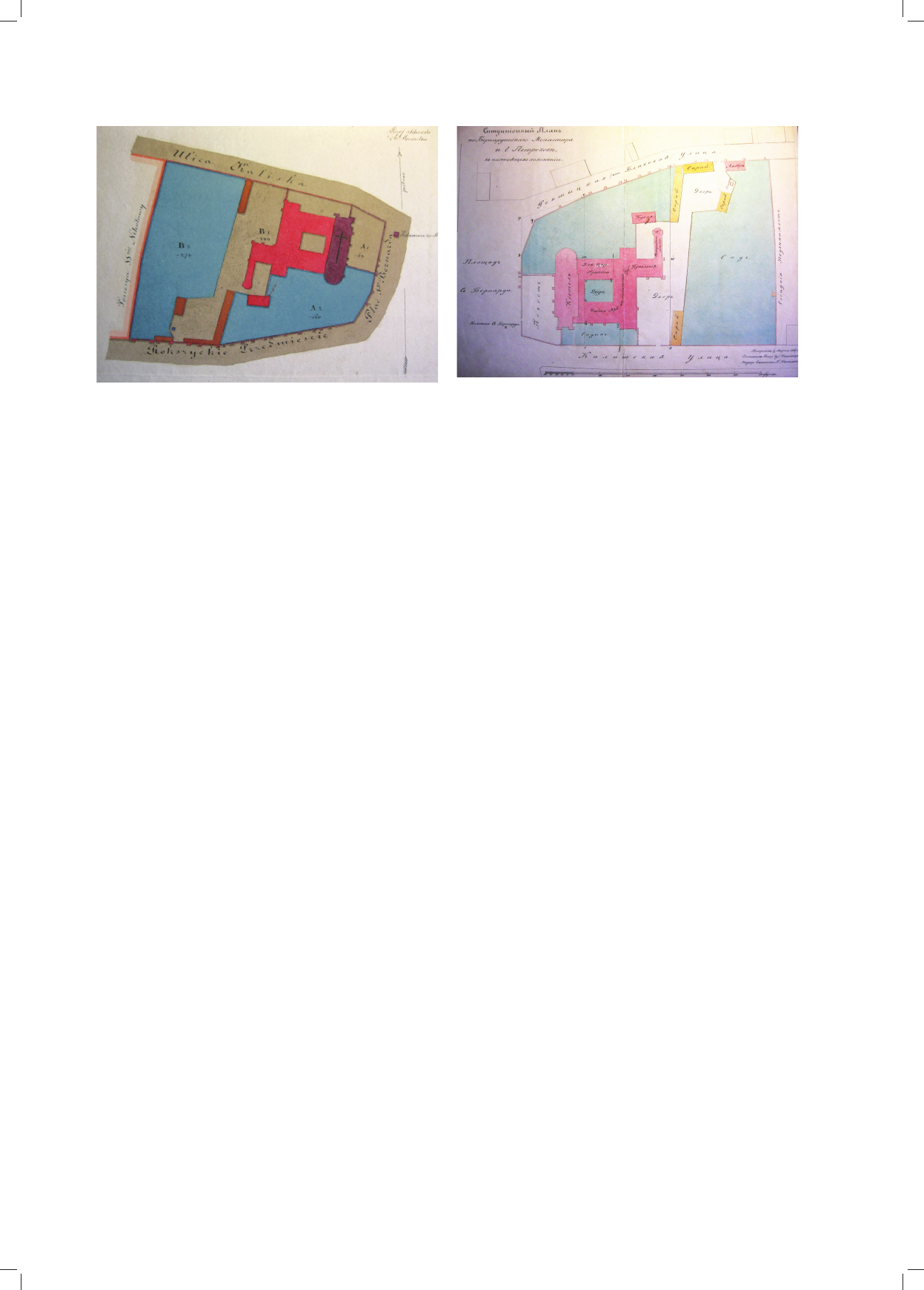
sza diecezjalnego (il. 2, 3) [6].
W 1919 r. piotrkowski klasztor bernardynów na wnio-
sek Ministra Sztuki i Kultury został uznany ocjalnie za
zabytek architektury i wpisany do Inwentarza Zabytków
Rzeczypospolitej [9]. Od 1921 r. świątynia zaczęła peł-
nić funkcję kościoła garnizonowego dla żołnierzy tutej-
szej załogi, a w sierpniu 1922 r. do Piotrkowa powrócili
dates back to 1217. According to this source, the founder
of the city was Piotr Włast Dunin who funded the first
temple here [4, p. 13]. The old history of the gord is con-
firmed in many stories referring to pagan times and ar-
chaeological research suggests that the oldest traces of
settlement come from the 8
th
century. It should be as-
sumed that the regular layout of Piotrków according to
medieval principles was established at the end of the 13
th
century, i.e. during the time of the alleged first location
privilege. The location privilege of Władysław Jagiełło
due to Magdeburg rights completed the process of crystal-
lization of the urban organism. At the same time, it was
the beginning of the lush development of Piotrków as
a place of convening ducal mass meetings as well as roy-
al district conventions and general church synods of
Gniezno Province, and then from 1493, Sejms (parlia-
ment sessions) of the Crown of the Kingdom of Poland,
including elective ones [5]. The 17
th
century brought
great destruction as a result of military operations, how-
ever, it enriched Piotrków with new church and monas-
tery functions which were very important for the develop-
ment of culture. In 1624, the first Bernardines arrived
here and began to construct a temporary wooden temple
on the suburban łysogórskie hill (i.e. outside the walls of
the medieval city and the gate from the west). In 1632,
after several years of preparation, the cornerstone was
laid for the walls of a large church and monastery. These
works were completed in 1643 thanks to the financial aid
of Mazovian Voivode Stanisław Warszycki [1]. Unfortu-
nately, there are no historical mentions about gardens
from that period. We can only assume that they were
“plantations” of crop plants (i.e. kitchen gardens and or-
chards) and a cemetery which was situated to the south of
the monastery, whereas in the heart of the monastery lay-
out there was a traditional in its form rectangular cloister
garth. The existence of the garden is confirmed only by
the 18
th
century map by Merlini, where its layout and
range are clearly visible in the part closest to the walls of
medieval Piotrków, however, the western part is not docu-
mented on this map (Fig. 1).
A slow decline of the Bernardine monastery in Piotr
ków dates back to the times when in 1813 the Russian
army seriously destroyed its buildings, which resulted in
a disturbance of economic stability that was never re-
stored again. On the night of November 27 and 28, 1864,
the dissolution of Piotrków monastery took place under
the regulation of the Tsarist authorities. The act was car-
ried out by the Russian authorities on the basis of the
highest ukaz (edict) which was issued by the tsar on No-
vember 8, 1864. According to the decision of the annexa-
tionist, the estate of the Order was temporarily placed
“under management” of the local magistrate, with the ex-
ception of the church – diocesan Vicar was appointed to
be in charge of it (Fig. 2, 3) [6].
In 1919, Piotrków Bernardine Monastery, at the re-
quest of the Minister of Art and Culture, was officially
recognized as a monument of architecture and entered in
the Monuments Inventory of the Republic of Poland [9].
From 1921, the monastery began to function as a garrison
church for the local soldiers and in August 1922 the
34 Małgorzata Milecka
bernardyni i objęli w posiadanie swe dawne zabudowa-
nia [10]. Zwrócony klasztorowi majątek nieruchomy nie
uwzględniał całej powierzchni dawnego ogrodu klasz-
tornego, czyli późniejszego Bernardyńskiego Ogrodu
Spacerowego [11]. Odwołania zakonników w tej sprawie
nie odniosły skutku i tereny te przeszły formalnie na wła-
sność miasta (il. 4–6).
Po najeździe hitlerowców na Polskę, już w listopadzie
1939 r. władze zakonne zaczęły prowadzić w klasztorze
tajne nauczanie, a w 1940 r. mnisi użyczyli lokum na po-
trzeby Polskiego Czerwonego Krzyża. Podczas okupacji
piotrkowskie cenobium stało się punktem dyspozycyjnym
władz polskiego podziemia [1]. Zakonnicy, ryzykując wła-
snym życiem, czynnie zaangażowali się w ratowanie od
zagłady
narodowych dóbr kultury. To tu, w kryptach ber-
nardyńskiej świątyni ukryte zostały zbiory naukowe i ar-
chiwalia licznych warszawskich instytucji. Między innymi
dzięki bezinteresownej opiece piotrkowskich mnichów
przetrwało przewiezione tu w części archiwum Zakładu
Architektury Polskiej Politechniki Warszawskiej z bez-
cennymi pomiarami budowli zabytkowych z terenu całej
Rzeczpospolitej [15]. Po wojnie społeczna działalność ber-
nardynów została ograniczona i skupiła się na posługach re-
ligijnych. Późniejsze lata nie obtowały już w wydarzenia
większej wagi, a obiekt do dziś pełni swe pierwotne funk-
cje. Jedynie dawne ogrody zmieniły nieco swoje przezna-
czenie, a co za tym idzie – kompozycję. Są jednak ważnym
świadkiem historii i reliktem dawnego rozległego układu.
Charakterystyka stanu istniejącego zespołu
Układ przestrzenny
Kościół i klasztor bernardynów w Piotrkowie Trybu-
nalskim wzniesiony został zgodnie z tradycją tuż poza
Bernardines returned to Piotrków and took over their for-
mer buildings [10]. The real estate which was returned to
the monastery did not include the entire area of the former
monastery garden, i.e. the later Bernardine Walk Garden
[11]. The appeals of the monks in this case did not take
effect and these areas were formally taken over by the city
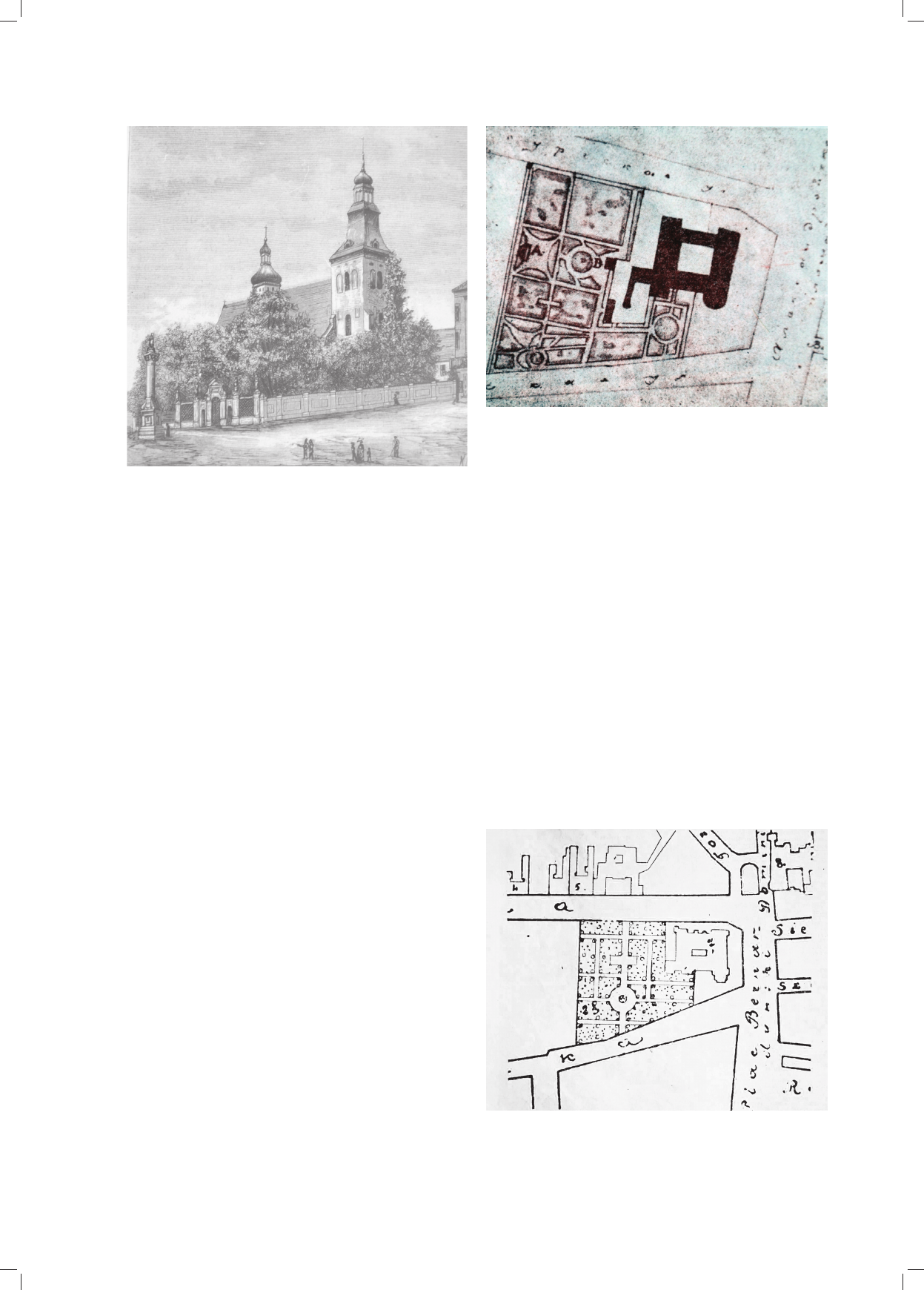
(Fig. 4–6).
After the Nazis invaded Poland, as early as in Novem-
ber 1939, the monastic authorities began to organize se-
cret classes in the monastery and in 1940 the monks pro-
vided lodging for the needs of the Polish Red Cross.
During the Nazi occupation, Piotrków Trybunalski mon-
astery became the disposable point of the authorities of the
Polish underground (resistance movement) [1]. Monks,
risking their own lives, actively engaged in saving na-
tional treasures from destruction. It is here that in the
crypts of the Bernardine church scientific collections and
archives of numerous Warsaw institutions were hidden.
Also, thanks to the selfless care of Piotrków Trybunalski
monks, the archives of the Polish Architecture Depart-
ment of the Warsaw University of Technology along with
the priceless measurements of historic buildings from the
whole Poland survived there [15]. After the war, the so-
cial activity of the Bernardines was limited and focused
on religious services. Subsequent years were no longer
abundant in events of greater importance and the building
still performs its original functions. Only the old gardens
changed their purpose a bit and as a result – the layout.
However, they are an important witness to history and
a relic of the former extensive layout.
Condition of the complex
Spatial layout
According to tradition, the church and the Bernardine
Monastery in Piotrków Trybunalski were constructed just
outside the medieval perimeter of the city walls and to
the west of the former Sieradzka Gate (Fig. 5). The com-
Il. 2. Odrys pomiaru zabudowań i gruntów oddanych do klasztoru
po xx. Bernardynach w Mieście Piotrkowie, Guberni Warszawskiej,
Powiecie Piotrkowskim, z pierworysów geometry J. Sikorskiego z 1866 r.
(źródło: [7])
Fig. 2. A sketch of the buildings and lands measurement, which were
given to the monastery after xx. Bernardines in the City of Piotrków,
Warsaw Governorate, Piotrkowski Poviat, from the first sketches
by certified geodesist J. Sikorski from 1866 (source: [7])
Il. 3. Plan sytuacyjny pobernardyńskiego klasztoru w Piotrkowie
(K. Ninkowski, 1867, źródło: [8])
Fig. 3. Situational plan of the former Bernardine monastery in Piotrków
(K. Ninkowski, 1867, source: [8])
Przekształcenia ogrodów przy klasztorze oo. bernardynów/Transformations of gardens at Bernardine monastery 35
średniowiecznym obwodem murów miejskich, na zachód
od dawnej bramy Sieradzkiej (il. 5). Zespół budowli klasz-
tornych zajął miejsce na wzniesieniu zwanym Łysą Górą.
Od wschodu na teren kościelny prowadzi wybudowana
w 1969 r. brama. Jest to rekonstrukcja bramy barokowej,
wykorzystująca autentyczne rzeźby i kraty z początku
XVIII w., pochodzące z rozebranego pierwowzoru. Na te-
renie przykościelnym od wschodu znajduje się niewielki
cmentarz z pozostałością dawnych nagrobków. Pośrodku
prostokątnego, obwiedzionego żelazną kratą trawnika stoi
kilka pamiątkowych pomników. Od północy ogrodzenie
terenu przykościelnego stanowi niewysoka podmurówka
przerwana schodkowym dojściem do kościoła. Z tej samej
strony teren zespołu wraz z ozdobnym ogródkiem otoczo-
ny jest płotem ustawionym w 1969 r. W ogrodzeniu wy-
korzystano kraty żelazne zrekonstruowane w 1917 r. na
wzór barokowych, a pochodzące z rozebranego ogrodze-
nia przykościelnego [15]. Od zachodu klasztor otoczony
jest wysokim, tynkowanym murem ceglanym. Od połu-
dnia rozgrodzony dawny sad klasztorny zamieniony zo-
stał na zieleniec z podejściem i schodami. Pod murami od
południa wydzielono ozdobny ogródek z fontanną i gurą
Matki Boskiej, otoczony współczesną żelazną kratą na
podmurówce. Naprzeciw prezbiterium w 1967 r. ustawio-
no murowaną kolumnę z gurą św. Antoniego przeniesio-
ną z rozebranej wówczas podobnej kolumny stojącej od
wieków przed wschodnią bramą kościoła. Budynek ko-
ścioła przylega od wschodu do czworoboku klasztornego,
jest wczesnobarokowy, zwrócony prezbiterium w kierun-
ku południowym. Wewnątrz budynku klasztornego znaj-
duje się niewielki, ale właściwie utrzymany pod wzglę-
dem formy i funkcji ogród wirydarzowy – cztery kwatery
trawnika otoczone są żywopłotem bukszpanowym, po-
środku zaś stoi gura Jezusa.
plex of monastery buildings was situated on the hill called
Łysa Góra. From the east, the gate, which was built in
1969, leads to the church area. It is the reconstruction of
the Baroque gate using authentic sculptures and bars from
the beginning of the 18
th
century, which came from a dis-
assembled prototype. From the east, in the church area
there is a small cemetery with remnants of the former
tombstones. In the middle of a rectangular lawn surround-
ed by iron bars, there are several commemorative monu-
ments. From the north, the fence of the church area is
made of a low foundation interrupted by a stepped en-
trance to the church. On the same side, the area of the
complex together with a decorative garden is surrounded
Il. 5. Piotrków Trybunalski – plan ogrodu bernardyńskiego
z lokalizacją nieistniejących już dziś obiektów:
A) muszli koncertowej, B) altany (Cz. Zambrzycki, 1901, źródło: [13])
Fig. 5. Piotrków Trybunalski – plan of the Bernardine garden
with the location of objects that do not exist today:
A) concert shell, B) gazebos (Cz. Zambrzycki, 1901, source: [13])
Il. 6. Piotrków Trybunalski – plan ogrodu bernardyńskiego
(autor nieznany, 1925, źródło: [14])
Fig. 6. Piotrków Trybunalski – plan of the Bernardine garden
(unknown author, 1925, source: [14])
Il. 4. Piotrków Trybunalski – kościół pobernardyński,
widok od północnego wschodu (źródło: [12])
Fig. 4. Piotrków Trybunalski – former Bernardine church,
view from the northeast (source: [12])
36 Małgorzata Milecka
Zachodnia część ogrodu to starodrzew z przeważają-
cym udziałem gatunkowym kasztanowców, lip i grabów.
Szczególnie piękne są w nim stare kasztanowce rosnące
na wysokości budynku klasztoru. W części tej po wojnie
wytyczono dwie skośne alejki z placami do wypoczynku.
Ustawiono tu kilka ławek, a całość oświetlono.
Od południa masyw starodrzewia odizolowano od
ul. Narutowicza przez skupinę nowo projektowanej zie-
leni i aleję prowadzącą do rozległego amteatru. Na te-
renie parku Śródmiejskiego (obecnie im. Jana Pawła II),
w części zachodniej znajduje się prostokątna fontanna
i nowe, agresywne ze względu na współczesną formę
elementy zagospodarowania służące rekreacji mieszkań-
ców. Elementy te jednak stanowią namiastkę dawnego
wyposażenia ogrodu bernardynów (pod względem kom-
pozycji i formy). Niewielka liczba drzew i „nowoczesna”
kompozycja omawianego parku zupełnie nie przystają
do zabytkowego charakteru tej części miasta, sprawiając
wrażenie przestrzeni zunikowanej, zacierającej dawne
znaczenia i kulturę tego miejsca. Jedyną ozdobą i izola-
cją zabytkowego zespołu bernardyńskiego od tej części
są stare i powolutku już zamierające kasztanowce i lipy
rosnące w najbliższym sąsiedztwie zachodniego muru
klasztornego.
Ocena stopnia zachowania układu zabytkowego
Analizując stare plany i porównując je z obecnym
stanem zagospodarowania ogrodu, należy stwierdzić, że
kompozycja założenia zachowała się w stopniu umożli-
wiającym jej odczytanie (choć z oczywistymi przekształ-
ceniami związanymi z zatarciem reliktów zagospoda-
rowania w części zachodniej). Zmianom uległy przede
wszystkim nasadzenia roślin (gatunki), ich charakter
i kompozycja, ponadto wyposażenie: przemieszczono za-
bytkowe gury i ogrodzenie zespołu. Miało to związek
z modernizacją centrum miasta (poszerzeniem ulic). Cza-
sy współczesne przyniosły również otoczeniu klasztoru
by a fence which was made in 1969. Iron bars, which
were reconstructed in 1917 in the baroque style and taken
from the disassembled church fencing, were used in the
fence [15]. From the west, the monastery is surrounded by
a high and plastered brick wall. From the south, the for-
mer portioned monastery orchard was turned into a green-
house with an approach and stairs. From the south, under
the walls there was a decorative garden with a fountain
and a statue of the Mother of God, which was surrounded
by contemporary iron bars set on the foundation. A brick
column with a statue of St. Anthony, which was moved
from a disassembled similar column standing for centu-
ries before the eastern gate of the church, was situated
opposite the presbytery in 1967. The building of the
church, which is an early baroque and faces the presby-
tery towards the south, adjoins the monastery quadrangle
from the east. Inside the monastery building there is
a small cloister garth garden, but it is properly maintained
in terms of form and function – four lawn quarters are
surrounded by boxwood hedges, whereas in the middle
there is a statue of Jesus.
The western part of the garden consists of old trees
with a predominant species share of chestnut trees, linden
trees and hornbeams. The old chestnut trees growing at
the height of the monastery building are particularly beau-
tiful. In this part after the war, two oblique alleys with
resting squares were marked out. Several benches were
situated there and the whole place was lit up.
In the south, the old trees were separated from Naruto-
wicza Street with a cluster of newly designed greenery
and an alley leading to a large amphitheatre. In the Śród
miejski Park (at present named after John Paul II), in
the western part there is a rectangular fountain and some
new elements of development for the inhabitants of the
town, which are aggressive due to their modern form.
The se elements, however, are only an ersatz of the former
furni shing of the Bernardine garden (in terms of compo
sition and form). A small number of trees and a “modern”
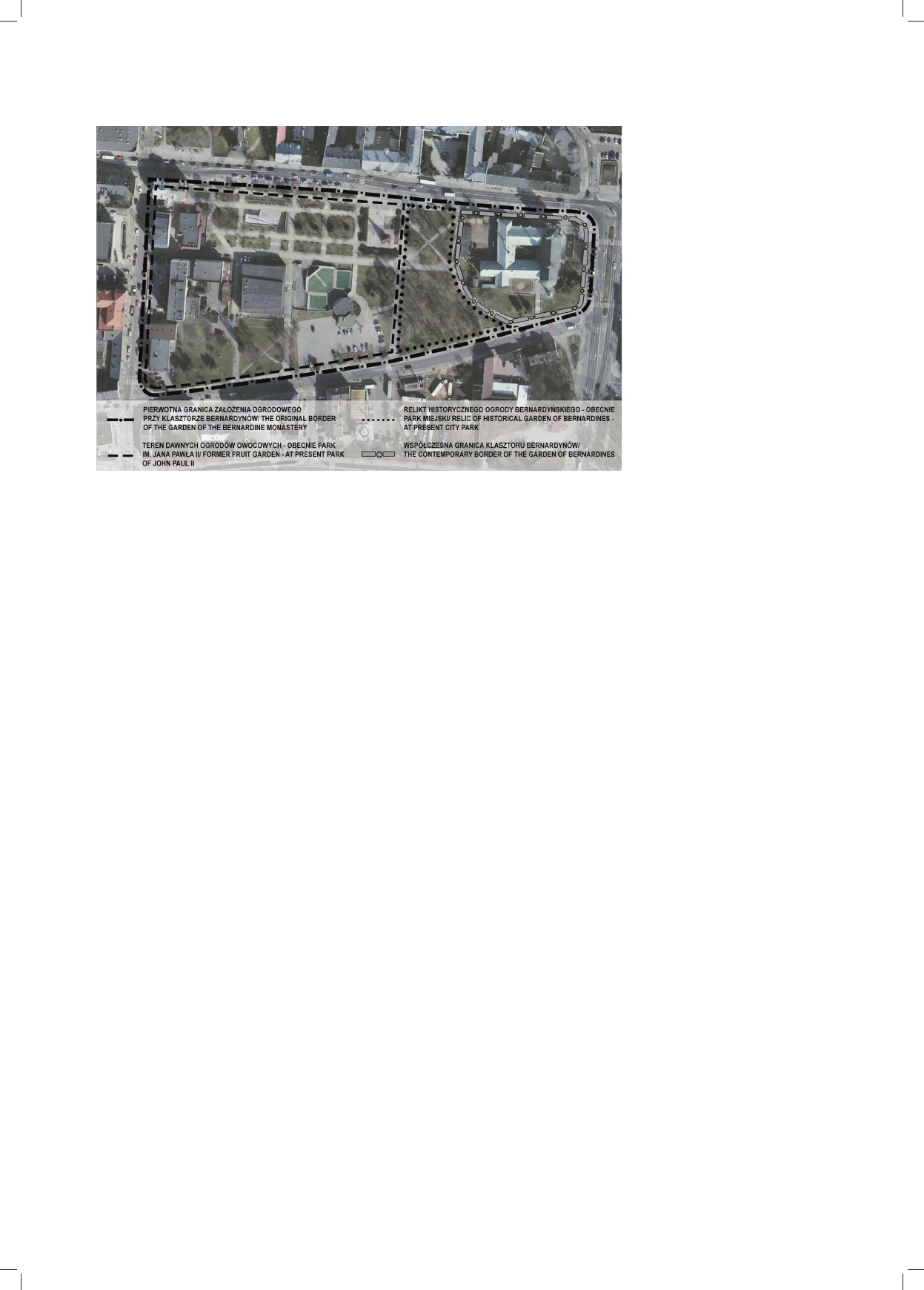
Il. 7. Teren dawnego
ogrodu bernardynów,
obecnie klasztor (po prawej stronie)
i park miejski (po lewej)
(oprac. własne na podst. [16])
Fig. 7. The area of the former
Bernardine garden, at present
a monastery (on the right)
and a municipal park (on the left)
(prepared by the author
on the basis of [16])

Przekształcenia ogrodów przy klasztorze oo. bernardynów/Transformations of gardens at Bernardine monastery 37
nowe pomniki poświęcone Oarom Katynia czy pamięci
księdza J. Popiełuszki. Od strony pl. Kościuszki zniknęły
pawilony handlowe, odsłaniając tym samym przedmurze
kościoła. Po zlikwidowanym cmentarzu od strony Stare-
go Miasta pozostał jedynie pamiątkowy kwietnik z kilko-
ma pomnikami. Przekształcenia te jednak można uznać za
normalne na tym etapie rozwoju i modernizacji centralnej
części miasta. Trudne do zrozumienia są jednak mody-
kacje, jakie nastąpiły w zachodniej części założenia zwa-
nego pierwotnie Bernardyńskim Ogrodem Spacerowym,
a po zabraniu zakonnikom tych terenów – Krzywdą. Za-
chowane plany świadczą o jego geometrycznej kompo-
zycji, czego dowodem są do dziś w dość słabej kondycji
rosnące na pewnych odcinkach stare kasztanowce białe.
Z układu tego zachowały się tylko reliktowe fragmenty
alei. Nowe, chaotyczne w stosunku do dawnej kompozy-
cji nasadzenia, zmiana układu alejek i nowoczesne wy-
posażenie przy całkowitej likwidacji historycznego spo-
wodowały, że obiekt ten zatracił dawny charakter, a po
jego przeszłości właściwie nie ma śladów. Dodatkowo
współczesna kompozycja powstałego po wojnie parku
Śródmiejskiego, do którego włączono przeważającą część
dawnych ogrodów bernardynów, degraduje to niewątpli-
wie interesujące, historyczne założenie ogrodowe, poło-
żone w ścisłym centrum Piotrkowa Trybunalskiego.
Rekonstrukcja ewolucji układu przestrzennego
ogrodu bernardynów
Trudno dziś stwierdzić, jak wyglądał pierwszy ogród
towarzyszący klasztorowi oo. bernardynów. Można jed-
nak przypuszczać – na podstawie miedziorytu ukazujące-
go Piotrków w 1657 r., podczas potopu szwedzkiego – że
wewnątrz murów klasztornych znajdowały się drzewa
(prawdopodobnie owocowe, posadzone regularnie). Ca-
łość otoczona była drewnianym ogrodzeniem, zaś główna
brama wjazdowa prowadziła od południa. Na zewnątrz
murów klasztornych wzdłuż wzniesienia, na którym po-
sadowiono zespół sakralny, rósł rząd drzew. W 1732 r.
dzięki fundacji starosty piotrkowskiego Jerzego Warszyc-
kiego bernardyni na gruntach starościańskich wybudowa-
li na własne potrzeby cegielnię. Przygotowany zakres ro-
bót objął wówczas swym zasięgiem m.in. przykościelne
ogrodzenie. W 1735 r., po usunięciu drewnianego płotu
przystąpiono do budowy murowanego ogrodzenia. Przy
prowadzonych wówczas pracach odnotowany został „mu-
rarius” – Wenecjusz Pensa. Według Michała Rawity Wi-
tanowskiego mógł być on autorem wznoszonej wówczas
okazałej bramy, prowadzącej od wschodu na przykościel-
ny cmentarz. Cytowany autor przypisał też Wenecjuszowi
Pensie równie problematyczne autorstwo kraty żelaznej
zdobiącej wspomnianą bramę. Całość murowanego ogro-
dzenia ukończona została w roku 1766 [6, s. 149, 150].
Teren przykościelny od strony starego miasta od po-
czątku zajmował cmentarz. Zgodnie z powszechną opinią
chowano tu pod murami kościoła mieszczan piotrkow-
skich, jak również pobliską ludność. Sporadycznie znaj-
dowali tu również miejsce ostatniego spoczynku żołnierze
biorący udział w okolicznych potyczkach. Po kasacie za-
konu w 1864 r. teren przyklasztornego ogrodu, liczącego
composition of the park in question do not match the his-
torical character of this part of the city, giving the impres-
sion of a unified space as well as obliterating the former
meanings and culture of this place. The only decoration
and isolation of the historic Bernardine complex from this
part are old and slowly dying chestnut trees and limes
which grow in the immediate vicinity of the western mon-
astery wall.
Analysis of the degree of the historic layout
preservation
Analyzing the old plans and comparing them with the
current garden development, it should be stated that the
composition of the layout was preserved to the extent that
we are enabled to read it (although with obvious changes
related to the obliteration of relics in the development of
the western part). The most important changes were plant-
ings (species) along with their character and composition
as well as the equipment: the antique statues and the band
fence were moved. This was connected with the modern-
ization of the city centre (widening of the streets). Mod-
ern times have also brought new monuments dedicated to
the victims of Katyn or to the memory of priest J. Po pie
łuszko in the surroundings of the monastery. From the
side of Kościuszki Square shopping pavilions disappeared
revealing the additional defensive wall of the church.
Only a commemorative flowerbed with several monu-
ments was left after the liquidated cemetery from the side
of the Old Town. These transformations, however, can be
considered normal at this stage of development and mod-
ernization of the central part of the city. Nevertheless, it is
difficult to understand the modifications that took place in
the western part of the layout, which was originally called
the Bernardine Walk Garden, and after taking over these
areas from monks it was named Krzywda (Harm). The
preserved plans prove its geometrical composition, which
even today is evidenced by old white chestnut trees in the
rather poor condition growing in some sections. Only
relic fragments of alleys survived in this layout. New, cha-
otic plantings in relation to the former composition,
a change of alley layouts and modern equipment with the
total liquidation of its historical part resulted
in the fact
that this object lost its former character and there are no
traces of its past times left. Moreover, a modern composi-
tion of the Śródmiejski Park which was established
after
the war and to which the majority of the former
Bernardine
gardens was included, degrades this un doubted ly
interest-
ing and historical garden layout which is situated in the
very centre of Piotrków Trybunalski.
Reconstruction of the evolution
of the spatial layout of the Bernardine garden
It is hard to say today what the first garden accompany-
ing the Bernardine monks’ monastery was like. However,
it can be assumed – on the basis of a copperplate depict-
ing Piotrków during the Swedish Deluge in 1657 – that
within the monastery walls there were trees (probably
fruit trees which were planted regularly). The whole was

38 Małgorzata Milecka
[…] jeden mórg miary nowopolskiej [...] w połowie więk-
szej murem, w części 1/4 parkanem otoczony, pozostał
pod zarządem rektora kościoła [6, s. 296]. W maju 1868 r.
na wniosek władz gubernialnych część dawnego ogro-
du przekształcono w publiczny ogród spacerowy, który
przez Piotrkowian – jak już wspomniano – nazywany był
Krzywdą. Uszczuplony teren przyklasztorny zamknięto
w części zachodniej nowym murowanym ogrodzeniem,
a pozostałe partie muru – od strony pl. św. Bernarda
(obecnie pl. Kościuszki) i od ul. Rokszyckiej (obecnie
ul. Narutowicza) – wyremontowano. Ocjalnie nazwany
odtąd Bernardyńskim Ogrodem Spacerowym, z chwilą
udostępnienia go mieszkańcom stał się popularnym miej-
scem wszelkiego rodzaju zgromadzeń i licznych akcji
społecznych. W 1874 i w 1882 r. przeprowadzono prace
remontowe muru okalającego założenie [17]. Pewnym
przekształceniom również uległ drzewostan – w miejsce
starych drzew owocowych posadzono tu pierwsze „kasz-
tany” (czyli kasztanowce białe), które do dziś nadają cha-
rakter temu parkowi [18]. W 1888 r. w Bernardyńskim
Ogrodzie Spacerowym otwarto bar mleczny K. Szymań-
skiego [19]. W 1893 r. od strony wschodniej „na placu
przed kościołem bernardynów” zaprojektowano nowy
skwer publiczny [20]. Ogrodnik miejski Hołójski jesienią
1894 r. uformował go ostatecznie w ozdobny ogród, któ-
rego klomby tworzyły nowo posadzone głogi, jaśminy,
róże sztamowe, tuje i derenie [21]. W roku 1894 stanęła
tu altana, a cztery lata później pojawiła się kolejna atrak-
cja, jaką był „basen z wodą” [22]. W 1901 r. gruntow-
nemu uporządkowaniu poddano teren przykościelnego
cmentarza oraz skweru publicznego [23]. W tymże roku
surrounded by a wooden fence, whereas the main en-
trance gate led from the south. Outside the monastery
walls and along the hill, on which the church complex
was founded, there was a row of trees. In 1732, thanks to
the foundation of the Piotrków Starost, Jerzy Warszycki,
Bernardines built a brickyard for their own needs on the
Starost’s land. The scope of works, which was prepared at
that time, covered, among other things, a church fence. In
1735, after the removal of the wooden fence, the con-
struction of a brick wall began. During the works carried
out at that time, “murarius” was reported – Venetius Pen-
sa. According to Michał Rawita Witanowski, he could
have been the author of the then erected gate which led
from the east to the church cemetery. The quoted author
also attributed to Venetius Pensa the equally problema
tic authorship of the iron grid adorning the abovemen-
tioned gate. The entire brick wall was completed in 1766
[6, pp. 149, 150].
The nearchurch area from the side of the old town was
occupied by the cemetery from the very beginning. Ac-
cording to the popular opinion, the burgesses of the city
of Piotrków were buried there along with the nearby pop-
ulation. Occasionally, soldiers who took part in nearby
battles also found their last resting place there. After the
monastery’s dissolution in 1864, the area of the cloister
garden covering [...] one hectare of the New Poland meas-
ure [...] surrounded in the larger part by a wall, in 1/4 part
surrounded by a fence, remained under the administra-
tion of the church rector [6, p. 296]. In May 1868, at the
request of the governor’s authorities, part of the former
garden was transformed into a public walking garden
which – as mentioned above – was called Krzywda (Harm)
by the city residents. A reduced area of the monastery was
closed in the western part with a new brick wall and the
remaining parts of the wall – from the side of St Bernard
Square (Kościuszki Square at present) and from Rokszy-
cka Street (Narutowicza Street at present) – were reno-
vated. The Bernardine Walk Garden which was officially
called so since the moment it became available to the
residents became a popular place for all kinds of gather-
ings and numerous social campaigns. In 1874 and in 1882
the renovation works were carried out on the wall sur-
rounding the layout [17]. There were also certain transfor-
mations in trees – instead of old fruit trees, the first
“chestnuts” (i.e. white horsechestnuts) were planted
here, which still create the character of this park [18]. In
1888 a cafeteria owned by K. Szymański was opened in
the Bernardine Walk Garden [19]. In 1893 from the east-
ern side, “on the square in front of the Bernardine church”,
a new public square was designed [20]. In the autumn of
1894, the town gardener Mr. Hołójski finally formed it
into a decorative garden, the flower beds of which were
made up of newly planted quickthorns, jasmines, stellar
roses, thuja and dogwoods [21]. In 1894 a gazebo was
built here, whereas four years later another attraction ap-
peared, which was “a pool with water” [22]. In 1901 the
area of the churchyard cemetery and the public square
was thoroughly cleaned up [23]. In the same year, it was
planned that the Bernardine Walk Garden, which was ad-
jacent to the monastery from the west, would receive an
Nazwa gatunkowa
Generic name
Nazwa polska
English name
Liczba
Number
Aesculus hippocastanum
kasztanowiec biały
horse-chestnut
20
Acer platanoides
klon pospolity
Norway maple
3
Betula verrucosa
brzoza brodawkowata
silver birch
5
Carpinus betulus
grab pospolity
European hornbeam
5
Picea abies
świerk pospolity
Norway spruce
9
Pyrus communis
grusza pospolita
European pear
3
Robinia pseudoacacia
robinia akacjowa
black locust
50
Symhoricarpos albus
śnieguliczka biała
common snowberry
20
Thuja occidentalis
żywotnik zachodni
northern white-cedar
10
Tilia cordata
lipa drobnolistna
little-leaf linden
25
Tabela 1. Skrócona inwentaryzacja drzew i starszych krzewów
w strefie ochrony konserwatorskiej klasztoru (oprac. M. Milecka)
Table 1. Abbreviated inventory of trees and older shrubs
in the conservation zone of the monastery (by M. Milecka)

Przekształcenia ogrodów przy klasztorze oo. bernardynów/Transformations of gardens at Bernardine monastery 39
effective gazebo for the orchestra built “in the shape of
a shell” at the expense of Rs. 515 [24].
In the summer of 1902, the commission headed by the
vicegovernor of Piotrków planned the expansion of the
layout area, for this purpose ordering the demolition of
the west wing of the monastery, which was neglected by
the Tsarist authorities. According to these “orderly” inten-
tions, the “greenhouse” situated in the garden next to the
wall was also supposed to be moved to another place [25].
As a result of strong protests by the public and activities
of the Plantation Committee which was established in
1901, this project, although technically developed, was
not implemented in its original form. The area of the pub-
lic garden was made bigger only by demolishing the then
octagonal monastic defensive tower, whereas near the
House of Gardener, Szula Goldberg set up a commercial
pavilion. A properly cultivated Bernardine Walk Garden
remained a favourite recreational place for the residents.
In 1904, its areas were made more attractive by installing
alcoholfuel lighting – “six proper lanterns” [26].
Renovation works, which were carried out in the
church during the rectory of Józef Bromski (1899–1914),
covered the area around the church as well. Making a new
entrance to the church from St. Petersburg Street (at pre-
sent Słowackiego) resulted in the necessity to add stairs
that would balance the level difference, then a new gate in
the northern part of the fence was made. In 1910, a deco-
rative flower bed was arranged around the figure of the
Holy Virgin Mary. The central cemetery was surrounded
with iron and openwork bars which were situated on
a slightly protruding foundation, thus creating a kind of
benches for those praying outside the church [4, p. 150].
On the second anniversary of “Marching of Shooting
Teams to the Kingdom” – August 6, 1914 – a monument
with the Shield of the Legions was erected in the Ber-
nardine Walk Garden – this event was accompanied by
a loud patriotic manifestation [4, p. 150]. During the an-
niversary celebrations which were organized in the city in
September 1914, “the city’s orangery was constructed”,
which gained a new glazing and an improved greenhouse.
In order to reveal the body of the church from the side of
Kaliska Street (at present Słowackiego), in May 1914, the
city engineer Romuald Miller designed a new openwork
fence with a decorative gate. This project included the
reconstruction of the iron grid in the new fence, which
was modelled on the original Baroque relics situated at
the main gate. Artistically forged “lace” iron grid was
made in the local Locksmith Department of Piotr
Krzemiński [27, p. 132]. In 1925, old and broadleaved
chestnut trees, which grew on the churchyard cemetery
and on the monastery yard from the northern side, were
cut down in order to dry the damp walls of the building.
In 1937, the works which were carried out around the
monastery buildings led to the “paving the yard at the
entrance to the monastery”. In the following year, the en-
tire stone wall of the church and the “precious lace grids”
were renovated [6, pp. 615, 616].
The outbreak of World War II caused huge losses in
Piotrków. As a result of street fights and bombings, the
city centre was destroyed during the very first days.
zadecydowano, że Bernardyński Ogród Spacerowy, przy-
legły do klasztoru od zachodu, otrzyma kosztem Rs. 515
efektowną altanę dla orkiestry zbudowaną „w kształcie
muszli” [24].
Latem 1902 r. komisja pod przewodnictwem wicegu-
bernatora piotrkowskiego zaplanowała rozszerzenie te-
renu założenia, zlecając w tym celu wyburzenie, zanie-
dbanego z winy władz carskich, zachodniego skrzydła
klasztornego. W myśl tych „porządkowych” zamierzeń
istniejąca w ogrodzie pod murem „cieplarnia” również
miała być przeniesiona w inne miejsce [25]. W wyniku
zdecydowanych protestów społeczeństwa i działalności
powstałego w 1901 r. Komitetu Plantacyjnego projekt
ten, choć opracowany technicznie, nie został zrealizowa-
ny w pierwotnej formie. Teren ogrodu publicznego po-
większono jedynie o wyburzoną wówczas ośmioboczną
klasztorną basztę obronną, zaś przy Domu Ogrodnika
Szuli Goldberg wystawił pawilon handlowy. Odpowied-
nio pielęgnowany Bernardyński Ogród Spacerowy pozo-
stawał ulubionym miejscem rekreacyjnym mieszkańców.
W 1904 r. postanowiono uatrakcyjnić jego tereny poprzez
zainstalowanie oświetlenia spirytusowego – „6 odpo-
wiednich latarni” [26].
Prace renowacyjne prowadzone przy świątyni za rek-
torstwa Józefa Bromskiego (1899–1914) objęły swym
zasięgiem również i teren przykościelny. Przebicie no-
wego wejścia do świątyni od ul. Petersburskiej (obecnie
Słowackiego) spowodowało konieczność uformowania
schodów niwelujących różnicę poziomu, przebito też
nową furtę w północnej partii ogrodzenia. W 1910 r. wo-
kół gury Najświętszej Panny Marii urządzono ozdobny
kwietnik. Cmentarzyk środkowy otoczono sztachetami że-
laznymi, ażurowemi wzniesionymi na podmurowaniu nie-
co wysuniętym, tworzącym w ten sposób rodzaj ławek dla
modlących się poza kościołem [4, s. 150]. W drugą rocz-
nicę „wkroczenia Zastępów Strzeleckich do Królestwa”
– 6 sierpnia 1914 r. – w Bernardyńskim Ogrodzie Spa-
cerowym ustawiony został pomnik z Tarczą Legionów
– wydarzeniu temu towarzyszyła głośna manifestacja
patriotyczna [4, s. 150]. Podczas organizowanych w mie-
ście obchodów rocznicowych we wrześniu 1914 r. „wy-
konana została oranżerja miejska”, która uzyskała nowe
oszklenie i ulepszoną cieplarnię. W celu odsłonięcia bryły
kościoła od strony ul. Kaliskiej (obecnie Słowackiego),
w maju 1914 r. inżynier miejski Romuald Miller zapro-
jektował nowe ażurowe ogrodzenie wraz z ozdobną furtą.
Projekt ten uwzględniał odtworzenie w nowym ogrodze-
niu żelaznej kraty, wzorowanej na oryginalnych baroko-
wych reliktach znajdujących się przy bramie głównej.
Artystycznie kuta „koronkowa” krata żelazna wykonana
została w miejscowym Zakładzie Ślusarskim Piotra Krze-
mińskiego [27, s. 132]. W 1925 r., dążąc do osuszenia
zawilgoconych murów obiektu, wycięto stare, rozłoży-
ste kasztanowce, które rosły na przykościelnym cmenta-
rzu oraz na podwórzu klasztornym od strony północnej.
W 1937 r. prace prowadzone wokół budowli klasztornych
doprowadziły do „wybrukowania podwórza u wejścia do
klasztoru”. W roku następnym odnowiono całe murowa-
ne ogrodzenie kościoła oraz znajdujące się przy nim „cen-
ne koronkowe kraty” [6, s. 615, 616].

40 Małgorzata Milecka
Warfare, although it did not reach the building itself, sig-
nificantly damaged the main gate and numerous tomb-
stones which were situated in the church cemetery. After
the liberation, on January 18, 1945, people started to
clean the city. In the immediate vicinity of the monastery
at the length of 150 m in Słowackiego Street, bombs de-
stroyed a whole row of houses. These houses were pulled
down and the empty squares were prepared for establish-
ing the Śródmiejski Park [6, p. 19]. However, it was es-
tablished partly at the expense of the former Bernardine
Walk Garden, a significant part of which was included in
a new, quite modern object, changing its composition and
destroying the remnants of the historical equipment. The
development of the area within the monastery walls was
also changed. In 1953, a new entrance gate to the monas-
tery courtyard from Słowackiego Street was built. The
facility buildings were remodelled, the old and destroyed
sheds were pulled down and a garage was constructed
from the park side. In January 1957, five huge chestnut
trees were cut down which were standing by the monas-
tery from the side of Narutowicza Street. In the middle of
the fountain built here, a statue of the Mother of God was
set on a fieldstone plinth, which was wrought in iron by
a Pauline monk in a concentration camp [6, pp. 51–86]. In
1965, profound changes were introduced to the monas-
tery’s surroundings. The churchyard cemetery was liqui-
dated, castiron tombs were removed and the area was
surfaced. In 1967, the column of St Anthony was pulled
down and rebuilt from scratch behind the presbytery of
the church, then the former stone capitol and the figure of
St Anthony of Padua were placed on top of it [6, p. 220].
In the summer of 1969, the former church fence from the
side of Kościuszki Square and Słowackiego Street was
disassembled and decorative bars were used for making
the fence of the monastery. In 1970, “bearing in mind the
need to improve the road safety”, one of the most artisti-
cally valuable elements of the church surroundings was
demolished, i.e. the main Baroque gate. This object,
which was preserved completely and maintained in very
good condition, was again constructed from scratch a few
meters closer to the church [6, p. 273].
The new Śródmiejski Park, which spread from the
monastery walls to Sienkiewicza Street (to the west of the
monastery), was “beautified” by means of a modern in
form monument next to the monastery’s body, whereas
the whole composition was completed by a modern am-
phitheatre and a fountain connected by means of a regular
layout of bituminous park alleys. It was forgotten to em-
phasize the basic compositional and scenic axes in this
part of the city as well as to underline the historical layout
of this “walk garden” which was so important for Pi-
otrków residents. Thus, the former monastery garden was
blurred and its relics were absorbed into a larger complex
of greenery with a definitely different function and faded
“symbolic speech”. The last years brought modernization
of this layout as part of the revitalization of the city cen-
tre, nevertheless, the composition of the previous mod-
ernist layout remained. Near the monastery, against the
background of a chestnut alley, a monument of John
Paul II, the saint patron of the new park, was erected.
Wybuch II wojny światowej spowodował ogromne
straty w Piotrkowie. W wyniku walk ulicznych i bom-
bardowań już w pierwszych dniach zostało zniszczone
centrum miasta. Działania wojenne, chociaż nie dosię-
gły samej budowli, znacznie uszkodziły główną bramę
oraz liczne nagrobki znajdujące się na przykościel nym
cmentarzu. Po wyzwoleniu 18 stycznia 1945 r. przystą-
piono do uporządkowania miasta. W najbliższym są
siedztwie klasztoru na długości 150 m ul. Słowackiego
bomby zniszczyły cały szereg domów.
Domy te roze-
brano, a place po nich przeznaczono na założenie parku
Śródmiejskiego [6, s. 19]. Powstał on jednak częściowo
kosztem dawnego Bernardyńskiego Ogrodu Spacerowe-
go, którego znaczną część włączono do nowego, całkiem
współczesnego obiektu, zmieniając jego kompozycję
i niszcząc resztki historycznego wyposażenia. Zmianom
uległo również zagospodarowanie terenu wewnątrz mu-
rów klasztoru. W 1953 r. wybudowano nową bramę wjaz-
dową na dziedziniec klasz torny od strony ul. Słowackie-
go. Przebudowano obiekty gospodarcze, stare zniszczone
komórki rozebrano i od strony parku postawiono garaż.
W styczniu 1957 r. od strony ul. Narutowicza ścięto pięć
ogromnych kasztanowców. Pośrodku zbudowanej tu fon-
tanny ustawiono na cokole z kamienia polnego gurę
Matki Boskiej wykutą przez zakonnika pauliń skiego
w obozie koncentracyjnym [6, s. 51–86]. W 1965 r. do
konano gruntownych zmian w otoczeniu klasztoru.
Cmentarz przykościelny został zlikwidowa ny, usunię to
żeliwne grobowce i splantowano teren. W 1967 r. ko-
lumnę św. Antoniego rozebrano i wzniesiono na nowo
za prezbiterium kościoła, umieszczając na szczycie daw-
ny kamienny kapitel i gurę św. Antoniego z Padwy [6,
s. 220]. Latem 1969 r. zdemontowano stare ogrodzenie
ko ścioła od strony pl. Ko ściuszki i ul. Słowackiego,
prze znaczając ozdobne kraty na ogrodzenie klasztoru.
W 1970 r., „kierując się koniecznością podniesienia bez
pieczeństwa ruchu ulicznego”, zdemontowano jeden
z naj cenniejszych artystycznie elementów kościelnego
otoczenia, jakim była barokowa brama główna. Obiekt
ten zachowany kompletnie i utrzymany w bardzo dobrym
stanie został postawiony na nowo kilka metrów bliżej ko-
ścioła [6, s. 273].
Nowy park, nazwany Śródmiejskim, rozciągający się
od murów klasztoru aż po ul. Sienkiewicza (na zachód od
klasztoru), tuż przy bryle klasztoru „upiększono” nowo-
czesnym w formie pomnikiem, całość kompozycji dopeł-
niły nowoczesny amteatr i fontanna spięte regularnym
układem bitumicznych alejek. Zapomniano o podkreśle-
niu podstawowych osi kompozycyjnych i widokowych
w tej części miasta, jak również o historycznym rozpla-
nowaniu tego jakże ważnego dla Piotrkowian „ogrodu
spacerowego”. Tak więc dawny ogród klasztorny zo-
stał zatarty, a jego relikty wchłonięte w większy zespół
zieleni o zdecydowanie innej już funkcji i zmienionej
„przemowie symbolicznej”. Lata ostatnie przyniosły mo-
dernizację tego układu w ramach rewitalizacji centrum
miasta, jednak kompozycja poprzedniego modernistycz-
nego założenia pozostała. W pobliżu klasztoru, na tle
kasz tanowej alei powstał pomnik Jana Pawła II, patrona
nowego parku.

Przekształcenia ogrodów przy klasztorze oo. bernardynów/Transformations of gardens at Bernardine monastery 41
Wnioski
Wartości historyczne i artystyczne piotrkowskiego ze-
społu bernardyńskiego bezsprzecznie są duże. Ten inte-
resujący zespół budowli i dawnych ogrodów pierwotnie
stanowił przykład klasztoru obronnego z własnym sys-
temem umocnień ziemnych i fortykacji. Z chwilą reali-
zacji na początku XIX w. nowej zabudowy Przedmieścia
Rokszyckiego i Sieradzkiego system ten uległ zatarciu.
Przebudowa dokonana na początku XX w. i „moderni-
zacja” powojenna spowodowały, że dziś dawny ogród
bernardynów w zasadzie przestał istnieć na rzecz nowe-
go zespołu, jakich wiele w całej Polsce (niestety o wąt-
pliwych walorach artystycznych, choć wpisujących się
w nowoczesny trend projektowania współczesnej zieleni
miejskiej). Dziś otoczenie zespołu oo. bernardynów od
wschodu i południa jest utrzymane w duchu patriotyzmu,
znajduje się tu duża liczba pomników i pamiątkowych
tablic, co także powoduje pewien chaos kompozycyjny –
zieleń stanowi tu pewnego rodzaju kulisowanie tych licz-
nych pamiątek ducha.
To co wydaje się niezwykle ważne, to fakt, że w kra-
jobrazie miasta duża skupina starodrzewia pozostałego
po dawnym ogrodzie klasztornym ma ogromne znacze-
nie mikroklimatyczne i widokowe. Nie sposób przecenić
także jego roli biocenotycznej – jest miejscem gniazdo-
wania wielu gatunków ptaków i drobnych zwierząt. Wiel-
ką stratą jest zanik symboliki tego zespołu, zatarcie jego
pierwotnej funkcji, gdzie reliktu dawnych ogrodów klasz-
tornych nieprzygotowany do tego historycznie odbiorca
może doszukać się jedynie w zrewaloryzowanym na po-
czątku XXI w. niewielkim wirydarzu.
Analiza zebranego materiału oraz badania terenowe
uzasadniają zalecenie, by teren dawnego ogrodu ber-
nardynów objąć ścisłą ochroną konserwatorską, w celu
zachowania jego pozostałości i tam, gdzie to możliwe,
odtworzenia jego historycznej kompozycji lub przynaj-
mniej nadania stosownej symboliki temu miejscu. Ze
względu na sąsiedztwo strefy ścisłej ochrony układu
urbanistycznego miasta celowe wydaje się rozszerzenie
jej o omawiane założenie.
Należy bezwzględnie chronić teren dawnego ogro-
du przed próbami umieszczania w nim przypadkowych
obiektów (także dekoracyjnych) i dążyć do odtworzenia
stanu z mniej więcej 1925 r. (np. na poziomie wyposa-
żenia czy też gatunków roślin właściwych dla miejsca
i epoki).
W przypadku tej ważnej dla miasta, bo położonej
w jego sercu kompozycji zieleni wielokrotnie popełniano
radykalne błędy. Doprowadziło to do stworzenia nowej,
agresywnej formy przestrzennej parku, niszczącej relik-
ty bardzo cennego kompozycyjnie i wartościowego dla
tożsamości miasta zespołu zieleni. Każdorazowo przy
podejmowaniu działań „modernizacyjnych” nowy układ
winien zostać podporządkowany kompozycyjnie do daw-
nego ogrodu bernardynów i stanowić jego „twórczą”
kon tynuację, przeciwnie do tego co uczyniono po wojnie
oraz pod koniec XX i na początku XXI w. Niestety zmia-
ny przestrzenne obecnie są tak duże, że jedynie działania
w najbliższym otoczeniu klasztoru mogą poprawić war
tość
Conclusions
The historical and artistic values of the Piotrków Ber-
nardine complex are unquestionably immense. This inter-
esting complex of buildings and old gardens constituted
originally an example of a defensive monastery with its
own system of fortifications. At the beginning of the 19
th
century, when the implementation of a new development
of Przedmieście Rokszyckiego and Sieradzkiego started,
this system became blurred. The reconstruction, which
was undertaken at the beginning of the 20
th
century and
postwar “modernization” resulted in the fact that today
the former Bernardine garden in fact ceased to exist at the
expense of a new complex – there are many such com-
plexes all over Poland (unfortunately with dubious artistic
values, although blending in with a modern design trend of
contemporary urban greenery). Today, the surroundings of
the Bernardine complex from the east and south are main-
tained in the spirit of patriotism and there is a large number
of monuments as well as commemorative plaques, which
also causes certain compositional chaos – greenery here is
a kind of cover up for these many memorabilia of the spirit.
What seems to be extremely significant is the fact that
in the cityscape a large group of old trees from the former
monastery garden is of great microclimatic and scenic im-
portance. It is impossible to overestimate the role of its
biologic community – it is the nesting place for many spe-
cies of birds and small animals. A great loss is the disap-
pearance of symbolism of this complex and the blurring
of its original function, where the relic of old monastic
gardens can be found by a recipient, who is historically
unprepared for this, only in the small cloister garth which
was revalorised at the beginning of the 21
st
century.
The analysis of the material collected and the field re-
search justify the recommendation that the area of the
former Bernardine garden should be under strict conser-
vation protection in order to preserve its remains and,
where it is possible, to reconstruct its historical composi-
tion or at least to give proper symbolism to this place. Due
to the proximity of the strict protection zone of the urban
layout of the city, it seems advisable to extend it to the
discussed layout.
It is imperative that we protect the area of the former
garden from attempts at placing random objects (includ-
ing decorative ones) in it and strive for restoring the con-
dition from about 1925 (e.g. at the level of the equipment
or plant species appropriate for the place and the époque).
With respect to this important greenery layout for the
city, due to its central location, many radical mistakes
were made. This led to the creation of a new and aggres-
sive spatial form of the park, which destroyed the relics of
the former greenery complex, which was very precious in
terms of composition and valuable for the identity of the
city. Each time when undertaking “modernization” activi-
ties, a new layout should be compositionally subordinate
to the former Bernardine garden and constitute its ‘crea-
tive’ continuation, contrary to what was done after the war
and at the end of the 20
th
and at the beginning of the 21
st
centuries. Unfortunately, the spatial changes are so large
today that only activities in the immediate vicinity of the

42 Małgorzata Milecka
kompozycyjną zespołu, a dawną formę malowniczego
piotrkowskiego ogrodu oo. bernardynów można oglądać
jedynie na rycinach i fotograach starego Piotrkowa.
Przykre, że wciąż tak mało w nas świadomości tego, co
stanowi istotę dziedzictwa kulturowego. Tym ważniejsze
jest uwrażliwienie społeczeństwa w zakresie utrzymy-
wania tradycji miejsca, ochrony zabytków ogrodowych
i właściwego nimi gospodarowania. Niezbędne też jest
kształcenie nowych kadr, które będą rozumiały, jak istot-
na jest ciągłość tradycji i kultura projektowania.
monastery can improve the compositional value of the
complex, whereas the former beauty of the Piotrków pic-
turesque Bernardine garden can only be seen in drawings
and in photographs of old Piotrków.
It is sad to notice that we still lack so much to be fully
aware of what constitutes the essence of our cultural herit-
age. Hence it is extremely important to make the society
more sensitive in the area of maintaining the place’s tradi-
tions, protecting garden monuments and taking care of their
proper management. It is also essential to educate new pro-
fessionals who will be able to understand how important it
is to maintain tradition and to foster the culture of designing.
Translated by
Bogusław Setkowicz
Bibliografia /References
[1] Owczarek H., Kościół i klasztor OO. Bernardynów pod wezwa-
niem Znalezienia Krzyża Św. i Matki Boskiej Anielskiej w Piotrko-
wie Tryb., Warszawa 1978, [mpis w Archiwum OO. Bernardynów
w Piotrkowie Trybunalskim].
[2] Heyduk B., Dahlberg w Polsce, Dziennik i ryciny szwedzkie z dzie-
jów Potopu 1656–1657, Ossolineum, Warszawa 1971.
[3] Plan Piotrkowa D. Merliniego z 1786 r. Zbiór Popielów, Vol. 204,
k. 582, AGAD, Warszawa.
[4] Głowacki K., Urbanistyka Piotrkowa Trybunalskiego, Urbanistyka
Architektura Sztuka, Piotrków–Kielce 1984.
[5] Florek R., Dziubecki J., WolskaRój A. et al., Wytyczne konserwa-
torskie do planu regionalnego zagospodarowania przestrzennego
województwa piotrkowskiego, Towarzystwo Urbanistów Polskich,
Warszawa 1987, [mpis].
[6] Archiwum klasztoru OO. Bernardynów w Piotrkowie Tryb., Akta
dotyczące klasztoru.
[7] Odrys pomiaru zabudowań i gruntów oddanych do klasztoru po
xx. Bernardynach w Mieście Piotrkowie, Guberni Warszawskiej,
Powiecie Piotrkowskim, z pierworysów geometry J. Sikorskiego
z 1866 r., Zbiór kartograczny, AGAD, Warszawa.
[8] Sytuacyjny plan pobernardyńskiego klasztoru w Piotrkowie, K. Nin
kowski, 1867, Zbiór kartograczny, AGAD, Warszawa.
[9] Krajewski S., Kasata klasztoru Bernardynów w Piotrkowie, „Głos
Trybunalski” 1925, nr 130.
[10] Witanowski Rawita M., [b.t.], „Dziennik Narodowy” 1915, nr 201.
[11] „Gazeta Piotrkowska” 1922, nr 32.
[12] „Biesiada Literacka” 1881, kr. 290, WUOZ, Piotrków Trybunalski.
[13] Plan ogrodu bernardyńskiego z lokalizacją nieistniejących już dziś
obiektów, Cz. Zambrzycki, 1901, WUOZ, Piotrków Trybunalski.
[14] Plan Ogrodu Bernardyńskiego, 1925, WUOZ, Piotrków Trybu
nalski.
[15] Piechotkowie K., M., Bóżnice drewniane, Budownictwo i Archi-
tektura, Warszawa 1957.
[16] System informacji przestrzennej Miasta Piotrkowa Trybunalskiego,
http://mpiotrkowtrybunalski.emapa.net/ [accessed: 25.11.2018].
[17] Rzecznikowski L., Wyjątki z kroniki miasta, „Tydzień” 1883, nr 12.
[18] „Tydzień” 1887, nr 24.
[19] „Tydzień” 1888, nr 19.
[20] „Tydzień” 1893, nr 30.
[21] „Tydzień” 1894, nr 46.
[22] „Tydzień” 1898, nr 28.
[23] „Tydzień” 1901, nr 16.
[24] „Tydzień” 1901, nr 14.
[25] „Tydzień” 1902, nr 25.
[26] „Tydzień” 1904, nr 29.
[27] Nowakowski T., Piotrków Trybunalski i okolice, Piotrków Trybu-
nalski 1972.
Streszczenie
Artykuł poświęcono prezentacji reliktu dawnego ogrodu bernardynów w Piotrkowie Trybunalskim. W oparciu o przeanalizowany materiał źródło-
wy autorka przedstawiła losy ogrodu w kontekście historii klasztoru. Ukazała zasób współczesny dawnego ogrodu bernardynów i określiła stan
zachowania historycznego układu. To pozwoliło na zrekonstruowanie ewolucji założenia i wyprowadzenie wniosków na temat ochrony dziedzictwa
ogrodowego, a następnie sformułowanie zaleceń dotyczących kształtowania krajobrazu historycznego centrum Piotrkowa. W wyniku analiz dowie-
dziono, że wartości historyczne i artystyczne piotrkowskiego zespołu bernardyńskiego są duże. Historia tego zespołu zieleni, jego kompozycja i ran-
ga dla współczesnego układu urbanistycznego zasługują na bliższą prezentację, co uczyniono w artykule. Założenie jest interesującym przykładem
ewolucji układów zieleni i świadectwem wielkiego wpływu zgromadzeń zakonnych na kształtowanie krajobrazu miasta.
Słowa kluczowe: bernardyni, klasztor, ogród, Piotrków Trybunalski
Abstract
The article is devoted to the presentation of a relic of the former Bernardine garden in Piotrków Trybunalski. Based on the analyzed source material, the
author presented the fate of the garden in the context of the history of the monastery. She showed the contemporary resource of the former Bernardine
garden and described the state of preservation of the historical system. This allowed us to reconstruct the evolution of the assumption and draw conc-
lusions about the protection of the garden heritage, and then formulate recommendations for shaping the historical landscape of the center of Piotrków.
As a result of the analysis, it was proved that the historical and artistic values of the Piotrków Bernardine complex are large. The history of this complex
of greenery, its composition and rank for the contemporary urban layout deserve closer presentation, as was done in the article. The assumption is an
interesting example of the evolution of green areas and a testimony of the great inuence of religious congregations on shaping the city landscape.
Key words: Bernardines, monastery, garden, Piotrków Trybunalski