Introduction
In the recent decade many towns have proved that
light has a positive impact on space and its identity, it is
a source of encouragement for people to meet and inter-
act socially and it also promotes architecture and culture
of a town. This proves that the art of illumination has
left the phase of artistic lightening of buildings and has
become a part of integrated artistic arrangements which
have accepted methods that constitute the strategy of
town development and promotion. A wide promotion of
this attitude resulted in the fact that visual values of the
landscape began to be protected by legal acts in many
countries. More than a few hundred towns have already
introduced illumination in accordance with Lighting
Master Plan in which the landscape is perceived in the
categories of public good in all of its aspects – ranging
from investment activities to ecological and energetic
ones. At the same time, we must pay attention to the
dynamic evolution that occurred in this domain within
merely three decades. Spontaneous illumination of sin-
gle structures unencumbered by anything, promoted at
the end of the 20
th
century, was transformed into a le -
gislative procedure of designing town illumination plans
or even regions with a requirement of implementing en-
ergy saving technologies and principles of the environ-
ment protection. Its artistic expression was also changed
– reserved actions of engineers were transformed into
ephemeral solutions full of creative virtuo sity and mys-
ticism.
2014
2(38)
DOI: 10.5277/arc140207
Magdalena Zienowicz*, Ewa Podhajska*
Kierunki, strategie i perspektywy
współczesnej iluminacji i oświetlenia miast na przykładzie Lyonu
Trends, strategies and perspectives
of modern illumination and lighting of towns on the example of Lyons
Wprowadzenie
Wiele miast w ostatniej dekadzie udowodniło, że świa-
tło wpływa pozytywnie na przestrzeń, jej tożsamość,
zachę ca do spotkań i interakcji społecznych, promu-
je architekturę i kulturę miasta. Jest to dowód, że sztuka
iluminacji wyszła już z fazy artystycznego oświetlania
budynków i stała się częścią zintegrowanych opraco-
wań planistycznych, które przyjęły metody będące stra-
tegią rozwoju i promocji miasta. Szerokie propago wanie
takie go podejścia spowodowało, że wizualne wartości
krajo brazu zaczęto chronić w wielu krajach aktami praw-
nymi. Już ponad kilkaset miast na świecie rea lizuje ilu-
minacje zgodnie z LMP (Lighting Master Plan), w któ-
rym krajobraz jest postrzegany w kategoriach dobra
publicznego we wszystkich jego aspektach – od dzia-
łalności inwestycyjnej po ekologiczną i energetyczną.
Jednocześ nie na leży zwrócić uwagę na dynamiczną ewo-
lucję, jak
ą przesz ła ta dziedzina w ciągu zaledwie trzech
dekad. Spontaniczna i niczym nieskrępowana iluminacja
pojedynczych obiektów, promowana pod koniec XX w.,
przekształciła się w legislacyjną procedurę projektowa-
nia planów iluminacji miast, a nawet regionów z wymo-
giem wdrażania energooszczędnych technologii i zasad
* Instytut Architektury Krajobrazu, Uniwersytet Przyrodniczy we
Wrocławiu/Institute of Landscape Architecture, University of En vi ron-
mental and Life Sciences, Wrocław.

70 Magdalena Zienowicz, Ewa Podhajska
In 2010 about 40 towns affi liated with LUCI
1
elaborat-
ed together the Luci Charter on Urban Lighting
2
in which
the role of illumination in the range of sustainable town
development was defi ned. This document describes ele-
ments which should be implemented in the illumination
strategy in order to support sustainable development of
towns.
In accordance with the provisions in the Charter illumi-
nation should contribute to:
– reduction of economic and social differences between
districts in towns,
– creation of a sense of safety,
– strengthening cultural and social identity,
– development of sustainable transportation (public, bi-
cycle and pedestrian transportation),
– local economic development,
– optimisation of energy consumption,
– reduction of light pollution.
This is not a comprehensive list of crucial and second-
ary elements which a responsible illumination strategy of
a town ought to take into consideration. These are only
basic elements which can help avoid illumination chaos.
Lyons as an example of a system and sustainable
approach to illumination and lighting
Illumination plan
An example of a town where realisation of illumination
actions exhibits a professional, holistic and sustainable
approach to lighting and illumination is Lyons. Since the
beginning of the 1990
s
the town has elaborated three types
of documents connected with illumination planning, i.e.:
– Schéma Directeur d’Aménagement Lumière – SDAL
(the lighting development plan) comprising general
guidelines for the whole town or its fragments, including
studies of conditions,
– Plan lumière (the lighting master plan) – compris-
ing illumination projects for designated town areas (land-
scape),
– Charte lumière (the lighting charter) – comprising de-
tailed guidelines for single structures or illuminated com-
plexes [3, pp. 13–14].
The presented documents constitute a platform for
a dis cussion between different departments in a town and
a set of guidelines for the realisation of public illumination.
In 1989 on the basis of the above scheme the fi rst illu-
mination plan, which focused on exhibiting over 50 struc -
1
Lighting Urban Community International (LUCI) – an organisa-
tion established in 2002 on the initiative of Lyons. It affiliates towns
which made an attempt to elaborate an illumination project, i.e. Lighting
Master Plan. LUCI acts first of all as a forum where representatives of
town authorities, architects and urban planners can meet to exchange
experiences and consider together the issue of using artificial light in the
best way. The priorities of the organisation are also connected with
protection of the environment and optimal use of light. At present, LUCI
associates 80 towns, 33 of which have already become signatories of the
Charter [1].
2
The document constitutes a set of guidelines on the basis of
which towns can develop their own illumination strategies [2, pp. 14–17].
ochrony środowiska. Zmienił się również jej wyraz ar-
tystyczny – powściągliwe działania inżynierskie uległy
transforma cji w rozwiązania efemeryczne, pełne twór-
czej wirtuo zerii i mistycyzmu.
W 2010 r. około 40 miast zrzeszonych w LUCI
1
opraco-
wało wspólnie kartę (Luci Charter on Urban Lighting)
2
,
w której określono rolę oświetlenia w zakresie zrówno-
ważonego rozwoju miast. Dokument ten opisuje elemen-
ty, które powinny być wdrażane w strategię oświetlenia
w celu wspierania zrównoważonego rozwoju miast.
Zgodnie z zapisami w karcie oświetlenie powinno
przy czyniać się do:
– redukcji gospodarczych i społecznych różnic pomię-
dzy dzielnicami w mieście,
– budowania poczucia bezpieczeństwa,
– wzmacniania tożsamości kulturowej i społecznej,
– rozwoju zrównoważonego transportu (komunikacji
publicznej, rowerowej i pieszej),
– lokalnego rozwoju gospodarczego,
– optymalizacji zużycia energii,
– redukcji zanieczyszczenia światłem.
Nie jest to wyczerpująca lista pierwszo- i drugopla-
nowych elementów, które powinna uwzględniać odpo-
wiedzialna strategia oświetleniowa miasta. Są to jedynie
bazowe elementy, które mogą pomóc w uniknięciu chao su
świetlnego.
Lyon jako przykład systemowego i zrówno wa żo ne go
podejścia do oświetlenia i iluminacji
Plan iluminacji
Przykładem miasta, w którym realizacja działań
świetlnych obrazuje profesjonalne, holistyczne i zrówno-
ważone podejście do oświetlenia i iluminacji, jest Lyon.
Mias to od początku lat 90. ubiegłego wieku opracowu-
je trzy typy dokumentów związanych z planowaniem ilu-
minacji:
– Schéma Directeur d’Aménagement Lumière – SDAL
– obejmujący ogólne wytyczne dla całego miasta lub jego
fragmentów, w tym studia uwarunkowań,
– Plan lumière – obejmujący projekty iluminacji dla
wydzielonych obszarów miejskich (krajobrazowych),
– Charte lumière – obejmujący szczegółowe wytycz-
ne dla pojedynczych obiektów lub zespołów iluminowa-
nych [3, s. 13–14].
Wymienione dokumenty stanowią platformę do dys-
kusji pomiędzy różnymi departamentami w mieście oraz
zbiór wytycznych do realizacji publicznego oświetlenia.
1
Lighting Urban Community International (LUCI) – jest to orga-
nizacja utworzona w 2002 r. z inicjatywy Lyonu. Zrzesza miasta, które
podjęły próbę opracowania projektu iluminacji, tzw. Lighting Master
Plans. LUCI działa przede wszystkim jako forum, gdzie przedstawicie-
le władz miast, architekci, urbaniści mogą się spotkać, aby wymienić
doświadczenia i wspólnie zastanowić się na tym, jak najlepiej wykorzy-
stać sztuczne światło. Do priorytetów organizacji należy również ochro-
na środowiska i optymalne wykorzystanie światła. Obecnie LUCI zrze-
sza około 80 miast, z których 33 stały się już sygnatariuszami karty [1].
2
Dokument stanowi zbiór wytycznych, na podstawie których mia-
sta mogą rozwijać własne strategie oświetlenia [2, s. 14–17].

Kierunki, strategie i perspektywy współczesnej iluminacji /Trends, strategies and perspectives of modern illumination 71
tures such as churches, towers, bridges, attractive te nement
houses, monuments and historical places, was rea lised.
First of all, structures and buildings located along two ri-
vers fl owing through the town, i.e. the River Saône and
the River Rhône, were chosen to be illuminated. In order
to crystallise and harmonise the illumination, the ele ments
located along the River Saône were given a warm light co-
lour temperature (below 3000 K), whereas the elements
located along the River Rhône were given a cool light
colour temperature (above 4000 K). The main purpose of
the plan implemented in 1989 was fi rst of all the emphasis
of monuments and heritage of the town. The exhibition of
historical and urban values of the town brought success
very quickly. The number of tourist increased and a dy-
namic development of the agglomeration centre start ed. At
the same time, there was growing dissatisfaction of cen-
tral district residents due to expansive penetration of light
into housing units along with discontent of residents of the
outskirts who felt neglected in the illumination strategy of
Lyons.
In 2003 work on a new plan started
3
. Its main postu-
lates were the following:
– beauty and originality,
– comfort and ergonomics,
– compliance with the requirements of sustainable de-
velopment (economy, energy saving, ecology).
Implementation of the plan was preceded by numerous
meetings and discussions with residents. Moreover, ex-
perts in various domains were asked to work on this plan
in order to develop this new plan based on art, technolo-
gies, social needs and environmental requirements.
With regard to urban planning, the second plan assu-
med fi ve focal points and it turned to peripheral areas. The
illu mination concept of the town involved the follow ing:
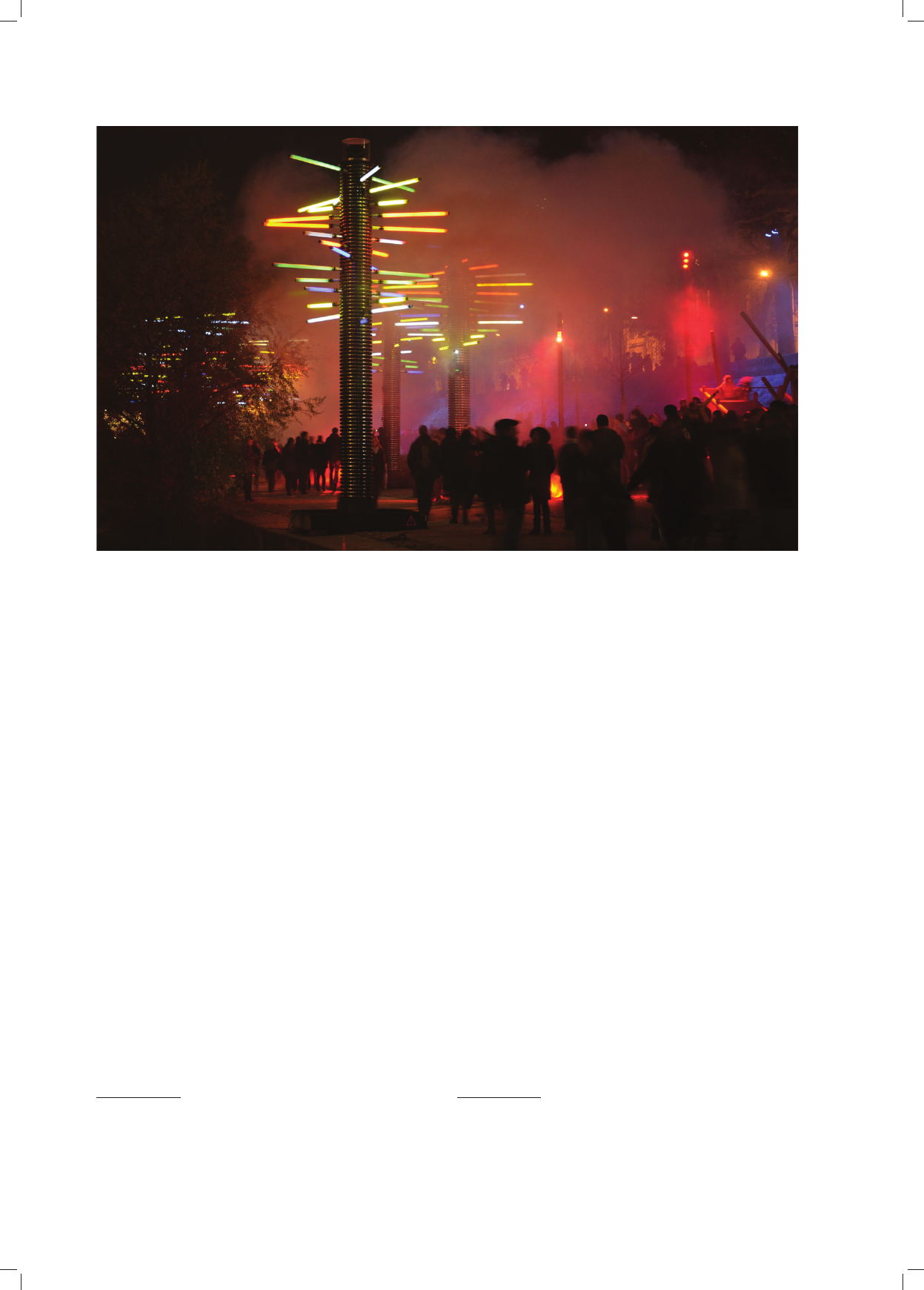
– differentiating the atmosphere of particular regions
(Fig. 1),
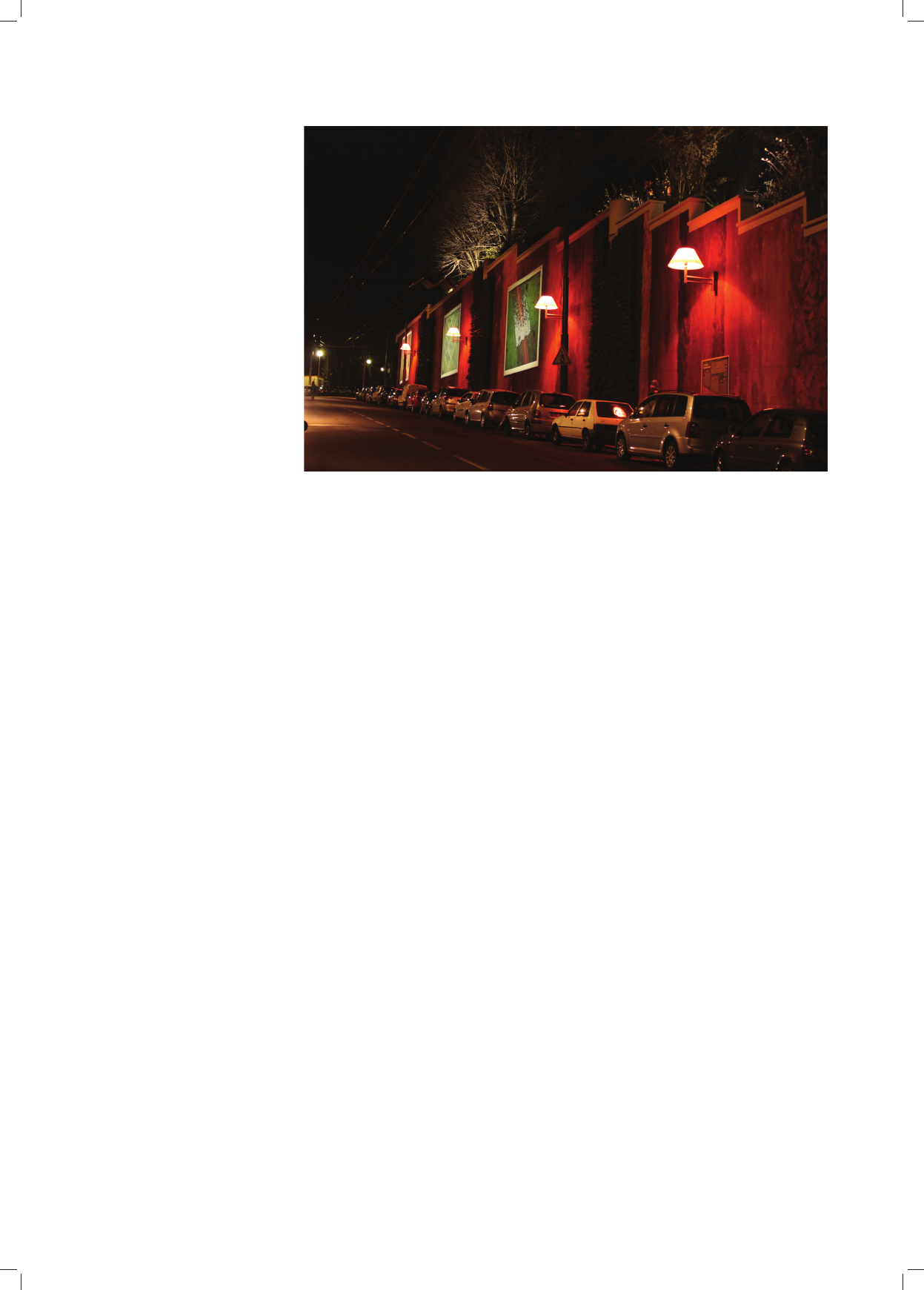
– identifying the character of particular districts (Fig. 2),
– adapting the illumination to the rhythm and pace of
life of the society (a division into illumination with a con-
stant and seasonal character as well as a decrease in levels
of light intensity in chosen regions),
– decreasing the level of light pollution through mod-
ernisation of lighting systems, recycling of used sources
of light as well as limiting illumination in some parts of
the town in order to mark an area border only.
At present, creation of artifi cial lighting in Lyons fol-
lows a direction of the illumination which is adapted to
a defi nite area and pace of life in the town. The illumi-
nation plan undergoes constant changes. Due to the latest
technology achievements, it evolves and meets the needs
of residents and tourists as well as current ecological and
energetic requirements [5, pp. 63–64]. These under-
3
The authors of the first illumination plan (1989) were Alain
Guilhot and Michel Bouit. Starting from 1995 Lyons experts, under the
guidance of Antoine Bouchet who was the co-author of the second gen-
eration of the plan in 2003 (along with Jean-Pierre Charbonneau,
François Brégnac and Isabelle Fèvre), were hired in more than 150
prestige illuminations in the world [4, p. 5].
W 1989 r. w oparciu o powyższy schemat działań zre-
alizowano pierwszy plan iluminacji, który skupiał się
na eksponowaniu ponad 50 obiektów, takich jak kościo-
ły, wieże, mosty, atrakcyjne kamienice, pomniki i his-
toryczne place. Do iluminacji wybrano przede wszyst-
kim obiekty i budowle zlokalizowane wzdłuż dwóch rzek
przepływających przez miasto – Saony i Rodanu. W celu
skrystalizowania i zharmonizowania iluminacji elemen-
tom zlokalizowanym wzdłuż Saony przypisano tempera-
turę barwową światła ciepłą (poniżej 3000 K), natomiast
zlokalizowanym wzdłuż Rodanu temperaturę barwową
chłodną (powyżej 4000 K). Celem planu zrealizowane-
go w 1989 było przede wszystkim podkreślenie zabyt-
ków i dziedzictwa miasta. Eksponowanie historycznych
i urbanistycznych walorów miasta bardzo szybko przy-
niosło sukces. Wzrosła liczba turystów i nastąpił dyna-
miczny rozwój centrum aglomeracji. Jednocześnie wzra-
stało niezadowolenie mieszkańców centralnych dzielnic
ze względu na ekspansywną penetrację światła do lokali
mieszkalnych oraz mieszkańców obrzeży miasta, którzy
czuli się pominięci w strategii oświetlenia Lyonu.
W 2003 r. rozpoczęto pracę nad nowym planem
3
. Jego
głównymi postulatami były:
– piękno i oryginalność,
– komfort i ergonomia,
– zgodność z wymaganiami zrównoważonego rozwoju
(ekonomia, energooszczędność, ekologia).
Wdrożenie planu do realizacji było poprzedzone licz-
nymi spotkaniami i dyskusjami z mieszkańcami. Po-
nad to do pracy nad planem zaproszono specjalistów
z róż nych dziedzin, tak aby nowy plan tworzyć w opar-
ciu o sztukę, technologie, potrzeby społeczne i wymogi
środowis kowe.
Pod względem urbanistycznym drugi plan zakładał pięć
punktów ogniskowych i zwrócenie się w stronę obsza rów
peryferyjnych. Koncepcja iluminacji miasta zakładała:
– różnicowanie atmosfery poszczególnych rejonów
(il. 1),
– identyfi kowanie charakteru poszczególnych dzielnic
(il. 2),
– dostosowanie iluminacji do rytmu i tempa życia spo-
łeczeństwa (podział na iluminację o charakterze stałym,
sezonowym oraz zmniejszenie poziomów natężenia świa-
tła w wybranych rejonach),
– obniżanie poziomu zanieczyszczenia światłem po-
przez modernizację systemów oświetleniowych, recy-
kling zużytych źródeł światła oraz ograniczenie ilumina-
cji w niektórych częściach miasta jedynie do zaznaczenia
granicy obszaru.
Obecnie kreowanie sztucznego oświetlenia w Lyonie
podąża w kierunku iluminacji dostosowanej do określo-
nej przestrzeni i tempa życia w mieście. Plan iluminacji
podlega ciągłym zmianom. Dzięki najnowszym osiąg-
3
Autorami pierwszego planu iluminacji (1989) byli Alain Guilhot
i Michel Bouit. Poczynając od roku 1995 r., eksperci lyońscy pod kie-
runkiem Antoine’a Boucheta, współautora drugiej generacji planu
z roku 2003 (wraz z Jean-Pierre’em Charbonneau, François Brégnakiem
i Isabelle Fèvre), byli angażowani do ponad 150 prestiżowych ilumina-
cji na świecie [4, s. 5].
72 Magdalena Zienowicz, Ewa Podhajska
nięciom techniki oświetleniowej ewoluuje, wychodząc
naprzeciw potrzebom mieszkańców, turystów oraz ak-
tual nym wymogom ekologicznym i energetycznym [5,
s. 63–64]. Działania te przez Jean-Michela Dele uila
4
zo-
stały określone jako chronotopical town planning
5
. Ter-
min ten odnosi się do miejsca (gr. tópos) oraz czasu
(gr. chrónos). Zgodnie z określeniem, każdy obszar prze-
znaczony do kreowania światłem powinien wykazywać
korelacje z miejscem i czasem.
Ostatnio lyońscy eksperci przystąpili do przygotowa-
nia trzeciego planu, który oparty zostanie na innowacyj-
nych technologiach. Do zasilania iluminacji chcą wyko-
rzystać zdecentralizowaną energię produkowaną przez
kolektory słoneczne oraz turbiny wiatrowe.
Wymiar społeczny oświetlenia i iluminacji
Polityka oświetlenia i iluminacji miasta od 2010 r.
przyjęła jeszcze jeden istotny kierunek – społeczny. Wła-
dze próbują sprowadzić światło do roli „mediatora”.
W 2011 r. w Lyonie jedna z instalacji świetlnych została
zrealizowana na peryferiach miasta w dzielnicy Mermoz,
zamieszkiwanej głównie przez emigrantów. Autora mi
projektu byli Xavier Lucas oraz Lucas Goy. W ramach fe-
4
Jean-Michel Deleuil jest projektantem światła, pracuje w NISA
(National Institute of Applied Sciences) w Lyonie, zajmuje się planowa-
niem oświetlenia w miastach i analizami urbanistycznymi [2, s. 14].
5
Termin chronotopical town planning został sformułowany i wy -
jaś niony przez Jean-Michela Deleuila podczas konferencji „Rein venting
the light of the city” w Paryżu 29 września 2011 r. [6].
takings were defi ned as “chronotopical town planning”
4
by Jean-Michel Deleuil
5
. This defi nition refers to a place
(in Greek tópos) and time (in Greek chrónos). Accord-
ing to this defi nition, each area which is supposed to be
created by lighting should show correlations with a place
and time.
Recently, Lyons experts have proceeded with preparing
the third plan which shall be based on innovative tech-
nologies. They want to use decentralised energy which is
produced by solar collectors and wind turbines in order to
supply illumination.
Social aspect of lighting and illumination
Since 2010 the lighting and illumination policy of the
town adopted one more signifi cant direction, namely a so-
cial one. The town authorities tried to see light in the role
of a “mediator”. In 2011 in Lyons one of the light systems
was installed on the outskirts of the town in the District
of Mermoz which is inhabited mainly by emigrants. The
authors of the design were Xavier Lucas and Lucas Goy.
In the framework of the festival the inhabitants of this
peripheral district were asked to participate in pre paring
illumination of their nearest surroundings. Before the fes-
4
The term “chronotopical town planning” was coined and
explained by Jean-Michel Deleuil during a conference “Reinventing the
light of the city” in Paris which was held on 29 September 2011 [6].
5
Jean-Michel Deleuil is a light designer and he works for NISA
(National Institute of Applied Sciences) in Lyons where he deals with
planning illumination of towns and urban planning analyses [2, p. 14].
Il. 1. Fragment nabrzeża Rodanu, widok nocny (fot. M. Zienowicz)
Fig. 1. Rhône river embankment, night view (photo by M. Zienowicz)
Kierunki, strategie i perspektywy współczesnej iluminacji /Trends, strategies and perspectives of modern illumination 73
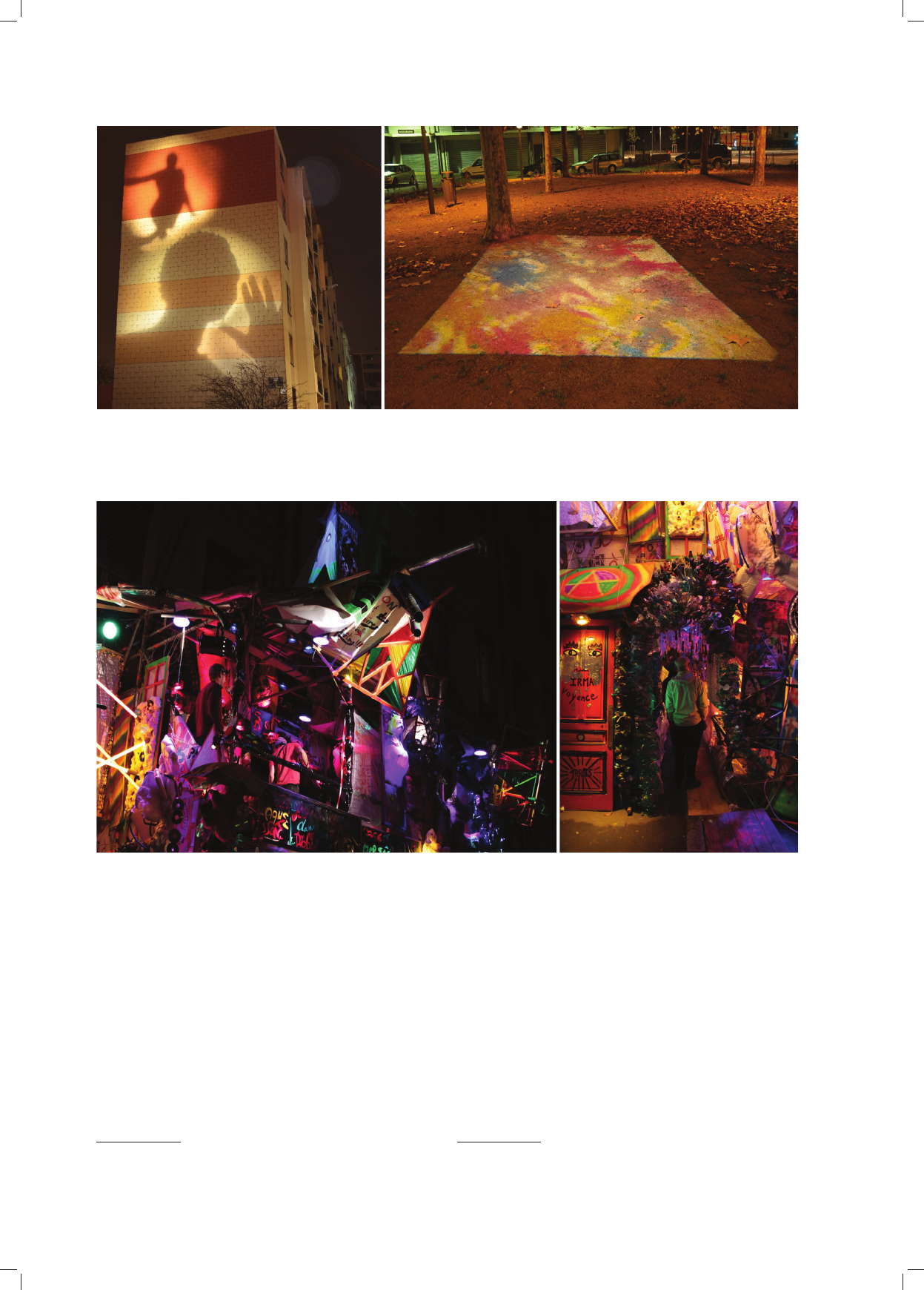
tival, workshops on activation of the inter-block space by
means of a lighting element were organised. The ideas
were presented within the framework of the festival of
light and in the future they are supposed to be taken into
account in the target district illumination (Fig. 3). This
project was one of the fi rst actions aimed at entering into
a dialogue between the town authorities and the inhabi-
tants as well as at initiating changes in the district.
Using illumination on the outskirts of the town shows
light as a tool of stimulating social development of the
agglo meration and may contribute to the following:
– building and reconstructing a sense of social unity,
– revitalisation of housing development areas,
– redesigning the outskirts of the town.
Another example of social actions was the light in-
stalla tion which was prepared on the initiative of the
in ha bitants themselves in the centre of Lyons. The re si -
dents of Pasteur Street built a small architectural struc ture
using useless things which they found in their fl ats. They
called this structure “Anti-architecture” and called them-
selves “Anti-architects”. The installation was a source
of pride and was treated by the residents and tourist as
a work of art. This spatial form, which was built collec-
tively, integrated the residents and it became a place of
common celebration of a several-day festival of light in
2011 (Fig. 4).
This realisation constitutes evidence that retrospec-
tion of the notion genius loci takes place also in the
domain of illumination. The main idea of these actions
is respect for the character of the existing place and its
identity.
Purposes, practices and methods of lighting
development policy of the town
The authorities of Lyons try to demonstrate advantages
resulting from investing in lighting. They show that light-
ing may become one of the methods of stimulating the
stiwalu mieszkańcy tej peryferyjnej dzielnicy zostali za-
proszeni do partycypacji w przygotowywaniu iluminacji
ich najbliższego otoczenia. Wcześniej zostały przeprowa-
dzone warsztaty na temat aktywizacji przestrzeni między -
blokowej poprzez element oświetlenia. Pomysły zostały
zaprezentowane w ramach festiwalu światła i mają być
brane pod uwagę w docelowym oświetleniu dzielnicy
(il. 3). Projekt ten był jednym z pierwszych działań ma-
jących na celu nawiązanie dialogu pomiędzy władzami
miasta a mieszkańcami oraz inicjację zmian w dzielnicy.
Skierowanie iluminacji na przedmieścia miast pokazu-
je światło jako narzędzie do stymulowania rozwoju spo-
łecznego aglomeracji i może przyczynić się do:
– budowania i odtwarzania poczucia jedności spo
łecznej,
– rewitalizacji obszarów zabudowy mieszkaniowej,
– przeprojektowania obrzeży miasta.
Innym przykładem działań społecznych była insta-
lacja świetlna powstała z inicjatywy samych mieszkań-
ców w centrum Lyonu. Mieszkańcy ulicy Pasteura zbu-
dowali małą formę architektoniczną z nieużytecznych
rzeczy, które znaleźli w swoich mieszkaniach. Wykreo-
waną bryłę nazwali „Antyarchitekturą”, a siebie „Anty-
architektami”. Instalacja była źródłem dumy i była trak-
towana przez mieszkańców i turystów jak dzieło sztuki.
Kolektywnie budowana przestrzenna forma zintegrowała
mieszkańców oraz stała się miejscem wspólnej celebracji
kilkudniowego festiwalu światła w 2011 r. (il. 4).
Realizacja ta jest świadectwem, że również w dziedzi-
nie iluminacji dokonuje się retrospekcja pojęcia genius
loci. Główną myślą tej postawy działań jest szacunek do
charakteru zastanego miejsca i jego tożsamości.
Cele, praktyki i metody rozwoju polityki
oświetleniowej miasta
Władze Lyonu starają się wykazać korzyści z inwesto-
wania w oświetlenie. Pokazują, że oświetlenie może być
jednym ze sposobów stymulowania rozwoju gospodar-
Il. 2. Fragment muru przy ulicy
de l’Annonciade w Lyonie.
Realizacja zdobyła pierwszą
nagrodę w prestiżowym
konkursie city.people.light
w 2012 r. (fot. M. Zienowicz)
Fig. 2. A fragment of the wall
at the Rue de l’Annonciade
in Lyon. This project won first
prize in the prestigious
competition city.people.light
in year 2012
(photo by M. Zienowicz)
74 Magdalena Zienowicz, Ewa Podhajska
czego. Miasto wydało kartę tzw. jakości życia nocnego
(fr. pour charte la qualité de la vie)
6
, która stara się łączyć
różne wymagania: przedsiębiorców, mieszkańców i tury-
stów. Podstawą działań zapisanych w dokumencie jest:
– dostosowanie oświetlenia publicznego do godzin
otwarcia fi rm, sklepów, kawiarni, barów,
– wspieranie nową infrastrukturą oświetleniową ob-
szarów miasta rozwijających się i wykazujących poten-
cjał gospodarczy,
6
Karta została wydana w 2006 r. przez władze Lyonu. Stanowi
lokalne rozporządzenie, które reguluje kulturę i jakość życia nocnego
w mieście [7].
economic development. The town issued the so called
night life quality charter (in French: pour charte la qualité
de la vie)
6
which tries to connect different requirements of
businessmen, residents and tourists. The actions specifi ed
in the document are based on the following:
– adaptation of public illumination to opening hours of
fi rms, shops, coffee shops, bars,
– supporting the town areas which develop and show
economic potential with illumination infrastructure,
6
The Charter was issued in 2006 by Lyons authorities. It constitu-
tes a local regulation which regulates culture and the quality of the night
life in the city [7].
Il. 3. Fragmenty iluminacji dzielnicy Mermoz (fot. M. Zienowicz)
Fig. 3. Portions of illumination of the district Mermoz (photo by M. Zienowicz)
Il. 4. Instalacja „Antyarchitektura” i „Antyarchitekci” przy ulicy Pasteura (fot. M. Zienowicz)
Fig. 4. “Anti-architecture” and “Anti-architects” installation at the Pasteur street (photo by M. Zienowicz)

Kierunki, strategie i perspektywy współczesnej iluminacji /Trends, strategies and perspectives of modern illumination 75
– including a private sector in joint investments by
making a list of priorities, signing long-term partnership
agreements.
The effects of these correlated actions brought about
a growing number of tourists every year, longer time of so-
cial activeness, a sense of pride resulting from the fact of
li ving in Lyons as well as better economic condition of the
agglomeration. An annual festival of light
7
as well as the
illu mination plan, which was realised impressively, con-
tributed to the fame of Lyons as a “city of light”. The festival
of light which takes place every year since 1999 is a place
of meetings of art and the most modern illumination techno-
logy. Its several-year history allows us to follow the new-
est trends and observe the evolution of illumination ranging
from the “stiff” one – based on technical solutions only – to
the subtle one – that fascinates through its artistic virtuosity.
The authorities of Lyons want their town to continue
its pioneering role in the domain of illumination and light-
ing. In parallel with the change of the town night image,
the authorities engaged in promoting the “knowledge of
illumination”. Educational and scientifi c actions resulted
in preparing the terrain for conducting illumination ex-
periments. In 2011 the city introduced two experimental
designs of lighting which aim at educating in the direction
of reducing and rationalising electric energy consump-
tion. The fi rst project was carried out on the bridge for pe-
destrians over the Saône called Passerelle St. Vincent. The
hitherto soda illumination of the footbridge was replaced
by LED diodes which were equipped with motion sen-
sors. When it gets dark the light intensity achieves 10% of
its power, however, when somebody is going to cross the
bridge the light intensity increases up to 100%. The appli-
cation of controls which detect presence makes it possible
for the pedestrian route to be illuminated only when it is
necessary. The second illumination project was carried out
in Square des droits des Enfants – a small garden for chil-
dren in one of the districts of Lyons. At the entrance to the
square near the gate there is a light switch so that the resi-
dents can turn on and turn off the light themselves in the
evenings. This action is based on human refl exes connect-
ed with turning the light on and off. Turning the switch on
makes the light, similarly to the previous example, increase
to 100% in its intensity, whereas turning the switch off
signifi cantly reduces this intensity [2, pp. 20–23].
Lyons as one of the fi rst cities in the world when im-
plementing illumination paid attention to the so called life
cycle analysis – LCA
8
. This is an evaluation method which
7
The festival has its roots in a traditional feast on 8 December that
has been observed since 1862. Every year on this day people put candles
in their windows to thank the Blessed Virgin Mary for the favours they
receive. In 1999 this religious feats was changed to a four-day cultural and
social event which is celebrated with the use of light in all possible forms,
i.e. torches, candles, lighting, light signals, projectors and fireworks [8].
8
Since 2009 all illumination products used in the realisation of
public illumination in Lyons have been subject to the assessment of
LCA. From 2015 lighting in all member states of the European Union
shall undergo a verification of the life cycle. Directive EC 347/2010,
which shall enter into force in April 2015, will, among other things, be
aimed at elimination of heavy metals from production and from all
illumination products [2, pp. 26–27].
– włączenie sektora prywatnego do wspólnych inwe-
stycji poprzez stworzenie listy priorytetów, podpisanie
umów o długoterminowym partnerstwie.
Efektem tych skorelowanych działań jest rosnąca
z roku na rok liczba turystów, wydłużenie się czasu ak-
tywności społecznej, poczucie dumy z zamieszkiwania
w Lyonie oraz coraz lepsza kondycja ekonomiczna aglo-
meracji. Do sławy Lyonu jako „miasta światła” przyczy-
nił się zarówno imponująco zrealizowany plan ilumina-
cji, jak i coroczny festiwal światła
7
. Odbywający się od
1999 r. jest miejscem spotkań sztuki i najnowszej tech-
niki świetlnej. Jego kilkunastoletnia historia pozwala śle-
dzić najnowsze trendy oraz obserwować ewolucję ilumi-
nacji od „sztywnej” – opierającej się na rozwiązaniach
wyłącznie technicznych do subtelnej – zachwycającej
wirtuozerią artystyczną.
Władze Lyonu aspirują, aby miasto kontynuowało
swoją pionierską rolę w dziedzinie iluminacji i oświe-
tlenia. Równolegle ze zmianą nocnego wizerunku mia-
sta zaangażowały się w promowanie „wiedzy o ilumina-
cji”. Wyrazem działań edukacyjnych i naukowych jest
przygotowanie terenu do prowadzenia eksperymentów
świetlnych. W 2011 r. miasto wprowadziło dwa ekspe-
rymentalne projekty oświetlenia, które mają na celu edu-
kować w kierunku zmniejszania i racjonalizacji zużycia
energii elektrycznej. Pierwszy projekt został zrealizo-
wany na moście dla pieszych Passerelle St Vin cent nad
Sao ną. Dotychczasowe sodowe oświetlenie kład ki zastą-
piono diodami LED, które są wyposażone w czujniki ru-
chu. Natężenie światła po nastaniu mroku osią ga 10%
swojej mocy, jednak gdy ktoś zamierza przejść przez
most, natężenie wzrasta do 100%. Zastosowanie sterow-
ników wykrywających obecność zapewnia, że ciąg pie-
szy jest oświetlony tylko wtedy, gdy jest to koniecz-
ne. Dru gą realizacją jest oświetlenie Square des droits
des Enfants – niewielkiego ogrodu dla dzieci w jednej
z dziel nic Lyonu. Przy wejściu na skwer obok bramy
został umieszczony przełącznik światła, tak aby w po-
rze wieczornej mieszkańcy mogli sami włączyć i wyłą-
czyć świat ła. Działanie to bazuje na ludzkich odruchach
włączania i wyłączania światła. Włączenie przełącznika
powoduje, że natężenie światła, podobnie jak w poprzed-
nim przykładzie, wzrasta do 100% swojej mocy, wyłą-
cze nie natomiast zmniejsza je znacznie [2, s. 20–23].
Lyon również jako jedno z pierwszych miast na świe-
cie przy wdrażaniu oświetlenia zwrócił uwagę na tzw.
analizę cyklu życia (ang. life cycle analysis – LCA)
8
. Jest
7
Uroczystość ma swoje korzenie w tradycyjnym święcie 8 grudnia
obchodzonym od 1862 r. Tego dnia co roku ludzie umieszczają w swo-
ich oknach świece, by podziękować Najświętszej Marii Pannie za otrzy-
mane łaski. Święto religijne od 1999 r. zamieniono w czterodniowe
wydarzenie kulturalno-społeczne, celebrowane w otoczeniu światła we
wszystkich jego formach: pochodni, świec, oświetlenia, sygnałów
świetl nych, projektorów i sztucznych ogni [8].
8
Od 2009 r. wszystkie produkty oświetleniowe użyte do realizacji
publicznego oświetlenia w Lyonie podlegają ocenie LCA. Od 2015 r. ana-
lizie cyklu życia będzie podlegało oświetlenie we wszystkich krajach UE.
Dyrektywa EC 347/2010, która zacznie obowiązywać od kwietnia
2015 r., będzie miała między innymi na celu wyeliminowanie metali cięż-
kich z produkcji i wszystkich produktów oświetleniowych [2, s. 26–27].

76 Magdalena Zienowicz, Ewa Podhajska
to metoda oceny, umożliwiająca określenie oddziaływa-
nia produktu na środowisko w całej jego egzystencji. Za-
stosowanie jej do sprzętu oświetleniowego pozwala na
identyfi kację wszystkich źródeł oddziaływania na środo-
wisko takich jak:
– ekstrakcja surowców użytych do wytworzenia urzą-
dzenia,
– proces produkcji,
– transport,
– aktywność produktu (zużycie energii, zanieczysz-
czenie światłem),
– recykling.
Metoda ta jest bardzo pomocna do uwzględnienia nega-
tywnego wpływu sprzętu oświetleniowego na środowis ko
i określenia priorytetów działań naprawczych, które zo-
stają wdrożone.
Ocenie wpływu na środowisko podlegają w Lyonie
nie tylko stałe iluminacje i oświetlenie, ale także corocz -
ny festiwal światła. Bada się jego oddziaływanie na roz-
wój polityki turystycznej miasta. Analizowane są takie
elementy, jak transport, wyżywienie i zakwaterowanie.
Od 2011 r. Lyon organizuje festiwal światła w myśl idei
eco-design
9
. Program ma na celu zmniejszenie nieko-
rzystnego wpływu festiwalu na środowisko, a jednocześ-
nie promowanie instalacji świetlnych, których rozwią-
zania opierają się na ograniczonym zużyciu materiałów
i energii (il. 5).
W 2011 r. organizatorzy festiwalu wyróżnili projek-
ty, do których budowy użyto materiałów przeznaczonych
lub pochodzących z recyklingu oraz instalacje wykorzy-
stujące technologie LED i naturalne źródła światła (il. 6
i 7). Zmieniono także kilka spraw organizacyjnych:
– program festiwalu w formie drukowanej został zmi-
nimalizowany do niezbędnych danych, dzięki czemu za-
oszczędzono ponad 14 ton papieru w porównaniu z ro-
kiem poprzednim,
– wprowadzono zakaz ruchu kołowego w trakcie trwa-
nia festiwalu, w zamian wytyczono ciągi piesze, które
umożliwiały optymalne poruszanie się mieszkańców i tu-
rystów po mieście,
– ruch służb porządkowych został zorganizowany wy-
łącznie pojazdami elektrycznymi.
Otwarta polityka i strategia miasta sprawia, że miesz-
kańcy są coraz bardziej świadomi zagroże
ń. Antoine
Bou chet, dyrektor departamentu oświetlenia publiczne-
go Lyonu, stwierdził, że postrzeganie ludzi zmienia się
bardzo szybko, jeszcze trzy lata temu mieszkańcy Lyonu
twierdzili, że w mieście jest za mało światła. Teraz otrzy-
muję listy, z których wynika, że oświetlenie należy ogra-
niczyć [za: 3, s. 130]. Strategia oświetlenia Lyonu zmie-
rza w kierunku dostosowania poziomu natężenia światła
do rzeczywistego jego wykorzystania. Priorytetem sta-
ją się ciągi piesze i rowerowe, które poprzez atrakcyjne
oświetlenie mają promować spacer i różne formy aktyw-
ności ruchowej.
9
Idea eco-design realizowana od 2011 r. w ramach festiwalu świa-
tła jest elementem wspierania strategii zrównoważonego rozwoju mia-
sta oraz zaznaczeniem problemu konsumpcji energetycznej [3, s. 74].
makes it possible to determine the impact of a pro duct on
the environment in the whole of its existence. Its applica-
tion
in the illumination equipment makes it possi ble to iden -
tify all sources of infl uences on the environment such as
– extraction of raw materials used for the production
of a device,
– a production process,
– transport,
– product potency (energy consumption, light pollu-
tion),
– recycling.
This method is very helpful when taking into consider-
ation the negative infl uence of the illumination equipment
on the environment and assessing priorities of repair ac-
tions which are implemented.
At present in Lyons not only is permanent illumination
and lighting subject to the assessment of their impact on
the environment, but the annual festival of light as well.
Its infl uence on the development of the town tourist policy
is also examined. Elements such as transport, food and
accommodation are analysed. Since 2011 Lyons has been
organising the festival of light in line with the idea of eco-
design
9
. The purpose of the programme is to reduce an
unfavourable infl uence of the festival on the environment
and at the same time to promote illumination installations
whose solutions are based on limited consumption of ma-
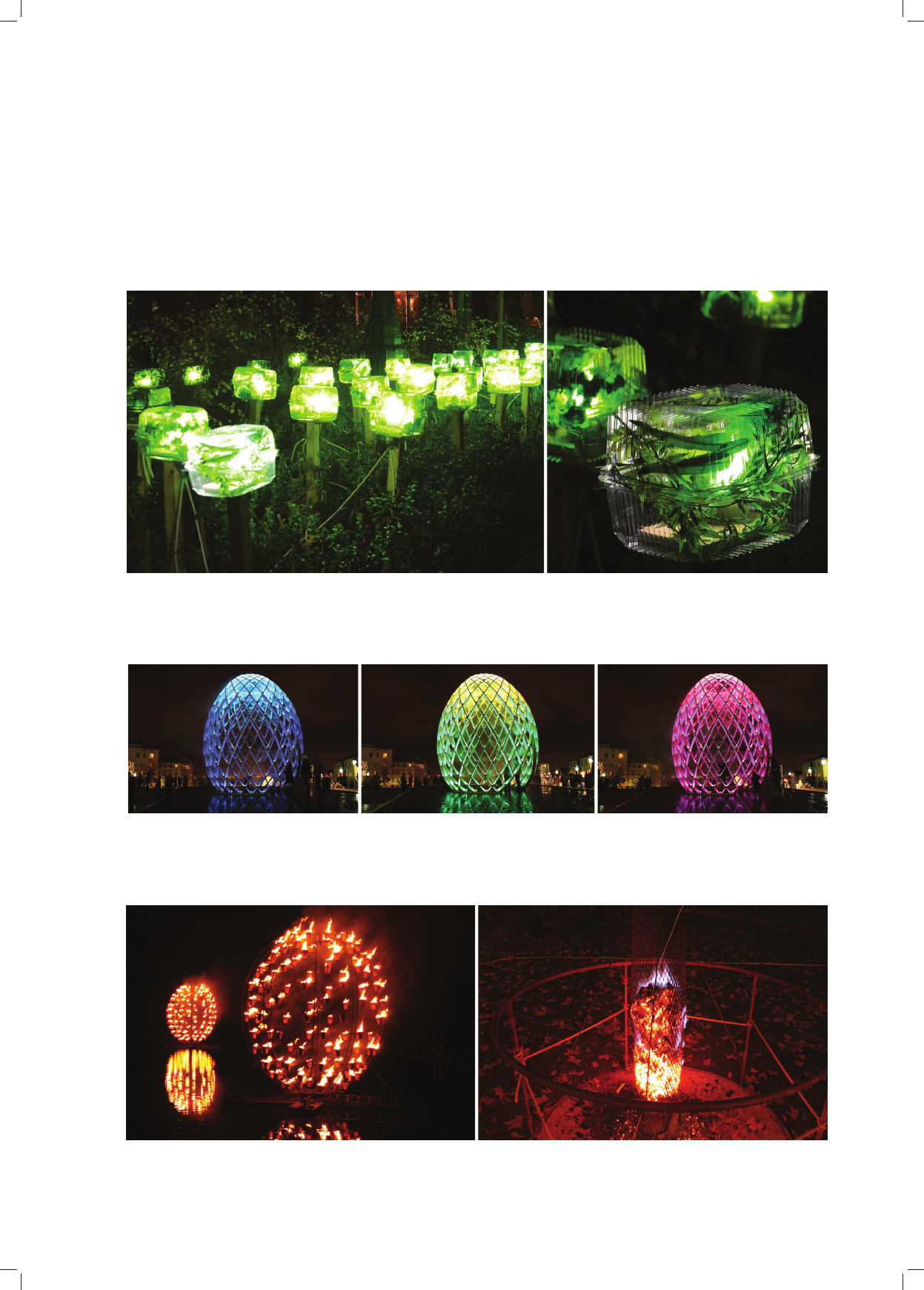
terials and energy (Fig. 5).
In 2011 organisers of the festival awarded the designs
in which materials for recycling or from recycling as
well as installations using LED technologies and natural
sources of light were applied (Fig. 6 and 7). The following
organisational aspects were also changed:
– the festival programme in its printed form was re-
duced to a minimum of necessary data due to which over
14 tonnes of paper were saved in comparison with the pre-
vious year,
– ban on vehicular traffi c was introduced during the
festival; instead, pedestrian routes were prepared which
made it possible for residents and tourists to move in an
optimal way,
– transportation of law enforcement offi cials took place
by means of electric vehicles only.
The open policy and strategy of the city is the reason
why the residents feel more and more aware of threats.
Antoine Bouchet, the president of the public illumina-
tion department of Lyons stated that perception of people
changes very quickly; still three years ago the residents
of Lyons claimed that there was not enough light in the
town. Nowadays, I receive letters which say that light
in the town should be limited [quoted in: 3, p. 130]. The
strategy of light of Lyons goes in the direction of adapting
the level of light intensity to its real use. Pedestrian and
bicycle routes which are supposed to promote walks and
various forms of physical activities by means of attractive
lighting have become a priority.
9
The idea of eco-design, which was realised in 2011 within the
framework of the festival of light, constitutes an element of supporting
the strategy of sustainable development of the town and it also empha-
sises the energy consumption problem [3, p. 74].
Kierunki, strategie i perspektywy współczesnej iluminacji /Trends, strategies and perspectives of modern illumination 77
Podsumowanie
Dzisiaj planowanie oświetlenia w miastach jest w punk-
cie zwrotnym. Władze miejskie stały się bardziej świado-
me rangi zagadnień iluminacji, jej wpływu na codzienne
życie mieszkańców oraz na tworzenie pozytywnego obra-
zu miasta, zarówno po nastaniu ciemności, jak i za dnia.
Il. 5. Instalacja z wykorzystaniem materiałów przeznaczonych do recyklingu (fot. M. Zienowicz)
Fig. 5. Installation made with recyclable materials (photo by M. Zienowicz)
Il. 6. Instalacja OVO wykonana przy użyciu technologii LED przy Croix-Rousse (fot. M. Zienowicz)
Fig. 6. OVO installation made with usage of LED technology near Croix-Rousse (photo by M. Zienowicz)
Il. 7. Iluminacja parku de la Tête d’Or przy użyciu naturalnych źródeł światła (fot. M. Zienowicz)
Fig. 7. Illumination of the de la Tête d’Or park with usage of natural light sources (photo by M. Zienowicz)
Summary
Today, planning illumination in cities is in its dead-
centre. City authorities have become more aware of illu-
mination issue importance, its infl uence on everyday life
of residents and creation of a positive image of the town,
both in the night and during the day.

78 Magdalena Zienowicz, Ewa Podhajska
Design conditions of LMP as maps of actions determin-
ing the illumination process have also changed – they are
more coordinated and adapted to the needs of residents.
The example of Lyons illustrates actions and initiatives
which can be implemented in other cities, particularly
in Eastern Europe. It draws attention to the necessity to
change our life – from the one focused on consumption to
a more balanced one which is characterised by sustainable
management of the environment resources. Creating the
lighting in Lyons shows that a city of the future is certain-
ly not a place which is supposed to present itself only but
rather a place where residents and tourists feel good every
day. Roger Narboni
10
when asked about the future of illu-
mination said that I am not very interested in architectural
heritage. So many times we hale transformed cites into
living museums! Architectural history seems to me to be
redundant, you fi nd the same thing everywhere. It is not
the best way to differentiate cites and reveal identities [9,
p. 22]. Designing illumination in the light of current and
future tasks must be closer to us and must be conducive to
“building the culture of unity”. Light, which emphasises
the magic of a town, should become a distinguishing fea-
ture not only of the market square and business centres but
also of each district of the town.
Translated by
Bogusław Setkowicz
10
Roger Narboni is one of the most titled French light designers.
He lectures on light at many prestigious universities around the world.
Currently as the director of Concepto Studio he works and carries out
projects mainly in China.
Zmieniły się też przesłanki projektowe LMP jako mapy
działań określające proces iluminacji – są coraz bardziej
skoordynowane i dostosowane do potrzeb mieszkańców.
Przykład Lyonu ilustruje działania i inicjatywy, któ-
re mogą być wdrażane w innych miastach, szczególnie
w Europie Wschodniej. Zwraca uwagę na ko nieczność
zmiany naszego życia – z konsumpcyjnego na bardziej
zbalansowane, charakteryzujące się zrównoważonym
gos podarowaniem zasobami środowiska. Kreowanie oś -
wietlenia w Lyonie świadczy, że miasto przyszłoś ci na
pewno nie jest do prezentowania, ale jest to miejs ce,
gdzie mieszkańcy i turyści czują się dobrze każdego
dnia. Roger Narboni
10
poproszony o wypowiedź na te-
mat przyszłości iluminacji zaznaczył, że Nie jestem zain-
teresowany dziedzictwem architektonicznym. Przez wiele
lat oświetlenie zamieniło miasta w nocne muzea. Oświet-
lenie architektoniczne powinno się redukować, ponie-
waż nie różnicuje przestrzeni miasta. To nie jest najlep-
sza droga do kreowania i ujawniania tożsamości miasta
[9, s. 22]. Projektowanie iluminacji w świetle aktualnych
i przyszłych zadań musi być bliżej nas i musi sprzyjać
„budowaniu kultury jedności”. Światło, podkreślając ma-
gię miasta, powinno stać się wyróżnikiem każdej dzielni-
cy, a nie tylko rynku i centrów biznesowych
10
Roger Narboni to jeden z najbardziej utytułowanych francuskich
projektantów światła. Wykłada naukę o świetle na wielu prestiżowych
uczelniach na świecie. Obecnie jako dyrektor Concepto Studio pracuje
i realizuje projekty przede wszystkim na terenie Chin.
Bibliografia /References
[1] www.luciassociation.org [accessed: December 2013].
[2] PLUS Mainstream Guide, Guidelines from cites on sustainable pub-
lic lighting strategies, Sepec, France 2012.
[3] LUCI Lighting Urban Community International, Light as a tool for
tourism development, Atout France, Lyon 2012.
[4] LUCI Lighting Urban Community International, Cities and light
planning. 20 years of light planning in Lyon, Rochelaise, Lyon 2010.
[5] Zienowicz M., Iluminacja krajobrazu miasta na przykładzie Lyonu,
„Architektura Krajobrazu” 2010, nr 4, 59–66.
[6] Deleuil J.-M., Reinventing the light of the city, [w:] Conference or-
ganized by Cluster Lumiere, Paris, 29 Septtember, 2011.
[7] www.lyon.fr [accessed: December 2013].
[8] Gambier G., The great story behind the 8
th
December in Lyon,
Editions La Taillanderie, Châtillon-sur-Chalaronne 2004.
[9] Narboni R., Lighting the landscape, Birkhäuser – Publishers for
Architecture, Basel–Berlin–Boston 2004.
Streszczenie
Sztuka iluminacji wyszła z fazy artystycznego oświetlania budynków i stała się częścią zintegrowanych opracowań planistycznych. Spontaniczna
i niczym nieskrępowana iluminacja pojedynczych obiektów, promowana pod koniec XX w., przekształciła się w legislacyjną procedurę projekto-
wania planów iluminacji miast, a nawet regionów z wymogiem wdrażania energooszczędnych technologii i zasad ochrony środowiska. Zmienił się
również jej wyraz artystyczny – powściągliwe działania inżynierskie uległy transformacji w rozwiązania efemeryczne, pełne twórczej wirtuozerii
i mistycyzmu.
Słowa kluczowe: iluminacja, oświetlenie publiczne, miasto
Abstract
From the stage of artistic illumination of buildings came art which became a part of comprehensive planning studies. Spontaneous and unrestrained
illumination of single objects, popular at the turn of the 20
th
century, has been replaced with legislation procedures for developing illumination plans for
cities and even whole regions with an additional requirement of implementing energy-saving technologies and observing rules of environmental pro-
tection. Its artistic expression has also changed – careful engineering transformed into ephemeral solutions, full of creative virtuosity and mysticism.
Key words: illumination, public lighting, city