
2025
3(83)
Krystyna Sulkowska-Tuszyńska*
Written in architecture… St. James’ Church in Toruń
– the Gothic pearl of Pomerania discovered by archaeologists
DOI: 10.37190/arc250301
Published in open access. CC BY NC ND license
Abstract
The article is about the Church of St. James in Toruń, which underwent archaeological research between 2008 and 2020. The author’s goal was
to present the most important ndings and the conclusions drawn upon them.
During excavations, numerous traces of architectural alterations and pieces of sacrum furnishings were discovered. Examination of the foundations
and stratication, as well as OSL dating of the bricks, proved that construction of the parish church in the Nowe Miasto Toruń began shortly after the
city’s foundation (1264). This structure was destroyed in the 13
th
century.
Analyses have revealed that the year 1309, previously considered the beginning of the parish church’s construction, denotes to the construction
of the new, second chancel. The basilica structure of the Nowe Miasto Toruń parish church, from the foundations to the roong of the nave, was built
in stages, from approximately the 3
rd
quarter of the 13
th
century to 1368. During the 15
th
century, chapels were built on arcaded foundations. After
1667, the old monastery was joined to the chancel by a corridor, and the claustrum was expanded.
From the 13
th
century, baptisms were performed at a stone baptismal font. In the 15
th
and 16
th
centuries, the interior was decorated with a oor
adorned with our de lis; a tombstone lay in the Chapel of St. Valentine, and a stone washbasin was used for ablutions in the sacristy.
This article points to the importance of archaeology in understanding the architectural history and the origins of Toruń’s Nowe Miasto, thanks to
interdisciplinary research on the Toruń church, considered a gem of Gothic architecture of Pomerania.
Key words: St. James Church, Toruń, Gothic architecture, archaeology, reconstruction of construction stages
Introduction
These considerations focus on the structure of St. James’s
Church in Toruń, recognized as a pearl of Pomeranian ar-
chitecture, built from the 2
nd
half of the 13
th
century to the
beginning of the 16
th
century and slightly modied until
the 19
th
century (Figs. 1–3).
The author’s goal is to demonstrate the crucial role of
archaeological discoveries and ndings in understanding of
the construction process, development stages, and the ar-
chitectural alterations. She also addresses the hypotheses
put forward by those who analyzed St. James’s Church
many years ago, some of whom believed that the construc-
tion of the rst church in the Nowe Miasto Toruń [New
Town of Toruń] begun immediately after the city’s founda-
tion, and others who believed that this history commenced
only in 1309.
State of research
The building in question is the parish church of the his-
toric Nowe Miasto Toruń, founded by the Teutonic Knights
in 1264 (31 years after the founding of the Old Town of
Toruń), located a short distance from the Vistula River,
northeast of the Teutonic stronghold (1231). As it transpires
from the literature of the subject, the parish church of Nowe
Miasto Toruń – formerly dedicated to Saints James and
Philip
1
– has been the subject of research by many architects
and historians, primarily
medievalists and art historians,
1
See the inscription on the southern wall of the chancel: […]
CHORUS ET PERFICIENDUS AD LAUDEM SANCTI JACOBI
PARITERQUE PHILIPPI IN QVO LAUDANDUS DEUS EST…
* ORCID: 0000-0002-8901-0437. Institute of Archaeology, Nico-
laus Copernicus University in Toruń, Poland, e-mail: kryssul@umk.pl
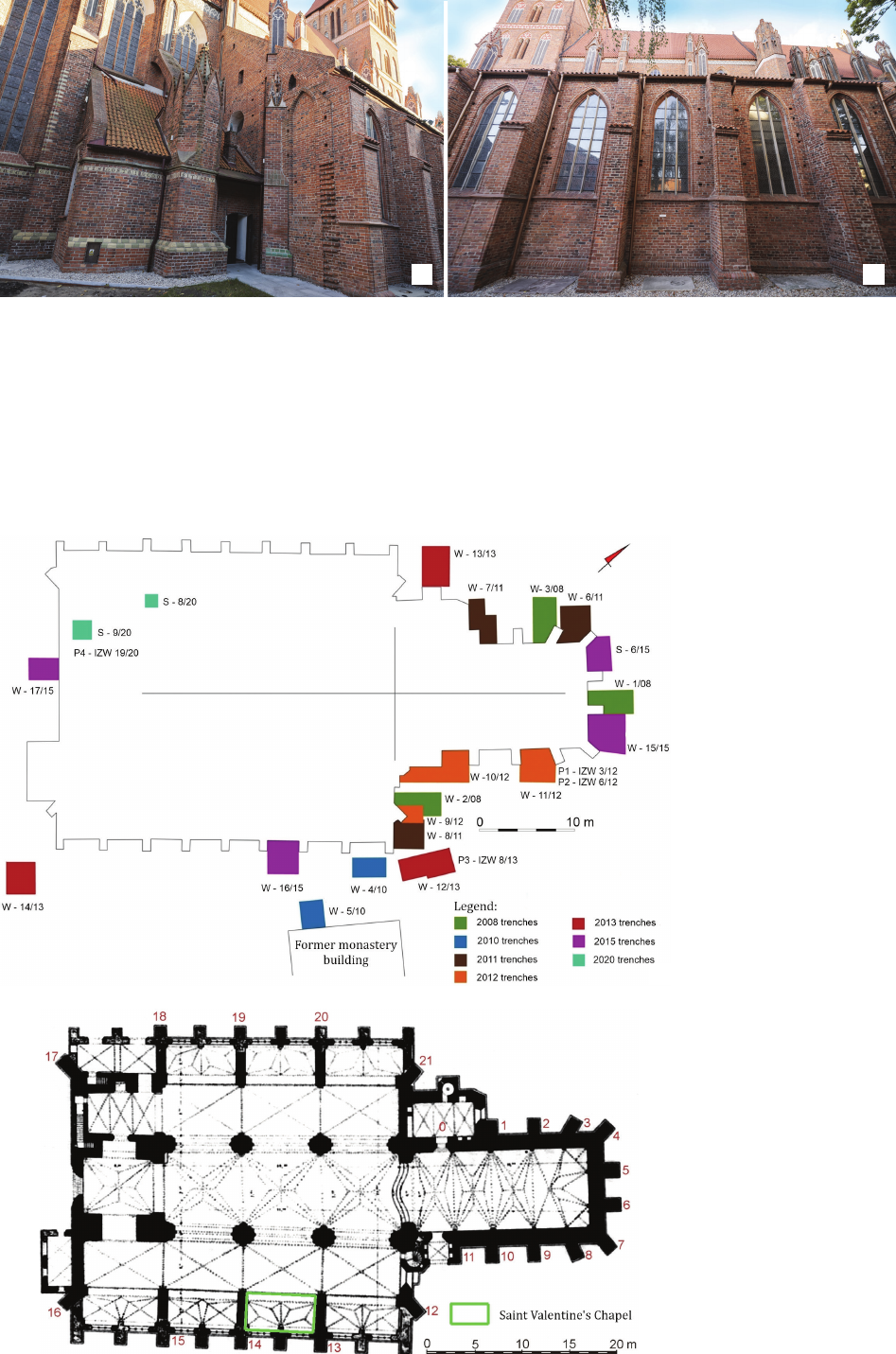
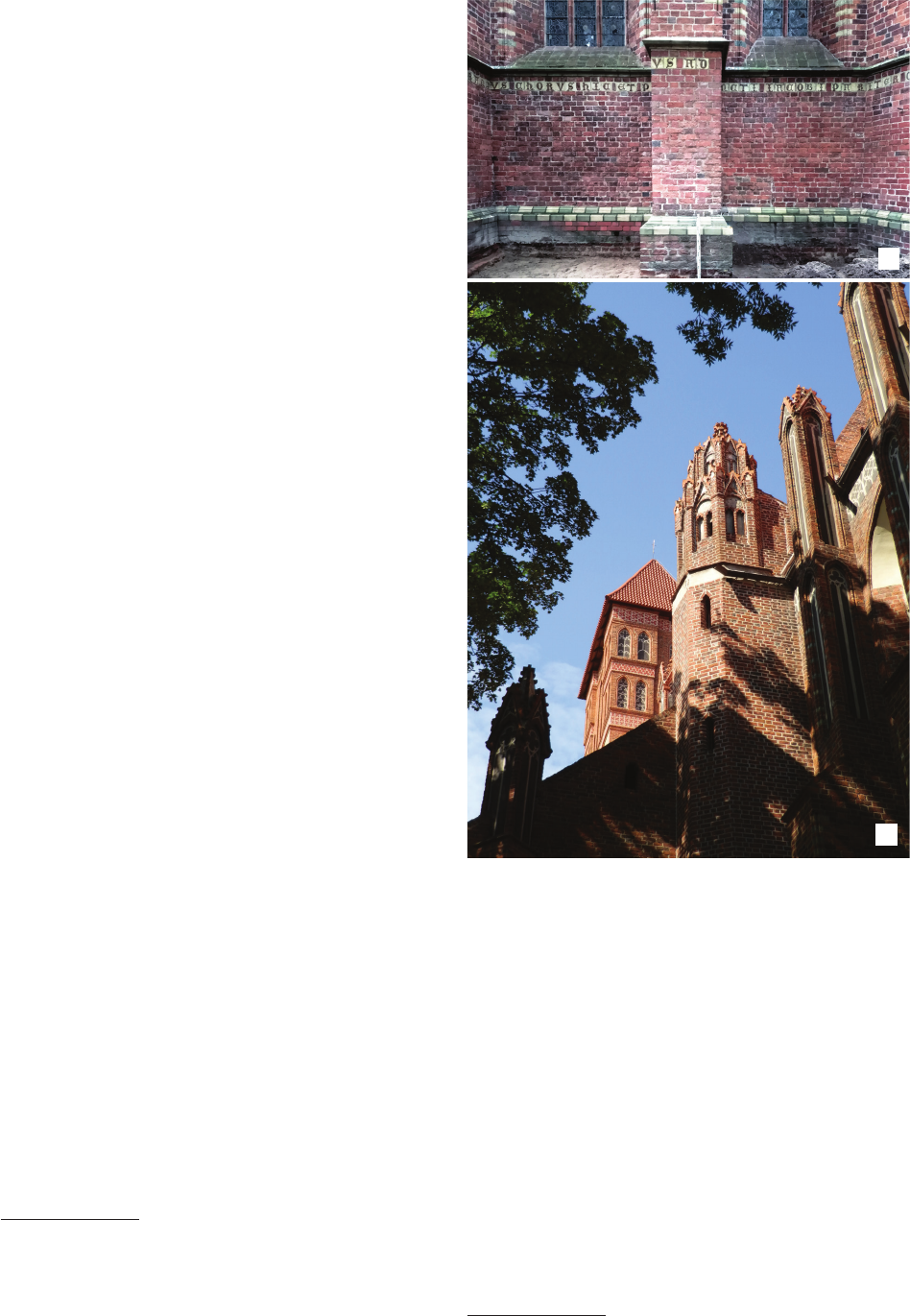
4 Krystyna Sulkowska-Tuszyńska
Fig. 1. Toruń, St. James’ Church:
A. View of the sacristy; the western tower in the background (photo by K. Sulkowska-Tuszyńska),
B. View of the chapels adjacent to the southern nave (photo by W. Ochotny)
Il. 1. Toruń, kościół św. Jakuba:
A. Widok na zakrystię; w tle wieża zachodnia (fot. K. Sulkowska-Tuszyńska),
B. Widok na kaplice przylegające do nawy południowej (fot. W. Ochotny)
Fig. 2. Toruń, St. James’ Church:
A. Archaeological excavation
plan (2008–2020)
(elaborated by A. Cicha, J. Struwe,
W. Miłek).
B. Plan of the church with
sacristy, chapels, and porch.
The buttresses are being referred
to by numbers 1 through 21
(based on Freymuth 1981)
Il. 2. Toruń, kościół św. Jakuba:
A. Plan wykopów
archeologicznych (2008–2020)
(oprac. A. Cicha, J. Struwe,
W. Miłek)
B. Plan kościoła z zakrystią,
kaplicami i kruchtą.
Cyfry 1–21 oznaczają
numery przypór
(na podstawie Freymuth 1981)
B
B
A
A
Writteninarchitecture…St.James’ChurchinToruń–theGothicpearlofPomeraniadiscoveredbyarchaeologists 5
since the 2
nd
half of the 17
th
century. In the 19
th
cen tu-
ry, when Poland was under partition, these were mainly
German researchers (Steinbrecht 1885, 26–30; Heise 1889,
291–315; Wernicke 1839, 40–42). In the 20
th
and 21
st
cen-
turies, Polish specialists gradually joint in this scientic
discourse (Mroczko 1980; Freymuth 1981; Kutzner 1986;
Krantz-Domasłowska, Domasłowski 2001; Sulkowska-
Tuszyńska 2022a, 18–21; Błażejewska 2022, 7–31; Pile c -
ka 2023).
The exterior of St. James’ Church in Toruń is preserved
in its Gothic style (Figs. 1, 3) with a Renaissance porch; in
the sacred space there are preserved polychromes and in-
scriptions, mainly medieval and baroque works of art.
The rst systematic archaeological research was con-
ducted at this site (site # 360) by the so-called Jacob’s
Expedition of the Institute of Archaeology of the Nicolaus
Copernicus University (Sulkowska-Tuszyńska 2022a, 22–
26). The object of research was a complex problem, made
all the more dicult to analyze and interpret because it
could only be observed from the outside
2
(Fig. 2A). From
2008 to 2020, research was carried out in eight installments
– mainly around the chancel; only four trenches were set
up near the nave from the south and west and between the
church and the monastery
3
. In 2020, due to the pavement
change around the church, rescue research conrmed and
enriched this knowledge. The ndings, concerning the ar-
chitecture, the church cemetery and the material culture of
Toruń’s inhabitants, have been presented in numerous pub-
lications (Sulkowska-Tuszyńska 2022a; 2022b; 2023a)
4
.
The research on St. James’s Church also aimed to verify
old theses, in order to answer important questions asked by
researchers who analyzed this structure thoroughly, but out
of necessity, only above ground level – Teresa Mroczko
(1980) and Otto Freymuth (1981). Independently, but un-
animously, they called for archaeologists to urgently un-
cover the temple’s foundations to clarify hypotheses that
could not otherwise be proven. This research was summa-
rized in a monograph on St. James’s Church (Sulkowska-
Tuszyńska 2022a, 47–50). In this article, additional results
from rescue research have been added (Sulkowska-
Tuszyńska 2023a) and others, yet unpublished
The history and architecture
of St. James’s Church
The architecture of St. James’s Church stands out from
the medieval hall-style buildings prevalent in Pomerania,
including Toruń. Its basilica form stands out. The building
features a relatively long and narrow chancel and a short
nave, centered on a massive tower with a two-gable roof
(Figs. 2B, 3B). The high chancel is squarely closed, with
2
Inside, it was possible to set up two surveys – in the northern nave
and at the western tower, where the new oor was not laid.
3
Between 2008 and 2020, 19 trenches (W-1/08 to W-19/19) and
nine surveys (S-1/11 to S-9/20) were opened. Systematic excavations
were conducted while students were trained during eldwork. Disco-
ve ries inside the church were made possible thanks to nancial support
from the Provincial Conservation Center in Toruń.
4
There is older literature and a blog: archeologia.jakub.wordpress.com.
a small sacristy to the north. The entire structure is sur-
rounded with buttresses – on the straight sections of the
walls, they are perpendicular to the church axis, on the cor-
ners, diagonal and doubled, and at the nave, single (Figs. 3A,
2B)
5
.
Some charm is added by two turrets with stairs inside
– a high polygonal one, from the south, at the junction of
the nave with the chancel, and a low one, from the north,
5
See also the new plan of St. James’s Church made in 2010, 2011
– measurements by M. Tuszyński, drawing by W. Miłek (after: Sul kow-
ska-Tuszyńska 2022a, Fig. 14 and page 48/49).
Fig. 3. Toruń, St. James’ Church:
A. View of the chancel from the south.
Fragment of the inscription is visible (photo by A. Cicha),
B. View from the southeast of the stair tower and western tower
(photo by K. Sulkowska-Tuszyńska)
Il. 3. Toruń, kościół św. Jakuba:
A. Widok na prezbiterium od południa.
Widoczny fragment inskrypcji (fot. A. Cicha),
B. Widok od południowego wschodu na wieżyczkę schodową
i wieżę zachodnią (fot. K. Sulkowska-Tuszyńska)
B
A

6 Krystyna Sulkowska-Tuszyńska
on a quadrangular plan with a cut corner – while also being
a pillar of the supporting arch stretching over the sacristy
(Figs. 3B, 1A)
6
. To the north and south, the naves are
anked by shallow chapels nestled between buttresses. The
smallest and newest chapel, adjoining the western wall of
the nave, is located next to the main portal (Figs. 1A on the
right, 1B, 2B). Soaring over the entire complex and the
city, the massive tower, on the axis of the complex, was
built into the western bay of the nave. It is anked on the
north and south by two rooms that extend the side naves.
Here is the main portal of the church. Near the tower, on
the north side, is a Renaissance plastered porch with two
portals leading into the interior (Fig. 2B).
The history of St. James’s Church is crucial for consider-
ing the circumstances of architectural alterations. It was
founded by the Teutonic Knights rather than the townspeo-
ple, a fact that has been and continues to be a subject of de-
bate (Błażejewska 2013), in the mid-14
th
century, the
church, together with the hospital and school, was handed
over by the Teutonic Knights to the Cistercian nuns of Toruń
under the patronage of the Teutonic Knights (Błażejewska
2022, 86–98). Until the mid-16
th
century, Catholics prayed
in this church; from 1557, for 110 years, it was occupied by
Protestants. Since 1667, it has been Catholic again.
With the advent of the Reformation, already in the 1520s
and 1530s, new religious trends reached Toruń, leading to
the Lutheranization of the townspeople and the city in the
middle of the century (Cackowski et al. 1994)
7
. Protestants
took over St. James’s Church, removing many furnishings,
rearranging the interior and whitewashing the walls to cov-
er the polychromes. Over time, the side altars were likely
taken apart and perhaps the ooring was replaced
8
. The
abandoned monastery was converted into a warehouse and
granary. During the, so-called, Swedish Deluge, the church
suered shelling and robbery of the bells. Only in 1667
were the nuns allowed to return to the reclaimed church
and old monastery
9
. The Protestant city authorities distrust-
ed the monastic orders and were hostile towards Catholics,
so it became necessary to create a cloistered area near St.
James’s Church through construction of a corridor to en-
sure safe passage between the church and the monastery
for the nuns. In the 18
th
century, the chancel was surround-
ed by new monastery buildings
10
.
In 1833, the Prussian occupying authorities forced the
Cistercian-Benedictine nuns to abandon their church and
6
The nave and sacristy were surrounded by supporting arches ex -
tending from the main walls to the buttresses. As a result of the con struc-
tion of chapels and the raising of the roof, these arches were obscured.
The arch extending onto the sacristy’s turret is the only visible element
of this structure today.
7
The privilege of King Sigismund Augustus of December 12, 1558,
allowing the preaching of the Gospel according to the Augsburg De no-
mination (Cackowski et al. 1994).
8
This is merely a supposition. Inside, two fragments of such tiles
were found in two of the surveys.
9
At the same time, the nuns lost their convent on the Vistula
River, which was destroyed by the Swedes.
10
This is indicated by preserved iconographic sources – plans of
Toruń from the 18
th
century and the results of archaeological research at
the contact point with the old monastery building (Cicha 2010; Sul kow -
ska-Tuszyńska, Cicha, 2010).
convent, thus beginning the dissolution of the monastery.
Several years later (1837), the Prussian authorities informed
the parishioners of their intention to close down the ceme-
tery, prohibiting burials in there. To this day, St. James’s
Church serves as the parish for the former Nowe Miasto
Toruń and the surrounding neighborhoods (Sulkowska-
Tuszyńska 2022a, 330, 331).
Of the many publications, two are particularly important
for the archaeologist studying architecture. The rst were
the research of Mroczko (1980), who demonstrated that St.
James’s Church was not a homogenous structure, but was
rather modied during its construction. Based on the “ab-
normal” arrangement of the corner, doubled buttresses of
the chancel, she suggested that the original concept of the
church had already been altered during construction
(Fig. 2B, 3A). She assumed that the chancel was extended
by a single bay, added from the east, over which a pseudo-
polygonal vault was installed. Due to the homogeneity of
the chancel with brick facing (a Polish bond), Mroczko be-
lieved that the hypothesis of the chancel’s extension could
only be veried in the foundation section. In conclusion,
she assumeded that the construction of the chancel began
in the 4
th
quarter of the 13
th
century, and subsequent con-
struction phases lasted from 1309 to approximately 1349
(Mroczko 1980, 167, 168). The second researcher, Frey-
muth (1981)
11
, was also doubteful that the year 1309 could
be the starting point of construction work on the church
and rightly believed that this date could be connected with
the reconstruction of the chancel. He suggested also, that
the entire structure was built by at least two masters and
that older forms are found in the naves, so the chancel is
younger than the naves (!). He stated that the master of
1309 must have taken into account remnants of an older
building, which may have had a polygonally closed chan-
cel, converted to a square one after 1309. According to
Freymuth, the new chancel was built on old foundations
the length and width of the old choir (1981, 14, 28, 30,
56–66, 72, 73); ultimately, he concluded that by the begin-
ning of the 14
th
century, nothing remained of the original
chancel, but the naves had survived in their original form.
He believed that around 1253 (before the city foundation)
the construction of the rst church with a three-sided clo-
sure began, from 1309 a new chancel was built, and al-
ready in 1349 the construction of the rst of the side cha-
pels between the buttresses of the naves began (Freymuth
1981, 83, 98) (Fig. 2B).
Liliana Krantz-Domasłowska expressed the opposite
opinion, claiming that […] thepresbyteryhadthesame
formasithastodayfromtheverybeginning (Krantz-Do -
ma słow ska, Domasłowski 2001, 47). Jakub Adamski was
convinced of the perfect compositional uniformity of all the
presbytery elements (2010, 19), and Adam Soćko conclud-
ed that the dierent arrangement of the diagonal buttresses
11
Freymuth was associated with Toruń until the end of World War II.
He died in Goslar in 1953. Only a year after Mroczko’s publication did
his work on the stages of construction of St. James’s Church appear.
What is signicant here is that many of the conclusions reached by both
researchers, undoubtedly formed independently, are convergent, and that
several of them have been positively veried.
Writteninarchitecture…St.James’ChurchinToruń–theGothicpearlofPomeraniadiscoveredbyarchaeologists 7
resulted from the need to transfer the forces of the vault’s
weight (2010, 60). Many of these theses were veried in the
course of archaeological work. The results of eight excava-
tion campaigns conducted at the church were made avail-
able in the form of articles, lectures, monographs of the ob-
ject, at exhibitions (Sulkowska-Tuszyńska 2022a, literature
there)
12
and in numerous presentations.
Results of archaeological
and architectural research
After archaeological and architectural research, seven
stages (I–VII) of construction and alterations in the build-
ing process were discerned (Figs. 4, 5A–D).
The rationale for dierentiation of the construction stag-
es and history of St. James’s Church has diverse footing
and importance – it stems from observations of architectur-
al changes, primarily revealed in the foundations, data en-
coded in the stratication of cultural layers, and the context
of artifacts deposited. Written and iconographic sources
were also used, and above all, the results of brick dating by
the OSL (Optically Stimulated Luminescence) method.
Unique medieval objects discovered during excavations,
related to the function and furnishings of the parish church,
also speak to the character of this architecture: a stone bap-
tismal font and tombstone, oor tiles, and a water tank by
the sacristy.
It has been established that the construction of this
church began immediately after the town was marked out.
12
St. James’s Church has been undergoing renovation and con-
ser vation work for several decades, both inside and outside. During this
work, additional polychromes and inscriptions (14
th
–18
th
centuries)
were uncovered, most of which have already been published (Kluczwajd
2010; Błażejewska, Pilecka and Saar-Kozłowska 2023).
StageI
Presbytery and western massif (Phase I: after 1264 – be-
fore 1309: IA – construction of the presbytery I and IB
– beginning of construction of the western massif) (Fig. 5I).
After digging the foundation ditch and collecting the
building materials, the construction of the foundations be-
gan, using eld stones, laying them in layers and pouring
mortar on top (Fig. 6A; phase IA). The stone foundations
of the chancel, both the walls and the buttresses, were con-
sistent in all the examined locations; they were built all at
once. The rst church in Nowe Miasto Toruń, built after the
city’s foundation until the beginning of the 14
th
century
(before 1309), had a rectangular chancel, square-ended on
the east, with one diagonal buttress resting on a foundation
uniform with the eastern wall in the northeast corner
(Fig. 5I, 10B). Both southern corners of the chancel, how-
ever, had foundations that extended signicantly beyond
the main walls to support some circular or polygonal ma-
sonry structures (presumably turrets). A layer of mortar re-
mained on the top of these foundations (up to 2.2 m high,
3.5 m diagonal) (Fig. 6A, on the left). In other places the
rst presbytery was surrounded by buttresses set at right
angles to the axis (Fig. 6A on the right, 6B – F0-1, phase
IA). The ring time of the bricks sampled from the osets
of the north-east corner of the chancel, above the founda-
tion stones, was determined to be the 13
th
century, closer to
the 3
rd
quarter of the century
13
. Thanks to the dating of the
bricks, it is known that the western massif was built no lat-
13
OSL dating indicates that the bricks from the lower oset: JK4
were red no later than 1221, and from the lower oset, near JK5, no
later than 1262. From the sacristy from the outside: JK3 – ca. 1300
(Chruścińska et al. 2014, Fig. 39, Table 5). The bricks from the north-
eastern corner of the chancel were the oldest of all those used in the
structure of St. James’s Church.
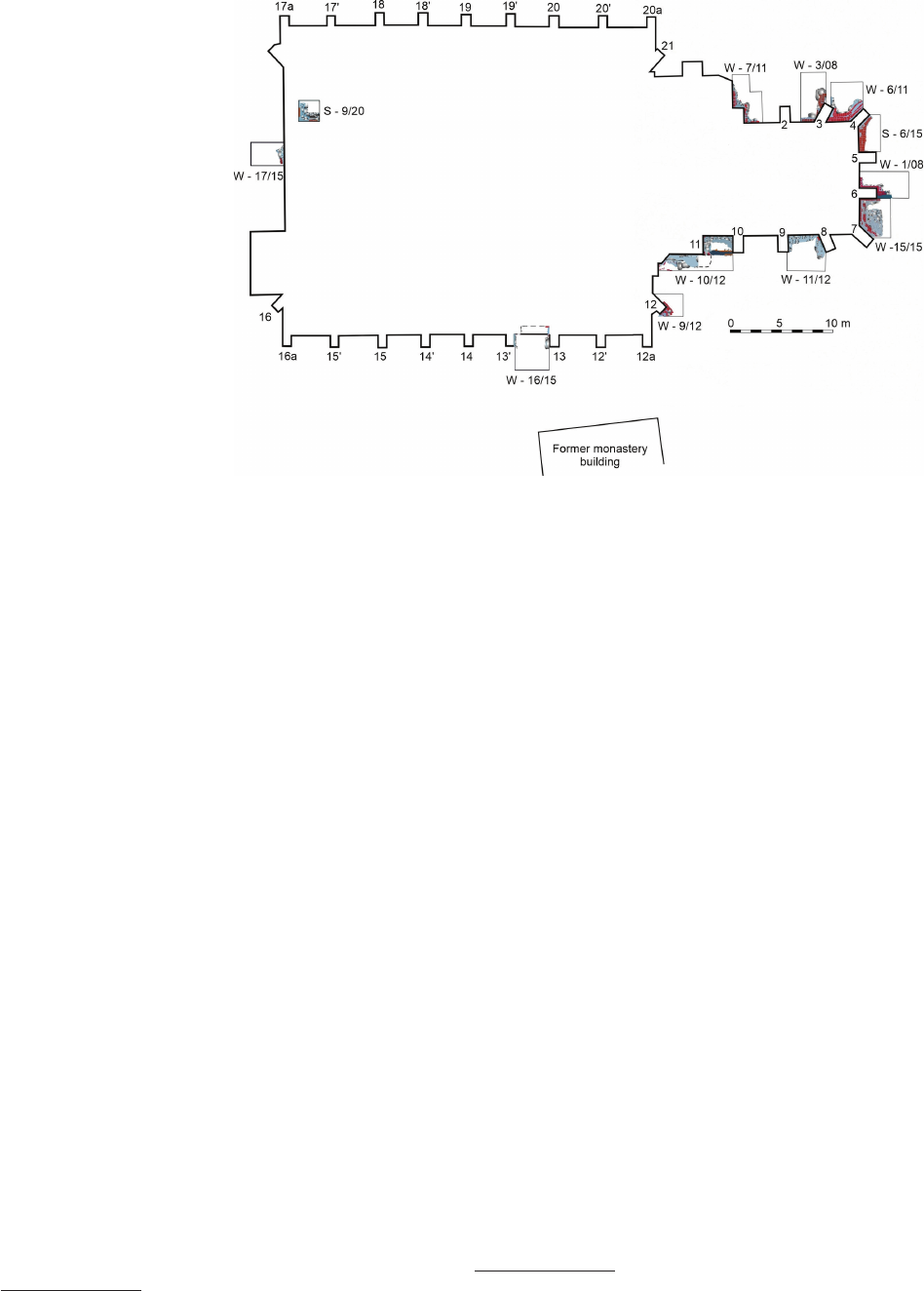
Fig. 4. Toruń, St. James’ Church.
Foundations of the church
uncovered during archaeological
excavations 2008–2020.
The buttresses are being referred
to by numbers 1 trough 21.
Blue and grey – stone foundation
in limestone mortar. Red – brick
foundation and offsets
(drawing by W. Miłek based on
the documentation
of the St. James’ Expedition)
Il. 4. Toruń, kościół św. Jakuba.
Fundamenty kościoła odsłonięte
podczas badań archeologicznych
2008–2020. Cyfry 1–21
oznaczają numery przypór.
Niebieski i szary – fundament
kamienny w zaprawie wapiennej.
Czerwony – fundament ceglany
i odsadzki (rys. W. Miłek wg
dokumentacji Ekspedycji Jakubowej)
8 Krystyna Sulkowska-Tuszyńska
er than the 3
rd
quarter and in the 4
th
quarter of the 13
th
cen-
tury (phase IB); the tower was started, and then the western
wall of the nave, homogenous with it, was built
(Chruścińska, Pawlak and Palczewski 2022, 292–298
14
)
(Fig. 7).
14
The OSL dating results of samples taken from the northern wall
of the tower (JW1 and JW2) indicated that both bricks were red no later
than 1250, and the average date for bricks from the western wall of the
nave massif JSz1, JSz2 is 1236 ± 30.
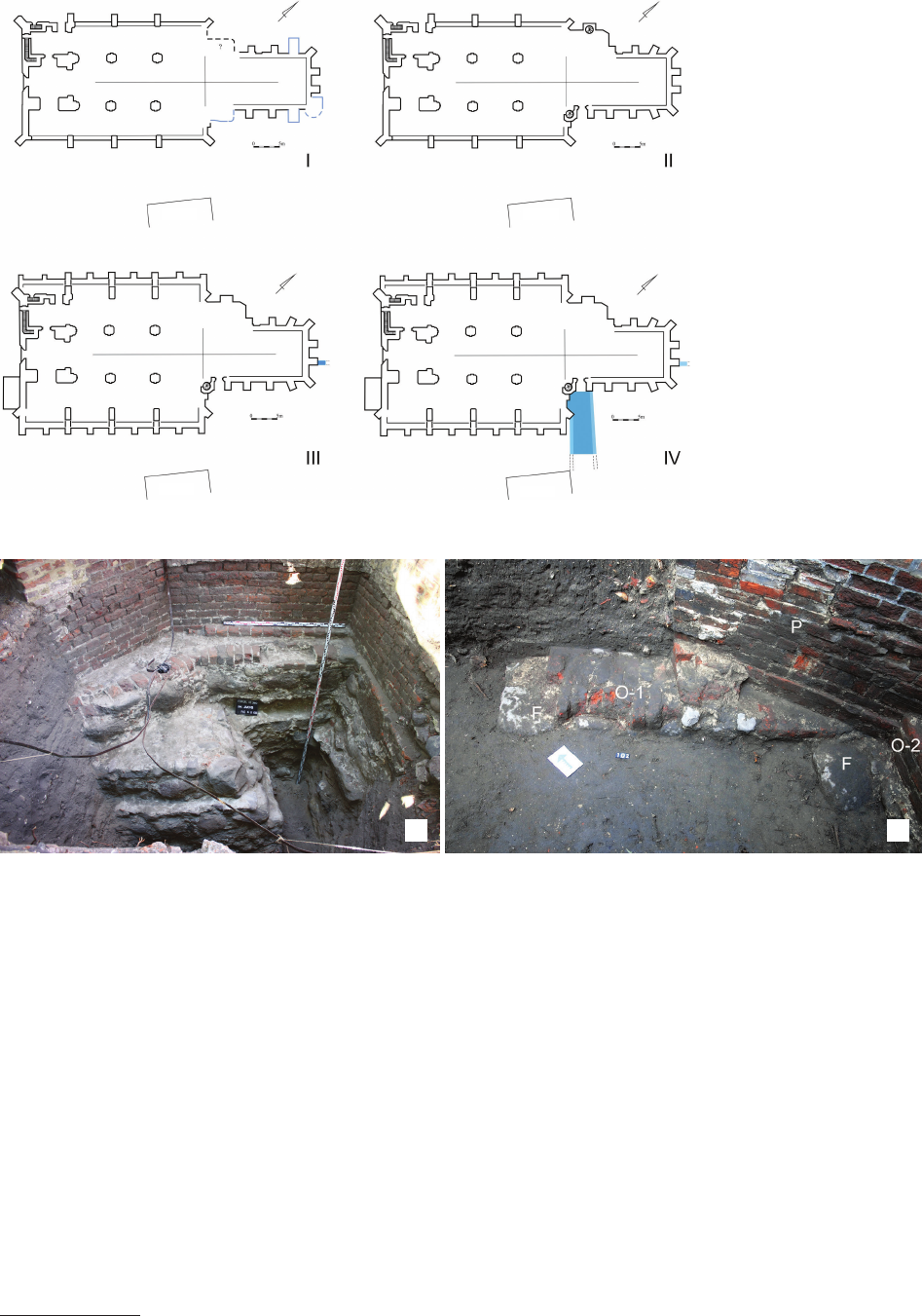
Fig. 5. Toruń, St. James’ Church.
Stages of church reconstruction:
I – Phase I
(beginning of construction),
II – Phase II
(reconstruction after 1309),
III – Phase III (addition of chapels);
IV – Phase V, addition of
a connecting passage and
construction of the modern monastery
Blue – connecting passage
foundation (Phase V)
(elaborated by K. Sulkowska-
Tuszyńska, drawing by W. Miłek)
Il. 5. Toruń, kościół św. Jakuba.
Etapy przebudowy kościoła:
I – faza I (rozpoczęcie budowy),
II – faza II (przebudowa po 1309),
III – faza III (dobudowa kaplic);
IV – faza V, dostawienie łącznika
i budowa nowożytnego klasztoru
Niebieski – fundament korytarza/
łącznika (faza V)
(oprac. K. Sulkowska-Tuszyńska,
rys. W. Miłek)
Fig. 6. Toruń, St. James’ Church, chancel: A – eastern wall from the south (W-15/15). The great foundation of the southern corner
(trench 15/15; Phase I), with a diagonal buttress (Phase II). On the right, a straight buttress (see Fig. 2B: 7, 6) (photo by J. Struwe);
B – diagonal buttress of the northern wall (W-3/08).
Foundation of the straight buttress of the northern corner (W-3/08 during exploration), on it a diagonal buttress (phase II) (see Fig. 2B: 3).
F – foundation of the northern chancel wall, O-1 offset of the foundation buttress, O-2 offset of the northern chancel wall, P – diagonal buttress (no. 3)
(photo by K. Sulkowska-Tuszyńska)
Il. 6. Toruń, kościół św. Jakuba, prezbiterium: A – ściana wschodnia od południa (W-15/15). Wielki fundament narożnika południowego
(wykop 15/15; faza I), na nim przekątniowa przypora (faza II). Po prawej przypora prosta (por. il. 2B: 7, 6) (fot. J. Struwe);
B – skośna przypora ściany północnej (W-3/08). Fundament prostej przypory narożnika północnego (W-3/08 w trakcie eksploracji),
na nim przekątniowa przypora (faza II) (por. il. 2B: 3).
F – fundament północnej ściany prezbiterium, O-1 odsadzka fundamentu przypory, O-2 odsadzka północnej ściany prezbiterium, P – przypora skośna (nr 3)
(fot. K. Sulkowska-Tuszyńska)
BA
The indicated construction period of the western massif
and the clearly dierent dimensions of the nave bays (at the
tower and at the junction with the chancel) suggest that
construction of the entire structure, was progressing simul-
taneously, from approximately the 3
rd
quarter of the 13
th
century through the 4
th
quarter of the 13
th
century, may
have proceeded from two directions – the chancel was built
from the east toward the nave, and the nave from the tower
and western wall toward the chancel. This construction se-
quence was already suggested by Freymuth (1981).
Former
monastery
building
Former
monastery
building
Former
monastery
building
Former
monastery
building
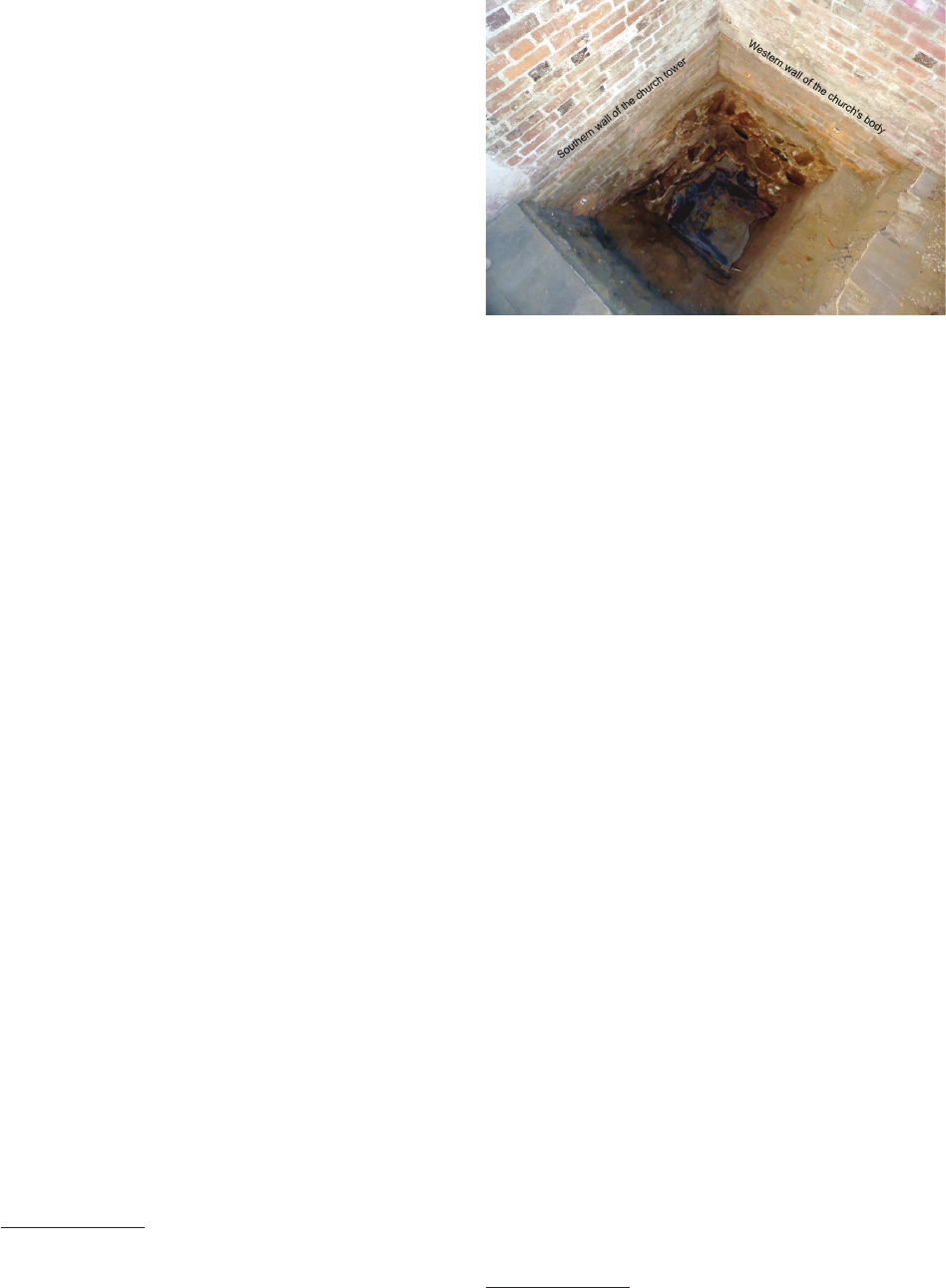
Writteninarchitecture…St.James’ChurchinToruń–theGothicpearlofPomeraniadiscoveredbyarchaeologists 9
Fig. 7. Toruń, St. James’s Church from the interior. Uniform foundation
of the tower and western wall. Bird’s eye view (photo by B. Kriks)
Il. 7. Toruń, kościół św. Jakuba od wnętrza. Jednorodny fundament wieży
i ściany zachodniej. Widok z góry (fot. B. Kriks)
pression of a polygonal closure (Fig. 3A). Perhaps the need
to accommodate the old foundations’ varying lengths and
widths meant that the pairs of diagonal buttresses are not
parallel to each other and have slightly dierent dimensions.
The third and fourth pair of straight buttresses were left un-
changed (Figs. 2B: 2 i 9, 1 i 10). Of the fth pair, right next
to the nave, the southern buttress was erected perpendicular
to the chancel (Fig. 2B: 11), resting its low foundation on
the great foundation from phase IA, and a side portal was
built next to it. Between this entrance and the eastern wall of
the southern nave, a slender, polygonal stair turret was “in-
serted”, partly resting on the great foundation of the phase
IA (Sulkowska-Tuszyńska 2014). Much older bricks were
used to build this turret, probably from the demolished wall
of the rst structure (Pawlak et al. 2025). On the northern
side, by the 3
rd
–4
th
quarter of the 14
th
century, a sacristy was
built or extended (?) with an external pillar for the support-
ing arch (Figs. 1A, 2B), inside which stairs lead to a small
gallery, from where there is a view of the main altar
18
.
The dating of bricks (OSL) sampled from several loca-
tions in the second chancel indicates a date of the 14
th
cen-
tury, primarily the 1
st
half. The results of the absolute dating
of these bricks and the stratication of the walls comple-
ment and conrm each other. The accuracy of this data is
conrmed by an inscription informing about the completion
of the church’s construction in 1368, located in the nave,
above the arcades, and recently discovered during conser-
vation work (Pilecka 2023, 121, 122).
Perhaps during the construction of the sacristy, or at the
latest in the 1
st
half of the 15
th
century, a recess was made
inside in its northern wall for a stone washbasin
19
, from
which a drain was led in the northern wall, in front of the
18
Archaeological research could not be carried out in the sacristy.
The sacristy was probably built from its eastern wall – the samples
taken there were the oldest (JK1:1297–1356; JK3: 1265–1337); inside,
the sacristy could have been completed as early as the 2
nd
half of the
14
th
century: JB: 1320–1400 (Chruścińska et al. 2014, Fig. 39, Table 3;
Chruścińska, Pawlak and Palczewski 2022, Table 6).
19
Washbasin was identied and uncovered during conservation work.
The above conclusions resulted from observations of the
foundations and their relationship to the above-ground struc-
ture. The architectural modications discovered are support-
ed by a key witness of the past – the stratication of the
layers. The only intact section of the soil prole, not dam-
aged by burial pits, has been preserved around and beneath
the side portal
15
(trench W-10B/12). There, between the
crown of the stone foundation (phase IA, late 13
th
/early 14
th
century) and the modern oor (3
rd
quarter of the 17
th
centu-
ry), six thin units have grown: typical utility and construc-
tion levels. The lowest preserved layer of brick dust proves
that after the wide foundation (phase IA) was laid, some de-
struction of the upper brick section occurred (Fig. 8, arrows).
From the oldest sacral furnishings, we know only of a stone
bowl in a distinctly late Romanesque style. It was a lime-
stone chalice baptismal font – octagonal, hemispherical in-
side, decorated with motifs of lions (?) striding around holy
water; the Teutonic Knights most likely brought it from
Gotland
16
. This bowl could have been used for a very long
time, also inside the new second chancel, not only in the
14
th
, maybe even in the 15
th
century (Sulkowska-Tuszyńska
2012; 2022a – cat. 1, 119, 120, Fig. 103; appendix XII,
315–324; 2022b, Fig. 25, 23).
In the 2
nd
half of the 13
th
century, closer to the end of
that century, the foundations of a large building perpendic-
ular to the axis of the presbytery began – the presumed rst
monastery (Chruścińska et al. 2014, tab. 5; Sulkowska-
Tuszyńska 2022a, 325, 326; Cicha 2010; Sulkowska-
Tuszyńska, Cicha 2010)
17
.
StageII
In the second stage, a new presbytery was built – the
second one (after 1309 until about the 3
rd
quarter of the
14
th
century; phase II) (Figs. 2B, 3A, 5II).
It can be assumed that Bishop Herman’s placing of the
cornerstone in 1309 was necessitated by the eects of a ca-
tastrophe, after which the chancel was thoroughly rebuilt.
Archaeological discoveries reveal that several new, now di-
agonal buttresses were built on the old foundations of the
rst chancel, without extension by a bay. The new structure
still had a straight eastern wall with three “old” buttresses –
two parallel to the axis and a diagonal one in the northern
corner; the southeast corner however, was thoroughly re-
built: a new diagonal buttress was built in place of the de-
molished (?) tower. This gave both eastern corners diagonal
buttresses (Fig. 2B: 7, 4).The second pair of corner buttress-
es from the east (No. 3 and No. 8) was dismantled to place
the diagonal buttresses on the old foundations and match
them with the rst pair of buttresses, thus obtaining the im-
15
In other researched places the arrangement of layers was dis -
rupted by burial pits (7–15 levels of graves).
16
Found in front of the church, in a demolition layer from the 19
th
century. Such baptismal fonts in the State of the Teutonic Order were used
mainly in the 13
th
and even in the 14
th
century (Sulkowska-Tu szyń ska
2022a, 119, 120).
17
OSL dating allowed us to establish that the brick from this founda-
tion was red no later than 1297. A similar result was shown by dating the
wood from the formwork of this foundation (14C dating by Prof. Marek
Krąpiec; 2022).
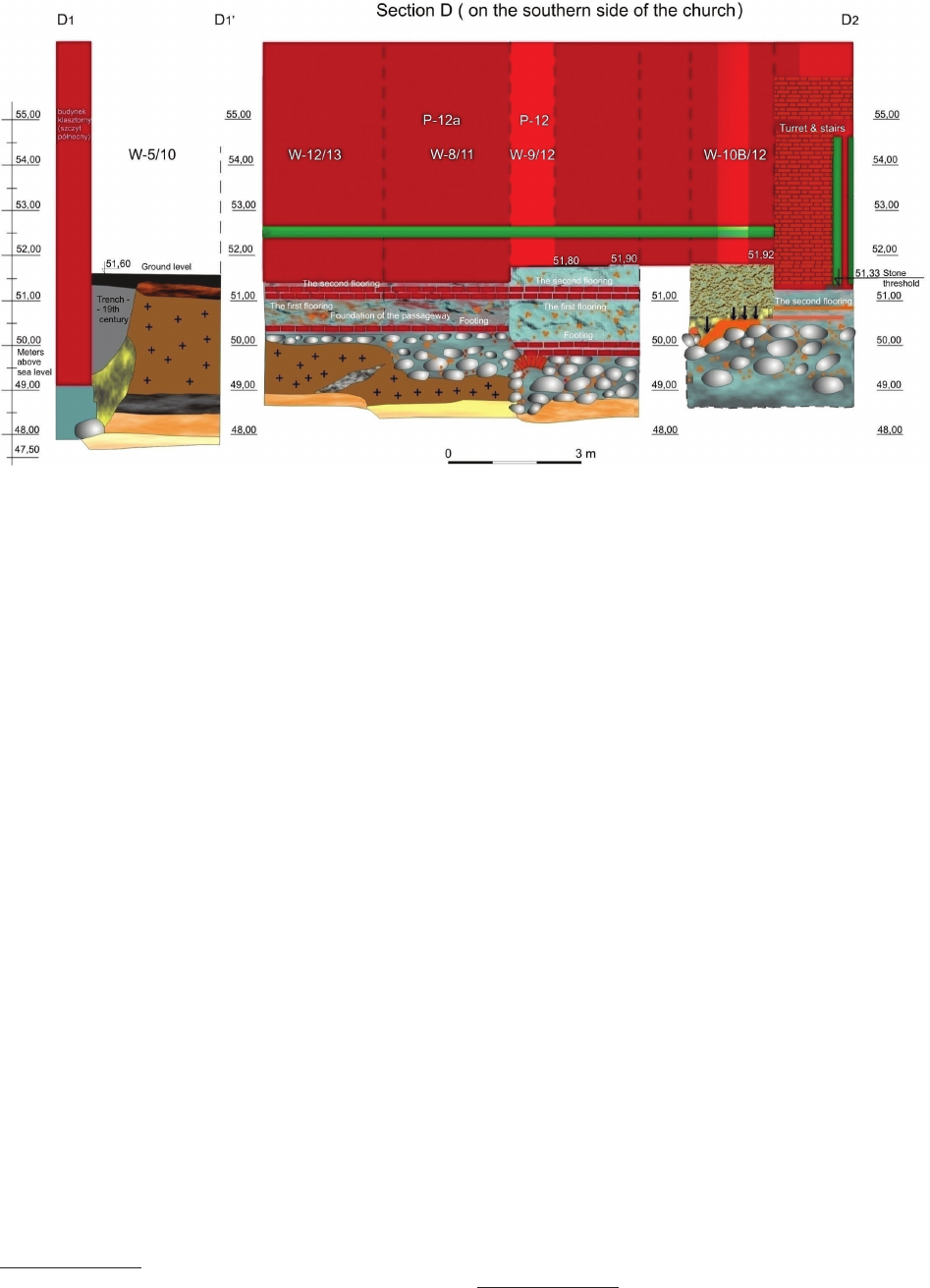
10 Krystyna Sulkowska-Tuszyńska
sacristy, 1 m below ground level. Around this opening (45 ×
15 cm), the space between the sacristy wall, the turret, and
the buttress was enclosed by a low wall, thus creating a quad-
rangular container (area 2.85 m
2
, depth 1 m). In the brick
bottom of the tank (+50.7 m above sea level), a funnel-shaped
outlet for the water was made (30–40 cm lower than the
oor). Until the 1760s
20
, this tank was lled with water-l-
tering charcoal (Sulkowska-Tuszyńska 2023a, 49, 50)
21
.
StageIII
This stage is connected with the construction of chapels
(15
th
–rst years of the 16
th
century).
In the 2
nd
quarter of the 15
th
century, chapels were suc-
cessively added to the nave between the buttresses (Ko-
niecz ny 2010, 112–118), resting their walls on arcade foun-
dations (Fig. 5II). It is known that the current chapel of St.
Va len tine
22
, was built as the last in the southern row, around
the 1420s–1430s (Konieczny 2010, 98; Sulkowska-Tu-
szyń ska 2023a, 67 .). Its construction began with the dis-
assembly of the appropriate section of the southern wall of
the church nave. Between two extended buttresses, made
of recycled bricks
23
, a new, southern wall of the chapel was
20
On the oor of the tank under the charcoal, a Toruń shilling was
found (August III Sas, 1760; IMo-55/20).
21
Such a container lled with charcoal is unknown from Polish
literature of the subject.
22
This is the only chapel examined by archaeologists, and only
from the outside.
23
OSL dating of bricks – 13
th
century (Pawlak et al. 2025).
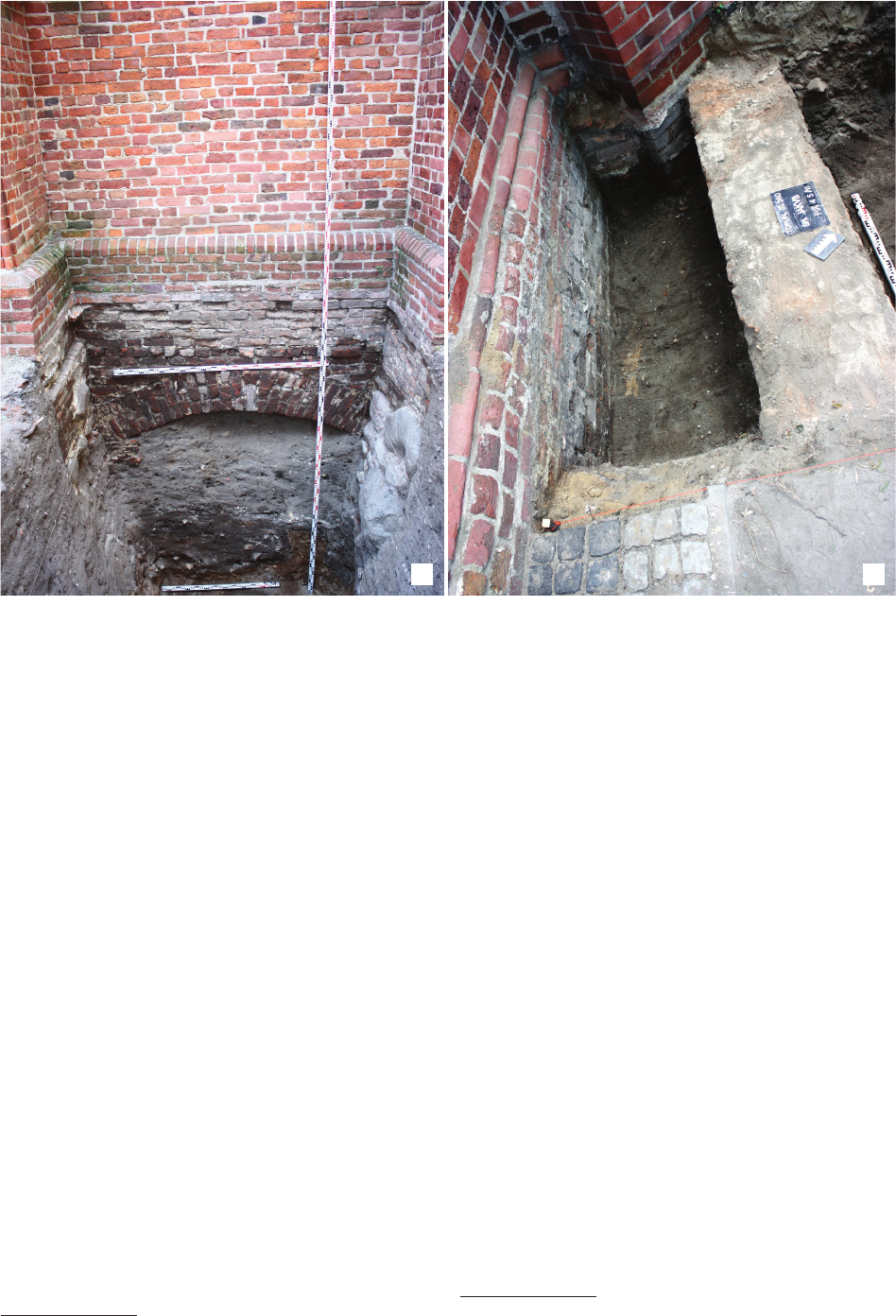
built, rested on an arcade foundation supported by a new
buttress on its axis (Fig. 9A). Its medieval furnishings are
unknown. The only known information about its interior
decoration is that the eastern wall and the vaulting were
decorated with plant motifs
24
. It is very likely that a grave
marked with a limestone slab, with a majuscule inscription
around the “head” and a maker mark on the axis, was locat-
ed in this chapel as early as 1435. The slab lay over the
supposed grave, as indicated by the inscription, of Toruń
alderman Mikołaj Rumpeler
25
(Krantz-Domasłowska,
Domasłowski 2001, 90; Jurkowlaniec 2015, 318). This is
one of the few medieval tombstones that is fully preserved
and legible
26
. At that time, the church was oored with tiles
decorated with our de lis (Sulkowska-Tuszyńska 2022a,
74–78, ryc. 56–58, Kat. 78–79).
StageIV
Between 1557 and 1667, the interior of the church was
altered, when Lutherans gathered there: the walls were
whitewashed to cover the polychromes, our de lis deco-
rated oor, which was perhaps associated with the Virgin
Mary, was likely removed, and the side altars were also dis-
assembled. There is no archaeological data for this stage.
24
Conservation work carried out in 2022.
25
Nicclos Rumpeler died in 1435, he was the son of Nicholas,
councilor and judge of the Nowe Miasto Toruń.
26
Over time, during the construction of the Baroque altar, it was
likely removed from the oor and used as a mensa. It remained there until
2020 and was revealed when conservators dismantled the altarpiece.
Fig. 8. Toruń, St. James’s Church. Stratification, section D – from the southern portal of the chancel to the monastery,
along the eastern wall of the nave and the connecting passage. Arrows above the foundation indicate brick dust (phase IA=destruction)
(elaborated by K. Sulkowska-Tuszyńska, drawing by W. Miłek)
Il. 8. Toruń, kościół św. Jakuba. Stratyfikacja, odcinek D – od południowego portalu prezbiterium do klasztoru,
wzdłuż wschodniej ściany nawy i łącznika. Strzałki nad fundamentem wskazują na miał ceglany (faza IA=destrukcja)
(oprac. K. Sulkowska-Tuszyńska, rys. W. Miłek)
Writteninarchitecture…St.James’ChurchinToruń–theGothicpearlofPomeraniadiscoveredbyarchaeologists 11
StageV
Dated after 1667 to the 1830s. The addition of a con-
necting passage began the construction of the modern mon-
astery (Fig. 5IV), which continued throughout the 18
th
cen-
tury. The dissolution of the monastery by the Prussians
(1833) brought it to an end.
When the Benedictine nuns were nally able to return
to their convent in 1667 after regaining St. James’s Church,
they rst commissioned the construction of a passageway
– a connecting passage between the old house and the chan-
cel. This was a long and narrow building, essential for
the cloistered convent in the turbulent, predominantly
Protestant city of that time. The connecting passageway was
built on a continuous brick foundation, that disturbed the
burial grounds. The foundation was constructed of recycled
brick
27
, had two communication routs – the outer one, be-
tween the portal and the monastery along its entire length,
and one on the church side, only between the buttress and
the monastery. The passage matched the width of one bay of
27
OSL dating of two bricks indicates the 16
th
and 17
th
centuries
(Pawlak et al. 2025).
the chancel and was probably roofed
28
, plastered
29
and had
a brick oor. It widened at the church portal, narrowed at the
monastery (external width 4.8–5.2 m, internal 3.5–4.4 m)
and visibly leaned towards the east (Figs. 5IV; 9B). The to-
tal length of the passage between the side portal of the chan-
cel and the monastery could have reached 17 m (Sulkowska-
Tuszyńska 2022a, 79–87). The passage was probably
demolished along with the early modern monastery after
the Prussians decided to dissolve the congregation in 1833.
This marks the end of the “monastic” phase of development
in the shade of St. James’s Church.
StageVI
It lasted from around the 1840s until at least the end of the
19
th
century. After the dissolution of the Benedictine con-
vent and the demolition of the monastery buildings, in the
2
nd
quarter of the 19
th
century, a narrow structure was built
along the entire southern wall of the chancel. It is known
from a lithograph – in 1846, it had the form of a Neo-Gothic
28
Traces preserved on the presbytery façade, just above the side portal.
29
Pieces of milky-grey plaster with burgundy wavy lines found in
the demolition layer.
Fig. 9. Toruń, St. James’ Church. St. Valentine’s Chapel:
A. View of the eastern part of the arcaded foundation and the foundation of buttress P-13 (Fig. 2),
B. Western foundation of the passage between the chancel and the monastery (see Fig. 5IV)
(photo by J. Struwe)
Il. 9. Toruń, kościół św. Jakuba. Kaplica św. Walentego:
A. Widok na wschodnią część arkadowego fundamentu i funf. przypory P-13 (il. 2),
B. Zachodni fundament łącznika pomiędzy prezbiterium a klasztorem (por. il. 5IV) (fot. J. Struwe)
BA
12 Krystyna Sulkowska-Tuszyńska
“wall” with battlements. Of this structure, only the outlines
of the foundations of the outer wall and two partition walls,
as well as thick layers of rubble, remain. Meanwhile, in the
sacristy, after 1873, the outer doorway was broken out, the
washbasin alcove was bricked up, and the charcoal tank was
lled in (Sulkowska-Tuszyńska 2023a, 50)
30
.
StageVII
This is the nal stage in the history of St. James’s Church.
All that remains of the claustrum is the oldest building, its
gable facing the chancel, and the cemetery site displays of
dozens of tombstones. St. James’s Church currently func-
tions as a parish. The new cemetery is located on Jakubskie
Przedmieście Street. The beautiful Gothic cellars of the
nearby hospital remain underground (!).
Summary and conclusions
In summary, the Gothic Church of St. James in Toruń,
an elegant creation by an unknown master (Sulkowska-
Tuszyńska 2022b), when subjected to archaeological re-
search, revealed evidence of architectural alterations over
the course of over seven hundred years. These alterations
were identied through observation of foundations, stratig-
raphy, OSL dating of bricks, and other sources. The most
important result of the investigation was conrmation that
construction of parish church began in Nowe Miasto Toruń
shortly after the city’s foundation. The church was de-
stroyed after the foundations were laid and the walls were
raised to an unknown height, perhaps as early as the 13
th
century (an invasion of pagan tribe). It should be added that
Tomasz Jasiński (1999, 145–148) also suggested, the par-
ish church in Nowy Toruń was built immediately after the
city’s foundation. As a result of the analyses, it became
clear that the inscription about the setting the cornerstone
for the church in 1309 refers to the new – second – chancel.
This house for God was built from two sides from the
3
rd
and 4
th
quarters of the 13
th
century. The Teutonic Knights,
increasingly powerful (from 1309 with their capital in Mal-
bork), as ruler of both Toruń cities, emphasized their grow-
ing dominion by erecting a new, taller structure (after 1309).
Verifying the theses of the Gothic architecture scholars
Mroczko and Freymuth, it was conrmed that St. James’s
Church in Toruń is not a uniform structure and that during
its reconstruction, new buttresses and two stair turrets were
built at the corners of the chancel and two stair turrets near
the naves. The two pairs of diagonal buttresses anking the
eastern wall of the chancel were intended to give the design
an impression of polygonality of the eastern closure.
Contrary to Mroczko’s suggestion, the “abnormal” arrange-
ment of duplicated buttresses did not necessitate the addi-
tion of an additional bay – the relevant buttresses were
merely rebuilt from straight to diagonal (Fig. 10A). Thanks
to brick dating using the OSL method, it is known that the
construction of the rst structure was carried out from
30
In the highest layer of rubble, below the entrance to the sacristy,
there was a coin (2 pfennig – 1873, Germany, Empire).
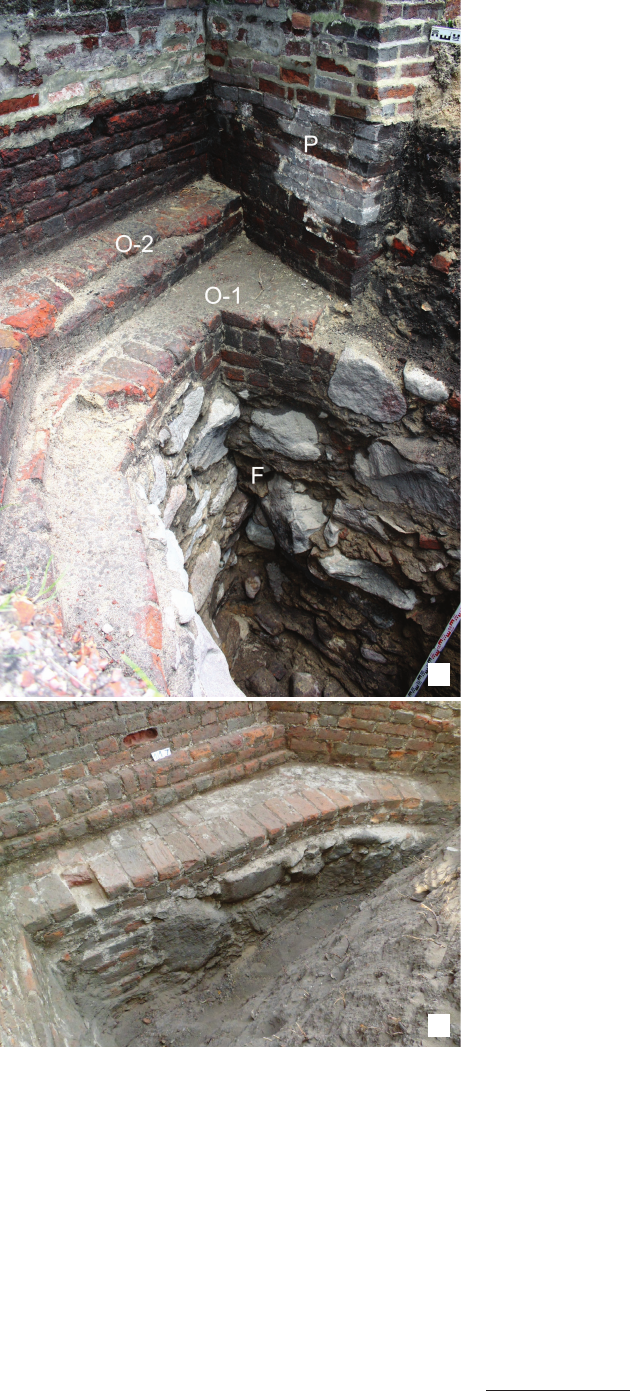
Fig. 10. Toruń, St. James’ Church.
Chancel – eastern wall. Foundation of the northern corner:
A. Trench W-6/11. View from the north. On the left, a diagonal buttress
with offsets O-1, O-2 (see Fig. 2B, no. 4 and Fig. 5I), on the right,
the foundation (F) of the straight buttress (Fig. 2B, no. 3 and Fig. 4),
on it a new diagonal buttress is visible (Fig. 5II and Fig. 10A-BP),
B. Survey S-6/15. View from the east on the homogeneous foundation
of the eastern wall and the diagonal buttress (not adjustable; Fig. 2B, no. 4)
(photo by J. Struwe)
Il. 10. Toruń, kościół św. Jakuba.
Prezbiterium – ściana wschodnia Fundament narożnika północnego:
A. Wykop W-6/11. Widok od północy. Po lewej przypora skośna
z odsadzkami O-1, O-2 (por. il. 2B, nr 4 i il. 5I),
po prawej fundament (F) przypory prostej (il. 2B, nr 3 i il. 4),
na nim widoczna nowa skośna przypora (il. 5II i il. 10A-BP),
B. Sondaż S-6/15. Widok od wschodu na jednorodny fundament
wschodniej ściany i skośnej przypory (nieprzestawianej; il. 2B, nr 4)
(fot. J. Struwe)
B
A
Writteninarchitecture…St.James’ChurchinToruń–theGothicpearlofPomeraniadiscoveredbyarchaeologists 13
References
Adamski, Jakub. “Pseudopoligonalne sklepienie chóru kościoła pw. św.
Ja kuba w Toruniu – próba nowego spojrzenia.” In Dzieje i skarby
kościołaświętojakubskiegowToruniu, edited by Katarzyna Klucz-
wajd. Towarzystwo Naukowe Organizacji i Kierownictwa “Dom
Orga nizatora”, 2010.
Błażejewska, Anna. “Kościół św. Jakuba w kontekście dyskusji nad zna-
czeniem patronatu krzyżackiego dla jego budowy i architektonicz-
nej formy.” In Stare i nowedziedzictwoTorunia, edited by Juliusz
Raczkowski. Wydział Sztuk Pięknych UMK, 2013.
Błażejewska, Anna. Architektura kościoła św. Jakuba w Toruniu jako
przedmiotbadańnaukowych. Wydawnictwo Naukowe UMK, 2022.
Błażejewska, Anna, Elżbieta Pilecka, and Alicja Saar-Kozłowska, eds.
Dzieje i skarby kościoła św. Jakuba. Nowe rozpoznanie. Oddział
Toruński Stowarzyszenia Historyków Sztuki, Towarzystwo Nau ko-
we w Toruniu, 2023.
Cackowski, Stefan, Bogumił Dybaś, Kazimierz Maliszewski, Zbigniew
Na worski, and Stanisław Salmonowicz. Historia Torunia. Vol. 2,
cz. 1. W czasachrenesansu,reformacjii wczesnegobaroku(1660–1793).
Wydawnictwo TNT, 1994.
Chruścińska, Alicja, Anna Cicha, Natalia Kijek, Piotr Palczewski, Krzy-
sztof Przegiętka, and Krystyna Sulkowska-Tuszyńska. “Lu mi nes-
cence dating of bricks from the gothic Saint James church in To -
ruń.” Geochronometria 41, no. 4 (2014): 352–60. https://doi.org/
10.2478/s13386-013-0165-y.
Chruścińska, Alicja, Natalia Pawlak, and Piotr Palczewski. “Datowanie
lu minescencyjne cegieł z bryły kościoła św. Jakuba w Toruniu.” In
Krys tyna Sulkowska-Tuszyńska, Kościół św. Jakuba w Toruniu.
His toria wziemizapisana. Towarzystwo Miłośników Torunia, 2022
[Aneks VI, 297, tab. 6].
Cicha, Anna. “Klasztor cysterek-benedyktynek przy kościele pw. św. Ja -
kuba w Toruniu w świetle źródeł ikonogracznych i archeologicz-
nych.” In Dzieje i skarby kościoła świętojakubskiego w Toruniu,
edited by Katarzyna Kluczwajd. Towarzystwo Naukowe Organizacji
i Kierownictwa “Dom Organizatora”, 2010.
Freymuth, Otto. “Untersuchungen zur mittelalterlichen Baugeschichte
der Neustädter Pfarrkirche St. Jacobi zu Thorn.” In Thorn:Königin
derWeichsel1231–1981, edited by Bernhart Jahnig and Peter Let-
ke mann. Vandenhoeck und Ruprecht, 1981.
around the 3
rd
quarter of the 13
th
century, and subsequent
construction phases accumulated after 1309 and, as indicat-
ed by the date in the inscription, lasted until 1368 (Pilecka
2023, 121, 122). Currently, without dating many bricks
from the upper parts of the structure, it is impossible to ver-
ify the construction stages up to the roof. Freymuth’s sug-
gestion that the entire structure was built by at least two
masters is justied, as there are visible dierences between
the foundations of the tower massif (wide footing, no o-
sets, slight slant of the foundation face, no large stones at
the corners, less care in arranging the stone layers) (Fig. 7)
and the presbytery (wide brick osets, no footing, consider-
able slant of the foundation face, large at stones at the cor-
ners, stones in the layers clearly selected according to size)
(Fig. 6, 10). It seems that the two brick bonds visible in the
walls – Wendish and Polish – can be linked to two stages of
the chancel’s construction. There is no evidence to deter-
mine at what stage or to what extent the rst construction
was advanced before the construction of the new, second
chancel began after some disaster. It has been assumed that
if the rst chancel had been nished and roofed before the
destruction, fragments of roof tiles would have survived
above the undisturbed soil, but none were found. The col-
lected data indicates that Freymuth was right in suggesting
that the second chancel could have been added to the naves,
but he was fundamentally wrong in claiming that a slanted
arrangement of the buttresses can be connected with a po-
lygonal closure. Archaeological verication carried out
along almost the entire eastern wall of the chancel (Fig. 6B,
10B) refuted the hypothesis of a three-sided eastern closure
of the rst church (Gąsiorowski 2011, 85). When building
a new chancel after 1309, the master used the existing foun-
dations and did not change them in anywhere (!).
From the above, it follows that before the addition of chapels
began, the construction of St. James’s Church, begun in the
3
rd
quarter of the 13
th
century, already lasted nearly a century.
Thanks to excavations, it is known that in the earliest
period, a chalice-shaped stone baptismal font was used in
the church; in the 15
th
and 16
th
centuries, the sacred space
was decorated with a colorful ooring with our de lis, and
a tombstone was located in the Chapel of St. Valentine.
A washbasin for ablutions before the liturgy was a signi
-
cant convenience in the sacristy.
In summary, the observations of the discovered alter-
ations made by archaeologists, conrmed by the results of
absolute OSL dating, leave no doubt that the Nowe Miasto
Toruń had been building its own church since the begin-
ning of its foundation (1264), a common practice in
Christian Europe and in Hanseatic cities.
Pointing to the role of archaeology in deciphering archi-
tecture, it was proven that in the course of archaeological
and architectural research identication certain stages of the
building’s construction and expansion was made possible.
The application of absolute brick dating using the OSL
method revealed the periods of architectural modications
and demonstrated that, in addition to new bricks, recycled
material was also employed in the 14
th
and 15
th
centuries.
The furnishings discovered conrm the building’s function,
speaking to the tastes and generosity of the benefactors and
parishioners, as well as to contacts and transfers of ideas.
Despite numerous publications on St. James’s Church in
Toruń and the extensive research already conducted, pri-
marily through conservation and archaeological eorts,
this elegant church deserves still further studies. From an
archaeological perspective, a series of further brick datings
using the OSL method (naves, chapels, upper sections of
the building, and tower) are urgently needed, as well as ar-
chaeological and architectural research beneath the chancel
and in the crypt. The alterations documented using this ar-
chaeological method, of crucial importance, especially for
explaining the initial history of this church and the entire
Nowe Miasto Toruń, do not resolve many issues, therefore,
research should continue.
Translatedby
JoannaDidik
14 Krystyna Sulkowska-Tuszyńska
Streszczenie
Zapisane w architekturze… Kościół św. Jakuba w Toruniu – gotycka perła Pomorza odkrywana przez archeologów
Tematem artykułu jest kościół św. Jakuba w Toruniu poddany w latach 2008–2020 badaniom archeologicznym. Celem autorki było przedstawienie
najważniejszych wyników odkryć i płynących z nich konkluzji.
W trakcie prac wykopaliskowych odkryto liczne ślady zmian dokonywanych w architekturze oraz elementy wystroju sacrum. Dzięki zbadaniu
fundamentów i stratykacji oraz datowaniu cegieł metodą OSL udowodniono, że w Nowym Mieście Toruniu farę zaczęto budować niedługo po
lokacji miasta (1264). Budowla ta w XIII w. została zniszczona.
Po wykonaniu analiz wiadomo, że rok 1309, uznawany dotąd za początek wznoszenia fary, odnosi się do budowy nowego – II prezbiterium.
Bazylikowa bryła fary Nowego Miasta Torunia od położenia fundamentów do zadaszenia korpusu powstawała etapami, od około 3. ćwierci XIII w.
do 1368 r. W ciągu XV stulecia budowano kaplice na arkadowych fundamentach. Po 1667 r. stary klasztor połączono z prezbiterium korytarzem,
a claustrum rozbudowano.
Od XIII w. chrztów udzielano w kamiennej chrzcielnicy. W XV–XVI w. wnętrze zdobiła posadzka z motywami lilii; w kaplicy św. Walentego
leżała płyta nagrobna, a w zakrystii do ablucji służyła kamienna umywalka.
W artykule wskazano na ważką rolę archeologii w poznawaniu historii architektury i początku Nowego Miasta Torunia, dzięki interdyscyplinar-
nym badaniom toruńskiego kościoła, uznanego za perłę gotyckiej architektury Pomorza.
Słowa kluczowe: kościół św. Jakuba, Toruń, architektura gotycka, archeologia, rekonstrukcja etapów budowy
Gąsiorowski, Eugeniusz. “Zaginione średniowieczne kościoły Torunia.”
ArcheologiaHistoricaPolona 19, (2011): 71–104.
Heise, Johannes. Die Bau- und Kunstdenkmäler der Provinz West-
preussen. H.6und7:DerKreisThorn. Commissions-Verlag von
Th. Bertling 1889.
Jasiński, Tomasz. “Toruń w XIII–XIV wieku. Lokacja miast toruńskich
i po czątki ich rozwoju (1231 – około 1350).” In Historia Torunia.
Vol.1:W czasachśredniowiecza(doroku1454), edited by Jadwiga
Chu dzia kowa, Tomasz Jasiński, Zenon Nowak, Janusz Tandecki,
Anna Tom czak, and Marian Biskup. Towarzystwo Naukowe w To -
runiu, 1999.
Julius Emil. GeschichteThornsausUrkunden,DokumentenundHand-
schriften.Bd.1:DieJahre1230–1530. H. Gruenauer, 1839.
Jurkowlaniec, Tadeusz. Nagrobki średniowieczne w Prusach. Instytut
Sztuki PAN, 2015.
Kluczwajd, Katarzyna, ed. Dzieje i skarby kościoła świętojakubskiego
wTo runiu. Towarzystwo Naukowe Organizacji i Kierownictwa “Dom
Or ganizatora”, 2010.
Konieczny, Aleksander. “Historia budowy kaplic przy kościele pw. św.
Jakuba w Toruniu w świetle najnowszych badań architektonicznych
i dendrochronologicznych.” In Dzieje i skarby kościoła świętoja-
kubskiegowToruniu, edited by Katarzyna Kluczwajd. Towarzystwo
Naukowe Organizacji i Kierownictwa “Dom Organizatora”, 2010.
Krantz-Domasłowska, Liliana, and Jerzy Domasłowski. Kościółśw.Ja-
kubawToruniu. Towarzystwo Naukowe w Toruniu, 2001.
Krąpiec, Marek. “Wyniki datowania metodą radiowęglową.” In Kry sty-
na Sul kowska-Tuszyńska, Kościółśw.JakubawToruniu. Hi storia
wziemizapisana. Towarzystwo Miłośników Torunia, 2022 [Aneks
XIII, 325, 326].
Kutzner, Marian. “Lubecki styl architektury gotyckiego kościoła św.
Ja kuba w Toruniu.” In Sztuka Torunia i ziemichełmińskiej 1233–
1815, edited by Józef Poklewski, Państwowe Wydawnictwo Nau ko-
we, 1986.
Mroczko, Teresa. Architekturagotyckanaziemichełmińskiej. Pań stwo-
we Wydawnictwo Naukowe, 1980.
Pawlak, Natalia K., Alicja Chruścińska, Piotr Palczewski, and Krystyna
Sul kowska-Tuszyńska. “Optically stimulated luminescence dating
of an cient bricks from the Church of St James in Toruń, Poland.”
Archaeometry 67, no. 5 (2025): 1098–1117. https://doi.org/10.1111/
arcm. 13069.
Pilecka, Elżbieta. “ Nowo odkryte gotyckie malowidła ścienne w koście-
le pw. św. Ja kuba Apostoła w Toruniu: pytania o interpretacje.” In
Dzie je i skarbykościołaśw.JakubaApostoławToruniu.Noweroz-
poznanie, edited by Anna Błażejewska, Elżbieta Pilecka and Alicja
Saar-Koz łowska. Oddział toruński Stowarzyszenia Histo ry ków
Sztu ki, To wa rzystwo Naukowe w Toruniu, 2023.
Soćko, Adam. “Trzy etapy budowy chóru kościoła pw. św. Jakuba
w Toruniu.” In Dzieje i skarbykościołaświętojakubskiegowTo ru-
niu, edited by Katarzyna Kluczwajd. Towarzystwo Naukowe Or ga-
ni zacji i Kierownictwa “Dom Organizatora”, 2010.
Steinbrecht, Conrad. DieBaukunstdesDeutschenRitterordensinPreus-
sen.Bd.1:ThornimMittelalter. Julius Springer 1885.
Sulkowska-Tuszyńska, Krystyna. “Kamienna misa chrzcielna odkryta
przy kościele pw. św. Jakuba w Toruniu.” SlaviaAntiqua 53 (2012):
187–206.
Sulkowska-Tuszyńska, Krystyna. “Prezbiterium kościoła św. Jakuba po ba -
daniach archeologiczno-architektonicznych. Nowa historia No we go
Miasta Torunia?” In NoweMiastoToruń.750latodlokacji, edited by
Krzysztof Mikulski, Piotr Oliński and Waldemar Rozyn kowski. Wy -
dawnictwo Adam Marszałek, Towarzystwo Miłośników Torunia, 2014.
Sulkowska-Tuszyńska, Krystyna. Kościółśw.JakubawToruniu. Histo-
ria wziemizapisana. Towarzystwo Miłośników Torunia, 2022a.
Sulkowska-Tuszyńska, Krystyna. TenwytwornyŚwiętyJakub.Kościół
św.JakubawToruniupobadaniacharcheologicznych.Małyprze-
wodnik. Studio Kropka dtp – Piotr Kabaciński, Urząd Marszałkowski
w To runiu, 2022b.
Sulkowska-Tuszyńska, Krystyna. “Wokół kościoła pw. św. Jakuba Apo-
stoła w Toruniu. Ratownicze prace archeologiczne w 2020 roku.” In
Dzieje i skarbykościołaśw.Jakuba.Nowerozpoznanie, edited by
Anna Błażejewska, Elżbieta Pilecka and Alicja Saar-Kozłowska.
Oddział toruński Stowarzyszenia Historyków Sztuki, Towarzystwo
Naukowe w Toruniu, 2023a.
Sulkowska-Tuszyńska, Krystyna. “Wokół kaplicy św. Walentego w koś-
ciele św. Jakuba w Toruniu. Budowa kaplicy i cmentarz.” Acta
UniversitatisNicolaiCopernici.Archeologia39, (2023b): 153–81.
https://doi.org/10.12775/AUNC_ARCH.2023.005.
Sulkowska-Tuszyńska, Krystyna, Anna Cicha. “Dawny klasztor przy
kościele św. Jakuba w Toruniu i jego otoczenie w świetle badań
archeologicznych z lat 2008–2009.” RocznikToruński 37, (2010):
251–73.