
2014
4(40)
DOI: 10.5277/arc140403
Gerard Parke*, Seyed Alireza Behnejad*
Zygmunt Stanisław Makowski: pionier konstrukcji przestrzennych
Zygmunt Stanisław Makowski: A pioneer of space structures
Młodość i wykształcenie
Profesor Zygmunt Stanisław Makowski urodził się
15 kwietnia 1922 r. w Warszawie. Był synem Juliusza Au-
gusta Makowskiego i Heleny Makowskiej, z domu Miło-
szewskiej. Z.S. Makowski ukończył gimnazjum im. Ta-
deusza Czackiego w Warszawie, a następnie, w 1942 r.,
rozpoczął studia w Państwowej Wyższej Szkole Technicz-
nej. Od roku 1943 kontynuował naukę na Wydziale In-
żynierii Lądowej Politechniki Warszawskiej. W tym cza-
sie Polska znajdowała się pod okupacją, a Makowski brał
udział w ruchu oporu oraz w Powstaniu Warszawskim
jako członek polskiej armii podziemnej. W konsekwen-
cji, okres od października 1944 r. do zakończenia wojny
spędził w Niemczech jako jeniec wojenny. Po wyzwole-
niu wstąpił do Polskich Sił Zbrojnych we Włoszech (Ar-
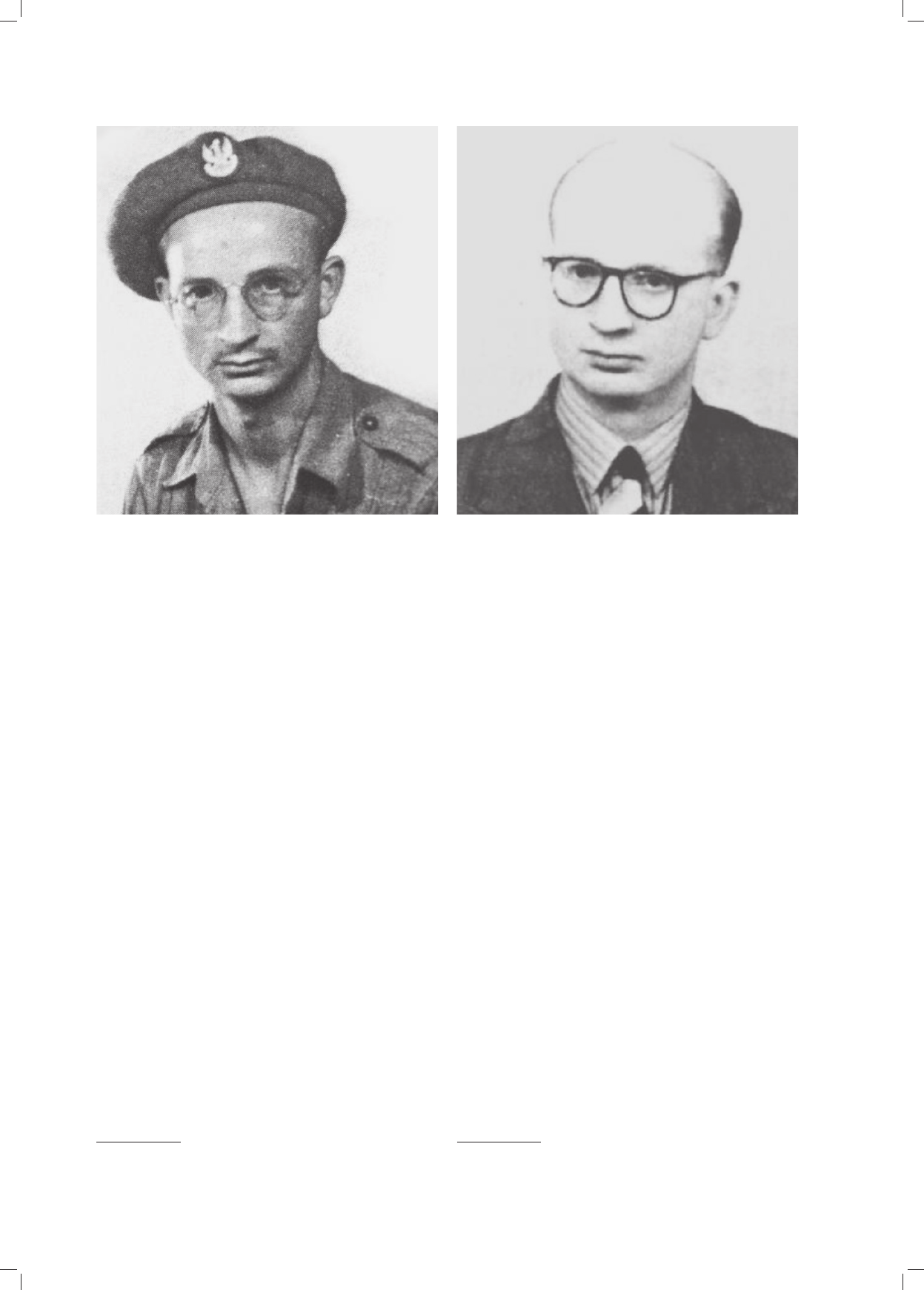
mia Andersa). Ilustracja 1 pochodzi z tego okresu i ukazu-
je Z.S. Makowskiego w mundurze armii polskiej.
Po wojnie Makowski rozpoczął studia na uniwersyte-
cie Reale Universitá degli Studi di Roma. Nie ukończył
go jednak i jesienią 1946 r. przeniósł się na Polish Uni-
versity College w Londynie. 30 stycznia 1950 r. uzyskał
dyplom inżyniera (PUC) z wyróżnieniem. Następnie za-
proponowano mu stanowisko wykładowcy w Imperial
College w Londynie, gdzie móg
ł również pracować nad
swoim doktoratem. Zdjęcie 2 powstało w pierwszych
dniach jego pobytu w Imperial College (1951).
* Centrum Badań Struktur Przestrzennych Uniwersytetu w Surrey,
Guildford, Wielka Brytania/Space Structures Research Centre, Univer-
sity of Surrey, Guildford, UK.
Background and education
Professor Zygmunt Stanisław Makowski was born in
Warsaw, Poland in 15 April 1922. He was the son of
Juliusz August Makowski and Helena Makowska, neé
Mi łoszewska. Z.S. Makowski was educated at the Tadeusz
Czac ki Grammar School. He began his higher education
in 1943 in the Civil Engineering department of the Tech-
nical University of Warsaw (PWST – Państwowa Wyższa
Szkoła Techniczna). At that time, Poland was an occupied
country, and Makowski took part in the resistance move-
ment and, in August–September 1944, in the Warsaw
Uprising of the Polish Underground Army. As a result, he
spent the period from October 1944 until the end of the
war as a prisoner of war in western Germa ny. After the
liberation, he joined the Polish Armed Forces in Italy
(popularly called the “Anders Army”). Fi
gure 1 shows
Makowski in this period, in military uniform.
After the war, he joined the Reale Universitá degli
Studi di Roma in 1946. However, he did not complete
his study there and resumed his university studies in the
fall of 1946 in the Polish University College, London.
He received his Dipl. Ing (PUC) with distinction on
30 Janua ry 1950. He was then offered a lecturer position
at the Imperial College in London, where he was able to
work also on his doctorate. Figure 2 shows his early days
at the Imperial College, London, 1951.
The subject of his thesis was the analysis of the existing
Dome of Discovery, erected for the 1951 festival of Brit-
ain Exhibition. The thesis was entitled Theoretical and
Experimental Stress Analysis of Braced Domes supervised
by Professor A.J.S. Pippard. In the pre-computer days,
such analysis was a signifi cant accomplishment. This
34 Gerard Parke, Seyed Alireza Behnejad
Tematem jego pracy dyplomowej była analiza ówczes-
nej kopuły Discovery zbudowanej na festiwal Britain Ex-
hibition w 1951 r. Praca pisana pod kierunkiem profesora
A.J.S. Pipparda nosiła tytuł Teoretyczna i ekspery mentalna
analiza naprężeń kopuł kratowych. W czasach, gdy nie wy -
korzystywano jeszcze komputerów na taką skalę jak obec -
nie, analiza ta stanowiła doniosłe osiąg nięcie. Te ba da nia
naukowe były początkiem trwają ce go przez całe życie Pro-
fesora jego zainteresowania struk turami przestrzen nymi.
Egzemplarz tej pracy jest dostępny w bibliotece Cen trum
Badań Struktur Przes trzen nych Uniwer sytetu w Surrey.
Makowski uzyskał sto pień doktora na Uniwersy tecie Lon-
dyńskim 20 lip ca 1953 r. Zdobył również dyp lom DIC (Di-
ploma of Imperial College) w dniu 14 października 1953 r.
Stanowiska akademickie
Z.S. Makowski pracował w Polish University College
w Londynie jako starszy asystent (1949–1951). Następ-
nie był wykładowcą (1951–1958) i starszym wykładowcą
(1958–1962) w Imperial College of Science and Techno-
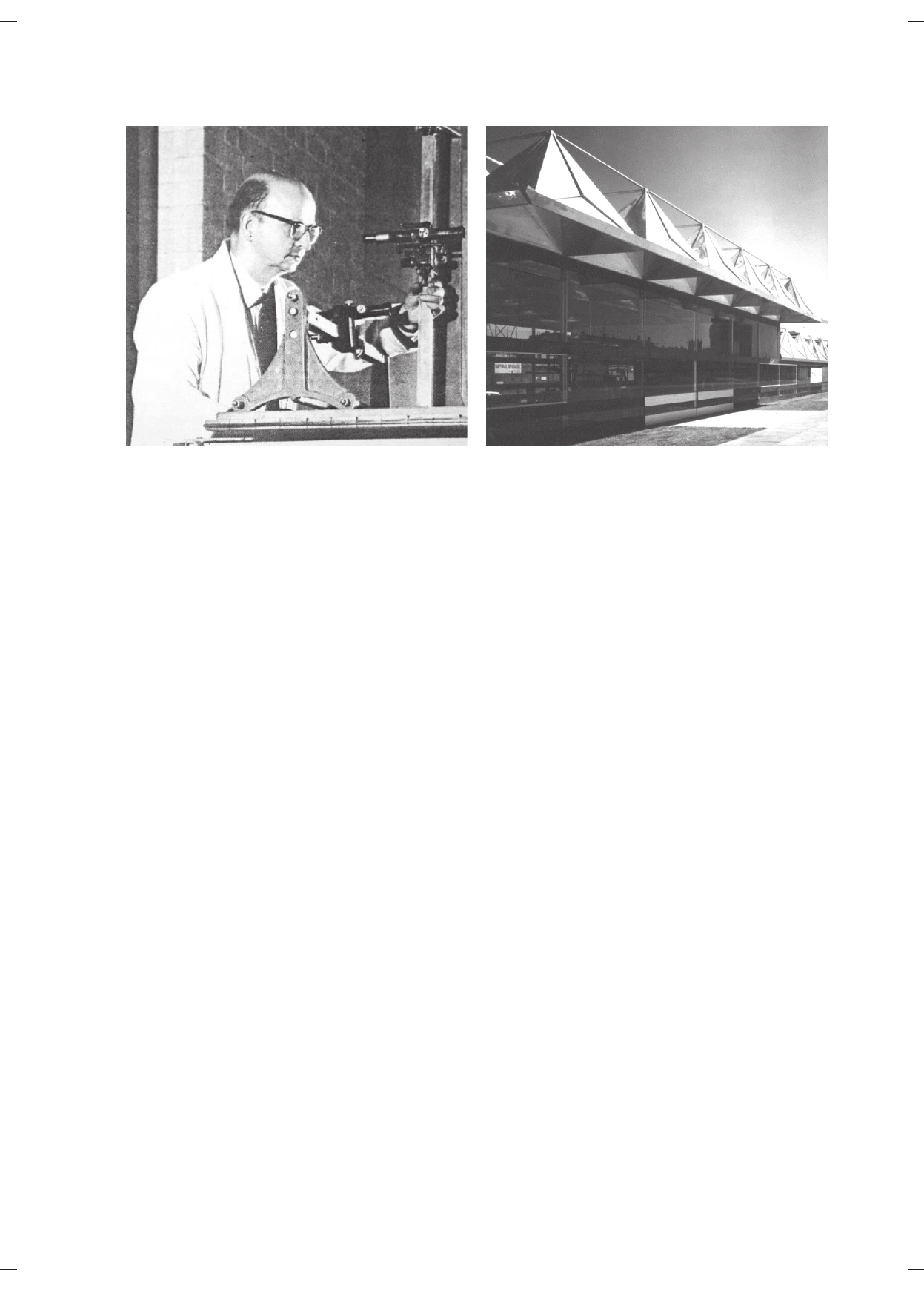
logy w Londynie (il. 3).
Profesor Makowski był kierownikiem Katedry Inży-
nierii Lądowej w Battersea College of Advanced Tech-
nology
1
(1962–1966) oraz kierownikiem Katedry na Uni-
wersytecie w Surrey (1966–1984). Na Uniwersytecie
w Surrey pracował również jako dziekan Katedry Inży-
nierii (1966–1968, 1976–1979 i 1984–1987).
Polish University College był poprzednikiem Battersea College
of Advanced Technology, który z kolei był poprzednikiem Uniwersytetu
w Surrey [2].
research was the beginning of his long-life interest in spa-
tial structures. A copy of the thesis is available in the li-
brary of the Space Structures Research Centre of the Uni-
versity of Surrey. Makowski received his PhD from the
University of London on 20 July 1953. Also, he received
his DIC on 14 October 1953 from the Imperial College.
Academic appointments
Z.S. Makowski was employed by the Polish Univer-
sity College, London as an assistant lecturer (1949–1951).
He then was a lecturer (1951–1958) and a senior lecturer
(1958–1962) in the Imperial College of Science and Tech-
nology, London. Figure 3 shows him in a laboratory at the
Imperial College (1961).
Professor Makowski was the Head of Department of
Civil Engineering, Battersea College of Advanced Tech-
nology
1
(1962–1966), and the Head of Department at the
University of Surrey (1966–1984). He also served the
University of Surrey as the Dean of Faculty of Engineer-
ing (1966–1968, 1976–1979 and 1984–1987).
Industrial collaboration
Professor Makowski has acted as consulting engineer
in numerous cases, carrying out structural analysis and
design of domes, barrel vaults and double layer grids in
steel, aluminium and glass fi ber reinforced plastics. An
Il. 1. Z.S. Makowski w mundurze Polskich Sił Zbrojnych (1945) [1]
Fig. 1. Z.S. Makowski in Polish Armed Forces uniform (1945) [1]
Il. 2. Pierwsze dni na Imperial College (1951) [1]
Fig. 2. First days of work at Imperial College (1951) [1]
Zygmunt Stanisław Makowski: pionier konstrukcji przestrzennych / Zygmunt Stanisław Makowski: A pioneer of space structures 35
Współpraca z przemysłem
Profesor Makowski był zatrudniany jako inżynier
kon sul tant, w wielu przypadkach przeprowadzał analizy
struk turalne oraz projektowe kopuł, sklepień walcowych
i dwuwarstwowych rusztów ze stali, aluminium oraz
tworzyw sztucznych wzmacnianych włóknem szklanym.
Przy kładem tego typu konsultacji jest sprawdzenie ana-
li zy Astrodome w Houston (USA). Wprowadził rów nież
nowatorską formę lekkiej konstrukcji półskorupowej –
rusztu piramidkowego, którą za sto sowano w kilkunastu
przypadkach w Wielkiej Bry tanii i innych krajach. Naj -
bardziej znanym przykładem tego systemu półskorupo we-
go jest aluminiowe pokrycie dacho we głównego bu dynku
na obrady kongresu Mię dzy na rodowe j Unii Architektów
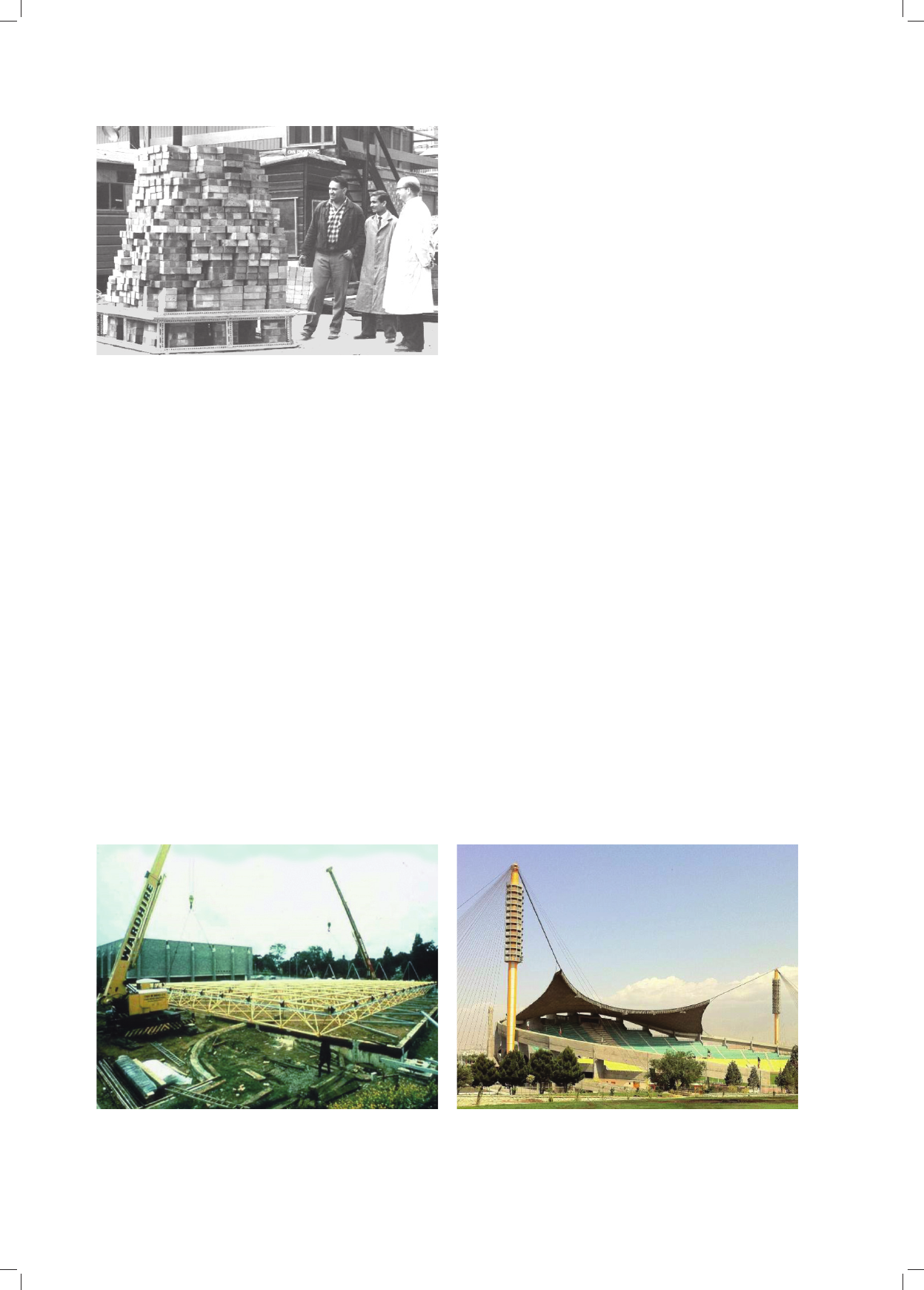
wzniesionego w Lon dy nie (il. 4). Ilustra cja 5 ukazuje
Ma kowskiego wraz ze studentami DIC H. Nooshinem
i D. Sar ną testujących jedną z jednostek konstrukcji pół-
skorupowej pod obciąże niem grawitacyjnym w Im perial
College w Londynie (1962) (H. Nooshin w późniejszym
czasie został bliskim współpracowni kiem i przyjacielem
Z.S. Makowskiego).
W maju 1963 r. Makowski założył Centrum Badawcze
Struktur Przestrzennych (Space Structures Research Cen-
tre). W 1972 r. Centrum uzyskało budynek na swoją głów-
ną siedzibę. Budynek był darowizną Brytyjskiej Korpo-
racji Stali. Ilustracja 6 przedstawia go w trakcie budowy
(obecnie Nodus Centre).
W Centrum Profesor Makowski wraz ze współpracow -
nikami brali udział w projektowaniu struktur o dużej
rozpiętości. Niektóre z ważniejszych przykładów takich
struktur to wisząca konstrukcja dachowa sprężonej siat ki
cięgnowej nad Stadionem Sportowym Farahabad (Takh ti
Stadium) w Teheranie (Iran) (wspólnie z H. Noo shi nem
oraz J.W. Butterworthem) (il. 7), kompleks pięciu pa wi-
example of this type of consulting work is the checking
of the analysis of the Astrodome in Houston, USA. He
did also develop a novel form of light-weight stressed-
skin pyramidal space grid system used on several occa-
sions in the UK and abroad. The most notable example
of this stressed-skin system is the aluminium roof cov-
ering of the headquarters building for the Congress of
the International Union of Architects erected in London
(Fig. 4). Figure 5 shows Z.S. Makowski, together with
the DIC students H. Nooshin and D. Sarna, testing one
of the stressed-skin units under gravity load at Imperial
College, London, 1962 (H. Nooshin, later became a close
colleague and friend of Z.S. Makowski).
In May 1963 he founded the Space Structures Re-
search Centre. In 1972 the Centre acquired a building for
its headquarters. The building was a donation by the Brit-
ish Steel Corporation. Figure 6 shows the building (now
Nodus Centre) during construction.
At the Space Structures Research Centre, together with
his colleagues, Professor Makowski was involved in the
design of large span structures. The more important exam-
ples include the suspended prestressed cable network roof
structure over the Farahabad Sports Stadium (Takhti
Sta dium) in Tehran, Iran (together with H. Nooshin and
J.W. Butterworth) (Fig. 7), complex of fi ve exhibition
pa vilions in Nancy, France, covered with prefabricated
double-layer grids, the three-way grid over the King
Hussein Sports Stadium in Amman, Jordan (togeth-
er with H. Nooshin), the space frame over the Spanish
Government Hydraulic Research Laboratory in Madrid,
Spain (together with H. Nooshin) and the Unibat double-
layer grid over the freight terminal for the RAF at Mil-
denhall.
Il. 3. Profesor Makowski w laboratorium Imperial College
w Londynie (1961) [1]
Fig. 3. In a laboratory at the Imperial College,
London (1961) [1]
Il. 4. Główny budynek na obrady kongresu Międzynarodowej Unii
Architektów, Londyn, 1961 (© Architectural Press Archive
/RIBA Library Photographs Collection, RIBA 63518)
Fig. 4. The headquarters building for the Congress of the International
Union of Architects, London, 1961 (© Architectural Press
Archive/RIBA Library Photographs Collection, RIBA 63518)
36 Gerard Parke, Seyed Alireza Behnejad
lonów wystawowych w Nancy we Francji, które przekry-
te są pre fa brykowanymi dwuwarstwowymi kratownica-
mi, trój stron ną kratę nad stadionem King Hussein Sports
Stadium w Ammanie w Jordanii (wspólnie z H. Nooshi-
nem), a także przestrzenną ramę nad Laboratorium Badań
Hy draulicznych Rządu Hiszpanii w Madrycie (Spanish
Go ver nment Hydraulic Research Labora tory) (wspólnie
z H. Nooshinem), jak również dwuwarstwowy ruszt Uni -
batponad terminalem frachtowym dla RAF-u w Mil denhall.
Jako konsultant Engineers India Ltd. Profesor Makow-
ski (razem z P. Mullordem) przeprowadził analizę oraz
wykonał projekt i uczestniczył w budowie ogromnej ko -
puły pokrywającej Stadion Indraprastha (Indira Gandhi
Stadium) w New Delhi, wzniesiony na IX Igrzyska
Azja tyckie w 1982 r. Konstrukcja stalowa ma rozpiętość
As a consultant to the Engineers India Ltd., Professor
Makowski (together with P. Mullord) was involved in the
analysis, design and construction of the huge dome cover-
ing the indoor of the Indraprastha Stadium (Indira Gandhi
Stadium) in New Delhi, erected for the IX Asian Games
1982. This steel structure has a clear span of 150 m and is
the largest of its kind in the whole of India.
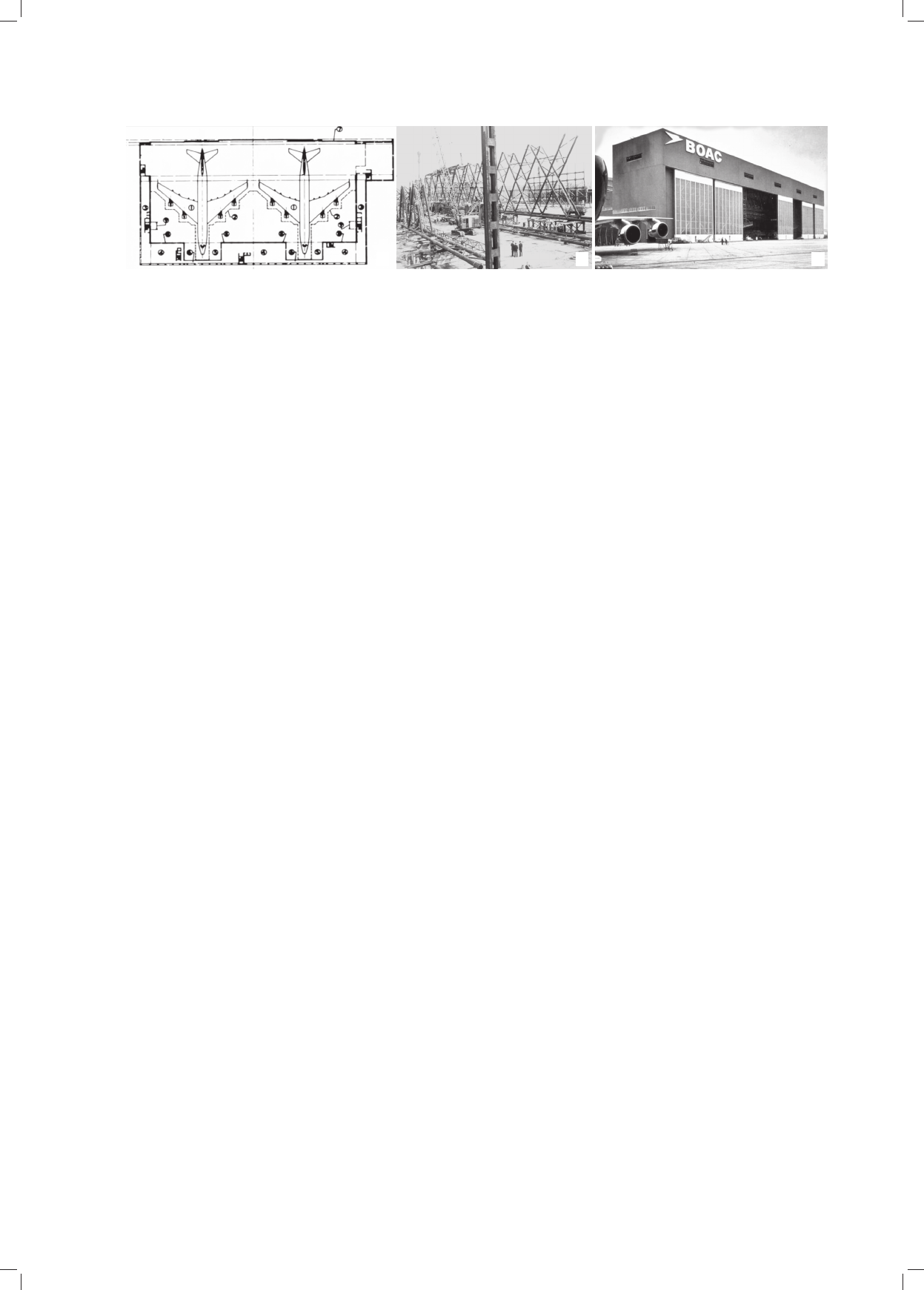
In 1968, Professor Makowski was appointed as the
structural consultant to BOAC and having formed his fi rm
of Z.S. Makowski and Associates, he was responsible for
the construction of two aircraft hangars at the London Air-
port, Heathrow, covered with prefabricated diagonal steel
grids having a clear span of 153 m (Fig. 8).
Prizes, medals and honours
Professor Makowski received many prizes and hon-
ours, some of the more important one of these are:
In 1971, for the design of the hangars, he received
the Special Prize awarded by the Institution of Structu-
ral Engineers and in 1972 a prize from the British Steel
Corporation and the British Constructional Steelwork
Association – the judges described the hangars as “superb
pieces of engineering design, integrating structure and
services”.
In 1974, he received the Golden Wing Prize from the
International Club of Plastics Experts in recognition of his
contribution to research on the structural applications of
plastics material.
In 1977 he received the Queen’s Jubilee Medal for his
work on Space Structures.
In 1980 he was admitted into the Freedom of the City
of London.
In 1982, in recognition of his contribution to the ad-
vancement of Science and Technology, he was awarded
the Fellowship of the City and Guilds of London Institute.
In 1983, he was elected a fellow of the Fellowship of
Engineering.
Il. 6. Nodus Centre (Uniwersytet w Surrey) w trakcie budowy, 1972
(źródło: Space Structures Research Centre Archives, University of Surrey)
Fig. 6. Nodus Centre during construction at the University of Surrey, 1972
(source: Space Structures Research Centre Archives, University of Surrey)
Il. 7. Stadion sportowy Takhti (Farahabad) w Teheranie
oddany do użytku w 1974 r. (© Omidali Samavati)
Fig. 7. Takhti (Farahabad) Sports Stadium in Tehran, Iran,
opened in 1974 (© Omidali Samavati)
Il. 5. Studenci DIC H. Nooshin i D. Sarna razem z Z.S. Makowskim
testują jedną z jednostek konstrukcji skorupowej pod obciążeniem
grawitacyjnym w Imperial College, 1962 r. (źródło: Space Structures
Research Centre Archives, University of Surrey)
Fig. 5. DIC students H. Nooshin and D. Sarna together with
Z.S. Makowski, testing one of the stressed-skin units under gravity
load at the Imperial College, London, 1962 (source: Space Structures
Research Centre Archives, University of Surrey)
Zygmunt Stanisław Makowski: pionier konstrukcji przestrzennych / Zygmunt Stanisław Makowski: A pioneer of space structures 37
150 m i jest największą tego rodzaju konstrukcją w całych
Indiach.
W roku 1968 Profesor Makowski został mianowa-
ny na stanowisko konsultanta ds. konstrukcji dla BOAC
(British Overseas Airways Corporation) i po założeniu
swo jej fi rmy Z.S. Makowski and Associates był od po-
wie
dzialny za budowę dwóch hangarów lotniczych na
lot nis ku Heathrow w Londynie, które zostały przekryte
pre fabrykowanymi diagonalnymi stalowymi rusztami o roz-
piętoś ci
153 m (il. 8).
Nagrody, medale i wyróżnienia
Profesor Makowski otrzymał wiele nagród i wyróż-
nień, z których najważniejszymi są wymienione poniżej.
W 1971 r. za projekt hangarów otrzymał nagrodę spe-
cjalną przyznawaną przez Instytut Inżynierów Konstruk-
cyjnych (Institution of Structural Engineers), a w roku
1972 nagrodę od Brytyjskiej Kor po racji Stali (British
Steel Corporation) i Brytyjskiego Stowarzyszenia Kon-
struk cji Stalowych (British Construc tional Steel work
Asso ciation) – jurorzy określili te hangary jako „znako-
mite przykłady projektu technicznego oraz konstrukcji
zintegrowanej z instalacjami”.
W roku 1974 otrzymał nagrodę Golden Wing przy-
znaną przez Międzynarodowy Klub Ekspertów Tworzyw
Sztucznych w uznaniu jego zasług przy badaniach nad
konstrukcyjnym zastosowaniem tworzyw sztucznych.
W 1977 r. otrzymał Medal Królowej (Queen’s Jubilee
Medal) za prace nad konstrukcjami przestrzennymi.
W 1980 r. przyznano mu tytuł honorowego obywatela
miasta Londynu.
W 1982 r. w uznaniu jego wkładu na rzecz rozwoju
nauki i technologii przyznano mu tytuł Fellowship of the
City and Guilds of London Institute.
W roku 1983 został wybrany na wykładowcę Stowa-
rzyszenia Inżynierów.
W 1986 r. Profesor Makowski otrzymał honorowe człon -
kostwo Międzynarodowego Stowarzyszenia Kon strukcji
Powłokowych i Przestrzennych (International Asso ciation
for Shell and Spatial Structures – IASS) pod czas sympo-
zjum Stowarzyszenia w Osace w Japonii.
Pod czas tej ce-
remonii Przewodniczący IASS, prof. Yoshi katsu Tsuboi
In 1986, Professor Makowski received the Honorary
Membership of the International Association for Shell
and Spatial Structures (IASS) during the Association’s
symposium in Osaka, Japan. During the ceremony, the
President of the IASS, Professor Yoshikatsu Tsuboi, said
that the conferment of the IASS Honorary Membership to
Professor Makowski is a formal recognition of the leading
role which he played over the years in the fi eld of Space
Structures.
In 1989, the Honorary Doctorate of the Warsaw Uni-
versity of Technology (WUT) was awarded to Professor
Makowski.
Publications
Professor Z.S. Makowski is the author of over 140 pa-
pers, published in English, French, German, Italian, Spa-
nish, Dutch, Polish, Japanese and Chinese.
He wrote a book on Steel Space Structures, published
in 5 languages, reprinted several times since its original
publication in 1963.
He is the Editor of three important books – Analysis,
Design and Construction of Double-layer Grids, pub-
lished in 1981, (English and American editions), Analysis,
Design and Construction of Braced Domes, (1984, also in
English and American editions), as well as the Analysis,
Design and Construction of Braced Barrel Vaults, pub-
lished in 1985.
During the period 1985–2005 he was, together with
Professor H. Nooshin, the Editor of the “International
Journal of Space Structures”.
Conferences
Professor Makowski had always placed special em-
phasis on the relationship between engineers, architects
and industrial designers. Himself, he was in close contact
with the companies involved in development of spatial
structures (Fig. 9). He was very well-known through his
lectures and seminars on space structures conducted at
numerous universities (Fig. 10). He has been invited to
give lectures not only at departments of civil or structural
engineering, but also by schools of architecture.
Il. 8. Hangar 01 do konserwacji samolotów Boeing 747 na lotnisku Heathrow w Londynie: a) schematyczny widok hangaru z góry,
b) dźwigar grzbietowy i fryzowy w trakcie konstrukcji, c) wejście do hangaru
(źródło: Space Structures Research Centre Archives, University of Surrey)
Fig. 8. Jumbo Jet Maintenance Hangar 01 at Heathrow Airport, London, UK: a) a schematic plan view of the Hangar,
b) spine girder and fascia girder during the construction, c) entrance to the Hangar
(source: Space Structures Research Centre Archives, University of Surrey)
a
b
c
38 Gerard Parke, Seyed Alireza Behnejad
powiedział, że nadanie honorowego członkos twa Profeso-
rowi Makowskiemu jest formalnym uznaniem jego wio-
dącej roli, jaką odgrywał przez wiele lat w dziedzinie kon-
strukcji przestrzennych.
W 1989 r. Profesor Makowski otrzymał tytuł doktora
honoris causa Politechniki Warszawskiej.
Publikacje
Profesor Makowski jest autorem ponad 140 prac wy-
danych w wielu językach, m.in. po angielsku, francusku,
niemiecku, włosku, hiszpańsku, holendersku, polsku, ja-
pońsku i chińsku. Jedną z ważniejszych jest książka pt.
Stalowe konstrukcje przestrzenne, która została opubli-
kowana w pięciu językach i była wznawiana kilkanaście
razy od daty pierwszego wydania w 1963 r. Jest też redak-
torem trzech istotnych zbiorów pt.: Analiza, projekt i kon-
strukcja dwuwarstwowych krat (1981; wydanie brytyjskie
i amerykańskie), Analiza, projekt i konstrukcja wzmocnio-
nych kopuł (1984, także wydanie brytyjskie i amerykań-
skie), jak również Analiza, projekt i konstrukcja wzmoc-
nionych sklepień kolebkowych (1985).
W latach 1985–2005 wraz z prof. H. Nooshinem był
redaktorem „International Journal of Space Structures”
(międzynarodowe czasopismo na temat konstrukcji przes-
trzennych).
Konferencje
Profesor Makowski zawsze przykładał wielką wagę
do wzajemnych relacji między inżynierami, architektami
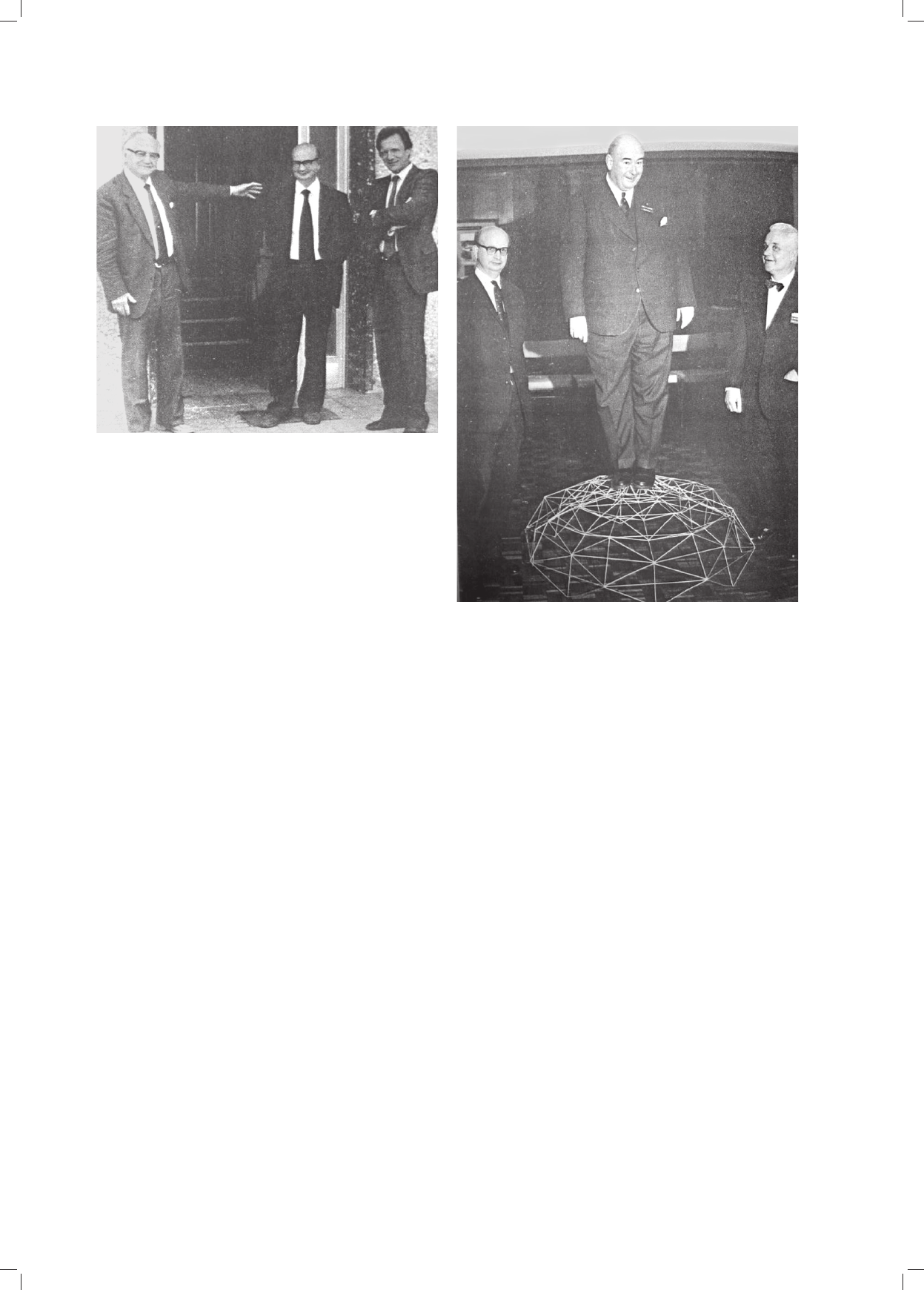
i projektantami przemysłowymi. Osobiście był w bli sk-
im kontakcie z fi rmami zaangażowanymi w rozwój kon-
strukcji przestrzennych (il. 9). Słynął ze swoich wykła-
He had extensive experience in organising conferences
and residential short courses. He was a member of various
organising committees, advisory board of liaison com-
mittees responsible for major international symposia on
space structures (Fig. 11).
He had a major role in organising fi ve important inter-
national conferences on space structures which were held
at the University of Surrey [3], [4].
The proceeding of the fi rst conference, held in 1966,
edited by R.M. Davies, the second one in 1975, edited by
W.J. Supple, the third one in 1984, edited by H. Nooshin,
the fourth one in 1993, edited by G.A.R. Parke together
with C.M. Howard and the fi fth one in 2002, edited by
G.A.R. Parke and P. Disney. These proceedings are recog-
nized as major contributions to the development of space
structures technology and architecture. The fi rst confe-
rence brought over 700 participants from 44 countries, the
second, some 400 engineers from 51 countries, the third
one over 500 engineers and architects from 63 countries,
the fourth, some of 400 participants and the fi fth one over
400 engineers and architects.
For a number of years Professor Makowski was
a member of the Engineering and Technology Advisory
Il. 9. Dr M. Mengeringhausen z Profesorem Makowskim
i dr. H. Eberlinem przed główną siedzibą MERO
w Würzburgu (1982) [1]
Fig. 9. Dr M. Mengeringhausen with Professor Makowski
and Dr H. Eberlin in front of the MERO headquarters
in Würzburg, Germany (1982) [1]
Il. 10. „Test praktyczny” drucianego modelu dwuwarstwowej kopuły
autorstwa dr. J.S. Blaira ze Stewarts and Lloyds Ltd, z udziałem
Profesora Makowskiego i Stefana du Château podczas konferencji
na temat konstrukcji budowlanych z elementów rurowych w Corby [1]
Fig. 10. “Practical” test of a wire model of a double-layer dome
by Dr J.S. Blair, of Stewarts and Lloyds Ltd, with Professor Makowski
and Stéphane du Château during the conference on tubular structural
engineering, Corby, 1965 [1]
Zygmunt Stanisław Makowski: pionier konstrukcji przestrzennych / Zygmunt Stanisław Makowski: A pioneer of space structures 39
dów i seminariów na temat konstrukcji przestrzennych,
pro wadzonych na wielu uniwersytetach (il. 10). Był za-
praszany do wygłaszania wykładów nie tylko w katedrach
inżynierii lądowej, ale także na wydziałach architektury.
Miał on olbrzymie doświadczenie w organizacji kon-
ferencji i krótkich kursów wyjazdowych. Był członkiem
różnych komitetów organizacyjnych oraz ciał dorad-
czych wspólnych komisji odpowiedzialnych za ważne
międzynarodowe sympozja pracujące nad konstrukcjami
przestrzennymi (il. 11). Odegrał wiodącą rolę w zorgani-
zowaniu na Uniwersytecie w Surrey pięciu ważnych mię-
dzynarodowych konferencji na temat konstrukcji prze-
strzennych [3], [4].
Materiały z pierwszej z tych konferencji, która odbyła
się w 1966 r., zostały wydane przez R.M. Daviesa, z dru-
giej w 1975 przez W.J. Supple’a, z trzeciej w 1984 przez
H. Nooshina, z czwartej w 1993 przez G.A.R. Parke’a
wspólnie z C.M. Howardem, z piątej w 2002 przez G.A.R.
Parke’a i P. Disneya. Materiały te są uważane za prace
mające znaczący wkład w rozwój technologii konstruk-
cji przestrzennych i architektury. Pierwsza z tych konfe-
rencji zgromadziła ponad 700 uczestników z 44 krajów,
druga około 400 uczestników z 51 krajów, trzecia ponad
500 inżynierów i architektów z 63 krajów, czwarta około
400 uczestników, a piąta ponad 400.
Przez wiele lat Profesor Makowski był
członkiem Ko-
misji Doradczej ds. Inżynierii i Technologii British Coun-
cil, a ponadto członkiem Rady SEFI – Europejskiego Sto-
warzyszenia Edukacji Inżynierskiej (European Society
for Engineering Education).
Epilog
Profesor Zygmunt Stanisław Makowski zmarł 5 listo-
pada 2005 r.
Tłumaczenie
Bogusław Setkowicz
Committee of the British Council, as well as a member of
Council of the SEFI (European Society for Engineering
Education).
Epilogue
Professor Zygmunt Stanisław Makowski passed away
November 5, 2005.
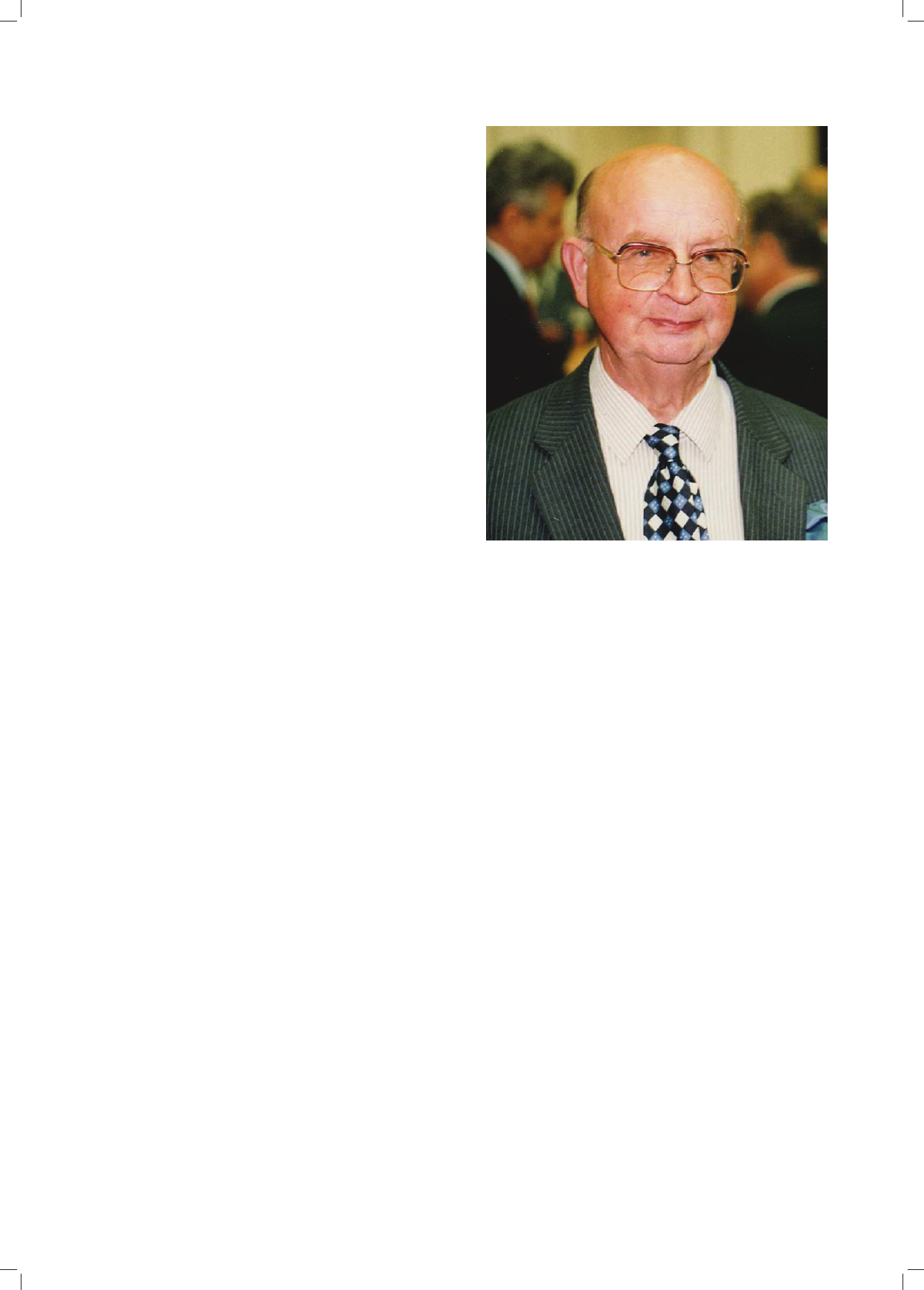
Il. 11. Profesor Z.S. Makowski, 1997 r. (źródło: Space Structures
Research Centre Archives, University of Surrey)
Fig. 11. Professor Z.S. Makowski, 1997 (source: Space Structures
Research Centre Archives, University of Surrey)
Bibliografia /References
[1] Nooshin H., Z.S. Makowski at Sixty Five, The University of Surrey
Publication, Guildford 1987, 165.
[2] Douglas R., SURREY The Rise of a Modern University, University
of Surrey, Guildford 1991, 214.
[3] Pick C., Understanding the Real World: A visual history of the Univer-
sity of Surrey, The University of Surrey Press, Guildford 2002, 224.
[4] Mitchell J., The University of Surrey: A History of Shaping the Fu-
ture, University of Surrey, Guildford 2011, 258.
Streszczenie
Celem niniejszej pracy jest zaprezentowanie informacji na temat osobowości, życia oraz osiągnięć Profesora Zygmunta Stanisława Makowskiego
(1922–2005) jako pioniera w dziedzinie konstrukcji przestrzennych. Przez 22 lata (od 1962 do 1984) był on szefem Katedry Inżynierii
Lądowej Uniwersytetu w Surrey w Zjednoczonym Królestwie. Profesor Makowski założył także Centrum Badań Naukowych and Konstrukcjami
Przestrzennymi na Uniwersytecie w Surrey (w maju 1963 r.) i w ciągu wielu lat praca tego Centrum zdobyła wielkie uznanie na arenie między-
narodowej.
Podziękowanie
Pracownicy Archiwum Uniwersytetu w Surrey bardzo po mogli przy
pracy nad niniejszym artykułem i należą się im wielkie wyrazy wdzięcz-
ności.
Acknowledgement
The Personnel of the Archives of the University of Surrey were very sup-
portive for producing this paper and their contribution is gratefully ac-
knowledged.

40 Gerard Parke, Seyed Alireza Behnejad
Słowa kluczowe: Zygmunt Stanisław Makowski, Space Structures Research Centre, International Journal of Space Structures, Department of Civil
Engineering of the University of Surrey
Abstract
The objective of this paper is to present information about the life, personality and the contributions of Professor Zygmunt Stanisław Makowski
(1922–2005) as a pioneer in the field of Spatial Structures. He was the Head of the Department of Civil Engineering of the University of Surrey,
in the United Kingdom, for 22 years (from 1962 to 1984). Professor Makowski also created the Space Structures Research Centre of the University
of Surrey in May 1963, and the work of this Centre, over the years, has won a great deal of international recognition.
Key words: Zygmunt Stanisław Makowski, Space Structures Research Centre, International Journal of Space Structures, Department of Civil
Engineering of the University of Surrey