Issue 2(30)/2011
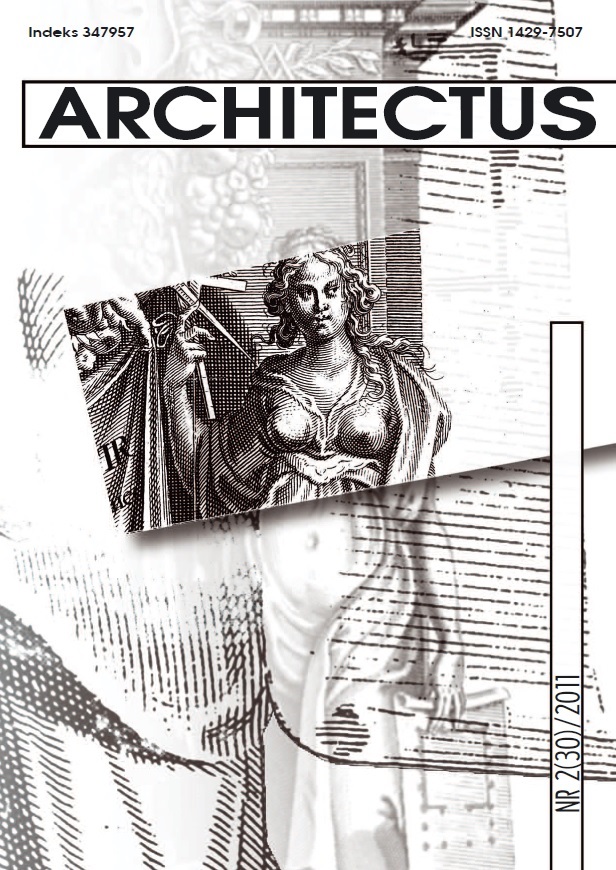
Table of contents
Open table of contents
- Elżbieta Trocka-Leszczyńska, Grażyna Hryncewicz-Lamber - Ethics in architectural practice
- Konrad Kucza-Kuczyński - Dilemmas of teaching professional ethics in the times of architecture of liquid modernity
- Paweł Jabłoński - What a lecturer of ethics can lecture about? On the margins of Zygmunt Bauman’s reading
- Przemysław Kaczmarek - Two manners of understanding of the code ethics concept in the light of Leszek Kołakowski’s consideration
- Tomasz Taczewski - Architecture of life
- Regina Maga-Jagielnicka - Axiology of space as a base of reflection on attitudes in the architect’s profession
- Jan Wadowski - Architecture – the hallmark of humanity
- Anna M. Wierzbicka - Modern church architecture. Ethical and non-ethical manner of creation
- Andrzej Baranowski - Between aesthetics and ethics in architecture
- Ewa Kuryłowicz - Moral conflict as the basic fact of morality in architectural practice. An opinion against the formulation of a code of ethical principles in architecture
- Robert Idem - Ethical aspects of the sustainable architectural design
- Elżbieta D. Ryńska - Ethics in practice – a sustainable design process
- Anna B. Frysztak - Complementarity of normative ethics and consumer ethics
- Barbara Widera - Idea above style. Sustainable architecture
- Jacek Wiszniowski - Responsibility of the architect to the local community
- Anna Krajewska-Ludwiczuk - Solar architecture as an ethical trend in architectural design practice
- Maciej Kowaluk - Public space in contemporary housing estates – attention to the common good versus maximisation of investor’s income
- Julian Jezioro - Copyright and ethics in architectural practice – selected issues
- Tomasz Stępień - Complementarity and divergences. Formation of professional ethics towards technological development
- Grzegorz Wojtkun - Between order and decency – between the code and abstract criteria
- Aleksander Furmanek - Principles of ethics and serving in the bodies of the Chamber of Architects of the Republic of Poland conducting disciplinary proceedings. Selected practical problems
- Ireneusz Huryk - Code of ethics – review of problems associated with codification of professional practice
- Krzysztof Bizio - Ethical implications of architect’s new roles in postmodern times
Articles
Elżbieta Trocka-Leszczyńska, Grażyna Hryncewicz-Lamber - Ethics in architectural practice
The emergence of the consumerist society has changed the role of culture and architecture. Zygmunt Bauman wrote: Since culture had lost its status as a necessary tool in the design, construction, and maintenance of the social order, cultural artifacts were withdrawn from the storefront, and, following improvement, made available for sale at the Shopping Centre. Can we manage as a profession to survive, in view of the dissolution of criteria for beauty and usefulness, in a world of fluid values and aesthetics? Are the new, ethics-oriented architectural movements now gaining authority, such as slow architecture and sustainable design, a hope for the renewal of architecture? This monographic issue of ARCHITECTUS, conceived as an interdisciplinary review of professional ethics merges the voices of architects, planners, philosophers and lawyers in a collection of texts structured within the three main topics: Education in ethics for students of architecture, understood as an awakening of ethical consciousness. Faculties of Architecture at Polish universities often entrust the teaching of professional ethics to specialists from ‘outside’. Not wishing to diminish the status of the teaching of ethics as a philosophical science by individuals concerned with philosophy and meta-ethics, it seems necessary to give thought to the overall curriculum of professional ethics in architectural education. Should the teaching of ethics be based on broad reflection on universal concerns linked with responsible design, or is it sufficient to make students of architecture aware of the existence of limits to professional behaviour, leaving to them the subtleties of distinctions between right and wrong?
Download article
Konrad Kucza-Kuczyński - Dilemmas of teaching professional ethics in the times of architecture of liquid modernity
The subject of this volume regards ethics in architectural practice: that is correct because indeed its practical application is the goal. We can say that it is an inseparable element of architectural skills. I presented such an approach in the title of my first paper on ethics of the architect’s profession – unfinished postdoctoral dissertation: unfinished due to fears of my “postdoctoral” advisors who claimed then at the beginning of the 1980s that this dangerously borders on the field of science of architecture [6]… That incident convinced me even more that professional ethics is not a natavistic moral conviction or the Decalogue – as many architects still believe today – but it is specific knowledge which is necessary in architectural practice. And the first step in its direction is didactics at a university level. When in 1982 I began to give regular lectures on that subject, first at the Technical University in Białystok and then since 1985 until today in Warsaw, sometimes as a visiting lecturer in Łódź, the times to teach that subject were morally favourable, but materially and mentally difficult. The martial law provided a clear black or white background and against that background it was easier to look for proper attitudes and values. It was easier to draw from Lech Niemojewski and his sometimes almost naive but actually true interpretations of the relation between ethics and architecture equally evident in its true message.
Keywords:
Download article
Paweł Jabłoński - What a lecturer of ethics can lecture about? On the margins of Zygmunt Bauman’s reading
The role of a lecturer is most commonly associated with passing on knowledge. The teacher expounds while the students absorb. The raison d’être of such a situation is the existence of something the teacher is equipped with and what the listeners do not possess. If the lecturer had nothing to convey, he would have no right to rid his students of something that none of us has in excess, i.e. time. If this really is the case, a question arises as to what a teacher of ethics can have to offer. Zygmunt Bauman seems to be an appropriate addressee of a question so formulated for a number of reasons. Firstly, it is so because the author of Liquid Modernity has devoted most of his immense research work to a diagnosis of the specificity of contemporary western society. Secondly, because of the einterdisciplinary nature of his works. Thirdly, because ethics is the core interest around which his deliberations concentrate. Education itself – let it be the fourth reason – has been the subject of numerous comments made by the philosopher. Thus, we can expect from Bauman the most relevant, impartial and competent hints.
Keywords:
Download article
Przemysław Kaczmarek - Two manners of understanding of the code ethics concept in the light of Leszek Kołakowski’s consideration
In the discussion of the code ethics concept, the problem of understanding it as well as the fact of accepting it as a factor which reinforces the sense of moral responsibility or leads to its distraction seems the key issue. In the reflections which follow I intend to prove that by maintaining skepticism about the code ethics concept it is possible to defend it from an understanding which boils down to the ‘preparation’ of: a) human personality, b) morality, c) choice of a decision which is taken. I shall also try to show that on the basis of L. Kołakowski’s ideas two different methods of understanding the code ethics concept can be distinguished. The first method is characterized by the tendency to create an ethical code as a complete and coherent system of principles. L. Kołakowski objects to this attitude by defining it as ‘code-like’ and contrasts it with the second method of understanding the problem, i.e. the attitude of being aware of a paradoxical character of the moral life. The purpose of the reflections which follow is to present the two methods of understanding the code ethics concept taking into particular consideration the questions about man’s image which they suggest.
Keywords:
Download article
Tomasz Taczewski - Architecture of life
Leon Jan Piniński – a count, lawyer, historian of art, professor at Lviv University and member of Academy of Learning, honoured by Złoty Wawrzyn Akademicki (Golden Academic Laurus) in his short study, which was published in 1912 as a commemorative book for the 250th jubilee of Lviv University, wrote that mankind is proud of civilisation, progress and astounding inventions. However, he expressed doubts whether through centuries, which separate us from the ancient times, this mankind ‘significantly advanced in the field of soul and heart’. One century is over and similar reflections are still present. At the beginning of the 21st century, Anthony Grayling – a professor of philosophy at London University and member of St. Anne’s College in Oxford evoked a general interest in ethics. It was due to his last books which were a result of his systematic research and constituted collections of lively well-written studies and essays.
Keywords:
Download article
Regina Maga-Jagielnicka - Axiology of space as a base of reflection on attitudes in the architect’s profession
Preparation for the architect’s profession is a process in which particular attention is paid to this stage of education (‘period of creating’) during which sensitivity to the beauty of space is developed in the first place. This is a basic stage which leads to the next stages: knowledge, understanding, responsibility and gaining experience. Therefore, ‘learning’ architecture is based on the development of responsibility which facilitates acquiring knowledge, deepening understanding, taking responsibility and taking advantage of experience. Sensitivity is of special significance in the process of creative work; therefore, it is really important to ask the following questions: what are the crucial elements which influence the level of sensitivity? Is sensitivity to the beauty of space along with its usefulness the only thing that matters? According to the classical philosophy, beauty, goodness and truth constitute a triad of the highest values. Thus, sensitivity to beauty when related to other values such as goodness and truth implies moral sensitivity. The architect’s attitudes – in relation to people who take part in the process of designing the space and in relation to the space itself – have a moral context. Ethical education of students of architecture is aimed at protecting the sensitivity with which they start their studies, then at developing the awareness of its existence and finally it is aimed at ‘correcting’ this sensitivity in relation to space and man.
Keywords:
Download article
Jan Wadowski - Architecture – the hallmark of humanity
Each civilisation is defined by its attitude to time. The way in which time is understood also determines the way of life. Time is incessantly shaped by us; in our modern times, it is more often done through communication and the speed of information transfer. We can also form space which is ‘crystallised time’ [3, p. 411]. As Leibniz put it, this constitutes ‘order of co-existence’ of things. Civilisation models its space-time thanks to architecture because Man is a spatiotemporal creature [10, p. 154]. ‘Spatiotemporal’ nature of man means that man builds his own culturally determined experience of dimensions. It is reflected in man’s plans and designs. According to Kopaliński, architecture is a domain which organises and shapes space in order to satisfy human needs; science of designing and erecting buildings [5, p. 36]. Of course, the definition of ‘need’ is not clear-cut inasmuch as we can have needs which are ‘down-to-earth’, for example, protection from cold or ‘sublime’, for instance, a possibility of having a place of worship. In other words, if we wish to think about designing and erecting a shelter that is also beautiful, we need advanced cognitive abilities as well as skills of transforming reflections and visions into a material realization.
Keywords:
Download article
Anna M. Wierzbicka - Modern church architecture. Ethical and non-ethical manner of creation
In this article we attempt to answer the following questions: where is the limit of free creation in the modern sacral architecture? Should sacral architecture be created in accordance with an accepted canon or rule of designing? What should modern architects follow? Should they draw inspiration from the past or rather look for new design solutions? The modern sacral architecture is a consequence of changes introduced by the Second Vatican Council, which emphasized a community character of the liturgy by recommending one centrally situated altar in the church as a sign of Christ. The second significant change which influenced formation of the sacral space was the fact that the presbyter faced the congregation so that people gathered in the church could participate in the rite in a more conscious way.
Keywords:
Download article
Andrzej Baranowski - Between aesthetics and ethics in architecture
Although there are no doubts that the esthetic issues are universally considered an important aspect of the discourse about architecture, the ethical issues, which are also present, sometimes known, and sometimes concealed, remain in the shadow of the former. They are limited primarily to the requirements of professional codes of ethics which operate in the realm of obligations. In the context of architecture, the ethics of attitudes, convictions, and the ethics of architecture are rarely discussed. Are the ethical requirements then an obstacle in the realization of the esthetic program? It is no coincidence that “less esthetics, more ethics” was the slogan of the Venetian Biennial of Architecture in 2000 [5]; was it supposed to mean that ethics is the opposite of esthetics? Do we have to choose between esthetics and ethics in architecture, or do esthetics and ethics complement each other? Wittgenstein [13] put it like this: Ethics and esthetics are one. If, however, ethics and esthetics can be considered “one”, then what is that union about in architecture if it is not at all so universally acknowledged as obvious? Finally, can we rationalize the ethical and esthetic issues in architectural practice as well as their inter-dependence and use them for the benefit of the designer? Or is it just about the workshop and the attitude?
Keywords:
Download article
Ewa Kuryłowicz - Moral conflict as the basic fact of morality in architectural practice. An opinion against the formulation of a code of ethical principles in architecture
Architecture is at present “the only liberal profession whose welfare – possibly its very survival – depends on its ability to enunciate and rally around a set of moral principles. The fact that these principles shift and evolve only makes the topic more intriguing and worthy of study” [4]. At present only? The first to write of the notion of truth from a moralising and uncompromising perspective in the architectural context was the British architect A. W. Pugin in the 19th century. His idea, of architecture as a socio-ethical crusade, grew into rhetoric in the 20th-century period of the modernist avant-garde. It was then too that it became clear just how much caution is needed in applying the notions of truth and falsehood, for they may be abused, and more: shown to be empty without the attitude of one who bandies them about. Apparent at first glance is the extent to which the area is sensitive and susceptible to duplicity and hypocrisy; with the significance for our work, all the more caution is required in attempts to perceive it.
Keywords:
Download article
Robert Idem - Ethical aspects of the sustainable architectural design
The idea of sustainable development has been reflected in numerous declarations, documents, laws and regulations. However, its realization still has the character of a challenge – architecture seeks a concept of environmentally friendly and socially responsible design, referred to as balanced or environmental design. Unfortunately, the social and ecological issues of design are not the centre of attention, they are trivialized or even ignored, while the native design-realization practice does not meet the standards of the developed countries. If we were to treat the challenges of balanced development seriously (there does not seem to be an alternative for the future), the seriousness of the problem becomes meaningful – the sustainable architectural design would have to be treated as a direction in the theory evolution and the design methodology [2, p. 156]. The questions of ethics play an important role in this concept. Their specificity concerns the environmental ethics (in axiological realm as the ideological basis of design) and the problems of social recognition (in practical and methodological realm).
Keywords:
Download article
Elżbieta D. Ryńska - Ethics in practice – a sustainable design process
The majority of structures designed in our times and erected according to the conventional principles of design and realization have little in common with maintaining the natural environment standard – and directly – sustainable development. In their entirety, the buildings constitute an example of high-expenditure investments and their owners have to have access to a significant capital stock. The conventional structures use a lot of energy, produce enormous amounts of waste – during realization as well as at the usage phase – and sometimes they have a negative impact on their users. Therefore, all ‘other’ attitudes towards the whole living cycle of buildings ought to be the subject of in-depth research and ethical consideration, on the one hand connected with the development of our culture and civilization, while on the other hand, with the necessity to preserve the natural environment for humankind. Sustainable design process is by no means a single occurrence. It is rather a constant process that is subject to continuous improvement and broadening the knowledge of the persons involved in the building industry. This issue constitutes the topic of this article.
Keywords:
Download article
Anna B. Frysztak - Complementarity of normative ethics and consumer ethics
Ethical issues (both generally and especially with reference to “fragments” of society, that is groups of professionals) cannot be considered as separate from the general, external conditions, including sociological characteristics. It should be remembered that the lower level ethical principles should not contradict those of a broader sense. Otherwise, the former ones can cause conflicts. We live in the times of globalization which is a complex issue. The new order, which is/will be its result, is not fully known to us. We can observe the process of globalization – rejecting it does not seem to predictably affect its course. Globalization processes occur regardless of our will and without regard to whether we are in favour of them or not. In the process of globalization, the society of producers transforms into the society of consumers. The former fetishized commodities, whereas subjectivity is considered an attribute of the latter. It is significant what Zygmunt Bauman said about the society of consumers, namely that […] no one can become a subject without first transforming into a product, and no one can save one’s subjectivity in a safe way if one does not have and does not constantly add the qualities which are required from a marketable commodity. The “subjectivity” of the “subject” and most of what can be achieved because of it focuses on the continuous effort to become a marketable commodity [1, p. 149–150]. This is an extreme position – revealing, in Bauman’s opinion [1, p. 150], the true, concealed identity of the society of consumers. However, it seems to make it easier to see the ongoing changes.
Keywords:
Download article
Barbara Widera - Idea above style. Sustainable architecture
The development of modern architecture is a complex process, the roots of which lie in the attitude towards tradition and cultural heritage, current state of knowledge in the field of constructing and technologies associated with the building industry, the author’s philosophical and aesthetic viewpoints, the character of location, climatic requirements, functional circumstances, end-user needs, investor’s expectations and law regulations. On this complicated background, however, certain values become predominant over the others, creating designing attitudes and, consequently, shaping architectural trends. Due to the constantly increasing pace of life in the 20th century, architectural currents were changing faster and faster to finally reach a blurry state at the beginning of the new millennium. In the 1990s solutions for these multiple correlations were sought within three main designing methods. The first one, continuing the idea of the so called white modernism, proposed forms based on simple and clear geometry. By the end of the century, their abstract and sublime character was emphasized. Modernist thought was often combined with Zen philosophy, with an expectation that the architecture would calm down emotions and create a favourable background for spiritual and intellectual development. Puristic solutions, based on overriding principles and harmonizing contradictions of the surrounding world were preferred.
Keywords:
Download article
Jacek Wiszniowski - Responsibility of the architect to the local community
A design improves or worsens people’s lives and its effects may last for decades [1, p. 5]. Depending on its scale, these effects may be seen in the area of a district, city or province [14] and in the light of the EU structural policy – of the region as well [10, p. 15]. A design transforms numerous biotechnical and mental factors in the residential environment. We can measure many of them and assess their influence on man as positive or negative. Since the mid-19th century, various systems of valuation of the transformed environment have been created and developed. On the basis of international programmes such as Agenda 21 [6], Health 21, UCLA Health System [9], URBACT and others, assessment tools of the influence of designed investments on man and nature are elaborated. The knowledge about the influence of architecture on people’s health and life is systematically broadened and along with this knowledge, the number of assessment systems is still growing. What we ought to bear in mind is the fact the architect’s work exerts an enormous influence – positive or negative – on man’s psycho-physical health and the development or deterioration of his social and spatial relations [4] – only then shall we see the greatness of responsibility that is placed on him. Unawareness of this influence does not discharge from responsibility. This responsibility is shared with other participants of the design process; however, taking into consideration the architect’s role in this process, it appears to be special. Practicing a public trust profession, such as an architect, imposes on him a necessity to use knowledge for the good of people.
Keywords:
Download article
Anna Krajewska-Ludwiczuk - Solar architecture as an ethical trend in architectural design practice
Values and ideals of human behaviour and attitudes evolve along with the world; they depend upon historical, political and social conditions as well as on the time in which they function. By introducing ecological awareness into the ethical values determining man’s actions, the attitude towards the concept of morality changes as it no longer refers only to people, but also to the environment in which they live. Ecological awareness proper is not integrally connected with changes of human behaviours. The contemporary man’s set of moral norms ought to be extended by ecological culture. This culture is closely linked with pro-ecological upbringing, education and natural resources management [3, p. 26]. Excessive environment pollution and a limited amount of mineable resources led to the necessity of changing the expansive attitude of man towards the environment and brought about an interest in alternative energy sources. Popularisation of renewable energy sources is significantly influenced by pro-ecological policy of the European Union. Within the framework of ecological requirements, Poland has also been obliged to undertake activities aimed at sustainable development. It is commonly agreed that economical values should not be created at the cost of degradation and irreversible changes to the natural environment.
Keywords:
Download article
Maciej Kowaluk - Public space in contemporary housing estates – attention to the common good versus maximisation of investor’s income
In the recent years we can observe a dynamic development of the housing market in Poland. Intensive activities of developers have been concentrated mainly on the outskirts of towns where the price of land is much lower than in the centre [1]. Very often, these areas do not have an official local land development plan and the structures that are built there are designed in accordance with the guidelines included in administrative decisions about conditions of building and land development, which are issued independently of one another. A really serious problem is the lack of a comprehensive concept of newly built districts. Structures are frequently created in a chaotic and inconsistent way. Moreover, these districts also lack the basic infrastructure such as roads. Another typical defect is negligence in relation to the public space which constitutes one of the characteristic elements of the city tissue that determines the residents’ quality of life. Developers’ activities are focused only on achieving profits on the sale of flats. Investors usually expect usable areas of flats to be maximised locally; at the same time, the building law strictly defines conditions of locating car parks, rubbish heaps or recreation areas without specifying their minimum sizes. Due to these conditions, many housing estates have a very limited area of common spaces or in fact there are no such spaces.
Keywords:
Download article
Julian Jezioro - Copyright and ethics in architectural practice – selected issues
The specific nature of the architect’s profession results in the development of special professional ethics which deals specifically with the activities conducted by that group of specialists. It is usually codified by a self-government or trade associations. This results in the development of a system of norms which demonstrates both consistency and nonconformity with similar systems which may concern architectural operations – especially with the system of statutory law. It should be presumed that these nonconformities are especially significant where ethical and legal norms come in contact as the latter ones result in the emergence of real liability imposed by the state. The words by A. Zwierzchowski quoted above accurately indicate the reasonability of the system of ethical norms – they often protect the values which are not subject to legal regulation and as such they do not entail legal liability, however, their significance can be greater than applicable legislative regulations.
Keywords:
Download article
Tomasz Stępień - Complementarity and divergences. Formation of professional ethics towards technological development
Professional ethics – one of the central issues which fringes upon the widely understood humanities as well as engineering and technical sciences – within the framework of philosophical and social sciences constitutes the topic which is discussed reluctantly and it is even marginalized. This results first of all from the dispute concerning ethics itself, which has been carried out for the recent decades and from the fact of the dynamic and explosive development of technology which is unprecedented in the general history. This development led to the establishment of new categories of science and new professions. A methodological postulate of including in the research and professional work a trans-disciplinary paradigm and a comparative studies paradigm with reference to particular professional ethics appears to be an alternative and an opportunity to break this specific deadlock at the same time. Moreover, this orientation makes it possible to emphasise a practical aspect, i.e. a professional reality in a specific field of modern science. The above mentioned diagnosis shows the most significant issues in the analysis of professional ethics on the example of architecture and modern architect’s work which is focused on the major principle of professional ethics and professionalism, namely on responsibility.
Keywords:
Download article
Grzegorz Wojtkun - Between order and decency – between the code and abstract criteria
It seems that the difficulty in the interpretation of the professional reality as an ethical message is today one of the biggest challenges faced by the designers of architecture. In the classical presentation of ethics, it is practice that provides the basis for formulation of a coherent set of axioms. At present, we live in the times when the methods of achieving success are more and more often based on encouragement instead of instruction, on flexibility and promotion instead of disciplinary sanctions. The architect’s code of professional ethics is not casuistic by nature and that is why it was based on universally accepted and established ethical norms and not on torts. However, this creates huge problems as an act which is ethical for some is not ethical for others. Regardless of that, it is an obligation of all architects to observe the general human and professional ethical norms, and especially guarding the dignity of the profession.
Keywords:
Download article
Aleksander Furmanek - Principles of ethics and serving in the bodies of the Chamber of Architects of the Republic of Poland conducting disciplinary proceedings. Selected practical problems
The subject matter of this article encompasses broader issues related to the professional ethics and the professional autonomy of architects in Poland. The architect’s ethics embraces deontological elements as well as metaphysical ones, sometimes taking the form – as in the timeless book ‘Uczniowie cieśli’ (Carpenter’s disciples) by Professor Lech Niemojewski – of a strictly religious reference. Closely related to the professional deontology of architects are the practical aspects, to which special attention is paid in this paper. It presents, within the context of ethical principles, a selection of chosen problems and the risks associated with performing a function in the bodies of the Chamber of Architects of the Republic of Poland (IARP) conducting disciplinary proceedings. On the basis of current activity of the professional association – set up in 2002 as the Chamber of Architects of the Republic of Poland (IARP)– one may notice both the benefits of its functioning as well as certain deficiencies typical of institutions built from scratch. Because of its volume, the paper does not address the full spectrum of problems connected with the subject included in the title.
Keywords:
Download article
Ireneusz Huryk - Code of ethics – review of problems associated with codification of professional practice
The Principles of the Architect’s Professional Ethics which were adopted on November 24, 2002, during the Extraordinary Conference of the Chamber of Architects proved to be so impermanent that a new Architect’s Code of Professional Ethics, based on the draft of the code prepared by the Architects’ Council of Europe, was adopted already on December 18, 2005. As it turned out later in practice, many of its provisions cause doubts among both the members of the Chamber of Architects commenting it and among judges of the disciplinary courts who should resolve disputes immediately. The necessity to interpret the rules included in the code was the reason for organizing trainings in the National Chamber. A good example of an unclear provision of the code which needed a straightforward interpretation was provision 4.5: Architects shall not claim the intellectual property or use the ideas of other architects, firms or other organizations without their consent. The judges could not resolve the disputes regarding intellectual property on the grounds of professional liability on the basis of copyright law, which at first seemed unavoidable.
Keywords:
Download article
Krzysztof Bizio - Ethical implications of architect’s new roles in postmodern times
The architect’s profession in its separate modern form appeared in Renaissance Italy (circa 1450), in France (circa 1550) and in England (circa 1650 r.). However, since ancient times, the Vitruvian ideal of an architect-scientist has been developed, namely, as a person with two basic characteristics: interdisciplinary knowledge and high moral virtues. According to Vitruvius, it is not possible to become an architect without meeting the moral standards criteria that serve the community in which a person lives and works. The problem of defining what architecture is constitutes a separate issue. In spite of the fact that there are several thousand definitions, there is hardly any unanimity among them, which seems to point to the multidimensional character of architecture itself rather than the necessity and possibility to coin a universal definition.
Keywords:
Download article