
© by the Author/Authors. Licensee WUST.
Published in open access. CC BY-NC license.
2026
1(85)
Angelika Czajczyńska-Mieszała*, Bogusław Wowrzeczka**
Adaptive transformations of tram depots
for museums and exhibition spaces
DOI: 10.37190/arc260102
Abstract
The article analyzes the adaptive potential of former tram depots in the context of contemporary revitalization processes in post-industrial cities.
Based on the study of eight cases – covering both compact 19
th
-century complexes and dispersed campus-like layouts – the authors assessed the
suitability of these facilities for museum and exhibition functions. The research enabled the identication of characteristic adaptation strategies and
types of architectural transformations, as well as the determination of their consequences for heritage preservation and the implementation of sustain-
able design principles. The results provide a practical tool supporting designers in selecting optimal solutions for adapting tram depots for cultural
purposes, combining the protection of historic fabric with the requirements of contemporary museum institutions.
Key words: historic tram depots, cultural heritage, adaptive reuse, museum, exhibition gallery, sustainable development
Introduction
Since the 1950s, transport infrastructure facilities – in-
cluding tram depots – have been gradually abandoned as
a result of changes in public transport systems, the reduc-
tion of tram lines in favour of other modes of transport
(metro and bus), or their modernisation combined with the
construction of new depots in dierent locations. The re-
use of transport infrastructure buildings is an established
heritage-preservation strategy. Introducing new activities
into existing building also has a positive impact on the ur-
ban context and can initiate processes of revitalisation and
socio-economic activation. These eects can be further
strengthened when adaptive reuse is treated as a city-wide
development strategy, extending beyond a single building
to encompass a network of similar facilities.
The adaptive potential of transport infrastructure build-
ings is closely linked to their spatial characteristics, which
allow them to be transformed for a wide range of functions
– particularly those requiring large, open volumes. This po
-
tential is reinforced by their favourable locations within the
urban fabric. These qualities are increasingly utilised in the
adaptation of decommissioned tram depots into multifunc-
tional centres (commercial, service-oriented, gastronomic,
educational) as well as cultural institutions, including mu-
seums and exhibition galleries.
Aim and scope of the study
The research focused on analysing cases of tram depots
adapted into museums – cultural institutions dedicated to
collecting, studying, and preserving architectural objects of
historical or artistic value – and exhibition galleries, under-
stood as spaces intended for the temporary presentation of
artworks, artist promotion, lectures, and related activities.
In both categories, the analysis covered the extent of in-
terventions in the historic fabric of the buildings and the
feasibility of meeting the spatial requirements of exhibition
functions. This enabled the identication of strategies and
typologies of transformations, as well as model solutions
for adapting tram depots for the above functions.
Completed projects and ongoing adaptive reuse schemes
were also examined in relation to sustainable design objec-
tives, such as heritage preservation, environmental protec-
* ORCID:
0009-0008-0447-4410. Doctoral School, Wrocław
University of Science and Technology, Poland.
** ORCID:
0000-0003-3115-1218. Faculty of Architecture, Wro-
cław University of Science and Technology, Poland, e-mail: boguslaw.
wowrzeczka@pwr.edu.pl
16
Angelika Czajczyńska-Mieszała, Bogusław Wowrzeczka
tion, resource eciency, social activation, and the mitiga-
tion of economic and social decline.
The study encompassed eight facilities, six of which cur -
rently operate as museums and/or exhibition spaces in for -
mer tram depots (MultipleXity in Timișoara, Classic Rem-
ise in Berlin, The Museum of Engineering and Technology
in Kraków, The Depot History Centre in Wrocław, Tram-
way – the Social Centre for Culture in Glasgow, and the
Academic Culture and Local Initiatives Centre Czasoprzes -
trzeń in Wrocław). Two additional projects are under devel-
opment (the Centre for Contemporary Art in Tashkent and
the Dundee Museum of Transport in Dundee). The selec-
tion criterion was typological diversity within a spectrum
of adaptive strategies.
Sources and materials
The primary sources for analysing the transformations of
tram depots into new functions include archival materials
from local municipal archives and transport institutions, as
well as heritage inventory records prepared by relevant con-
servation authorities. These include, among others: Dundee
City Archives and Dundee Museum of Transport Archives
(Dundee), Arhivele Naționale ale României – Direcția Ju-
dețeană Timiș (Timișoara), Landesarchiv Berlin and Ber-
liner Verkehrsbetriebe – BVG Archiv (Berlin), the National
Heritage Board of Poland (Kraków and Wrocław), the Aca-
demic Culture and Local Initiatives Centre (Wrocław), and
Historic Environment Scotland. The literature review also
incorporated publications by institutions specialising in in-
dustrial and transport heritage (e.g., Industrial Archaeology
Review, The Journal of Transport History).
An important source of information was the websites of
the architectural studios responsible for the adaptive reuse
projects, including Andrew Black Design (Dun dee), DFZ
Architekten (Berlin), Gołąbek Da lecz ko Architekci (Wro-
cław – Czasoprzestrzeń) and Studio KO (2026), the authors
of the concept for the Centre for Contemporary Art Tashkent.
Supplementary materials included professional portals
and project databases such as ArchDaily and Dezeen, which
publish both project documentation and – after completion
– photographic studies enabling the analysis of spatial, ma-
terial, and functional solutions.
State of research
The adaptation of tram depots forms part of a broader
eld of research on the revitalisation of industrial heritage,
where concepts of sustainable design, circular economy,
and adaptive architecture play a central role. The litera-
ture emphasises that reusing existing structures reduces
emissions associated with the production of new materials
(Plevoets, Van Cleempoel 2019) while preserving cultural
and identity-forming values (Bullen, Love 2011). Tram de-
pots, due to their scale, exible interior spaces, and robust
construction, are particularly suitable for transformation
into cultural institutions.
Contemporary approaches to adaptive reuse highlight
the importance of functional exibility (Schmidt III et al.
2010), which enables long-term programmatic adaptability,
as well as social integration, which strengthens the dura
-
bility of revitalisation projects (Evans 2005). For cultural
institutions, the concept of creative reuse is also signicant,
as it combines heritage preservation with innovative forms
of art and education (Douglas 2006).
The adaptive transformation of historic tram depots into
museums and exhibition spaces remains a relatively under-
researched topic.
Existing studies focus primarily on the
history of urban transport, the evolution of tram infrastruc-
ture, or the vehicles themselves. Comparatively few analy-
ses address the transformed spaces of former depots or the
potential of unadapted depots for museum functions. The
available materials include local studies, historical mono-
graphs, and isolated academic articles describing the spe-
cic heritage of individual cities.
For the Dundee Museum of Transport (Scotland), the main
sources are historical studies on the development of pub-
lic transport (Burt 2014; Waller 2019). A similar focus is
found in publications on Tashkent (Kupaysinov 2022; Aki-
mov, Banister 2011), which discuss the evolution of tram
and bus networks, providing context for later adaptive re-
use eorts. More extensive historical material exists for the
depot in Timișoara, now MultipleXity (Directuinea 1929;
Întreprinderea 1969), and for the Tramway Social Centre
for Culture in Glasgow (Mitchell 2022). In the context of
Berlin, studies describe the development of the tram net-
work and the operations of the municipal transport compa-
ny, oering insight into the functional evolution of trans-
port facilities (Bennewitz, Demps and Winkler 2002; Die
Berliner Verkehrs 2019). Information on Wrocław is largely
historical (Sielicki 2010; Kołodziejczyk 2016; Głowacki
2017), covering both the development of the tram network
and the contemporary transformation of depots into cultural
and tourist facilities, including the adaptation of the Dąbie
depot into the Czasoprzestrzeń cultural centre. Wdo wiarz-
Bilska (2022) analysed the revitalisation of the depot on
Św. Wawrzyńca Street in Kraków, highlighting its role in
shaping public space and its signicance for local identity.
The literature review reveals a lack of comparative and
systematising studies. Existing research focuses mainly
on transport history or individual revitalisation processes,
with out attempting to classify transformation types or as-
sess their relevance to sustainable design. Consequently,
there is a clear research gap concerning a comprehensive
analysis of adaptive strategies for transforming tram depots
into museums and exhibition galleries.
Methods
The study was conducted in two stages. The rst stage
consisted of a comprehensive literature review aimed at
gathering relevant data, theoretical frameworks, and best
practices – beginning with publications on strategies for
preserving broadly dened post-industrial heritage (Pie cz-
ka, Wowrzeczka 2021) and concluding with works directly
addressing historic tram depots in the context of their adap-
tive reuse (Wdowiarz-Bilska 2022).
The second stage involved analysing all source mate-
rials collected for the examined facilities. Based on these
materials, case studies were carried out for eight former
Adaptive transformations of tram depots for museums and exhibition spaces
17
tram depots adapted into museums or exhibition galleries.
The selection was guided by the diversity of operational
proles, the variety of adopted adaptive methods, the orig-
inality of solutions, and the availability of documentation
enabling in-depth analysis.
Adaptive strategies for historic post-industrial buildings
and the typological diversity of former tram depot com-
plexes – along with their relationships to the urban fabric
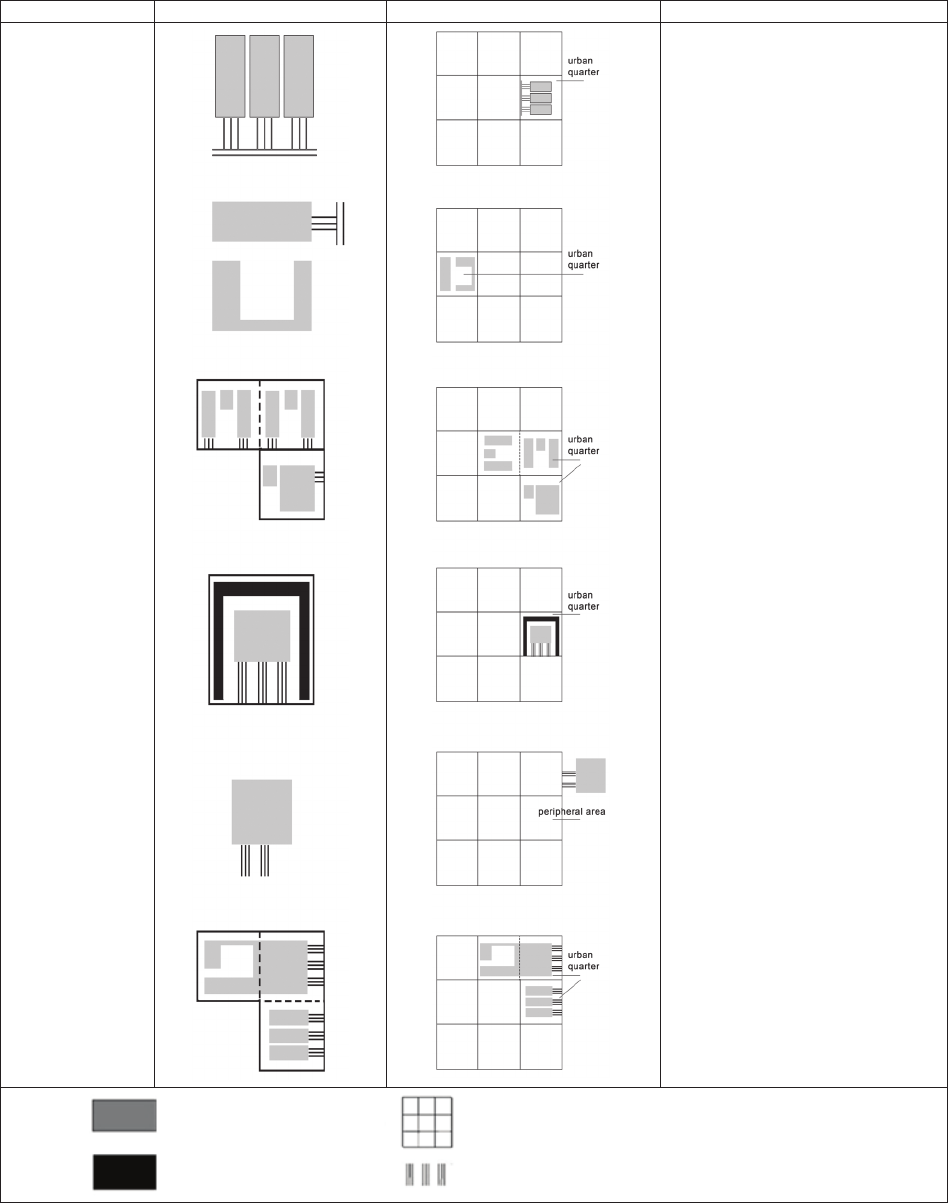
– were used as reference points (Table 1). The collected ma-
terial underwent both qualitative and quantitative analysis,
Table 1. Spatial typologies of tram depot layouts in urban structure (elaborated by B. Wowrzeczka, A. Czajczyńska-Mieszała)
Tabela 1. Typy układów przestrzennych zajezdni tramwajowych w urbanistyce miasta (oprac. B. Wowrzeczka, A. Czajczyńska-Mieszała)
Urban layout type Plot level scheme Urban scale scheme Examples
Linear (row) layout
Courtyard layout
Campus layout
Block integrated
layout
Peripheral layout
Hybrid layout
– Dundee Museum of Transport
(Dundee, Scotland);
– Tramway (Glasgow, Scotland)
– Centre for Contemporary Art
(Tashkent, Uzbekistan)
– MultipleXity (Timișoara, Romania)
– Classic Remise (Berlin, Germany)
– The Depot History Centre
(Wrocław, Poland)
– Czasoprzestrzeń (Wrocław, Poland)
– The Museum of Engineering
and Technology (Kraków, Poland)
LEGEND:
existing buildings
of the quarter
tram depot urban grid
tram tracks
18
Angelika Czajczyńska-Mieszała, Bogusław Wowrzeczka
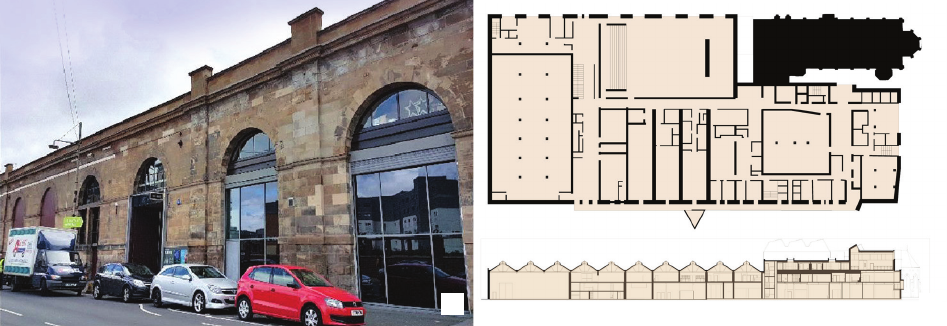
The former Tramway depot in Glasgow, built in the late
19
th
century as a linear, row-type arrangement of storage
halls (Browning 1965), is one of the most successful exam-
ples of transport infrastructure adapted into a cultural insti-
tution in Europe. After its closure in the 1960s, the building
served as a storage facility for some time; however, its large
scale, rhythmic structural grid, and raw spatial character
created ideal conditions for transformation into a contem-
porary arts centre (Jenkins, Price 2022).
The adaptation introduced theatre black boxes, rehearsal
rooms, performance spaces, and exible exhibition halls.
The original hall layout was preserved, with steel trusses,
brick walls, and traces of former track infrastructure left
exposed. The industrial aesthetic became a deliberate nar-
rative element – a backdrop for artistic activities that bene-
t from the neutrality and scale of the space. The interiors
were designed to allow rapid reconguration, supporting
experimental art forms.
Over time, the Tramway complex was expanded with
a new function – the Scottish Ballet Centre, located adja-
cent to the former depot halls. The project completed the
linear building layout, creating a cohesive ensemble that
links historical spaces with contemporary architecture. The
new building houses rehearsal rooms, dance studios, tech ni -
cal facilities, and educational spaces, while its transparent,
lightweight form contrasts with the solid, industrial struc-
ture of the former depot.
Tramway has become one of the most important cen-
tres for contemporary art in Scotland, known for producing
performances, hosting artist residencies, and collaborating
with local communities. The facility functions as a hybrid
institution – combining a theatre, gallery, educational cen-
tre, and venue for performative events.
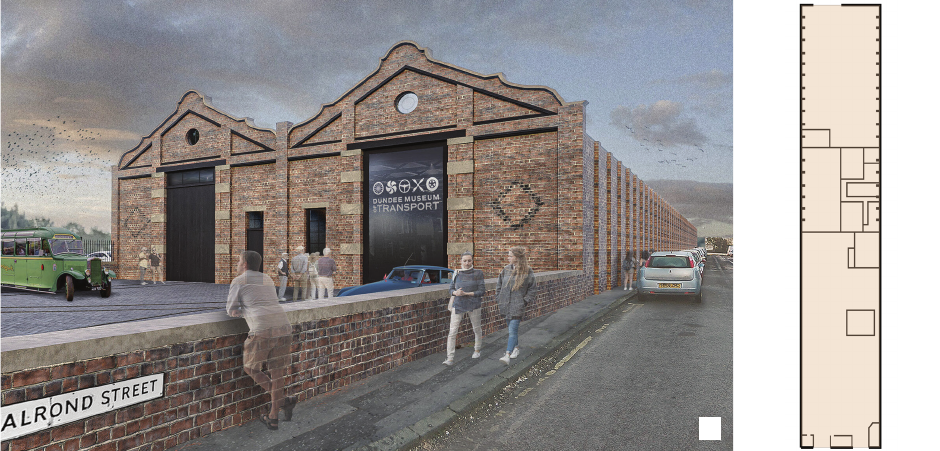
The second example is the Maryeld depot – the Dun-
dee Museum of Transport in Dundee. It is characterised by
a row-type arrangement of halls and tracks, typical of de-
pots located on narrow, elongated plots. The facility is cur-
resulting in a classication of individual cases, a discussion
of the advantages and limitations of such facilities, their
technical requirements, the factors determining the success
of adaptive reuse, and an assessment of their signicance
in the context of sustainable design and the revitalisation of
post-industrial areas.
Case studies
Eight former tram depots adapted into museums or ex-
hibition galleries were selected for analysis. The sampling
was purposive and based on four criteria:
1. Functional diversity – the selected facilities represent
dierent models of adaptation (technical museums, city mu-
seums, art galleries, cultural centres), allowing the study to
capture a broad spectrum of possible transformations (case
des
criptions).
2. Originality and representativeness of solutions – the
facilities were chosen to reect dierent conservation tra-
ditions, management models, and urban contexts (Table 1).
3. Diversity of adaptive methods – the sample includes
both conservative interventions and projects involving
a high degree of transformation, enabling a comparison of
design strategies.
4. Availability of source materials – only depots with
sucient archival, design, and descriptive documentation
were included, ensuring the reliability of the analysis.
This selection made it possible to identify patterns, dif-
ferences, and relationships relevant to future adaptive reuse
processes for transport infrastructure buildings.
Linear layout
The linear layout is represented by two examples: the
Tramway Social Centre for Culture in Glasgow (Fig. 1) and
the Dundee Museum of Transport in Dundee (Fig. 2), both
located in Scotland.
Fig. 1. Linear (row) depot layout adapted into the Tramway Social Centre for Culture, Glasgow:
a) north façade from Albert Drive (photo by Stinglehammer, 2017,
source: https://en.wikipedia.org/wiki/Tramway_%28arts_centre%29#, accessed: 15.03.2026),
b) plan and longitudinal section of the building (after Glasgow Life elaborated A. Czajczyńska-Mieszala)
Il. 1. Zajezdnia o układzie liniowym (szeregowym) adaptowana na Społeczne Centrum Kultury Tramway w Glasgow: a) elewacja północna
od strony ul. Albert Drive (fot. Stinglehammer, 2017, źródło: https://en.wikipedia.org/wiki/Tramway_%28arts_centre%29#, dostęp: 15.03.2026),
b) rzut oraz przekrój podłużny budynku (oprac. A. Czajczyńska-Mieszała na podstawie Glasgow Life)
a b
Adaptive transformations of tram depots for museums and exhibition spaces
19
rently undergoing an advanced adaptation aimed at creating
a transport museum with a strong educational and com-
munity-oriented prole. The architecture will be preserved
with minimal alterations and subjected to conservation
works. The collection will include historic vehicles, archi-
val materials, oral histories, and documentation of techno-
logical change. Particular emphasis will be placed on pre-
senting the modernisation processes that shaped the city’s
development and on illustrating the role of public transport
in the social and economic transformations of Dundee. The
adaptation of the depot is intended to contribute to the so-
cial and economic revitalisation of the surrounding area,
strengthening local identity and creating a new cultural
public space.
The adaptation of linear-layout facilities supports the or-
ganisation of exhibitions as a narrative sequence guiding
visitors through successive thematic sections. In the case
of Dundee, the linear layout enabled the creation of a clear
visitor route and facilitated the integration of museum func-
tions with workshop and educational spaces.
The main characteristics of this layout type include the
dominance of an axial hall arrangement, which translates
into the linear movement of visitors. Its advantages include
clarity and intuitive narrative ow, while its limitations in-
volve restricted possibilities for lateral expansion.
Courtyard layout
The courtyard layout is based on a central internal space
that plays an integrative role, with halls and auxiliary build-
ings arranged around it. It is represented by the depot in
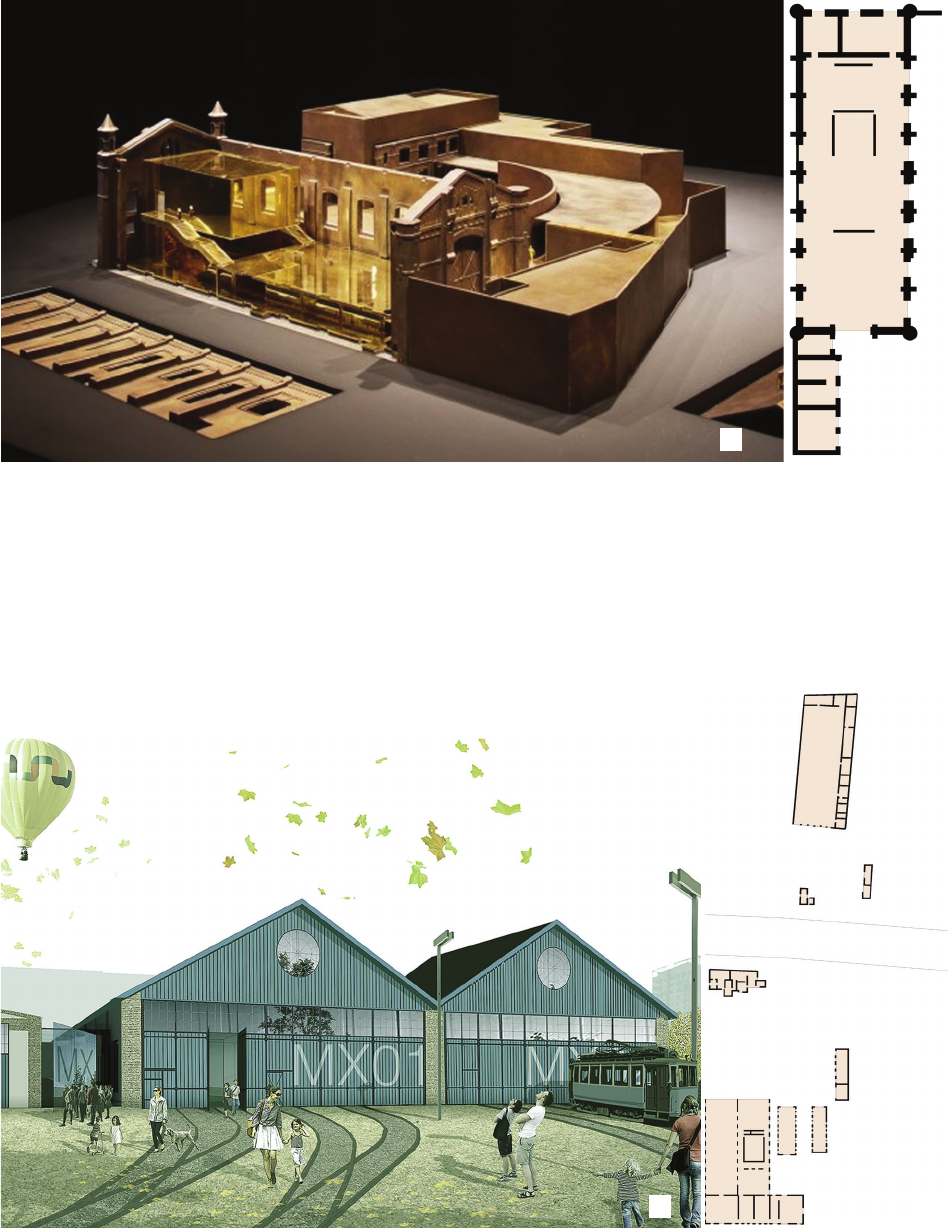
Tashkent (Fig. 3), whose historic layout has been trans-
formed into a multifunctional complex with a courtyard
serving as a public space, event venue, and zone of social
interaction.
The historic depot from 1912 is currently being trans
-
formed (according to a design by Studio KO, 2026) into
the Centre for Contemporary Art (CCA), combining ex-
hibition, research, and educational functions. The CCA is
intended to serve as a platform supporting the development
of local artists, curators, and researchers, oering work-
shops, seminars, and creative workspaces.
The adaptation strategy involves using the building’s
authentic architectural structure as a carrier of memory of
Tashkent’s industrialisation in the 20
th
century, while add-
ing new built elements that complement the form. The core
of the CCA will be the exhibition hall, characterised by its
considerable height, open structure, and exible arrange-
ment enabled by modular display systems, as well as the
preservation of a raw post-industrial aesthetic that forms an
integral part of the artistic narrative.
The dening feature of the courtyard layout is its cen-
tral square, which functions as a social space – often highly
exible and suitable for outdoor events. This layout also
generates strong integration between buildings, facilitating
circulation and multiple spatial connections.
Campus layout
The campus layout consists of several buildings distrib-
uted across a larger site, often with diverse functions and
origins. In MultipleXity in Timișoara (Fig. 4), former tram
halls and workshops built in 1927 have been transformed
into a dispersed complex combining the Corneliu Miklosi
Museum, technology laboratories, workshop spaces, and
exhibition halls. Since 2020, they have formed a centre for
Fig. 2. Linear (row) depot layout adapted into a transport museum – Dundee Museum of Transport: a) visualisation of the front façade
from Forfar Road (proj. Andrew Black Design, “Dundee Museum of Transport Project”, andrewblackdesign.com, accessed: February 15, 2026),
b) building plan (elaborated by A. Czajczyńska-Mieszała)
Il. 2. Zajezdnia o układzie liniowym (szeregowym) adaptowana na Dundee Museum of Transport: a) wizualizacja elewacji frontowej
od strony Forfar Road, aut. Andrew Black Design, „Dundee Museum of Transport Project”, andrewblackdesign.com, dostęp: 15.02.2026),
b) rzut budynku (oprac. A. Czajczyńska-Mieszała)
a b
20
Angelika Czajczyńska-Mieszała, Bogusław Wowrzeczka
Fig. 3. Courtyard-layout depot adapted into a contemporary art centre – Centre for Contemporary Art, Tashkent:
a) model of the complex viewed from the courtyard (photo: O’zbekiston Respublikasi Madaniyat va San’atni Rivojlantirish Jamg’armasi,
source: https://pr.uz/uzbekistan-vystavka-design-miami-basel/, accessed: March 20, 2026),
b) building plan (elaborated by A. Czajczyńska-Mieszała)
Il. 3. Zajezdnia o układzie dziedzińcowym adaptowana na centrum sztuki współczesnej – Centre for Contemporary Art w Taszkencie:
a) makieta kompleksu z widokiem od strony dziedzińca (fot. Fundacja Rozwoju Kultury i Sztuki Republiki Uzbekistanu,
źródło: https://pr.uz/uzbekistan-vystavka-design-miami-basel/, dostęp 20 marca 2026), b) rzut budynku (oprac. A. Czajczyńska-Mieszała)
Fig. 4. Former tram halls and workshops transformed into the MultipleXity campus in Timișoara
– a centre for art, technology, and experimentation:
a) competition-project visualisation of the front façade from Bulevardul Take Ionescu (design by Parasite Studio,
source: parasitestudio.com, accessed: March 15, 2026),
b) campus building plans (elaborated by A. Czajczyńska-Mieszała)
Il. 4. Dawne hale tramwajowe i warsztaty przekształcone w kampus MultipleXity w Timisoarze – centrum sztuki, technologii i eksperymentu:
a) wizualizacja z projektu konkursowego elewacji frontowej od strony ul. Bulevardul Take Ionescu
(proj. Parasite Studio, źródło: parasitestudio.com, dostęp: 15.03.2026),
b) rzuty budynków kampusu (oprac. A. Czajczyńska-Mieszała)
a
a b
b
Adaptive transformations of tram depots for museums and exhibition spaces
21
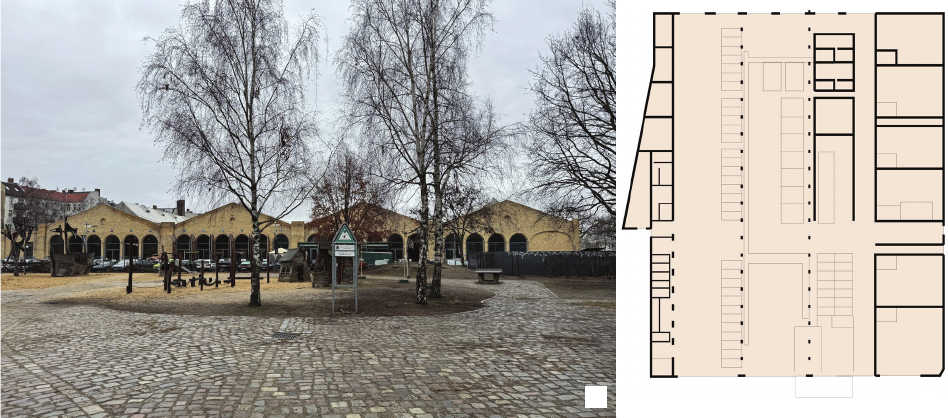
bition, service, retail, and event functions (Denkmaldaten-
bank 2026). It is an interesting example of historic transport
infrastructure repurposed into a contemporary service-ori-
ented space while retaining its industrial character and ar-
chitectural value.
The exhibition area, which showcases classic cars from
private collectors, preserves the open character of the halls,
with their considerable height and exposed steel structure.
The display is organised using modular glazed frames from
which vehicles can be driven out at any time. This solution
merges functional and museological roles, creating a unique
model for presenting automotive heritage. The former de-
pot also houses restaurants, cafés, conference rooms, and
event spaces (Classic Remise Berlin 2026).
A key characteristic of this layout type is its direct re-
lationship with the street, which often results in a strong
emphasis on architectural quality.
Peripheral layout
The peripheral layout refers to facilities located outside
the compact urban fabric. It is represented by two examples
from Wrocław: the Depot History Centre (Fig. 6) and the
Academic Culture and Local Initiatives Centre Czasoprze-
strzeń(former Dąbie depot) (Fig. 7).
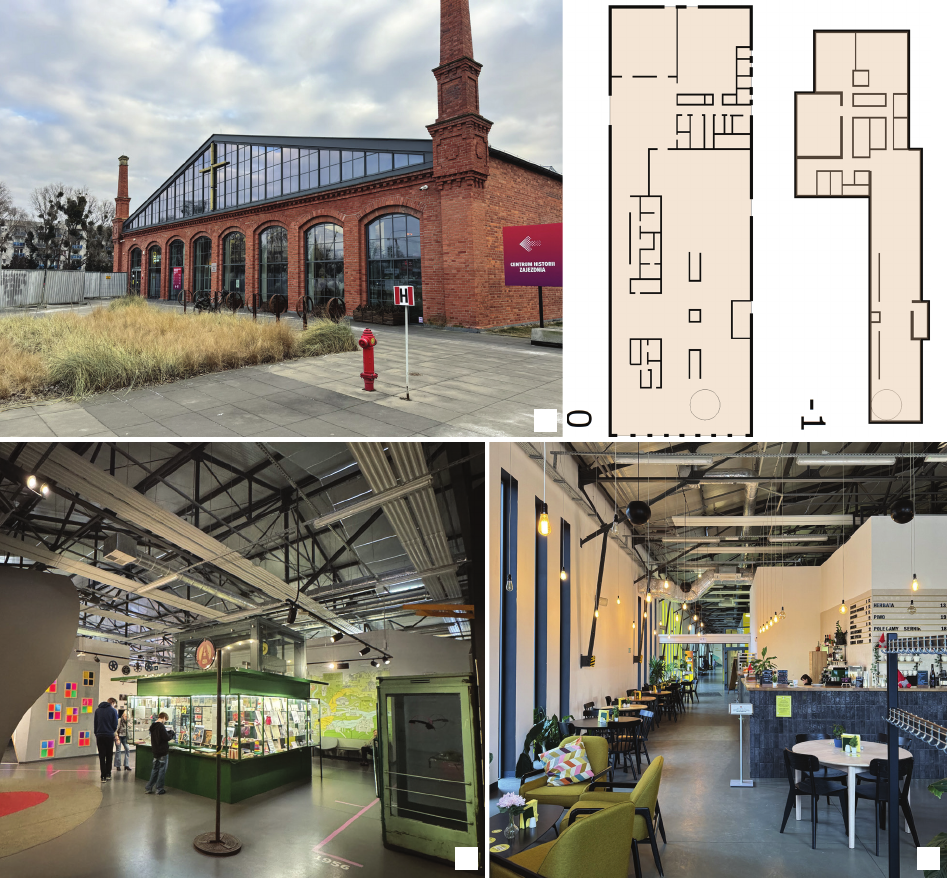
The Depot History Centre – the former tram depot in
Grabiszyńska Street, built in 1893 as one of the rst in the
city – served as a technical base for public transport for
over a century. It was here, in August 1980, that the rst
“Solidarity” strike committee in Lower Silesia was formed.
The adaptation of the depot into a cultural institution there-
fore had a dual purpose: preserving transport heritage and
commemorating key social events.
art, technology, and experimentation, with a strong empha-
sis on innovation and cross-sector collaboration.
The adaptation strategy is based on dividing the site into
several complementary zones that together create a com-
plex institutional ecosystem. The most important areas are
the exhibition spaces designed for multimedia installations,
generative and interactive art, and VR/AR projects. The
post-industrial halls retain their raw character, and their
considerable height and open layout allow for projects with
high technical requirements. In addition, the complex in-
cludes studios for artists and designers, prototyping and ex-
perimentation spaces, as well as educational and research
zones. Between the buildings, a vibrant public space has
been created, with courtyards and plazas used for outdoor
events, as well as gastronomic, coworking, and recreational
spaces. A dening feature of this layout is its multi-build-
ing structure, which oers signicant potential for future
development. New architectural elements have been inte-
grated into the preserved historic structures (Ordinul Arhi-
tecților din România 2020).
Block-integrated layout
Facilities of this type form an integral part of the com-
pact urban fabric, embedded within a city block, often us-
ing a gate-type access system. Adaptation in such contexts
requires particular conservation sensitivity and careful in-
tegration of new functions with the existing built environ-
ment. An example of this layout is the former tram depot on
Wiebestraße in Berlin – now Classic Remise (Fig. 5).
The building, erected at the beginning of the 20
th
cen-
tury (Classic Remise Berlin 2026), has been transformed
into a multifunctional automotive centre combining exhi-
Fig. 5. Tram depot on Wiebestraße in Berlin, embedded within a city block and transformed into the multifunctional automotive centre Classic Remise:
a) front façade from the interior of the block, Wiebestraße (photo by A. Czajczyńska-Mieszała),
b) building plan (elaborated by A. Czajczyńska-Mieszała)
Il. 5. Zajezdnia tramwajowa przy Wiebestraße w Berlinie wtopiona w kwartał zabudowy miejskiej, przekształcona na wielofunkcyjne centrum
motoryzacyjne z dominującą funkcją ekspozycyjną Classic Remise:
a) elewacja frontowa od strony wnętrza kwartału przy ul. Wiebestraße (fot. A. Czajczyńska-Mieszała),
b) rzut budynku (oprac. A. Czajczyńska-Mieszała)
a b
22
Angelika Czajczyńska-Mieszała, Bogusław Wowrzeczka
The transformation process included comprehensive
struc tural modernisation, restoration of the brick façade, and
complete replacement of installations. The characteristic
hall-type structure was preserved, with its height and open-
ness used to create a contemporary exhibition space. The in-
terior was fully adapted to its new function and divided into
narrative zones combining multimedia, archival materials,
and scenographic elements.
Additional functions were introduced, including educa -
tio nal rooms, a conference space, a reading room, and a café,
enabling broader community use. The peripheral location
made it possible to create a public space around the depot
– a recreational, event-oriented plaza.
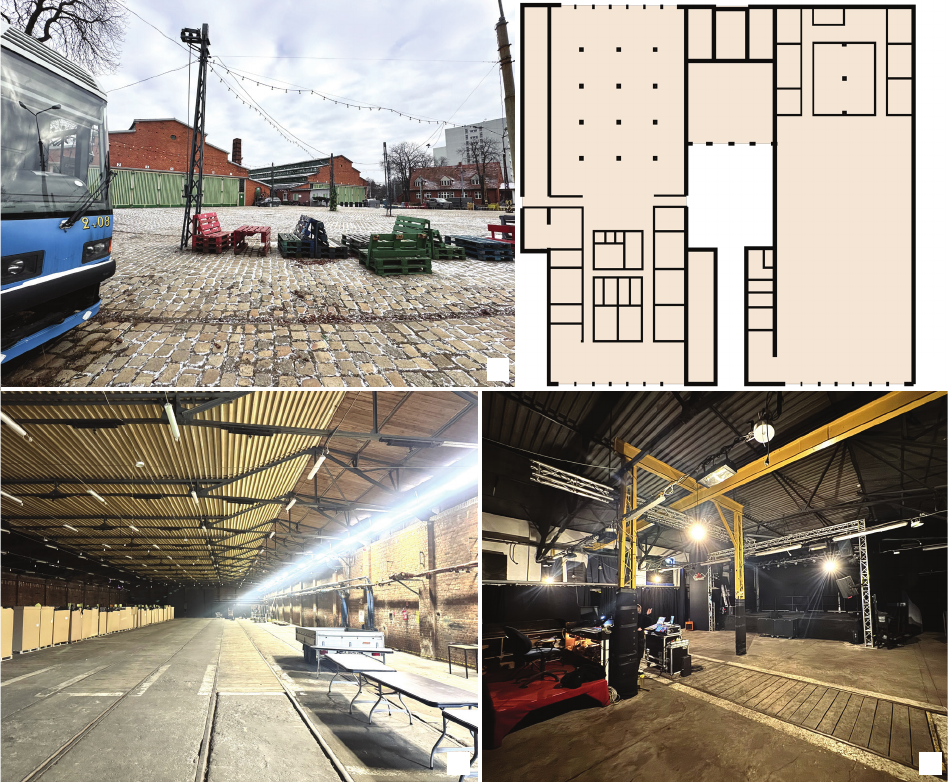
The second example is the Dąbie depot in Wrocław,
which underwent conservation work and was transformed
into the Academic Culture and Local Initiatives Centre Cza -
soprzestrzeń.The complex, built in 1913, consists of se veral
halls and auxiliary buildings that have been adapted into
functionally diverse spaces, such as concert and event halls,
as well as exhibition and market areas. The courtyard is also
used for outdoor events.
A dening feature of this layout is the greater availabili-
ty and expansiveness of the site, oering higher recreation-
al and landscape potential and typically facing lower con-
servation pressure.
Hybrid layout
The hybrid layout combines features of several types,
usually as a result of multistage transformations or a complex
Fig. 6. Former tram depot in Grabiszyńska Street in Wrocław, located outside the compact urban fabric and adapted into the Depot History Centre:
a) front façade from Grabiszyńska Street, b) building plan, c) exhibition area inside the museum, d) entrance and gastronomic zone
(photos and elaborated by A. Czajczyńska-Mieszała)
Il. 6. Dawna zajezdnia tramwajowa przy ul. Grabiszyńskiej we Wrocławiu zlokalizowana poza ścisłą zabudową miejską, adaptowana na Centrum
Historii Zajezdnia: a) widok elewacji frontowej od strony ul. Grabiszyńskiej, b) rzut budynku, c) część ekspozycyjna we wnętrzu muzeum,
d) strefa wejściowa i gastronomiczna (fot. i oprac. A. Czajczyńska-Mieszała)
a
b
c d
Adaptive transformations of tram depots for museums and exhibition spaces
23
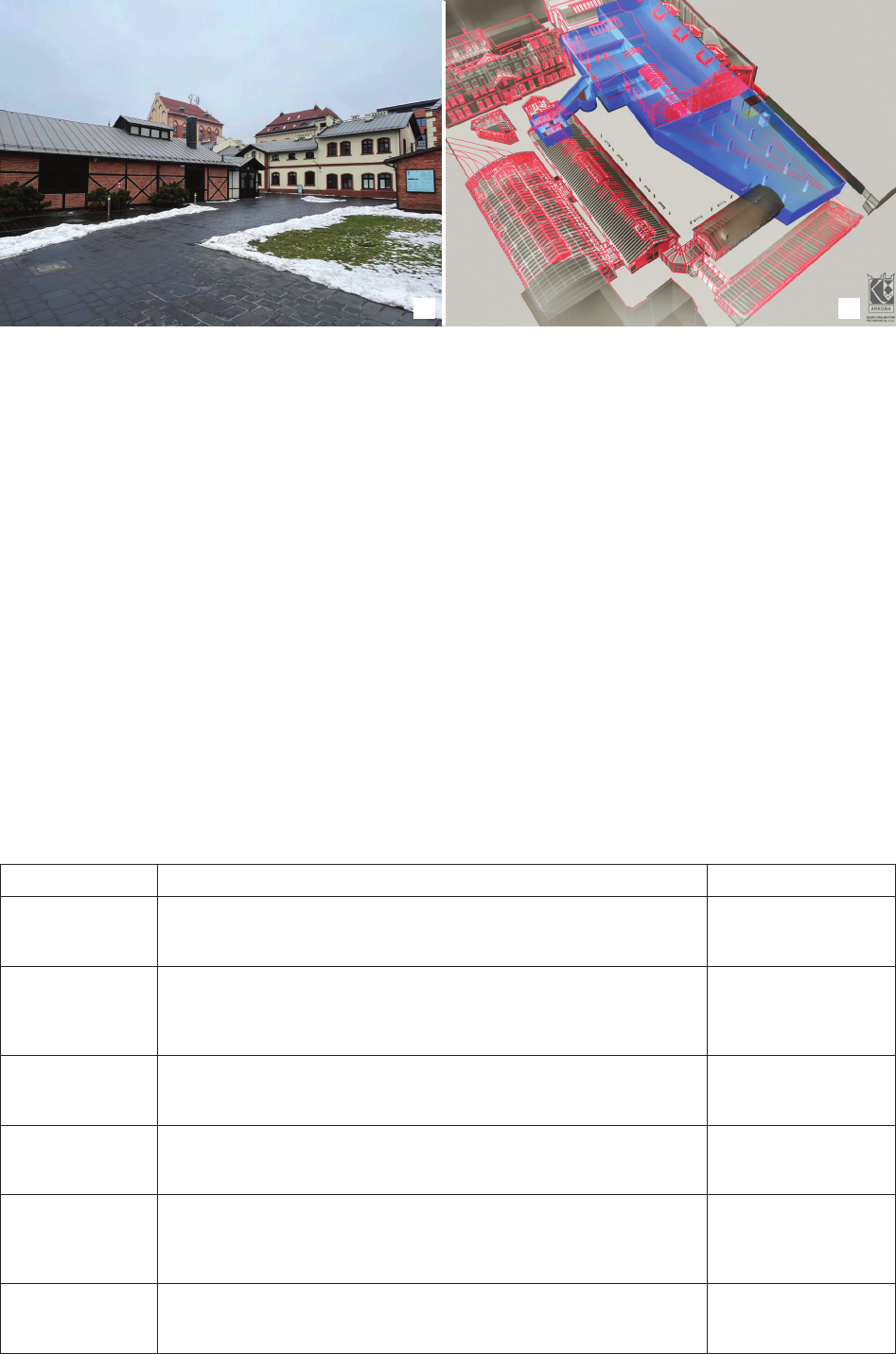
historical structure. An example of such a complex, hybrid
arrangement is the depot complex located within the dense
urban fabric on Św. Wawrzyńca Street in Kraków (Fig. 8).
This depot was built at the end of the 19
th
century as one
of the oldest in Poland (Dyba 2014). After its closure and
subsequent modernization, it was divided into two separate
yet functionally complementary parts: the Old Depot, serv-
ing gastronomic and event functions, and the Museum of
Engineering and Technology (MET), which continues the
tradition of documenting the history of urban transport and
technology. The ensemble, composed of both courtyard
and linear layouts and expanded with underground exhibi-
tion halls and connecting passages – elements that integrate
the entire built structure – represents an example of his-
torically layered development embedded within the dense
urban fabric. The spatial organisation of MET is based on
preserving the original halls and tracks, which constitute an
important component of the museum’s narrative. The com-
plex includes exhibition halls with historic rolling stock,
interactive zones, educational workshops, an archive and
documentation centre, as well as conservation workshops
where restoration work on historic vehicles is carried out.
Hybrid layouts are characterised by high adaptive po-
tential but require an advanced design strategy that func-
tionally and spatially integrates all components of the built
structure.
Results
Based on the conducted analysis, clear patterns can be
identied in the transformation of former tram depots,
encompassing both characteristic spatial layout types and
applied adaptive strategies. The study also makes it possi-
ble to dene key technical requirements that determine the
feasibility of assigning museum and exhibition functions to
these facilities.
Fig. 7. Dąbie depot in Wrocław, located peripherally and transformed into the Academic Culture and Local Initiatives Centre Czasoprzestrzeń:
a) front façade from the manoeuvring yard, b) building plan, c) interior of the main hall – event space,
d) interior of the concert space of Klub Łącznik (photos and elaborated by A. Czajczyńska-Mieszała)
Il. 7. Zajezdnia Dąbie we Wrocławiu zlokalizowana peryferyjnie, przekształcona w Centrum Kultury Akademickiej
i Inicjatyw Lokalnych Czasoprzestrzeń:
a) elewacja frontowa od strony placu manewrowego, b) rzut budynku, c) wnętrze hali głównej – przestrzeni eventowej,
d) wnętrze przestrzeni koncertowej Klubu Łącznik (fot. i oprac. A. Czajczyńska-Mieszała)
a
c
b
d
24
Angelika Czajczyńska-Mieszała, Bogusław Wowrzeczka
Typology of spatial structures
of former tram depots
adapted for museum/exhibition purposes
The adaptation of former tram depots for museum and ex-
hibition functions reveals a wide spectrum of spatial solutions
resulting from original technical conditions, urban location,
and the degree of preservation of historic fabric. A compara-
tive analysis of eight selected cases allows the identication
of six recurring models of spatial organisation, which form
the basis of the typology presented in Table 2. These types
are not rigid categories – in many cases, intermediate or hy
-
brid forms occur – but distinguishing them helps capture key
relationships between spatial structure, adaptive potential,
and the range of possible museum functions.
Strategies and types of transformations
Each analysed case of tram depot adaptation represents
a specic type of intervention in the architectural and ur-
ban structure of the facility. The process operates on two
parallel levels:
Fig. 8. Depot complex in Św. Wawrzyńca Street in Kraków, embedded in the compact urban fabric, featuring a hybrid spatial layout
(courtyard + linear) after revitalisation and expansion with an underground section, transformed into the Museum of Engineering and Technology:
a) side façades from within the block, b) 3D visualisation of the building complex (photos and elaborated by A. Czajczyńska-Mieszała)
Il. 8. Wpisany w zwartą tkankę miejską zespół zajezdni przy ul. Św. Wawrzyńca w Krakowie, o hybrydowym układzie przestrzennym
(układ dziedzińcowy i liniowy) po rewitalizacji i powiększeniu o część podziemną, przekształcony w Muzeum Inżynierii i Techniki:
a) elewacje boczne od strony wnętrza kwartału, b) wizualizacja 3D kwartału budynków (fot. i oprac. A. Czajczyńska-Mieszała)
a b
Layout type Characteristic features Examples
Linear layout
(row type)
Classical and most common; multi nave (2–6) halls arranged in parallel,
with tracks running perpendicular to the street; manoeuvring yard in front of the halls;
administrative building at the front; high adaptive potential due to large, tall hall spaces
Dundee Museum of
Transport (Dundee),
Tramway (Glasgow)
Courtyard layout
Depot enclosed within a city block; buildings form a perimeter around an internal
courtyard used for manoeuvring and storage; often linked with residential or industrial
buildings; high adaptive potential, especially due to the courtyard’s suitability
as an exhibition space
Centre for Contemporary Art
(CCA), Tashkent
Campus layout
Ensemble of several buildings (halls, warehouses, administration) dispersed across
a large site; presence of open yards, sidings, and technical spaces; very high functional
flexibility and strong potential for phased adaptation
MultipleXity, Timișoara
Embedded block layout
Depot forming part of compact, usually 19
th
century urban fabric; administrative building
facing the street, halls located deeper within the block; advantage: central location;
limitations: spatial and conservation constraints; medium adaptive potential
Classic Remise, Berlin
Peripheral layout
Depots located on the outskirts of cities, on large plots without spatial constraints;
halls arranged in parallel or fan shaped; often connected with railway or technical roads;
medium high adaptive potential: broad functional possibilities but lower social
attractiveness
Czasoprzestrzeń (Wrocław);
The Depot History Centre
(Wrocław)
Hybrid layout
Complex structure resulting from multi stage development; parallel halls preceded
by a fan shaped entrance; presence of a courtyard linked to a campus type layout;
high adaptive potential but requiring an advanced design strategy
The Museum of Engineering
and Technology (Kraków)
Table 2. Spatial layouts of tram depots and their characteristics (elaborated by A. Czajczyńska-Mieszała)
Tabela 2. Układy przestrzenne zajezdni i ich charakterystyka (oprac. A. Czajczyńska-Mieszała)
Adaptive transformations of tram depots for museums and exhibition spaces
25
1) adopting a conservation strategy appropriate to the
historical and heritage value of the complex, and
2) adapting the building to contemporary functional re-
quirements resulting from its new museum or exhibition
role.
The adaptation strategy denes the overarching goal and
direction of transformation: the extent of historic fabric pre-
servation, the degree of permissible intervention, and the
overall functional-spatial concept (e.g., conservation-based
revitalisation, total revitalisation, adaptation with recon-
struction elements).
The type of adaptation, understood in terms of building
structure, classies specic technical interventions in the
fabric – such as superstructures, extensions, interior re-
modelling, insertion of new structures into existing halls,
or changes of use without altering the external form.
For historic tram depots adapted for museum and exhi-
bition purposes, six basic types of architectural transforma-
tions can be identied:
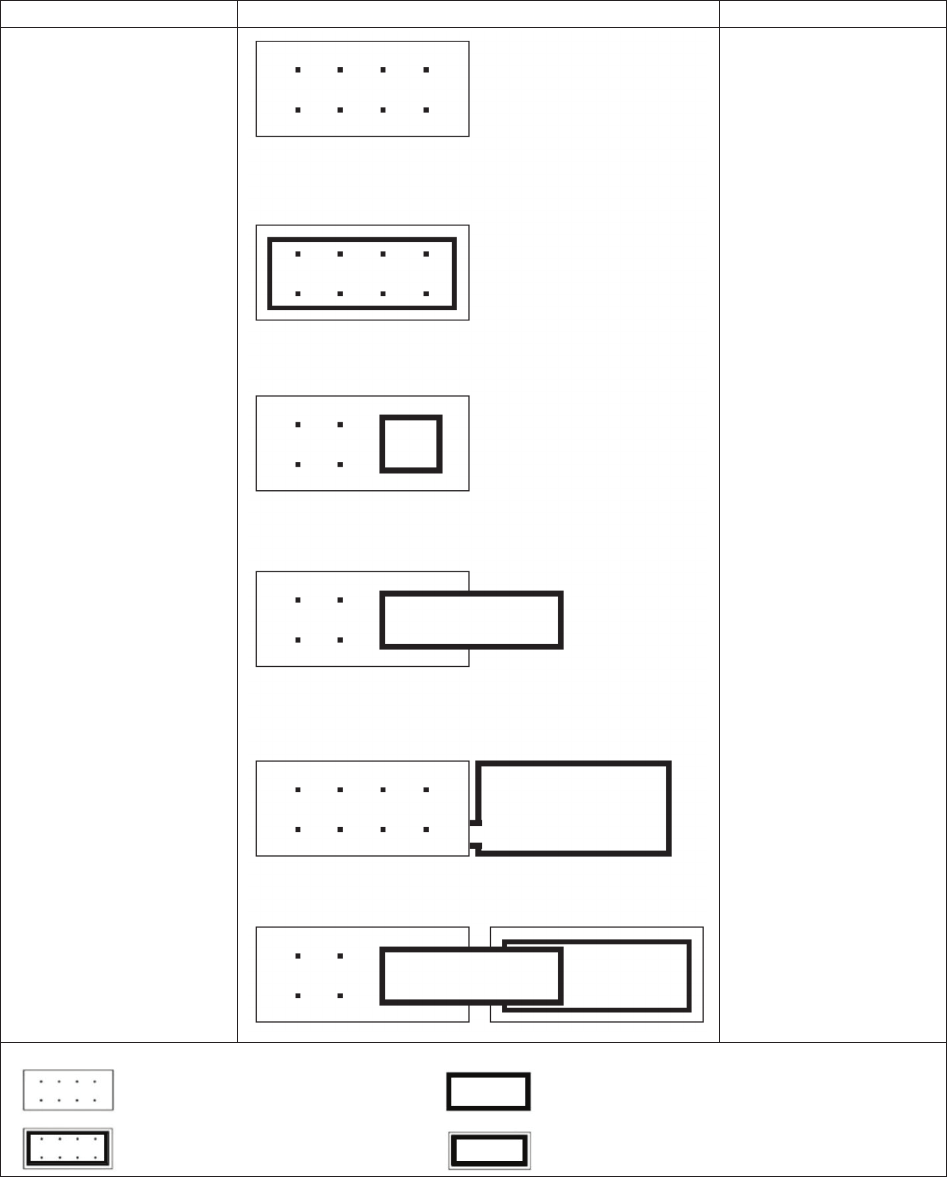
1. Preservation without alteration – conservation work
only.
2. Preservation of the existing layout – minimal inter-
vention, retaining the original hall structure and track lay-
out, introducing only essential installations and auxiliary
functions.
3. Insertion of new internal elements – adaptation through
adding new structures (e.g., mezzanines, exhibition cubes,
platforms, circulation cores) that do not alter the external
form but modify spatial use.
4. Addition of a new structure interwoven with the his-
toric one – integrating heritage fabric with a new volume,
often formally contrasting but functionally linked to the
depot halls.
5. Construction of a new complementary building – cre-
ating additional facilities (entrance pavilions, storage build-
ings, laboratories, educational rooms) adjacent to the histor-
ic structure without altering its form.
6. Mixed layout – a complex combination of the above
strategies, typical for multi-stage, heterogeneous complex-
es with diverse functional requirements.
This typology is presented in Table 3 and serves as a tool
for comparing dierent models of adaptation, as well as as-
sessing their impact on the preservation of heritage values
and on the programmatic possibilities of contemporary mu-
seum institutions.
Technical requirements for tram depots adapted
for museum and exhibition use
The adaptation of former tram depots into museum and
exhibition facilities requires a wide range of technical inter-
ventions. These requirements are listed in Table 4.
Summary
The adaptation of tram depots into museums is a global
practice that enables the preservation of historic industrial
architecture while showcasing large-scale collections asso-
ciated with it – primarily tram rolling stock (whose unique
character is thus retained) and other vehicles, such as his-
toric cars. Among adapted depot buildings, one now nds
not only transport museums but also history museums (e.g.,
the Depot History Centre in Wrocław) and exhibition gal-
leries, where the emphasis is placed on creating a neutral
backdrop (e.g., white-cube interiors) for artworks while
maintaining stable environmental parameters for delicate
exhibits (Charkowska 2016).
Heritage preservation,
historical identity,
and interaction with the city
The adaptation of former tram depots transforms aban-
doned industrial sites into cultural institutions, giving new
identity to historic urban areas. This process combines the
preservation of transport heritage with the needs of con-
temporary cultural institutions. It involves revitalisation
that retains the industrial character of interiors (such as
multi-bay halls, steel or reinforced-concrete structural el-
ements), tram tracks (serving both as exhibition elements
and historical remnants), and façades, while introducing
new functions.
Notably, contemporary projects for adapting former de-
pots into museums increasingly move away from static dis-
plays toward immersive experiences, combining preserved
artefacts with VR and AR technologies, multimedia (such
as 3D mapping, binaural sound, touchscreens, AI-based
systems), and simulators that allow visitors to sit in the
driver’s cabin of a historic tram and take a virtual journey
along routes that no longer exist.
These transformations maintain the original industrial
aesthetic, and in some cases include reconstructions based
on historical documentation. Preserved tracks also enable
the movement of exhibits, while maintaining an active
connection to the city network allows for the operation of
tourist tram lines directly from exhibition halls (“open mu-
seum”).
It should also be emphasised that the adaptation of for-
mer depots should be integrated into broader revitalisation
programmes for neglected urban areas. Particularly eec-
tive is the strategy of creating a network of several adapted
depots with mutually complementary functions.
Sustainable design in tram depot adaptations
The analysis of eight tram depot adaptations demon-
strates that sustainable design constitutes a shared found -
a tion across all projects, regardless of their scale, prog-
ramme, or urban context. A key element is the preservation
and reuse of the existing building fabric, which signicant-
ly reduces the project’s carbon footprint. Facilities such as
Dundee, MIT in Kraków, or Classic Remise in Berlin retain
original structures, tracks, and architectural details, mini-
mising the scope of new interventions. Larger-scale proj-
ects – Tramway Glasgow, MultipleXity, or CCA Tashkent
– combine conservation with advanced energy-ecien-
cy upgrades, introducing HVAC systems, insulation, and
low-emission technologies.
Adaptive transformations of historic tram depots into
museums and exhibition galleries make use of expansive,
26
Angelika Czajczyńska-Mieszała, Bogusław Wowrzeczka
Type of intervention Diagram Example
Building preserved
without changes
– conservation works only
Building preserved with interior
adapted to a new function
New elements inserted into
the existing preserved structure
New structure interwoven
with the historic building
New structure as an extension
of the existing building
Mixed type / combination of three
intervention types: façadism,
new structure, and preserved
historic building
– Dundee Museum of Transport,
Dundee, Scotland
– Czasoprzestrzeń,
Wrocław, Poland
The Depot History Centre,
Wrocław, Poland
– MultipleXity,
Timișoara, Romania
– Classic Remise,
Berlin, Germany
– The Museum of Engineering
and Technology, Kraków, Poland
– Tramway, Glasgow, Scotland
Centre for Contemporary Art,
Tashkent, Uzbekistan
LEGEND:
Table 3. Types of transformations of tram depots for museum and exhibition functions (elaborated by B. Wowrzeczka, A. Czajczyńska-Mieszała)
Tabela 3. Typy przekształceń zajezdni tramwajowych na funkcje muzealne i wystawiennicze (oprac. B. Wowrzeczka, A. Czajczyńska-Mieszała)
existing building
building with adapted interior
new building
façadism
industrial, and modular spaces, enabling creative and ex-
ible use as well as adaptation to changing exhibitions or
multifunctional arrangements. These modernisations pre-
serve industrial heritage while creating unique venues for
large-scale displays. Parallel nave structures – often char-
acterised by open interiors, natural lighting, and reinforced
construction – are ideally suited for storing, exhibiting,
and maintaining large vehicles, such as transport artefacts
showcased at MET in Kraków or the Dundee Museum of
Transport in Scotland.
All analysed depots exhibit high functional exibility,
enabling long-term adaptability and reduced operational

Adaptive transformations of tram depots for museums and exhibition spaces
27
costs. These adaptations show that sustainability in such
post-industrial facilities combines heritage preservation,
energy eciency, and programmatic durability, creating
cultural models of high environmental value.
Social activation and counteracting economic
and social degradation
An important aspect is the involvement of local commu-
nities, particularly evident in Space-time and the Depot His-
tory Centre, where revitalisation plays an integrative role.
The adaptation of disused tram depots into museums fos-
ters community interaction, enabling educational and social
programmes, collaboration with universities, schools, and
technical organisations, as well as integration with munici-
pal tourism initiatives.
The analysis of eight adaptations shows that the type of
location determines the dominant benets, while the type
of intervention shows the scale and character of sustainabil-
ity. The location-related benets are as follows:
– In city centres, adaptations strengthen social and cul-
tural life (Tramway Glasgow, Classic Remise).
Technical area Scope of requirements/actions
Load bearing capacity and floor
structure
– analysis and potential reinforcement of the floor due to point loads generated by rolling stock
– decision on how to use inspection pits (e.g., as exhibition elements)
– possibility of securing pits with tempered glass
Track and overhead line infrastructure
– maintaining tracks and overhead lines to preserve the operability of selected vehicles
– possibility of occasional tourist rides through connection to the city network
– promotional function of the museum through the movement of historic vehicles
Microclimatic conditions
– humidity control (45–50%) and temperature control (19–22°C),
especially for artworks and documents
– challenges resulting from the large volume of depot halls
– climate zoning through sealed display cases
– protection of metal and wooden vehicle components
– appropriate ventilation and heating using concealed systems that do not interfere
with the historic structure
Safety (OHS, fire protection)
– zoning using smoke extraction systems and fire curtains adapted to high hall roofs
– ensuring safe pedestrian circulation
– separation of functional areas: ticketing, cloakrooms, restrooms
– possibility of adding modular units or adapting auxiliary buildings (e.g., gatehouses)
Lighting
– UV protection (filters in skylights, blackout systems)
– flexible lighting systems (track lighting on suspended structures)
– ability to quickly reconfigure lighting without interfering with historic fabric
Acoustic adaptation
– reducing reverberation typical of brick, raw industrial halls
– use of sound absorbing materials
– ensuring visitor comfort and suitable conditions for events (e.g., exhibition openings)
Accessibility requirements
– ensuring accessibility for people with disabilities in spaces with significant level differences
– integrating ramps, platforms, and lifts in a way that does not conflict with the historic structure
Logistical requirements – designating a delivery and exhibition assembly zone that meets operational needs
Table 4. Technical requirements for adapting tram depots for museum and exhibition purposes (elaborated by A. Czajczyńska-Mieszała)
Tabela 4. Wymagania techniczne dla adaptacji zajezdni tramwajowych na cele muzealne i wystawiennicze (oprac. A. Czajczyńska-Mieszała)
– In historic districts, they protect heritage and build ed-
ucational narratives (Museum of Engineering and Technol-
ogy; Centre for Contemporary Art, Tashkent).
– In peripheral zones, they become tools for revitalisa-
tion and reducing development pressure (Dundee Museum
of Transport, Czasoprzestrzeń, MultipleXity, Depot Histo-
ry Centre).
Meanwhile, the degree of intervention – from preserva-
tion to expansion – translates into dierent forms of sus-
tainability, ranging from minimising the carbon footprint to
creating new, innovative cultural models. All cases conrm
that tram depots are exceptionally eective assets for sus-
tainable urban transformation.
In the analysed depots, the suitability of new museum
and exhibition functions is highest where the institution’s
programme makes full use of the scale, openness, and in-
dustrial character of the halls – both in technical museums
(Museum of Engineering and Technology, Dundee Muse-
um of Transport) and contemporary art institutions (Tram-
way Glasgow, MultipleXity, CCA Tashkent). The weakest
outcomes are observed in projects with dispersed or unsta-
ble programmatic proles (Classic Remise, Space-time).
28
Angelika Czajczyńska-Mieszała, Bogusław Wowrzeczka
Streszczenie
Adaptacyjne przekształcenia zajezdni tramwajowych na funkcje muzealne i galerie wystawiennicze
W artykule przedstawiono analizę potencjału adaptacyjnego dawnych zajezdni tramwajowych w kontekście współczesnych procesów rewitali-
zacji miast post industrialnych. Na podstawie studiów ośmiu przypadków – obejmujących zarówno zwarte XIX-wieczne zespoły, jak i rozproszone
układy kampusowe – oceniono przydatność tych obiektów do pełnienia funkcji muzealnych i wystawienniczych. Badania pozwoliły ich autorom
na wyodrębnienie charakterystycznych strategii adaptacji oraz typów przekształceń architektonicznych, a także na określenie ich konsekwencji dla
zachowania dziedzictwa i wdrażania zasad zrównoważonego projektowania. Wyniki stanowią praktyczne narzędzie wspierające projektantów w wy-
borze optymalnych rozwiązań dla adaptacji zajezdni na cele kultury, łącząc ochronę substancji zabytkowej z wymaganiami współczesnych instytucji
muzealnych.
Słowa kluczowe: zabytkowe zajezdnie, dziedzictwo kulturowe, adaptacja, muzeum, galeria wystawowa, zrównoważony rozwój
References
Akimov, Alexandr, and David Banister. “Urban Public Transport in Post-
Communist Transition: The Case of Tashkent, Uzbekistan.” Com -
pa rative Economic Studies 53, no. 4 (2011): 234–66. https://doi.
org/10.1057/ces.2011.18.
Bennewitz, Jürgen, Ralf Demps, and Hans-Georg Winkler. Auf Schienen
nach Weißensee. 125 Jahre Straßenbahn im Nordosten Berlins.
GVE-Verlag, 2002.
Browning, Anthony S.E. Glasgow Trams: Their History and a Descrip-
tive Guide to the Various Types Which Have Been Used. Scottish
Tramway and Transport Society, 1965.
Bullen, Peter, and Peter E.D. Love. “Adaptive Reuse of Heritage Build-
ings.” Structural Survey 29, no. 5 (2011): 411–21. https://doi.
org/10.1108/02630801111182439.
Burt, Walter. Dundee’s Trams and Buses. Amberley Publishing, 2014.
Charkowska, Anna. “Kształtowanie mikroklimatu w muzeach, archiwach
i magazynach dzieł sztuki (cz. 1).” ChłodnictwoiKlimatyzacja 10 (2016).
Accessed February 10, 2026, at https://www.chlodnictwoiklimatyza-
cja.pl/artykuly/263-wydanie-10-2016/3979-ksztaltowanie-mikrokli-
matu-w-muzeach-archiwach-i-magazynach-dziel-sztuki-cz-1.html.
Classic Remise Berlin. “Center Management.” Accessed February 11,
2026, at https://remise.de/berlin/infos/center-management.
Denkmaldatenbank Berlin. “Objekt 09050339.” Accessed February 10,
2026, at https://denkmaldatenbank.berlin.de/daobj.php?obj_dok_
nr=09050339.
Die Berliner VerkehrsAG BVG und ihr Betrieb 1934. Faksimile der Fest-
schriftzum5.JahrestagderBVGGründung. GVE-Verlag, 2019.
DirecțiuneaTramvaielorComunale.60anidelaînințareatramvaiului
înTimișoara.Monograe1869–1929. Direcțiunea Tramvaielor Co-
munale, 1929.
Douglas, James. Building Adaptation. Elsevier, 2006.
Dyba, Olga. “Zespół d. zajezdni tramwajowej.” Published July 10, 2014.
Accessed February 10, 2026, at https://zabytek.pl/pl/obiekty/kra-
kow-zespol-zajezdni-tramwajowej.
Evans, Graeme. “Measure for Measure: Evaluating the Evidence of Cul -
ture’s Contribution to Regeneration.” Urban Studies 42, no. 5/6 (2005):
959–83. https://doi.org/10.1080/00420980500107102.
Glasgow Life. Tramway. Accessed February 10, 2026, at https://www.
tramway.org/.
Głowacki, Tomasz. “Centrum Historii Zajezdnia we Wrocławiu.” Ar-
chitekturaMurator. Published January 27, 2017. Accessed February
10, 2026, at https://architektura.muratorplus.pl/realizacje/centrum-
historii-zajezdnia-we-wroclawiu-aa-vRCn-7NnN-sUmz.html.
Întreprindereade Transport Timișoara. 100deanidela introducerea
tramvaiuluiînTimișoara.Monograe1869–1969. Întreprinderea de
Transport Timișoara, 1969.
Jenkins, Martin, and Geo Price. Glasgow Trams. Pen and Sword Trans-
port, 2022.
Kołodziejczyk, Krzysztof. “Przekształcenia zabytkowych zajezdni ko-
munikacji miejskiej we Wrocławiu w obiekty kulturalnoturystycz-
ne.” TurystykaKulturowa 6 (2016): 51–78.
Kupaysinov, Ismail. “Public Transportation: A Glance at the History
of the Tram.” Eurasian Journal of Academic Research 2, no. 12
(2022): 879–80. Accessed February 10, 2026, at https://in-academy.
uz/index.php/ejar/article/view/6424.
Mitchell, Peter. Around the Glasgow Tramway System. Scottish Tram-
way and Transport Society, 2022.
Ordinul Arhitecților din România. RezultateConcursdeSoluții“Centrul
pentruArtă,TehnologieșiExperiment–MultipleXity”,Timișoara.
Pub lished May 25, 2020. Accessed February 10,
2026, at https://
oar.archi/stiri/stiri-din-concursuri/rezultate-concurs-de-solutii-cen-
trul-pentru-arta-tehnologie-si-experiment-multiplexity/.
Pieczka, Michał, and Bogusław Wowrzeczka. “Art in Post Industrial Fa-
cilities – Strategies of Adaptive Reuse for Art Exhibition Function
in Poland.” Buildings 11, no. 10 (2021): 1–27. Accessed February 1,
2026, at https://doi.org/10.3390/buildings11100487.
Plevoets, Bie, and Koenraad Van Cleempoel. Adaptive Reuse of the Built
Heritage. Routledge, 2019.
Schmidt, Robert III, Toru Eguchi, Simon Austin, and Alistair Gibb.
“What Is the Meaning of Adaptability in the Building Industry?”
In Proceedingsofthe16
th
International Conference on Open and
Sustainable Buildings, edited by José María de Ureña, Ignacio de la
Puerta, and Aitor Arana. Universidad del País Vasco / Euskal Her-
riko Unibertsitatea, 2010.
Sielicki, Tomasz. TramwajemprzezWrocław. Wydawnictwo Wrocław-
ski Neptun, 2023.
Studio KO. “Project 70.” Accessed February 1, 2026, at https://www.
studioko.fr/#en-project-70.
Waller, Peter. Lost Tramways of Scotland: Dundee. Graeg, 2019.
Wdowiarz-Bilska, Małgorzata. “Rewaloryzacja zajezdni tramwajowej
a kształtowanie przestrzeni publicznej w ciągu ulicy św. Wawrzyńca
w Krakowie.” WiadomościKonserwatorskie–JournalofHeritage
Conservation 71 (2022): 94–106. https://doi.org/10.48234/WK-
71TRAMWAY.
