
2026
1(85)
Aleksandra Gierko*, Paulina Sołowiej**
Internationale Bauausstellungen as an expression
of the transformation of environmental, social,
and economic paradigms in architecture and urban planning
DOI: 10.37190/arc260103
© by the Author/Authors. Licensee WUST.
Published in open access. CC BY-NC license.
Abstract
German international construction exhibitions – Internationale Bauausstellungen (IBA) – are an architectural and urban-planning support tool that
has been used since the early 20
th
century. The subject of each edition and the scope of their activities corresponded to the then-current problems of
each site by executing accompanying projects and initiatives.
This article presents a chronological analysis of activities undertaken as part of each exhibition, concerning the natural environment, society, and
the economy. The objective of the study was to observe the evolution of sustainability paradigms in architecture and urban design.
The results show a clear development of the IBAs – from events that largely focused on architecture and structural solutions to complex instru-
ments of spatial transformation. The analysis of successive events found a growing signicance attributed to environmental, social, and economic
matters and a departure from isolated design actions towards systemic and interdisciplinary interventions. There was also an observable shift in the
scale of the activities – from those focused on a single city, to regional and cross-border projects. The approach to existing urban fabric also changed,
following the notion of circularity; a greater emphasis was placed on the adaptive reuse of pre-existing buildings and developments. The signicance
of public participation also increased, as it gradually became a key tool that allowed for grassroots, local-level transformation.
Key words: Internationale Bauausstellung, sustainable development, natural environment
Introduction
Since the early 20
th
century, German international build-
ing exhibitions (Internationalle Bauanstellungen – IBA)
(In ter nationale Bauausstellungen 2025) have been a tool
for supporting architectural and urban development and
plann ing
at the city and regional scales. Over time, the
exhibitions also began to be held outside Germany, and
their character evolved from presenting purely architectur-
al solutions to much more complex events, encompassing
activities for local communities, the economy, culture, and
the environment. A chronological analysis of the solutions
adopted within each exhibition can allow for tracing the
dynamics of these paradigm shifts. To date, the exhibitions
have predominantly been described monographically in
the literature through case studies (Wojtyszyn 2004; Kuhn
2010; Waal, Wit 2012; Kuc 2014). A given phenomenon
was analyzed within a single exhibition, e.g., the imple-
mentation of sustainable development solutions on a lo-
cal scale (Pinch, Adams 2013). Projects carried out as part
of IBA also served as the basis for assessing the process
from idea to implementation, as well as the factors inu-
encing it (Burggräf 2013). Architectural and urban issues
were investigated, which mainly concern the Berlin exhibi-
tion from the 1980s (Neto 2020; Salgo 2021; Zedda 2021;
Domènech-Rodríguez, López López 2023), which was also
compared with its predecessor (Fi scher 2014). However,
comparative analysis is always conducted for exhibitions of
a similar scale and character (Dra pella-Hermansdorfer 2004;
Fischer 2014), while there is a lack of cross-sectional analy-
ses that would present them as a cumulative process, with-
in which subsequent editions refer to earlier experiences,
* ORCID:
0000-0001-7504-329X. Faculty of Architecture, Wro-
cław University of Science and Technology, Poland, e-mail: aleksandra.
gierko@pwr.edu.pl
** ORCID:
0009-0009-5500-3384. Independent researcher, War-
saw, Poland.
30 Aleksandra Gierko, Paulina Sołowiej
modifying them in response to new social, environmental,
and economic conditions.
This article lls this gap by proposing a chronological
analysis of postwar exhibitions. It presents the context of
their creation and the implemented solutions. The little-ex-
amined aspect of changing trends in addressing issues relat-
ed to the natural environment, society, and economy was ex-
plored, both in shaping architecture and urban planning and
in the landscape. Also, a cross-sectional approach – cover-
ing several exhibitions over the years – is an approach not
found in any publication so far.
Methods
The building exhibitions discussed were examined
through desk research based on the literature on the sub-
ject, materials studies, and publications posted on the IBA’s
ocial website and on websites dedicated to individual
exhibitions. All designs of architectural objects, residential
complexes, or housing estates, as well as urban and rural
projects, were analyzed. Additionally, independent eld re-
search was conducted
1
, which enabled verication of some
observations and the preparation of photographic docu-
mentation. The results were summarized in a table, which
1
In Hamburg during IBA 2013, in Vienna during IBA 2022, in
Berlin in 2018 and 2025, and in Lower Lusatia in 2023.
enables chronological comparative analysis and presenta-
tion of the solutions implemented in subsequent editions of
the exhibitions.
Results
Interbau Berlin was the rst exhibition to take place af-
ter World War II; however, its organizational method re-
sembled pre-war exhibitions
2
(Schulz, Schulz 2007; Wag-
ner-Conzelmann 2007; Bauten der “Interbau 57” 2025).
Located in the western part of the city, in the Hansaviertel
district, it was a response to the construction of the axis laid
out from Alexanderplatz in East Berlin. The new district of
West Berlin was intended to be a prestigious urban proj-
ect demonstrating the superiority of one political system
over another. Fifty-three internationally renowned design-
ers were selected through a competition, and the district of
tenement housing, destroyed as a result of hostilities, was
replaced by model buildings ranging from several to a doz-
en or so stories in height, placed freely on an area arranged
with greenery.
It should be emphasized that before the construction of
the new Hansaviertel development, the proportion of built-
up areas to open spaces was 1:1.5, while the exhibition
achieved a ratio of 1:5.5 (Interbau 1957: Landschaftsar-
chitektur 2025). The vast green areas were to be a coun-
terpoint to tight block housing. In terms of environmental
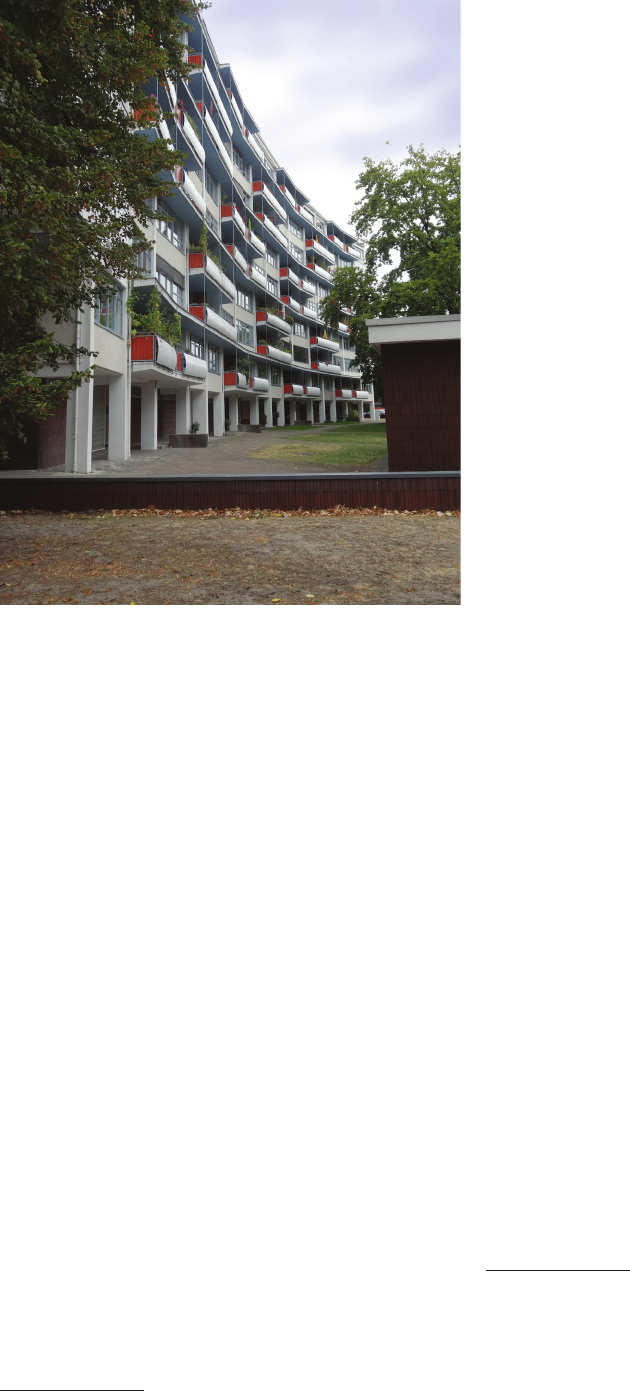
aspects, the implementation of multi-story buildings was
therefore of key importance (Fig. 1). Furthermore, the
greenery design became part of the urban design
3
, and
landscape architects
4
were responsible for shaping the sur-
roundings of the buildings. The area was saturated with tall
greenery, much like the adjacent and extensive Tiergarten.
Trees of ultimately large sizes and various species were
planted, intensively greening not only street sequences but
also parking lots or atrial spaces of single-family houses.
Water-permeable pedestrian surfaces were widely used. At
the beginning of the 21
st
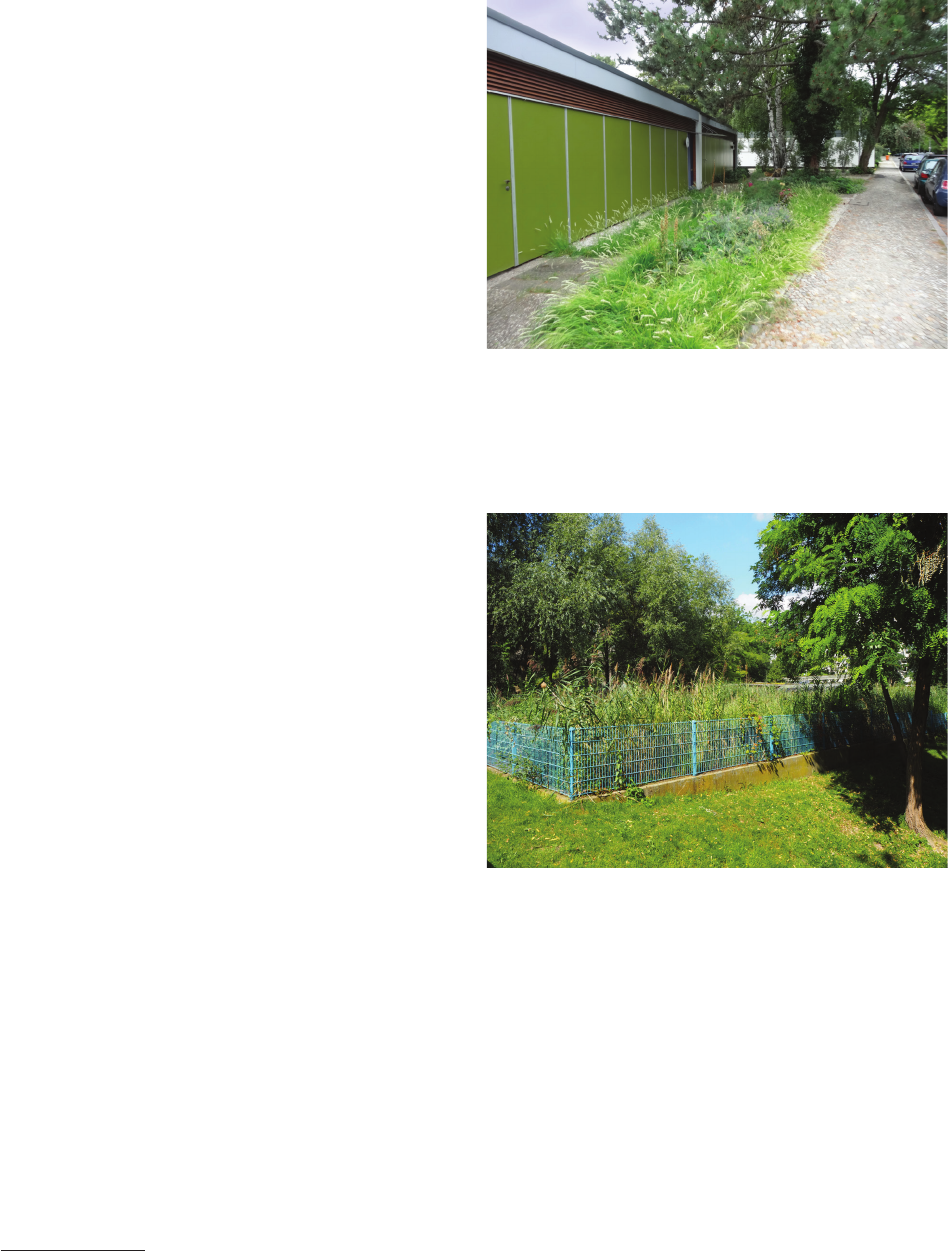
century, green roofs were intro-
duced on part of the multi- and single-family housing, and
rain gardens were introduced into roadside spaces (Fig. 2).
Against the background of postwar urban practices, In-
terbau Berlin constituted an example of an innovative ap-
proach. Under conditions of the dominance of the intensive
reconstruction model, which marginalized the role of green
areas, this project introduced a conscious increase in the
share of biologically active areas and treated greenery as an
integral component of the urban structure.
Thirty years after the rst postwar exhibition, another
IBA was implemented in Berlin, which this time concerned
downtown development destroyed by hostilities and the di-
vision of the city
5
(Salgo 2021). Six intervention areas were
2
The exhibition was organized at a single location, covering an
area of several dozen hectares.
3
Landscape architects were involved in the project only after nu-
merous appeals by Walter Rossow.
4
The work was carried out by ve design teams, each responsible
for one section of the site and composed of a German and a foreign
landscape architect.
5
The exhibition was held in West Berlin.
Fig. 1. Multi-unit residential building by Walter Gropius at the Interbau
1957 in Berlin (photo by A. Gierko, 2018)
Il. 1. Budynek wielorodzinny projektu Waltera Gropiusa na terenie
Interbau 1957 w Berlinie (fot. A. Gierko, 2018)
Internationale Bauausstellungen as an expression of the transformation of environmental, social, and economic paradigms 31
selected, and their revitalization and revalorization were to
be a response to the growing criticism of the practices of
demolishing historical heritage. During the preparation for
the exhibition, two paths were designated: IBA-Neubau
and IBA-Altbau, analogously taking up the threads of the
so-called critical reconstruction
6
and careful renovation of
cultural heritage. As part of the rst path, almost 5,000 new
apartments were built in four locations. In Tegeler Hafen,
located peripherally to the center, it was possible to design
neighborhood park areas and create connections with pe-
ripheral green areas. Green façades of vines and green roofs
became standard. These new greenery forms proved them-
selves particularly in the strict center, where the develop-
ment index was higher. In the centrally located Südliches
Tiergartenviertel, in building block No. 647 from the side
of the Landwehrkanal, buildings were set back from the
street, using extensive front gardens, and thus referring to
the historical layout of buildings. In the area located by the
Berlin Wall, ecological standards common today were test-
ed and implemented for the rst time: water-saving devices
in all apartments, waste segregation, green infrastructure
solutions – extensive green roofs, and blue infrastructure
– the use of gray water to water greenery. A retention pond
was built in one of the quarters (Fig. 3). The introduction of
ecological threads into the exhibition space was caused by
growing social involvement in environmental protection.
The axis of activities under the second path – IBA-Altbau
– was the illegal occupation of apartments and their short-
age. Activities in the eastern part of the Kreuzberg district
consisted mainly of renovating buildings and apartments in
a cooperative process, which covered a total of over 7,000
residential units. In strict tenement housing, the predom-
inant forms of greenery were roadside plantings, small
neigh borhood parks, green façades made of vines, and in
in dividual cases, green roofs. Görlitzer Park was also reval-
orized as part of the IBA. The pilot renovation contributed
to the introduction of subsidies for the renovation of build-
ings with cultural value, changes in legal practice regard-
ing reconstruction and environmental protection, and led
to the creation of social protection standards. In the 1980s,
when urban planning was still technocratic in nature, in
Berlin residents were recognized as active co-creators of
space transformation. This exhibition introduced a new so-
cio-economic paradigm to urban planning: the priority was
to be the protection and modernization of existing build-
ings, instead of demolishing them and building new ones in
their place
7
. In the following decades, it became one of the
key models of urban policy in Europe.
IBA Emscher Park was the rst large-scale exhibition:
conceptual activities covered an area of a part of a federal
state
8
and were a reaction to the industrial decline of the
6
The new approach was based on giving priority to urban planning
over architectural design and subordinating it to the context of the site.
The landscape context and the presence of green spaces was an import-
ant element.
7
Although the role of IBA in the discourse on urban renewal is
invaluable, it should also be noted that some individual projects imple-
mented as part of the exhibition were later demolished.
8
The exhibition was implemented in the northern part of the Ruhr
region in North Rhine-Westphalia, across the territory of 17 municipalities.
region (Sieverts 1991; Dettmar, Rohler 2015). Landscape
planning and urban development projects came to the fore
for the rst time in the history of building exhibitions.
New ways of designing on a regional scale were devel-
oped, which went far beyond housing and urban life, and
were undertaken to establish an identity and a fundamental
ecological, economic, and cultural change of the degraded
area. The exhibition adopted six leading themes: working
in the park; new buildings and modernization of housing
estates; industrial monuments; ecological renewal of the
river system; promotion and social stimuli for urban devel-
opment; creation of a regional park structure. For the rst
time as part of an IBA, issues related to the circular econo-
my were addressed: in land use, building resources, energy
consumption, and water management. Many postindustrial
facilities were preserved and prepared for reuse. The im-
plementation of a large-scale landscape design project and
Fig. 2. Rain gardens near single-family housing in Hansaviertel, Berlin
(photo by A. Gierko, 2018)
Il. 2. Ogrody deszczowe przy zabudowie jednorodzinnej na terenie
Hansaviertel w Berlinie (fot. A. Gierko, 2018)
Fig. 3. Retention pond at Dessauer Strasse in Berlin, remodeled in the
early 21
st
century (photo by A. Gierko, 2025)
Il. 3. Staw retencyjny przy Dessauer Strasse w Berlinie przebudowany
na początku XXI w. (fot. A. Gierko, 2025)
32 Aleksandra Gierko, Paulina Sołowiej
to tourists (IBA Fürst-Pückler-Land 2012; IBA See 2025).
The exhibition made 30 projects available to visitors, di-
vided into 7 issues: industrial culture, water landscapes, en-
ergy landscapes, new territories, border landscapes, urban
landscapes, and intermediate landscapes. Analogous to the
experiences of IBA Emscher Park, also in Lower Lusatia
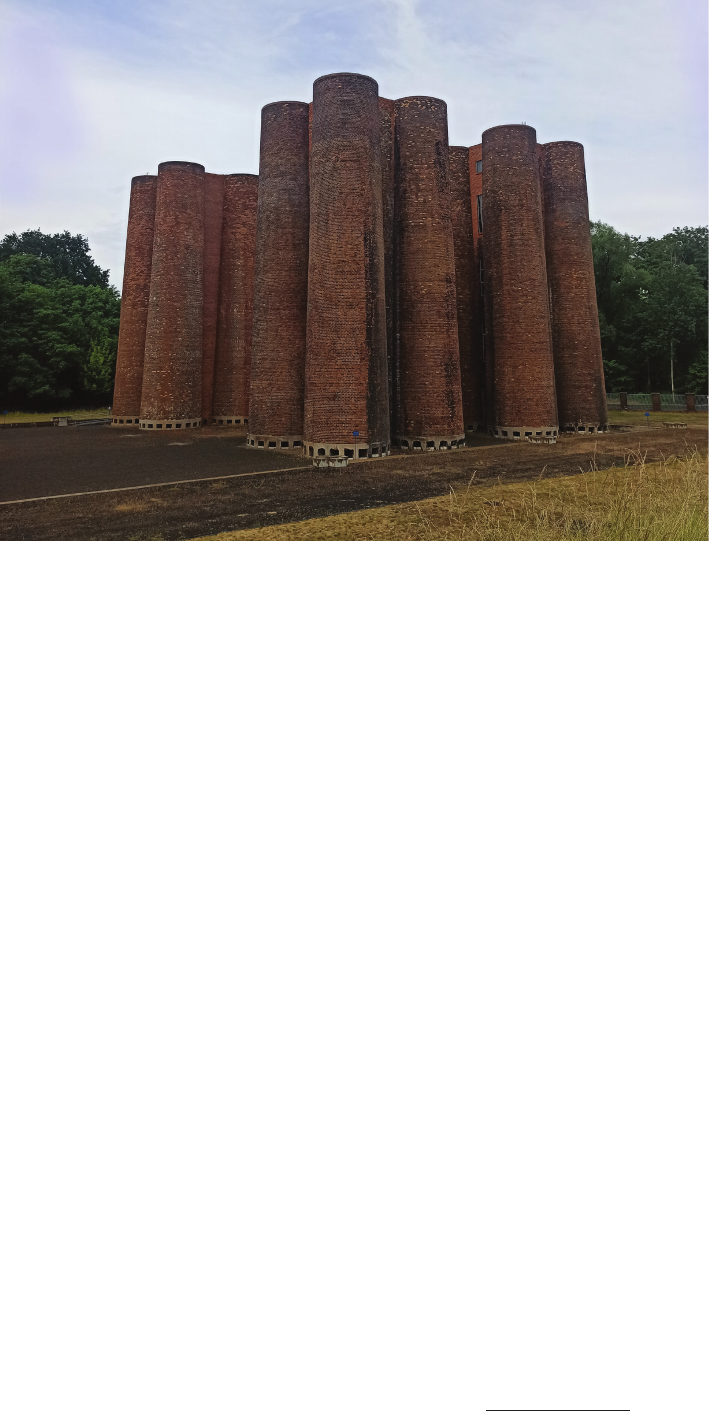
many technical monuments gained a new function, and
a concept expressed by the slogan “the future needs roots”
was formulated (Fig. 4). As part of looking to the future,
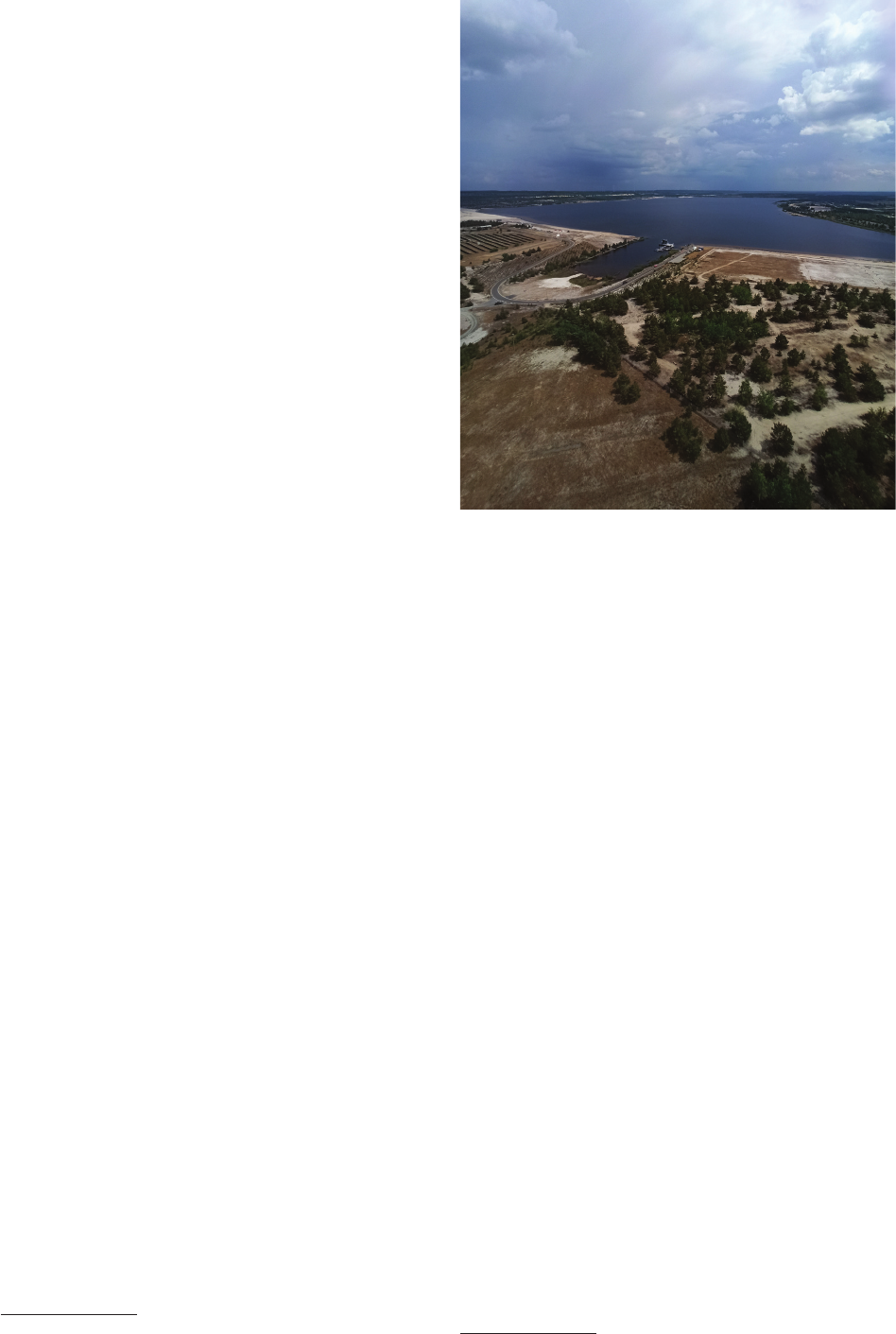
many places were designated for installations for generat-
ing electricity from renewable sources (Fig. 5). Most of the
mines were intended to be ooded, resulting in the creation
of the Lusatian Lake District, the largest articial landscape
in Europe, consisting of twenty lakes connected by naviga-
ble canals and a system of bicycle paths. Once again, the
implementation within the exhibition became a reference
point for the reclamation of postindustrial areas.
Taking place in nineteen cities of Saxony-Anhalt, IBA
Stadtumbau
9
addressed economic, social, and environmen-
tal perspectives for cities in the face of the withdrawal of
industry from their areas, and consequently, population
shrinkage and unemployment (IBA-Büro 2007; 2008). As
a result of the exhibition, urban scenarios were created for
cities in demographic stagnation, which also took into ac-
count the impact of future climate changes on the region
and the need for energy transformation. It is signicant that
many cities feature high-value cultural heritage sites, which
was often the starting point for transformations. The en-
tire process was carried out jointly by the Bauhaus Dessau
Foundation and a special purpose vehicle. It was in Des-
sau-Roßlau that one of the landscape projects was imple-
9
It was the rst exhibition to encompass the entire federal state.
the establishment of the Emscher Landscape Park gave rise
to new thinking about the landscape and natural values of
postindustrial areas on a European scale.
Retrospective analysis indicates that Emscher Land-
schaftspark, together with Landschaftspark Duisburg Nord
created on the site of a former factory, became an inspira-
tion for the implementation of many similar landscape ar-
chitecture sites based on the existing postindustrial fabric.
In the context of the implementation and modernization of
housing complexes, IBA Emscher Park presented systemic
thinking about greenery and water. Hence, connections with
the surroundings, green roofs, or rainwater management on
a neighborhood scale appear as a standard. On a landscape
scale, the most important project was the renaturalization
of the Emscher River, which for years had been treated as
a receiver of industrial wastewater. In contrast to previous
exhibitions, which focused mainly on architecture and ur-
ban planning, IBA Emscher Park treated space as a tool for
economic restructuring. The innovative aspect was primar-
ily the use of industrial heritage as an economic resource,
not a burden. In this sense, the exhibition can be seen as
one of the rst European examples of a comprehensive
regional development strategy, integrating environmental,
social, and economic factors into a single coherent model
of action.
In 2010, two exhibitions were opened simultaneously
for the rst time, both in the area of the former East Germa-
ny. The aim of the IBA Fürst-Pückler-Land project was the
reinterpretation and revalorization of the landscape of the
rural region of Lower Lusatia after the cessation of mining,
hence it became an important issue to build on the experi-
ences of the previous exhibition. As part of the IBA, a pro-
cess was initiated to transform the landscape of vast areas
degraded by opencast lignite mining into areas attractive
Fig. 4. Biotürme, old coke
production furnaces
in Lauchammer, revalorized as
a part of IBA Fürst-Pückler-Land
(photo by P. Sołowiej, 2023)
Il. 4. Biotürme, dawne piece do
produkcji koksu w Lauchhammer,
zrewaloryzowane w ramach IBA
Fürst-Pückler-Land
(fot. P. Sołowiej, 2023)
Internationale Bauausstellungen as an expression of the transformation of environmental, social, and economic paradigms 33
mented, touching upon the issues of deurbanization, natural
values, social participation, and economic issues. Over the
years, the demolition of buildings deemed not worth main-
taining has created open areas throughout the city. In the
long term, the city is to be transformed into a set of small
centers, the core of which will be a coherent greenery sys-
tem. Also in Schönebeck, the topic of abandoned areas was
addressed: vacant plots in the city center, once occupied by
industrial facilities, may become an attractive location for
housing development in the future. In the meantime, they
have been developed with ower meadows, divided into
sections in places of historical plot division by hedges.
Historical tree avenues were re-valorized by planting
new
trees, thereby maintaining green connections between
districts. In Weißenfels, where many factory buildings were
demolished, an open area was created for compensatory
plantings carried out by stakeholders in the food industry,
which are still present in the city. In Staßfurt, where, as a re-
sult of mining damage after salt extraction and land subsid-
ence, many buildings had to be demolished, including the
town hall and church, and thus the town lost its historical
center, a system was developed to drain built-up areas into
an articial water reservoir. The lake was created at the site
of a depression cone, and the shores lined with white grav-
el are supposed to remind of salt: the cause of the city’s
development and then its degradation. A cultural heritage
project whose solutions can also serve as a remedy for the
future took place in Naumburg, where the House of Archi-
tecture and Environment was opened, oering visitors the
chance to learn about historical clay architecture. This is,
at the same time, an attempt to revitalize the city center,
which was abandoned due to decentralization during the
GDR era. As part of the exhibition, scenarios for rural areas
were also developed, concerning transport, the end of the
fossil fuel era, and tourism, combining social, economic,
and environmental threads.
As a result of IBA Hamburg, ultimately over 17,000
apartments are to be built on the Elbe Islands. The reali-
zation of the new center of the Wilhelmsburg district was
a pilot project to develop a new construction standard
aimed at reducing construction and maintenance costs and
optimizing the design and approval process, without lower-
ing architectural and ecological quality (Hamm 2010). An
important aspect was also the exibility of residence. This
standard is currently repeated in subsequent implementa-
tions of housing complexes
10
(Hamm 2014). As a result of
the exhibition, the following were built: a new town hall
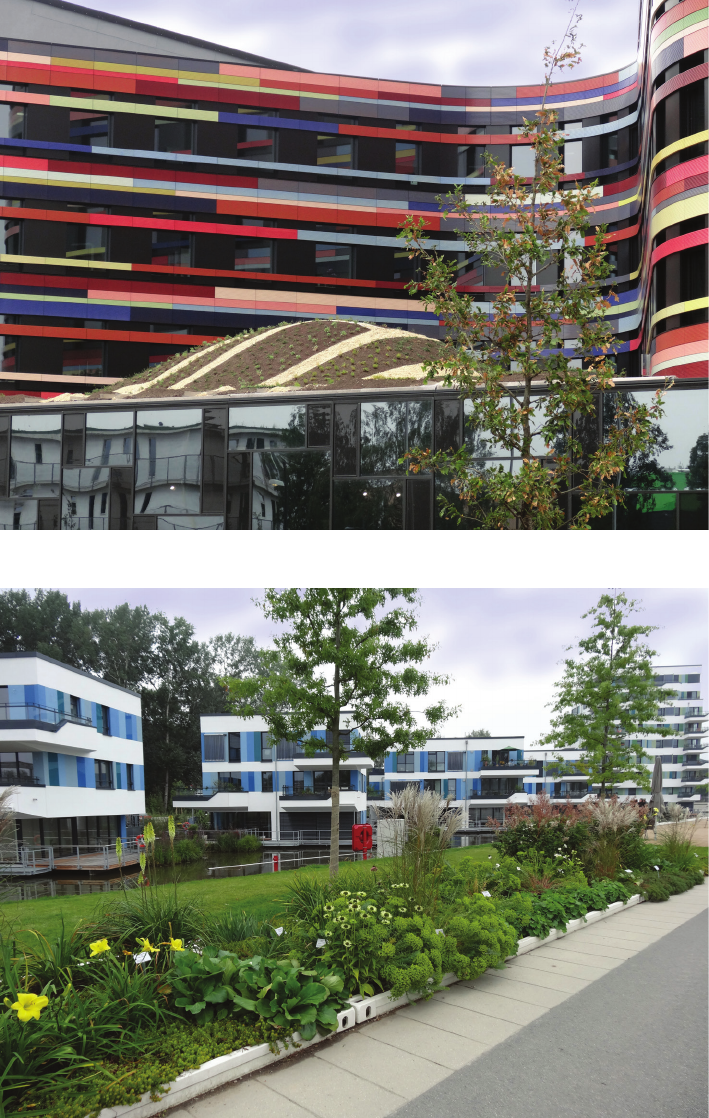
(Fig. 6) and a local activity center, as well as residential
and commercial buildings (Fig. 7). In the eld of green and
blue infrastructure, the implementation presented a mod-
ern approach: existing greenery was adapted to the proj-
ect, new roadside avenues, neighborhood and settlement
parks were created, as well as systemic connections with
peripheral green areas; various permeable surfaces were
used in parking lots and planted with greenery, and reten-
tion swales were used along streets. Green roofs and green
10
Three projects have been completed, while six are currently un-
der construction.
façades made of vines became a standard, and “green inno-
vations” were favored by the simultaneous realization of an
international horticultural exhibition
11
.
The rst cross-border exhibition was IBA Basel, which
connected the territories of Germany, France, and Switzer-
land, covering an area with a radius of 30 km from Basel
(IBA Basel 2025). The city was a national center of the
chemical and pharmaceutical industries, and its character
was largely dened by its port function. The main goal of
the exhibition was to meet conventional border divisions
and respect the tri-national character of the region. In ac-
cordance with the motto “Together crossing borders”, the
organization aimed to build responsibility for the agglom-
eration through activities including the design of infrastruc-
ture, buildings, and green areas, as well as the stimulation
of cross-border cooperation. Consequently, activities with-
in IBA Basel focused around three areas. The rst was the
landscape. The exhibition aimed to show how green areas
can be combined into coherent systems of open spaces that
bring benets to urbanized areas. Understanding their su-
pra-local role was of particular importance. The second
area of activity was urbanized spaces and the communi-
cation infrastructure connecting them. The implemented
projects focused primarily on intensifying development
along tram lines, S-Bahn stations, and railway stations. The
latter were treated as key urban nodes of both functional
11
Internationale Gartenbauausstellung (IGA).
Fig. 5. A photovoltaic installation (on the left) seen from a viewpoint
on a mining machine adapted for tourism purposes
in Lichterfeld-Schacksdorf (photo by P. Sołowiej, 2023)
Il. 5. Instalacja fotowoltaiczna (po lewej) widziana z punktu
widokowego na zaadaptowanej na potrzeby turystyczne maszynie
górniczej w Lichterfeld-Schacksdorf (fot. P. Sołowiej, 2023)
34 Aleksandra Gierko, Paulina Sołowiej
and cultural importance. The third area concerned commu-
nity building and a common vision for the future. As part of
it, the challenge of transforming an agglomeration of inde-
pendent municipalities and cities into a common space was
undertaken. The factors that distinguished this exhibition
from others were: cross-border planning, the creation of ur-
ban management instruments, and spaces for discussion not
limited by formal divisions. This resulted in the creation
of both eective urban connections stimulating the region
economically, such as pedestrian and bicycle bridges and
footbridges allowing for free circulation, as well as the im-
plementation of international socio-artistic activities. Most
importantly, however, thanks to such an approach, it was
possible to eectively rebuild or create green systems.
Two years later, activities began simultaneously within
two exhibitions. One of them was IBA Heidelberg, located
in the former West Germany. The identity of the city was
strongly associated with its academic history and the old-
est university in Germany. At the same time, Heidelberg
experienced frequent resident turnover, which signicantly
aected the city’s specicity (IBA Heidelberg 2019). The
exhibition was intended to address needs related to new
Fig. 6. The roofs of an office at
Neuenfelder Strasse in Hamburg,
covered with greenery
(photo by A. Gierko, 2013)
Il. 6. Pokryte zielenią dachy
urzędu przy Neuenfelder Strasse
w Hamburgu
(fot. A. Gierko, 2013)
Fig. 7. Experimental floating
houses in the Wilhelmsburg
neighborhood in Hamburg
(photo by A. Gierko, 2023)
Il. 7. Eksperymentalne domy
pływające na osiedlu
Wilhelmsburg w Hamburgu
(fot. A. Gierko, 2013)

Internationale Bauausstellungen as an expression of the transformation of environmental, social, and economic paradigms 35
surfaces were unsealed, trees and shrubs were planted, and
ower meadows were designed to increase local biodiver-
sity and water inltration.
The rst exhibition carried out entirely outside Germany
was IBA Parkstad. The exhibition took place in the Nether-
lands, in the area of 7 municipalities of the former Eastern
Mining Region (IBA Parkstad 2025). In the 1970s, mines
in this region were closed, intensifying social problems
such as rising unemployment and accelerating the region’s
demographic shift towards an aging society. Faced with
a declining population and a surplus of both residential
and commercial real estate, IBA aimed to give new func-
tion to abandoned spaces and adapt the region to changing
socio-economic realities. The main goals of the exhibition
were to support urban renewal, develop new sectors of the
economy such as healthcare and logistics, and promote
energy transformation. A key element of the activities was
engaging residents, which allowed not only for shaping the
space in accordance with their needs but also for rebuilding
their identication with the place. Thanks to the cooper-
ation of the IBA organization and an external consulting
company specializing in circular management and building
demolition, some of the existing facilities could be disman-
tled in a way that enabled inventory and reuse of materials.
The last exhibition and simultaneously the second out-
side Germany was IBA Wien. The problems Vienna faces
are an important factor in distinguishing it from several
preceding exhibitions. For years, the city has experienced
above-average population growth and related challenges
(IBA_Wien 2022 2020). These included increases in hous-
ing prices and rents, a tendency to marginalize lower-in-
come social groups in some parts of the city, the privat-
ization of municipal housing, and politicians’ withdrawal
from initiatives to build housing. Therefore, the exhibi-
tion’s main theme was “new social housing”. It was to be
based on an innovative approach to urban planning, which
combined the optimization of construction methods, new
nancing models, and sustainable neighborhood develop-
ment. The most important activity was adapting apartments
to the changing needs of society, taking into account cli-
matic, social, and economic factors. At the center of the
ac tivities was also the need to ensure the availability of mu-
nicipal housing and mixed-use projects, and to strengthen
the role of local governments, new support models, and so-
cial participation in the housing process. The buildings and
housing estates created as part of the exhibition presented
a comprehensive approach to the simultaneous design of
architecture and urban greenery. To regulate the microcli-
mate, the standard applied solutions included planting trees
and low greenery and sowing meadows. Additionally, ex-
tensive green roofs and vertical greenery elements, such as
vines on building walls, were present on many buildings
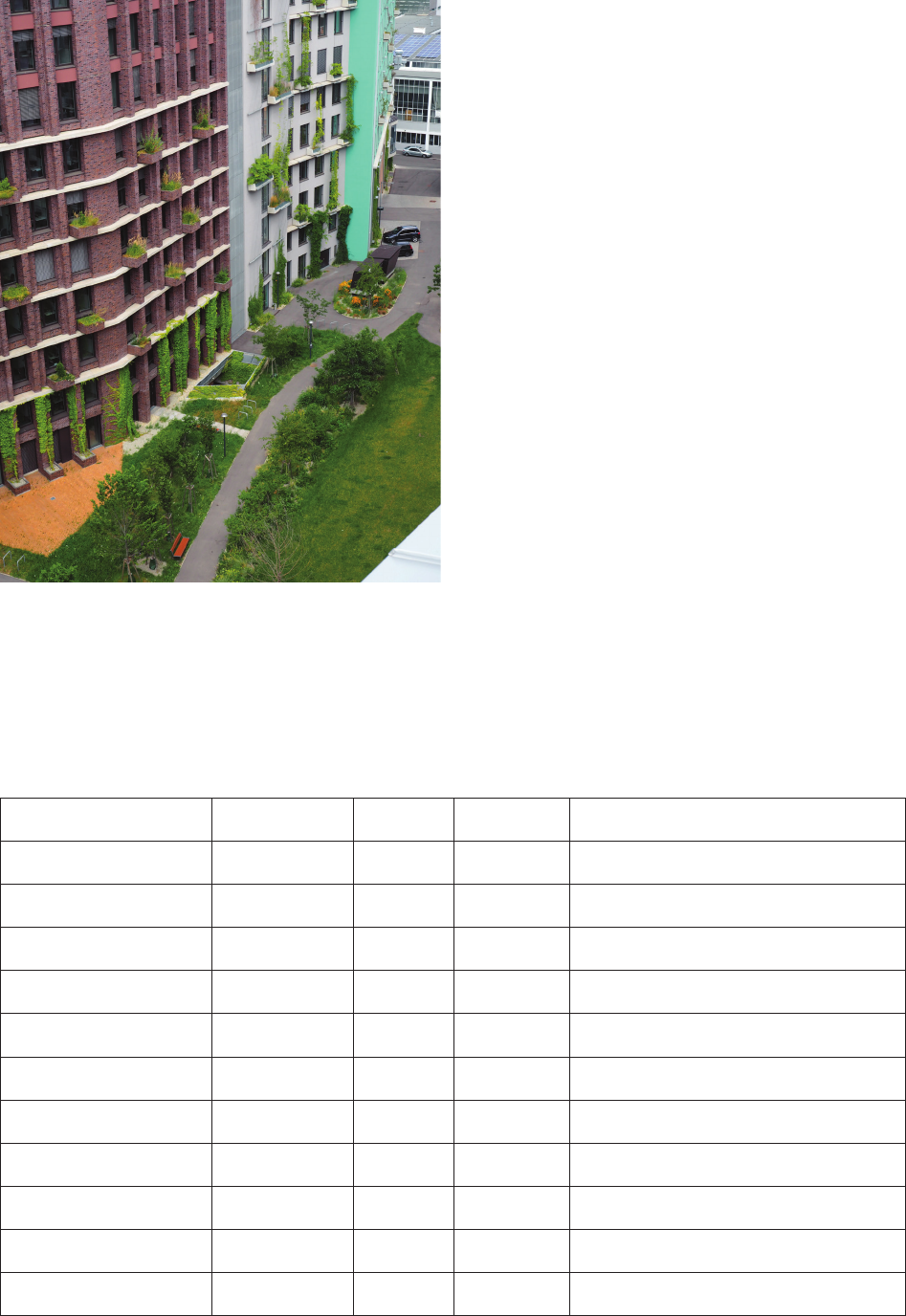
(Fig. 8). Greenery on façades was applied to both newly
designed and existing buildings. Water management in-
cluded inltration, drainage, and retention, as well as stor-
age through the creation of features such as rain gardens.
Furthermore, for the rst time on such a scale, solutions
that provide shelter not only for people but also for animals
appeared at the IBA exhibitions. They took the form of bat
shelters built into building structures, insect hotels on roofs,
spaces for knowledge and information exchange, as well
as climate change, multimodal mobility, the use of new
ener gy sources, and the improvement of the quality of ur-
ban greenery. As pa
rt of the exhibition, it was important to
create aordable and easily accessible spaces, which was
to respond to the aforementioned problem of frequent resi-
dent turnover. For the rst time, on such a large scale, plans
were presented for the revalorization of not only individual
buildings but also entire districts that once served as mil-
itary areas. Additionally, as part of the implementation of
the greenery project, materials from demolition began to
be used in one of such areas. In the case of shaping urban
greenery, social consultations were held, which were part
of more complex participatory processes. Furthermore, one
of the projects presented new agricultural methods devel-
oped based on the idea of a circular economy, intended to
enable more sustainable food production. Architectural ac-
tivities included the expansion of existing buildings, which
involved interference with the historical fabric of the city,
and particularly concerned academic centers. The projects
also referred to renewable energy sources, and a 55 m high
facility was built, serving as an energy storage, viewpoint,
and tourist attraction.
The second exhibition, which started at the same time,
was IBA Thüringen, taking place in the former GDR. Its
theme touched upon the problem of demographic dispro-
portion between urban and rural areas
12
. The main goals
of the exhibition were: strengthening the economic posi-
tion of the region, protecting the climate and transforming
rural areas, using vacant buildings, opening up to immi-
grants, and building structures to support the introduction
of innovative activities (IBA Thüringen 2023). Addition-
ally, it was decided to put great emphasis on the region’s
strong point, that is its own production of wood and its
derivatives
13
. The use of this material enabled the imple-
mentation of both standard projects and socially import-
ant ones that required rapid, systemic execution. In turn,
the most characteristic activities carried out as part of this
exhibition included adaptations of vacant buildings. They
required the implementation of new legal regulations con-
cerning empty houses and plots, but also a change in think-
ing about existing architecture. This resulted in the imple-
mentation of box-in-box projects, which used the shells
of former buildings and, using light structures, freely and
transformatively lled their interiors. Furthermore, in the
social dimension, the perception of the role of the church
also had to change. In Thuringia, 99% of about 2,000 Prot-
estant churches are listed as monuments. They constitute
a special cultural value but are also a challenge due to their
number and the fact that many are not regularly used. To
preserve locally important meeting places, it was decid-
ed to assign new functions to some churches. Transfor-
mations were also visible in the space between buildings,
where, for example, a parking lot was transformed into an
intergenerational space with a playground, impermeable
12
Approximately 90% of the federal state’s territory can be clas-
sied as rural.
13
For example, insulation materials such as wood bre or blown
cellulose.
36 Aleksandra Gierko, Paulina Sołowiej
and “constructions” of stones or dead wood that served as
natural habitats for small animals.
Conclusions
A chronological analysis of the exhibitions found chang-
es in the approach to their organization (Table 1). Con-
temporary exhibitions no longer present only structural
achievements or architectural realizations but are complex
events involving urban transformations of districts and
regions. Already the second postwar exhibition in Berlin
addressed issues relevant from a contemporary perspec-
tive, concerning greenery as a key element of the urban
landscape, social inequalities in access to housing, and the
conservation of cultural heritage. Both in Berlin and in the
subsequent IBA Emscher Park, social activation through
participatory processes became important. In subsequent
exhibitions, local stakeholders were important participants
in the planning process, and events within IBA activities
helped build more resilient communities. Starting with IBA
Emscher Park, equipping local organizations and structures
with the necessary planning and organizational strategies
and instruments enabled cities or entire regions to change
their spatial planning policies and shape a new identity, in-
cluding an economic one.
Changes were also observed regarding thinking about
the built environment (Table 2). From exhibition to exhibi-
tion, more and more projects concerned the circular econ-
omy: considering the life cycle of materials and the possi-
Fig. 8. Green façades made of vines in the Biotope City development
in Vienna (photo by A. Gierko, 2022)
Il. 8. Zielone fasady z pnączy na osiedlu Biotope City w Wiedniu
(fot. A. Gierko, 2022)
Table 1. Comparison of the IBAs investigated in the study (elaborated by A. Gierko, P. Sołowiej)
Tabela 1. Zestawienie IBA wziętych pod uwagę w badaniu (oprac. A. Gierko, P. Sołowiej)
Environment Society Economy Dominant paradigm
Interbau Berlin ●●○ ●○○ ●○○ postwar modernization
IBA Berlin ●●○ ●●○ ●●○ critique of modernism
IBA Emscher Park ●●● ●●○ ●●● postindustrial transformation
IBA Fürst-Pückler-Land ●●● ●●● ●●○ landscape regeneration after mining activities
IBA Stadtumbau ●●○ ●●● ●●● transformations of shrinking cities
IBA Hamburg ●●○ ●●○ ●●● new construction standard
IBA Basel ●●● ●●○ ●●● cross-border integration
IBA Heidelberg ●●○ ●●● ●●● adaptation and climatic & social transformation
IBA Thüringen ●●● ●●● ●●● strengthening synergy in the region
IBA Parkstad ●●○ ●●● ●●● urban regeneration
IBA Wien ●●● ●●● ●●● new forms of living
Legend:
●○○ – marginal aspect, ●●○ – significant aspect, ●●● – key aspect.

Internationale Bauausstellungen as an expression of the transformation of environmental, social, and economic paradigms 37
bility of their reuse after demolition. The rst activities in
this area were undertaken as part of IBA Emscher Park,
while their clear intensication has been observed in recent
years, starting with the exhibition in Heidelberg. Earlier, as
part of IBA Fürst-Pückler-Land or IBA Stadtumbau, the is-
sues of renewable energy sources were addressed. The ap-
proach to greenery and water in the city has also changed:
from the introduction of single solutions to more complex,
systemic activities.
However, despite high standards related to aspects of
natural environment protection, and the fact that projects
are veried and some rejected as not tting the exhibition’s
Years Exhibition name
Number
of projects
Measures that consider aspects of
the environment society the economy
1957 Interbau Berlin
42 building
projects
increase in biologically
vital area ratio, planting trees
development with contemporary
amenities
prefabricated technology
1979–
1984/87
IBA Berlin
6 project
areas
various forms of greenery and
water, including pioneering
solutions: retention pond,
use of gray water
response to housing shortages,
development of cooperative
principles
adaptation to modern
conditions,
thinking about recycling
1989–1999
IBA Emscher
Park
117
renaturalization of the river,
protection of
the postindustrial landscape
participatory redevelopment,
new jobs
circular economy,
revitalization of the industrial
fabric, development of
the Ruhr region’s image
2000–2010
IBA Fürst-
Pückler-Land
30
renaturalization of
a post-mining area
activation of the local
community, transformation
of the region in
a participatory process
revitalization of engineering
monuments, RES
2002–2010 IBA Stadtumbau 19 cities
scenarios for climate change,
conversion of brownfields
into greenfields
scenarios for a shrinking
population, heritage-based
tourism and education,
public participation
economic forms of greenery
maintenance, RES
2006–2013 IBA Hamburg 86
various forms of greenery and
water, including experimental
solutions: façade with algae
cultivation
building housing cooperatives,
flexible forms of housing
optimization of the design
and construction process,
sustainable mobility, RES
2010–2020 IBA Basel 33
creation of ecological
corridors, renaturalization of
rivers and postindustrial areas
sustainable mobility, social
participation, international
cooperation, mixed housing
modernization of railway
stations, cross-border
cooperation
2012–2022 IBA Heidelberg 23
introduction of new
agricultural methods,
restoration of historic
avenues, park design
participatory processes
in the creation of
development strategies
adaptation of former military
sites, adaptation and
expansion of existing
buildings, RES
2012–2023 IBA Thüringen 32
creating an arboretum
of urban, climate-resilient
trees, unsealing paving
sustainable mobility,
activating residents,
preventing social isolation,
caring for the elderly,
caring for local memory
renovation and adaptation
of monuments, low-tech
solutions, use of local raw
material, recycling
of materials, planning
guidelines for climate,
carbon footprint calculation,
RES
2013–2021 IBA Parkstad 50
green roofs, restoration
of native plant species
public participation,
design for senior citizens
building adaptation,
transformable building
design, sustainable and
circular demolition, RES
2016–2022 IBA Wien 72
green roofs and walls,
blue infrastructure,
animal shelters
privately-owned and public
housing complexes,
mixed-use projects, sustainable
mobility, public participation,
inclusion of senior citizens,
people with disabilities,
children in projects
renovation and adaptation
of buildings,
design of transformable
systems in buildings, RES
Table 2. Matrix showing the evolution of the importance of sustainable development paradigms (elaborated by A. Gierko, P. Sołowiej)
Tabela 2. Macierz ewolucji znaczenia paradygmatów zrównoważonego rozwoju (oprac. A. Gierko, P. Sołowiej)
38 Aleksandra Gierko, Paulina Sołowiej
assumptions, some solutions may be subject to critical
analysis. In IBA Parkstad (2021), the issue of urban recy-
cling was addressed: although the demolition of buildings
in the context of the region’s socio-economic conditions is
justied, the practice of demolishing and re-constructing
buildings with identical uses in the same place may arouse
controversy. Analogously, the contemporary implementa-
tion of new housing complexes based on IBA Hamburg
models, in which an area of social and natural importance
is transformed into a built-up area, requires evaluation from
the perspective of contemporary sustainable development
concepts.
Summary
IBA should be seen not only as a tool for urban policies
but also as an example of a holistic approach to environ-
mental, economic, and social issues. Over the decades of
organizing successive exhibitions, it became possible to es-
tablish a mechanism where new events build upon previous
ones. Exhibitions are organized in response to current and
local needs, but they also showcase practices developed
over several years, which then resonate in a given region
or in future IBAs. A comparison of successive exhibitions
shows that many solutions now considered standard – such
as a systemic approach to greenery and water, social partic-
ipation, or the integration of spatial planning with econom-
ic policy – originated precisely within the IBA.
However, it should be noted that not all exhibitions can
currently be clearly assessed and their eects observed. It
is challenging to determine the true long-term impact of
activities from exhibitions held over the past ve years be-
cause the time span is too short. Nonetheless, it was possi-
ble to observe trends and changes in how exhibitions are
organized and, within them, in their approaches to environ-
mental, social, and economic aspects. This article can serve
as an initial review and an introduction to further analyses,
such as the impact of exhibitions on the natural environ-
ment.
Translated by
Krzysztof Barnaś
References
Bauten der “Interbau 57”. Accessed March 22, 2025, at https://denkmal-
datenbank.berlin.de/daobj.php?obj_dok_nr=09050387.
Burggräf, Sabine Marion. “Der Weg der Idee.” PhD diss., Technische Uni-
versität Dortmund, 2013.
Dettmar Jörg, and Hans-Peter Rohler, eds. Der Emscher Landschaftspark
die grüne Mitte der Metropole Ruhr-Weitergedacht. Klartext, 2015.
Domènech-Rodríguez, Marta, and David López López. “The Idea of Cul-
tural Heritage in Border Neighbourhoods of West-Berlin in 1976–
1978.” Heritage 6, no. 3 (2023): 2614–32. https://doi.org/10.3390/
heritage6030138.
Drapella-Hermansdorfer, Alina. “‘Przemysłowe Królestwo Ogrodów’ i Krai-
na księcia Puecklera: poszukiwania w skali regionalnej.” In Kształ
towanie krajobrazu: Idee, strategie, realizacje. Część I. Saksonia, Bran-
denburgia, Berlin, edited by Alina Drapella-Hermansdorfer. O cyna
Wydawnicza PWr, 2004.
Fischer, Karl Friedhelm. “Berlin’s International Building Exhibitions
1957 and 1984/87.” In Exhibitions and the Development of Modern
Planning Culture, edited by Robert Freestone and Marco Amati.
Routledge, 2014.
Hamm, Oliver G., ed. IBA Hamburg: Projekte und Konzepte. Jovis, 2010.
Hamm, Oliver G., ed. Stadt in der Stadt bauen. Jovis, 2014.
IBA Basel. Accessed March 25, 2025, at https://www.iba-basel.net/de/
home.
IBA Fürst-Pückler-Land. Verwundete Landschaft neu gestalten: die IBA-
Werkstatt in der Lausitz. Jovis, 2012.
IBA Heidelberg. Dynamik der Wissensstadt: Projekte, Prozesse. Park Books,
2019.
IBA Parkstad. Accessed March 25, 2025, at https://www.iba-parkstad.nl/.
IBA See. Accessed March 22, 2025, at http://www.iba-see2010.de.
IBA Thüringen. StadtLand Projekte: Für eine neue Raumpraxis. M BOOKS,
2023.
IBA_Wien 2022. Neues soziales Wohnen: Positionen zur IBA_Wien 2022.
Jovis, 2020.
IBA-Büro. Die anderen Städte: IBA Stadtumbau 2010. Interventionen.
Stiftung Bauhaus, 2008.
IBA-Büro. Die anderen Städte: IBA Stadtumbau 2010. Stadt und Erbe.
Stiftung Bauhaus, 2007.
Interbau 1957: Landschaftsarchitektur. Accessed March 22, 2025, at https://
hansaviertel.berlin/interbau-1957/landschaftsarchitektur/.
Internationale Bauausstellungen. Accessed March 20, 2025, at https://
www.internationale-bauausstellungen.de/.
Kuc, Sabina. “Technologies and Innovations at the IBA and IGS Exhibi-
tions.” Czasopismo Techniczne. Architektura, no. 8-A (2014): 19–26.
Kuhn, Rolf. “IBA Finale in Europe’s Biggest Landscape Construction
Site: A Former Lignite Mining District Is Being Reinvented as Lu-
satian Lake Land.” Czasopismo Techniczne. Architektura, no. 7-A1
(2010): 184–88.
Neto, Filipe Lacerda. “Careful Urban Renewal in Kreuzberg, Berlin:
International Bauausstellung Berlin 1987.” IOP Conference Series:
Earth and Environmental Science 609 (2020): 012022. https://doi.
org/10.1088/1755-1315/609/1/012022.
Pinch, Philip, and Neil Adams. “The German Internationale Bauausstel-
lung (IBA) and Urban Regeneration: Lessons from the IBA Emscher
Park.” In The Routledge Companion to Urban Regeneration, edited
by Michael E. Leary and John McCarthy. Routledge, 2013.
Salgo, Andreas. Neue Blöcke für die Innenstadt: Die IBA ’87 in Berlin und der
Wiederaufbau der Südlichen Friedrichstadt. Gebr. Mann Verlag, 2021.
Schulz, Stefanie, and Carl-Georg Schulz. Das Hansaviertel: Ikone der
Moderne. Braun, 2007.
Sieverts, Thomas, ed. IBA Emscher Park: Zukunftswerkstatt für Industri-
eregionen. Rudolf Müller, 1991.
Waal, Renée de, and Arjen de Wit. “Brown Coal, Blue Paradise: The Res-
toration of Opencast Coal Mines in Lusatia, Germany.” In Urban
Wildscapes, edited by Anna Jorgensen and Richard Keenan. Rout-
ledge, 2012.
Wagner-Conzelmann, Sandra. Die Interbau 1957 in Berlin: Stadt von heu-
teStadt von morgen. Imhof, 2007.
Wojtyszyn, Bogusław. “Kraina księcia Pücklera: Strategia realizacji Po-
jezierza Łużyckiego.” In Kształtowanie krajobrazu: Idee, strategie,
realizacje. Część I. Saksonia, Brandenburgia, Berlin, edited by Alina
Drapella-Hermansdorfer. Ocyna Wydawnicza PWr, 2004.
Zedda, Ilaria Maria. “Beyond Façades: The Berlin Block and the Housing
Issue at IBA 1987.” Studies in History and Theory of Architecture
(2021): 165–83. https://doi.org/10.54508/sITA.9.11.
Internationale Bauausstellungen as an expression of the transformation of environmental, social, and economic paradigms 39
Streszczenie
Internationale Bauausstellungen jako wyraz transformacji paradygmatów środowiskowych, społecznych i ekonomicznych
w architekturze i urbanistyce
Niemieckie międzynarodowe wystawy budowlane – Internationale Bauausstellungen (IBA) – to stosowane od początku XX w. narzędzie wspierania
rozwoju i planowania architektonicznego i urbanistycznego. Tematyka poszczególnych edycji oraz zakres podejmowanych działań odpowiadają na
aktualne problemy i wyzwania w wybranych lokalizacjach poprzez realizację inwestycji i inicjatyw towarzyszących.
Przedmiotem artykułu jest chronologiczna analiza działań podejmowanych w ramach każdej z wystaw, dotyczących środowiska przyrodniczego,
społeczeństwa i ekonomii. Celem badania jest obserwacja ewolucji paradygmatów zrównoważonego rozwoju w architekturze i urbanistyce.
Wyniki przeprowadzonych analiz wskazują na wyraźny rozwój IBA – od wydarzeń koncentrujących się głównie na architekturze i rozwiązaniach
konstrukcyjnych ku złożonym instrumentom transformacji przestrzennej. Analiza kolejnych edycji pozwoliła zaobserwować rosnące znaczenie za-
gadnień środowiskowych, społecznych i ekonomicznych, przy jednoczesnym odejściu od pojedynczych działań projektowych na rzecz interwencji
systemowych i interdyscyplinarnych. Zauważalna jest także zmiana skali działań – od skupionych w obszarze jednego ośrodka miejskiego ku projektom
o charakterze regionalnym i transgranicznym. Przekształceniu uległo również podejście do istniejącej tkanki miejskiej: zgodnie z ideą gospodarki obiegu
zamkniętego coraz większą wartość przypisuje się adaptacji istniejących budynków i zespołów zabudowy. Równolegle wzrasta znaczenie partycypacji
społecznej, która stopniowo staje się jednym z kluczowych narzędzi umożliwiających oddolną transformację na poziomie lokalnym.
Słowa kluczowe: Internationale Bauausstellung, zrównoważony rozwój, środowisko naturalne
