
2025
3(83)
Klaudia Stala*
Sheltering structures in archaeological reserves.
Analysis and assessment
of contemporary architectural design
DOI: 10.37190/arc250308
Published in open access. CC BY NC ND license
Abstract
The design of architecture within areas of archaeological heritage, where immovable surface relics, stratied cultural deposits, and the sur
rounding landscape are subject to protection, is not only a creative but also a scientic and conservation challenge. This article examines the most
recent approaches to the design of protective shelters for archaeological reserves. Given the intrinsic relationship between archaeological sites,
their cultural landscapes, and the natural environment, contemporary design must address the preservation of these interdependent dimensions
simultaneously. Current standards for protective interventions dier substantially from those of the mid to late20
th
century and continue to evolve.
This transformation is informed in large part by comprehensive analytical studies conducted since the early 21
th
century, which demonstrated that
existing shelters were often ineective and, in some cases, even harmful to the relics they were intended to safeguard. These ndings necessitated
a critical revision of prevailing guidelines. The article presents the author’s research on the evaluation of recent archaeological shelter designs and the
new predesign standards that inform their development.
Key words: archaeological shelter, archaeological reserve, design for conservation
Introduction, research objective
and methods
Open archaeological reserves require continuous mon
itoring, as exposed relics are highly vulnerable to external
factors. Particularly fragile remains should be protected
with shelters specically designed to reduce degradation
risks. This article evaluates such protective structures built
in the 1
st
quarter of the 21
st
century, drawing on data from
postdesign monitoring of environmental conditions be
neath the shelters and their eects on the preserved relics.
The analysis addresses both the design and conservation
measures undertaken, as well as the technical and material
solutions applied.
Among the 40 archaeological sites selected for research,
14 are sites where archaeological shelters were constructed
in the last century, but due to design errors, including the
selection of inappropriate materials, they were demolished
and replaced with modern, new structures. In assessing the
causes for the failure of the 20
th
century projects, the au
thor relied mainly on the research ndings and experiences
of Italian and Turkish conservators concerning the process
of progressive degradation of historic substances, with par
ticular emphasis on Franco Minissi’s work, noting that this
topic is not the main theme of the article, but only a side
issue explaining the reasons for the changes that had to take
place in the design of protective coverings in the 21
st
cen
tury (Stala 2019). The compilation and analysis of the col
lected data made it possible to identify contemporary trends
in the design of archaeological shelters and to evaluate the
appropriateness of the solutions applied. The selection of
sites was guided by the following criteria:
1. The shelters must have been constructed in the 21
st
century.
2. The scope of the study was limited to European coun
tries, including Turkey, which – though only partially lo
cated in Europe – has been actively engaged in developing
protective structures in the 21
st
century as part of a consistent
* ORCID: 0000000172228504. Faculty of Architecture, Cracow
University of Technology, Poland, email: klaudia.stala@pk.edu.pl
82 Klaudia Stala
pol
icy of safeguarding and promoting archaeological her
itage.
3. The selected sites and relics were, and remain, ex
posed to adverse environmental factors, both climatic and
anthropogenic.
4. Systematic postdesign monitoring of the relics’ con
dition had been conducted at the sites to verify the eec
tiveness of the applied solutions, supplemented, where pos
sible, by predesign monitoring.
5. The examples provided welldocumented and accessi
ble technical and design data.
The research work used a broadly dened method of
analysis, including a monographic analysis of each of the
40 selected examples, together with an analysis of the ar
chaeological site in terms of the value of the preserved her
itage and conservation issues. Each example was critically
analysed in terms of compliance with imposed standards
and strict conservation guidelines, and the research results
were compiled and compared.
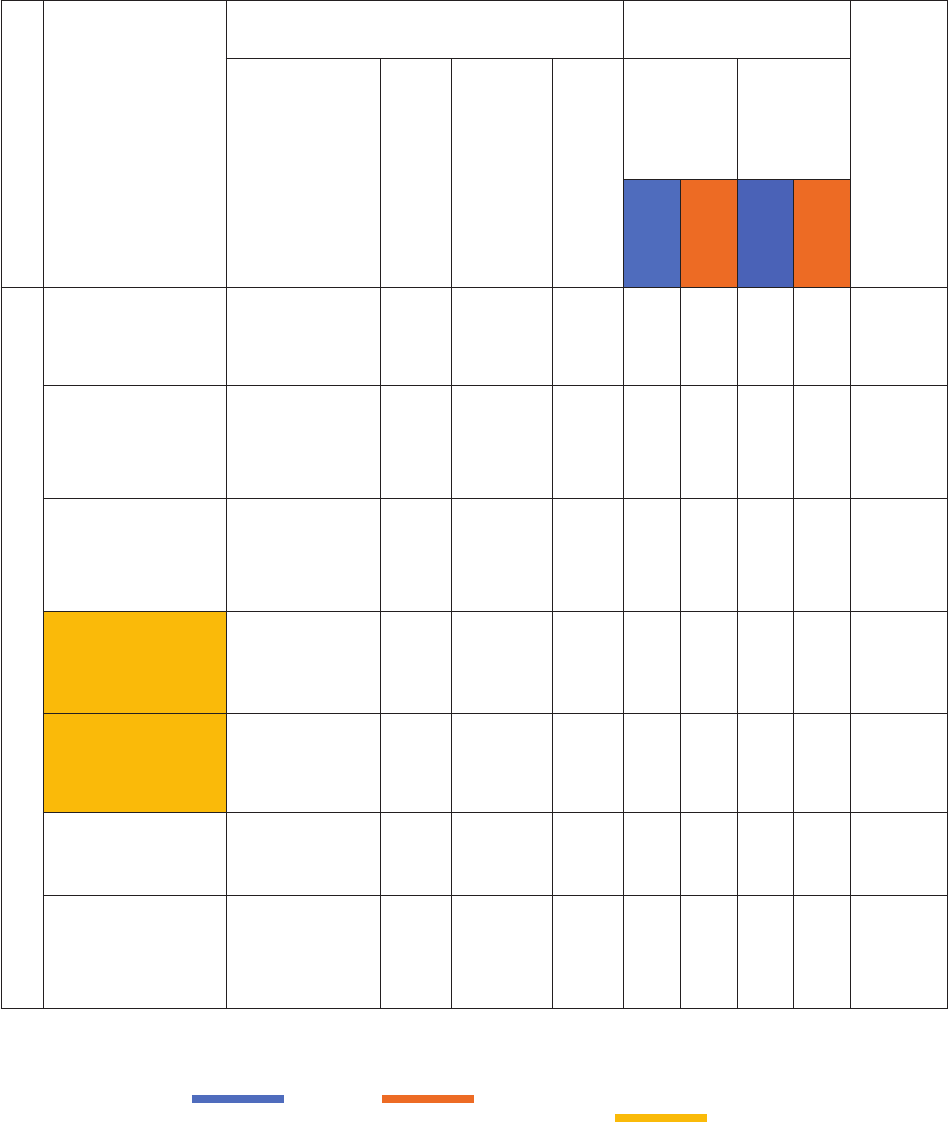
The selected archaeological sites with relics protected by
shelters are presented in table, which summarizes data on
the materials used for the coverings, supporting structures
and fastening systems. The table also includes an analysis
of the supporting structures and fastening systems in terms
of their invasiveness into archaeological layers and historic
fabric, as well as an assessment of their reversibility, mod
ularity, and passivity.
State of research
Since the turn of the 21
st
century, the scientic commu
nity has become increasingly critical of the criteria guiding
the design of archaeological shelters, particularly in light
of numerous projects that created conditions detrimental to
the relics they were intended to protect. An early contri
bution to this debate was Zaki Aslan’s paper on protective
structures in the conservation and presentation of archae
ological sites, presented at a conference in Tunis (Aslan
1997). The author, both an architect and a conservator, is
well acquainted with this subject and actively contributes
to international fora, engaging in discussions and publica
tions (Aslan 2007). In the broader discourse on archaeo
logical shelters, important contributions include the work
of May Cassar on sustainable heritage (Cassar et al. 2001),
Koen Van Balen and Aziliz Vandesand (2021), Sadamichi
Maekawa (2006), Jacques Neguer and Yael Alef (2008),
Martha Demas (2013), and Cristina Cabello Briones (2016;
2017). Maria Concetta Laurenti was among the rst to pub
lish research on archaeological coverings, including mate
rial analyses and the development of a risk map (2006).
Similarly, Sandro Ranellucci (2011) carried out a detailed
study of the environmental conditions generated beneath
such structures. With the increasing demand for archaeo
logical shelter design, the body of scholarship in this eld
continues to expand.
Outline of the research problem
By the end of the 20
th
century, an increasing number of
reports addressed the condition of relics at archaeological
sites under conservation, particularly those wholly or partial
ly covered by protective structures. Alarming ndings, espe
cially from Europe and the Middle East, indicated that the
state of many relics was deteriorating, as the microclimatic
conditions beneath the shelters often proved more harmful
than those outside. This prompted a series of studies and ex
pert assessments, notably in Italy, where the condition of 100
relics under shelters was examined, and in Israel, where 106
cases, primarily mosaics, were analysed. The results were un
favourable: only 38% of the shelters eectively safeguarded
the relics, while many others not only failed to full their
protective function but also created adverse conditions that
endangered their preservation (Cabello Briones 2017, 35).
A prominent example of this phenomenon can be found
in the work of Franco Minissi, a renowned Italian architect
specialising in the design for conservation of historic build
ings and archaeological sites, whose greatest professional
activity lasted from the 1960s–1980s. Minissi’s projects,
distinguished by their author’s deep respect for historical
context, formal simplicity, and an innovative aesthetic based
on material transparency, earned numerous awards and be
came part of the canon of architectural conservation (Ala
gna 2008; Villani 2012, 34–45). However, they ultimately
failed to withstand the test of time. Criticism from both the
public sphere and the conservation community arose as the
condition of the protected relics visibly deteriorated beneath
Minissi’s structures. Research has demonstrated that design
aws – most notably the inappropriate selection of materials
– were the primary cause. The shelters not only aged rapidly
due to the poor durability of these materials but also gen
erated or intensied harmful environmental factors, thereby
aggravating the degradation of the relics. A notable example
is the Roman Villa del Casale in Piazza Armerina, Sicily,
where the shelter’s structure caused the interior temperature
to rise by 6–7°C above the outside air, reaching approximate
ly 40°C during the summer months, while relative humidity
increased by 10%. Additional new harmful factors included
the oxidation of iron reinforcement bars within the concrete
foundation slabs, water inltration, and excessive microbial
growth. These conditions endangered the valuable mosaics
– many of which began detaching from their substrate – and
also posed risks to human health (Vivio 2015, 205, 206).
This led to the gradual dismantling of the structure and
its replacement with a new shelter designed in accordance
with contemporary standards (Rizzi 2008). Similar mea
sures were taken with two other Sicilian projects by Minis
si: the protective shelter over the Capo Soprano walls in
Gela and that of the theatre in Eraclea Minoa (Stala 2019).
These cases exemplify the challenges faced by conserva
tors, archaeologists, and museologists at the end of the 20
th
century – challenges that required both urgent and substan
tive responses. Another factor contributing to the harmful
eects of earlier shelters was that many structures erected in
the 1970s and 1980s had originally been intended as tempo
rary solutions, yet remained in place for decades, ultimately
causing more damage than protection. Comparable situa
tions can be observed across much of the Mediterranean ba
sin, with notable examples in Turkey, including the sites of
Karatepe, Zeugma, Arslantepe, Ephesus, and Çatalhöyük,
which are discussed in this study (Ertosun 2012, 94–150).
Sheltering structures in archaeological reserves. Analysis and assessment of contemporary architectural design 83
Analysis of contemporary principles
in the design of archaeological shelters
Pre- and post-design research
In light of the aforementioned examples and the deterio
rating condition of many archaeological sites, one of the rst
essential measures has been to identify the causes of dam
age and to establish permanent monitoring of the environ
mental conditions beneath archaeological shelters and their
eects on the relics. The risks are not conned to poorly
designed shelters; broader environmental factors also play
a decisive role. Climate change, in particular, has become
a critical threat, contributing to increasingly frequent and
intense atmospheric phenomena, higher summer tempera
tures, weather instability, and rapid uctuations occurring
in the environment within even one day (Sardella et al.
2020). Additional stressors include air pollution, ultraviolet
radiation, and the impact of tourist trac. Sites located in
urban areas are further exposed to noise from adjacent infra
structure, vibrations associated with transportation systems,
and other pressures resulting from intensive land use. Even
modest increases in temperature beneath a shelter – such as
those documented at the Villa del Casale – become more
dangerous in the context of contemporary climate change.
In Sicily, summer temperatures now frequently exceed 40°C
for several consecutive days or even weeks, causing relics
to reach surface temperatures of 45°C and higher. Extreme
cases have been recorded in poorly designed temporary
shelters, such as at Karatepe in Turkey, where wallsurface
temperatures reached 65°C (Ertosun 2012, 119).
Climate change has increasingly exposed relics in open
air archaeological reserves – many of which had remained
stable for decades – to degradation processes not previous
ly observed. An illustrative example is the reserve at Ħaġar
Qim in Malta. Rising summer temperatures and the grow
ing frequency of heavy rainfall at the turn of the 21
st
cen
tury placed this site, which had functioned as an openair
exhibition since the 19
th
century discovery of its megalith
ic temple, at considerable risk. These changing conditions
resulted in extensive damage of a stone, including crack
ing, surface aking, delamination, and localized collapses,
particularly in areas where rainwater accumulated due to
inadequate drainage. Studies have also identied wind as
a signicant factor contributing to the deposition of biolog
ical material on stone surfaces. In addition, intense solar ra
diation created further stress, with air temperatures during
summer months reaching up to 40°C.
A similar situation was observed at the temples of Mnaj
dra and Tarxien, where intense solar radiation and elevat
ed temperatures directly contributed to the deterioration of
the stone, while in Tarxien air pollution was an additional
aggravating factor. Consequently, it became necessary to
construct protective shelters over all three sites in order
to eliminate, or at least mitigate, conditions detrimental to
their preservation. Prior to the design phase, comprehensive
monitoring was undertaken, enabling the development of
sitespecic guidelines – for example, determining the re
quired transparency and degree of light reection for roong
materials. At Ħaġar Qim, a membrane of expanded polytet
rauoroethylene (ePTFE) with 12% light transparency was
adopted, compared with 8% at Mnajdra, while both shelters
employed a uniform light reectance coecient of 60%.
The cover at Ħaġar Qim was completed in 2009–2010, and
at Mnajdra in 2015. Since the year 2000, systematic mon
itoring and analysis of climatic and anthropogenic factors
have been carried out at the site of Ħaġar Qim.
Research at the site continued intermittently until the
completion of the protective shelter, after which systemat
ic monitoring was undertaken to verify the eectiveness of
the roong and the extent to which harmful factors were re
duced. The results of both pre and postdesign studies were
compiled by JoAnn Cassar and her team. For example, June
temperature data collected in 2005 (prior to construction)
were compared with measurements from 2012 taken both
under and outside the cover. In 2005, temperatures on the
exposed relics reached 40°C. By contrast, in 2012 the tem
perature beneath the shelter was up to 15°C lower, while
outside the cover it uctuated around 37°C. In August,
the reduction was smaller, approximately 5°C, whereas in
January the membrane provided thermal protection, main
taining temperatures several degrees higher than the exter
nal minimum of 2.8°C (Cassar et al. 2018). The cover also
eectively reduced wind exposure, limiting the spread of
biologically active organisms. However, dust accumulation
remained high, most likely due to the characteristics of the
natural substrate.
The impact on salinity proved more complex. No sig
nicant reduction was observed in 2012–2014, leading Ca
bello Briones (2016) to highlight this as a shortcoming of
the shelter, despite extensive predesign analysis. By 2015,
however, conditions began to improve slightly, suggesting,
as Cassar and colleagues observed a gradual longterm sta
bilization beneath the shelter (Cassar et al. 2018). Other
monitored parameters showed marked improvement, with
most adverse changes proving reversible.
These observations demonstrate that both predesign re
search and postdesign monitoring are indispensable com
ponents of architectural design at archaeological sites (Stala
2024). Determining the minimum duration of predesign
research is particularly important to ensure reliable project
data. According to Rosina et al. (2011), one year of monitor
ing is sucient to identify the principal challenges of a giv
en site. Postdesign monitoring, however, must extend over
a longer period, as illustrated by the case of Ħaġar Qim,
where a measurable reduction in stone salinity was achieved
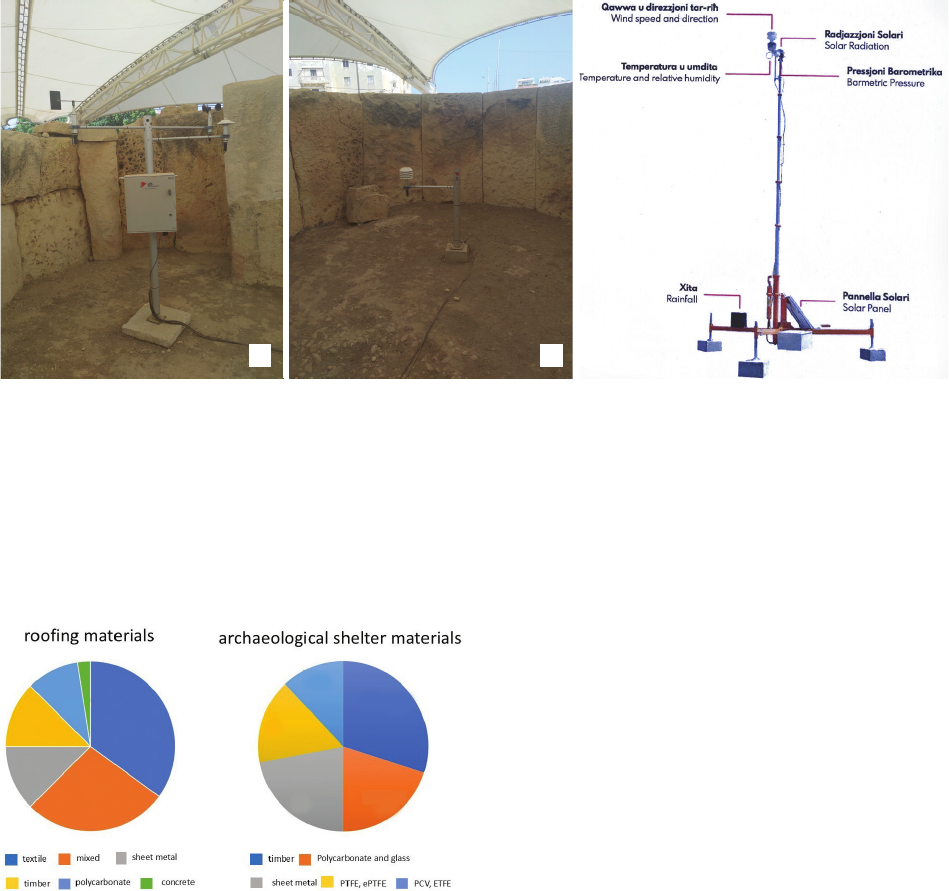
only ve years after the shelter’s construction (Fig. 1).
Selection of materials
– covering and supporting structures
The selection of appropriate materials is fundamental to
ensuring both the safety of the relics and the creation of
suitable environmental conditions beneath protective shel
ters. Lessons learned from 20
th
century practice, together
with the contemporary challenges posed by climate change
and the rapid development of new technologies, have un
derscored the need for highquality, durable materials.
This study examined the materials employed in selected
archaeological shelters. In most cases, these were selected
84 Klaudia Stala
by designers on the basis of predesign analyses, frequently
supported by simulation studies conducted under both nat
ural and laboratory conditions. The ndings indicate that
textile membranes are currently the most widely used cov
ering material, accounting for 35% of the cases analysed
(Fig. 2).
This type of solution has been implemented at all three
megalithic temples in Malta, at sites in Serbia and Slovenia,
in France, at Capo Soprano in Sicily (replacing Minissi’s
unsuccessful design), and at three sites in Turkey (Table 1).
The most commonly used materials include polyethy lene,
PVC, expanded polytetrauoroethylene (ePTFE, widely
known as GoreTex), polyurethane (PU), ethylene tetrau
oroethylene (ETFE), and berglass. Their popularity stems
from properties highly relevant to conservation projects, as
these materials satisfy complex technical and preservation
requirements. As demonstrated by the research of Salva
tore Viscuso, Alessandra Zanelli, and Marta Barozzi (2018,
115), such materials oer eective protection against ad
verse environmental factors – including solar radiation, pre
cipitation, wind, and snow – while remaining waterproof
and breathable. Moreover, depending on the thickness of
the coating, their transparency and light reectivity can be
precisely regulated.
Textile materials may be applied in single, double, or
multilayer congurations, allowing performance parame
ters to be tailored to the specic requirements of each ar
chaeological site. All textiles currently employed in shelter
design are treated with antiUV coatings. By carefully se
lecting transparency and lightreectance values, designers
can prevent excessive heating of the cover and thereby limit
heat transfer to the relics. These materials are highly dura
ble, typically carrying warranties of at least 20 years, even
under challenging environmental conditions. Their elasticity
provides considerable exibility in shaping roof structures,
while the degree of coverage can be adjusted in response
to external factors. This adaptability is crucial for eective
protection, enabling shelters to be modied from simple
overhead coverage to neartotal enclosure, which is partic
ularly advantageous in conditions of strong winds or heavy
rainfall. Furthermore, textile coverings are lightweight, re
ducing the need for heavy supporting structures that might
otherwise intrude upon archaeological layers much more.
According to Cabello Briones (2017), textile membranes
consistently perform best in the evaluation of archaeologi
cal shelters. The use of alternative materials, as demonstrat
ed by the author’s research, is considerably less common.
Among the 40 shelters examined, 13% employed wood
for roong, 12% utilized highquality metal sheets (often
coated), and 10% used transparent polycarbonates, which,
Fig. 2. Percentage breakdown of materials used in roofing
and overall in protective structures (elaborated by K. Stala)
Il. 2. Procentowe zestawienie materiałów użytych w zadaszeniach
i całościowo w konstrukcjach osłonowych (oprac. K. Stala)
Fig. 1. Devices monitoring climatic conditions under cover in Tarxien:
a) multifunctional environmental monitoring station with remote telemetric data transmission (Enviro Technology Services),
b) temperature and relative humidity sensor with radiation shield (Vaisala),
c) drawing of a multifunctional automated weather station with a rain gauge and photovoltaic panels (information board, Tarxien) (photo by K. Stala)
Il. 1. Urządzenia monitorujące warunki klimatyczne pod osłoną w Tarxien:
a) wielofunkcyjna stacja monitoringu środowiskowego ze zdalnym telemetrycznym przesyłem danych (Enviro Technology Services),
b) czujnik temperatury i wilgotności względnej powietrza z osłoną radiacyjną (Vaisala),
c) schemat wielofunkcyjnej zautomatyzowanej stacji pogodowej mającej deszczomierz i panele fotowoltaiczne (tablica informacyjna, Tarxien) (fot. K. Stala)
a b c
35%
30%
12%
16%
22% 20%
13%
12%
27%
3%
10%

Sheltering structures in archaeological reserves. Analysis and assessment of contemporary architectural design 85
Table 1. The results of the research (elaborated by K. Stala)
Tabela 1. Wyniki przeprowadzonych badań (oprac. K. Stala)
Country
Archaeological reserve /
date of shelter implementation
Material Assembly/Installation
Modularity
Reversibility
Passivity
covering
antiUV coating
fastening system
supporting structure
supporting
structure
fastening
system
of tourist routes
Cyprus
Villa of Theseus
Nea Pafos
2019
mixed technique
⸙Ꚛ◊
x
rafters
⸙
⸙
–
type 3
– e m, p
France
Gallic villa
Bibracte
2003
textile
○∆
x
grid
*
aluminium
*
type 1
– d – m, r, p
GalloRoman Villa
Séviac
2018
textile
○
x
grid
*
*
–
type 3
– – –
Greece
Town ruins Akrotiri
205/2011
volcanic soil
⸙*
x
frame *
□*
tpe 2
– d e
m, p
bio
climatic
Nestor Palace
Pylos
2013
mixed technique
*⌂
x
steel
profiles*
*
–
type 3
a – –
Necropolis of Orthi Petra
Eleutherna
2013
*
x
steel
profiles*
*
–
type 3
– e m, p
Spain
Roman remains
Cartagena
2011
Ꚛ
x
mesh
grid
*
*
–
type 3
– e –
Al.Andalus town
Siyâsa
2020
mixed technique
□⌂
– –
*
–
type 3
– g –
Ruins of Monastery San
Juan
Burgos
2015
mixed technique
⌂⸙
–
grid
*
*
–
type 3
– g –
House of Grifos
Complutum Madrid
2011
mixed technique
*∆
–
grid
*
domeshaped *
–
type 3
– – –

86 Klaudia Stala
Table 1 cont. The results of the research (elaborated by K. Stala)
Tabela 1 cd. Wyniki przeprowadzonych badań (oprac. K. Stala)
Country
Archaeological reserve /
date of shelter implementation
Material Assembly/Installation
Modularity
Reversibility
Passivity
covering
antiUV coating
fastening system
supporting structure
supporting
structure
fastening
system
of tourist routes
Malta
Megalithic Temple
Ħaġar Qim
2009
textile
membrane
○∆
x
mesh
*
arches
*
–
type 3
d – r
Megalithic Temple
Mnajdra
2009
textile
membrane
○
x
mesh
*
arches
*
–
type 3
d – r
Megalithic Temple
Tarxien
2015
textile
membrane
○
x
mesh
*
arches
*
–
type 3
d – r
Germany
Ironworks remains
St. Antony
Oberhausen 2011
galvanized sheet
metal
*
–
steel profiles*
□ –
type 3
– e –
Ruins behind the House
of Luther Wittemberg
2010
foil
textile
○
x
beams
*
grate
□
type 1
– – g –
Pałac w Vlotho
after 2000
*
–
beams
*
based on the crown
of the wall steel mesh *
–
type 3
– g –
Poland
Ruins of Palatial
complex
Ostrów Lednicki
2008
⸙
– –
*□
type 2
– – f –

Sheltering structures in archaeological reserves. Analysis and assessment of contemporary architectural design 87
Country
Archaeological reserve /
date of shelter implementation
Material Assembly/Installation
Modularity
Reversibility
Passivity
covering
antiUV coating
fastening system
supporting structure
supporting
structure
fastening
system
of tourist
routes
Italy
Basilica of
Villa Romana del Casale
Piazza Armerina
20072012
⸙◌
–
⸙◌ *◌
–
type 3
– f –
Roman walls Capo
Soprano
2008
textile
membrane
○
x
* *
–
type 3
– – –
Roman House of Coiedii
Castellone di Suasa
2017
mixed technique
oxidized sheet metal
*⸙⌂◌
–
rafters⸙ grid*
*
–
type 3 (g)
– f –
Roman Bath of Agrippa
Pianosa
textile
membrane
○
–
grid
ropes
*
vertical pipes*
–
type 3
– – –
Building 2
Ostia Antica
2021
steel, sheet metal
*
–
panels
*
boxload
bearing *
–
type 3
–
d
–
Titus Marcus House
Aquleia
2015
⸙◊
–
beams ⸙
*□
–
type 3 (g)
–
f
–
Bronze Age Foundry
Aqua Fredda
Bedollo
2000
oxidized steel
*⸙
–
coffered
ceiling*⸙Ꚛ
gxidized
pipes*
–
type 3
d f –
Roman city
Claterna
2018
⸙
–
⸙
*⸙□
–
type 3
d – –
Roman House
with frescos (Affreschi)
Luni, La Spezia
2022
⸙Ꚛ
–
⸙
□
type 1
– d –
m, r
Basilica Church
Caucana
Santa Croce Camerina
2011
mixed technique
*⸙
–
steel grate
*
steel
*
–
type 3
– – –

88 Klaudia Stala
Table 1 cont. The results of the research (elaborated by K. Stala)
Tabela 1 cd. Wyniki przeprowadzonych badań (oprac. K. Stala)
Country
Archaeological reserve /
date of shelter implementation
Material Assembly/Installation
Modularity
Reversibility
Passivity
covering
antiUV coating
fastening system
supporting structure
supporting
structure
fastening
system
of tourist
routes
Serbia
Prehistoric site
Lepenski Vir
2011
panels
Ꚛ
–
oxidized steel
grid
*
oxidized steel*
–
type 4
d – –
Roman villa with the
Peristyle
Mediana
2013
textile
●
–
arches and crossbeams ⸙
⸙*
–
type 3 □
d – –
Roman Mausoleum
Viminacium
2004–2005
textile
●
–
rafters
⸙
rafters⸙
–
type 3
a – –
Slovenia
3 Baptistery
Ancient Emona
Lubljana
2012
membrane
○
–
grate
arches*
poles*
–
type 3
– e –
Roman hause
Ancient Emona
Lubljana
2016–2017
mixed technique
*⸙Ꚛ
–
strips
*
poles□
–
type 3
– e –
Switzerland
Abbey of St. Maurice
SaintMaurce
2010
stone –
grid
*
ropes
*
type 1
– – – –
Sheltering structures in archaeological reserves. Analysis and assessment of contemporary architectural design 89
unlike the Plexiglas applied in the 1960s and 1970s, exhibit
superior performance characteristics and greater resistance
to scratching, as well as mechanical and thermal stress. The
second most prevalent roong solution is the mixed tech
nique, currently accounting for 27% of the examples an
alysed. This method combines several types of materials,
typically arranged in layered sequences with appropriately
designed expansion joints. Such congurations create an in
sulating zone – most often for thermal and light regulation
– enhancing the protective performance of the shelter.
At Akrotiri, for instance, the inner roof surface of the
shelter was constructed with solid wooden slats, while the
exterior was clad in sheet metal and then covered with vol
canic soil to harmonise with the surrounding environment.
A dierent approach can be seen in the San Juan church
in Burgos, where an exceptionally rened design employs
Country
Archaeological reserve /
date of shelter implementation
Material Assembly/Installation
Modularity
Reversibility
Passivity
covering
antiUV coating
fastening system
supporting structure
supporting
structure
fastening
system
of tourist routes
Turkey
Remains of Megaron
Troja
2003
stretch membrane
○
– * * –
type 3
–
d
⸙
–
Neolithic settlement
Building 5
Çatalhöyük Southern
2003/4
panels
∆
–
grid
*
* –
type 4
– e
f
–
Chalcolithic settlement-
Building 77
Çatalhöyük northen
2008
panels
Ꚛ
–
arches
⸙
□⸙
–
type 4
– e
f
–
Ancient palace
Arslantepe
20082011
⸙ –
frame
*
beams
vertical *
type 1
– – b
c
m, r
Roman Villa Zeugma
2010
mixed technique*
mesh sides⌂
open roof Ꚛ
–
grid
*
*□
type 2
– – e
m, p
Göbekli Tepe 2016–2018
textile
○
x
mesh
*
pillars*
–
type 3
a e –
Ruins beside Trajaneum
Pergamon 2004
mixed technique
*⸙
– * * –
type 3
– – –
Legend
Materials: * sheet metal/steel, ⸙ wood/timber, ꚚPC, ◊ ceramics, ○ PTFE, ePTFE, ● PCV/ ETFE, ⌂ glass, ◌ copper, ∆ fiberglass,
□ concrete/reinforced concrete
Foundation: nondestructive , destructive
Archaeological sites where ineffective protective covers were removed and new ones installed
Methods of installing tourist routes within the archaeological reserve: a – suspended, b – encircling, c – enclosing, d – placed on the ground,
e – placed on the top of the wall without interference, f – installation outside the walls – point installation, g – installation in relics
m – modularity, r – reversibility, p – passivity, x occurs, – not occurs or no data available
90 Klaudia Stala
highquality materials: an outer shell of laminated glass com
bined with an inner lining of densely arranged wooden slats.
This conguration not only provides subdued light
ing and
a cooling eect conducive to the preservation of architectur
al relics, but also creates a spiritual atmosphere appro
priate
to a sacred site. The most common mixedtechnique solu
tion combines transparent polycarbonates or various types
of sheet metal with wooden elements. These coverings are
typically permanent and nonmodiable, which limits their
eectiveness in adapting to variable external con ditions.
However, they dominate in terms of aesthetic value.
In the selection of materials for supporting structures and
fastening systems, metals – particularly steel – predominate.
Wood is also frequently employed, valued not only for its
aesthetic qualities, historical associations, and contextual
relevance, but also for its excellent performance in coastal
environments with high air salinity, where it demonstrates
notable strength and longterm durability.
Supporting structures and fastening systems
– protection of cultural layers and historic substances
An important aspect in the design of archaeological shel
ters is the method of placing the supporting structure in the
ground and the method of attaching the structures support
ing the roof and tourist routes in relation to the relics. Ex
perience from the 20
th
century highlights numerous errors
in this regard, many of which resulted in the disturbance
and degradation of archaeological heritage. Contemporary
practice therefore favours minimal foundations and limited
fastening of structural elements within archaeological sites.
On the basis of comparative analysis, the author identied
four principal types of supporting structures.
Type 1: Non-invasive structures. These supports do not
penetrate the ground and therefore avoid disturbing cultural
layers. A persistent misconception among some designers
is that only the surface remains require protection, whereas
the true archaeological heritage lies primarily in the stratig
raphy. Sequences of undisturbed cultural layers are partic
ularly valuable and may be irreparably damaged even by
excavation. It must be emphasised that an archaeological
site generally extends beyond the area of exposed relics, and
the entirety of the heritage – including what remains hidden
– should be protected. For this reason, the development of
noninvasive methods for xing loadbearing structures is
of critical importance. Such solutions are especially feasible
when employing lightweight membrane roofs, which con
servationists should consistently recommend in shelter de
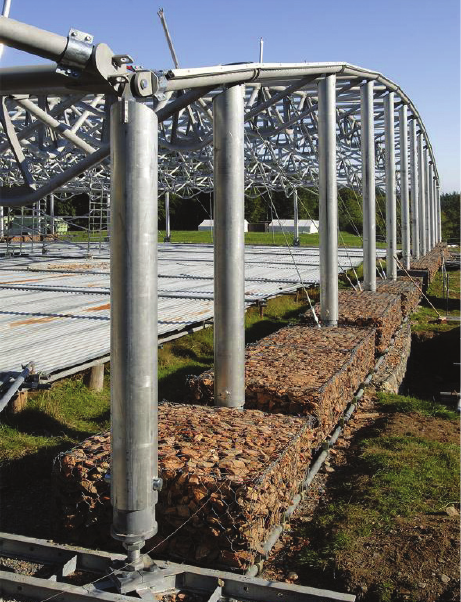
sign. An exemplary case is the GalloRoman site at Bibracte
in France, where vertical supports weighted with gabions
lled with rubble rest on a horizontal frame of two paral
lel rails. This system provides stability and durability while
remaining fully reversible, as it can be dismantled without
damaging the historic substance or archaeological layers
(Fig. 3).
Type 2: Secondary-installation method. This might be
considered an invasive approach, as the supporting struc
tures are anchored in the ground. However, they do not
destroy cultural layers, since the elements are inserted into
postholes of dismantled earlier enclosures or into areas
where stratigraphy had already been disturbed by previous
excavations. In this sense, the method is often conditioned
by the existence of earlier shelters. A notable example is the
archaeological shelter at Akrotiri on the island of Santorini,
where the supporting posts were placed in the locations of
earlier structural elements. In this case, the shafts reached
depths of up to 18 m, cut directly into the natural volcanic
substrate (Fintikakis 2005).
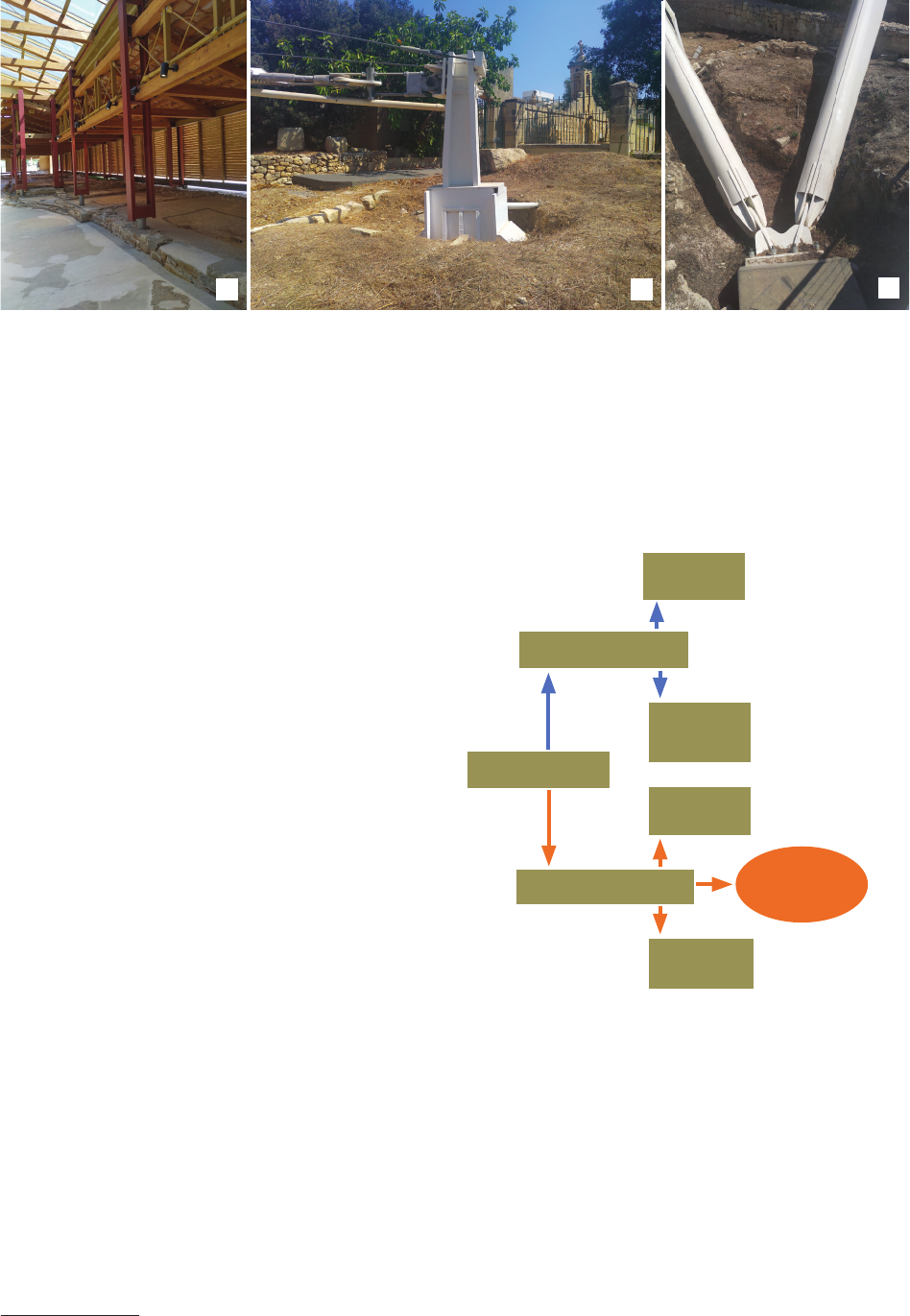
Type 3: Limited – is an invasive and destructive type. It
involves creating small diameter point foundations or drill
ing holes for anchors and bolts used to fasten ropes and steel
proles supporting tentlike textile covers. This method is
also applied in the construction of heavier roofs supported
by slender pillars or beams, thereby limiting the area of in
terference with the ground (Fig. 4). At present, this is the
most widely employed technique, representing 88% of inva
sive projects with comparatively low destructive potential.
Examples include shelters in Italy – such as the cover over
the House of Titus in Aquileia and at Castellone di Suasa
– as well as in Turkey, notably at Göbeklitepe and several
other sites.
Type 4: Extensive – this method typically employs strip
footings or other largearea foundation systems. It is the
most intrusive method of foundation laying at archaeolog
ical sites, carrying a higher risk of damaging or destroying
Fig. 3. Type 1 of a support structure – noninvasive structure
from the Bibracte site in France
(designed by P. Andreu, Tess Atelier D’Ingénierie;
source: https://www.tess.fr/en/projet/excavationshelter)
Il. 3. Typ 1 konstrukcji nośnej – konstrukcja nieinwazyjna
ze stanowiska Bibracte we Francji
(autor projektu P. Andreu, Tess Atelier D’Ingénierie;
źródło: https://www.tess.fr/en/projet/excavationshelter)
Sheltering structures in archaeological reserves. Analysis and assessment of contemporary architectural design 91
cultural layers. Owing to these risks, it is now rarely ap
plied today; studies indicate that such solutions account for
only about 8% of invasive installation techniques.
Types 3 and 4 require preliminary archaeological inves
tigations, and in the case of Type 3, at least continuous ar
chaeological supervision (Fig. 5). A recurring trend in the
20
th
century – particularly between the 1960s–1980s – was
the attachment of structural elements directly to the relics
themselves. This practice applied to supporting systems for
roong, suspended side panels, and even visitor walkways.
Such solutions, which directly compromised the historic
fabric, were frequently employed by the Italian school. No
table examples include Villa del Casale and the Capo So
prano walls (prior to their dismantling), as well as the castle
hall in Vlotho, Germany
1
– the latter being a contemporary
realization and the only one among the 40 cases analysed in
which this approach was used.
The author classies hanging, framing, enclosing, and
groundmounted systems, along with structures placed on
horizontal bases such as rails laid directly on the surface or
stabilised with weights, as noninvasive installations. How
ever, solutions mounted on the crown of walls – without
additional supports – may have an impact on the historic
substance, depending on the weight of the structure and the
securing mechanisms employed. Conversely, installations
positioned outside the walls are invasive to the archaeolog
ical layers, but these generally involve pointxings that
minimize disturbance. The last type is the most harmful in
vasive installation directly in the relics, as previously noted.
An alternative typology of fastening systems, with concise
descriptions, was proposed by Iranian researchers Ahmad
Moghaddasi and Mansour Khajepour (2013) (Fig. 6).
1
In the medieval castle in Vlotho, due to its condition, it was de
cided to cover the palatial aula with an archaeological shelter. The re
maining relics of the castle buildings did not require such solutions.
Reversibility and modularity
One of the most important features in the design of ar
chaeological shelters is their reversibility. The need for re
versible solutions arises primarily from the nature of archae
ological sites. In this context, reversibility means that the
structure does not permanently alter the site or the cultural
landscape, and can be dismantled without causing damage to
the archaeological heritage or its surroundings. Reversibil
ity is also signicant in light of rapid climate change: shifts
Fig. 4. Type 3 of a support structure:
a) example of spacelimited fastening of structural elements from the archaeological site in Tarxien, Malta,
b), c) example of a cover from the House of Titus in Aquileia with point foundation of loadbearing structures,
in this case also embedded in the crown of historic walls (variant g) (photo by K. Stala)
Il. 4. Typ 3 konstrukcji nośnej:
a) przykład ograniczonego powierzchniowo mocowania elementów konstrukcyjnych ze stanowiska archeologicznego w Tarxien na Malcie,
b), c) przykład osłony z Domu Tytusa w Aquilei o punktowym posadowieniu konstrukcji nośnych, w tym przypadku osadzonych także
w koronie zabytkowych murów (wariant g) (fot. K. Stala)
a b
Fig. 5. Diagram of the typology shelters foundation methods
at archaeological sites (elaborated by K. Stala)
Il. 5. Schemat typologii metod fundamentowania osłon
na stanowiskach archeologicznych (oprac. K. Stala)
a b
c
NoN-
destructive
type 1
iNvasive
secoNdary
iNstallatioN
type 2
iNvasive
limited
type 3
iNvasive
exteNsive
type 4
NoN-destructive
fouNdatioN
destructive
prelimiNary
archaeological
excavatioNs
92 Klaudia Stala
in external conditions may render a shelter unnecessary for
certain periods, in which case it can be easily removed.
The issue of reversibility is closely linked to the use of
modular systems in archaeological shelters. Modular sys
tems make it possible to extend or reduce the covered area
depending on needs and existing conditions. They are par
ticularly eective in situations where the exhibition and
public display of relics coincide with ongoing archaeologi
cal excavation, allowing the protected area to expand grad
ually as work progresses.
The reversibility of shelters is most readily achieved
through the use of textile coverings. Their dening feature
is adaptability: both the shape and the size of the sheltered
area can be modied as needed. They can be assembled into
modular sails, enabling multiple congurations based on
sitespecic requirements, while also facilitating ecient
packaging and transport (Zanelli et al. 2013). Membrane
structures are additionally characterised by rapid assembly
and disassembly. Owing to their low weight, they typically
require only shallow foundations or smalldiameter sup
ports, allowing the use of minimally invasive anchoring
systems. The potential for modifying textile covers in re
sponse to changing external conditions was demonstrated
by Barozzi, Viscuso, and Zanelli (2018), who developed
si mulation models for the mosaic shelter project in Nora,
Sardinia. Three congurations were proposed: Congura
tion 1, a winter layout; Conguration 2, oriented to prevail
ing wind and sun; and Conguration 3, a summer layout,
in which the slope of the arches adjusts to pretension the
membrane. An exemplary case of a reversible and modular
system is the aforementioned shelter at Bibracte, France.
While reversibility is more dicult to achieve with mate
rials other than textiles and in tentlike structures – and is
therefore less common – modularity is often feasible when
using alternative materials, typically within mixedtech
nique solutions. Examples can be found at Akrotiri on San
torini, Arslantepe in Turkey, and Orthi Petra Eleutherna in
Greece.
Aesthetics and context
as a protecting the cultural landscape
Archaeological shelters impact the cultural landscape. In
this case, structures using mixed techniques, employing ma
terials such as transparent polycarbonate, glass, metals in
cluding steel, galvanized sheet metal, oxidized copper, and
traditional wood, oer signicantly greater aesthetic value
and integrate seamlessly with the historical and surrounding
context. As mentioned, each site is analysed individually,
and on this basis, problems are diagnosed and conservation
guidelines are drawn up. A similar procedure applies to the
aesthetics of the cover. There are covers that aim to mini
mise interference with the landscape at the expense of spec
tacular external architectural forms. A good example is that
of the reserve in Akrotiri. It is admired for
its aesthetic inte
rior, while the intervention in the landscape is minimal, to
the extent that the external structure is practically hidden in
its surroundings. Such solutions are preferred when an ar
chaeological site is located in a valuable natural landscape.
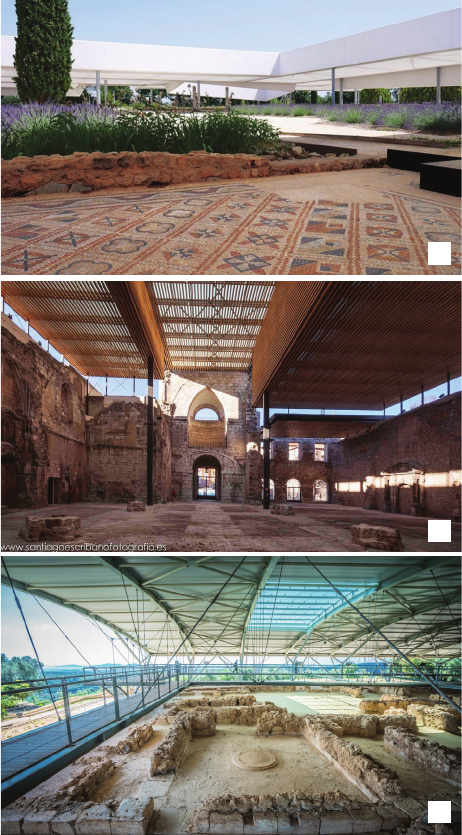
Some of the roong shelters are highly aesthetic, such as
the one in the Church of San Juan in Burgos (Fig. 7). How
ever, it should be remembered that aesthetics cannot be
treated as superior to the protective function of archaeo
logical shelters, as was the case in Minissi’s projects. They
were architecturally and aesthetically perfect, but they did
not function properly. Another important message related
to the protection of cultural landscapes and their integration
into the historical context is the awareness among archi
tects that protective structures cannot dominate over relics
and should remain at least in balance with the protected
heritage. A controversial example is the covering of Ro
man relics in Cartagena, Spain, which is appreciated as an
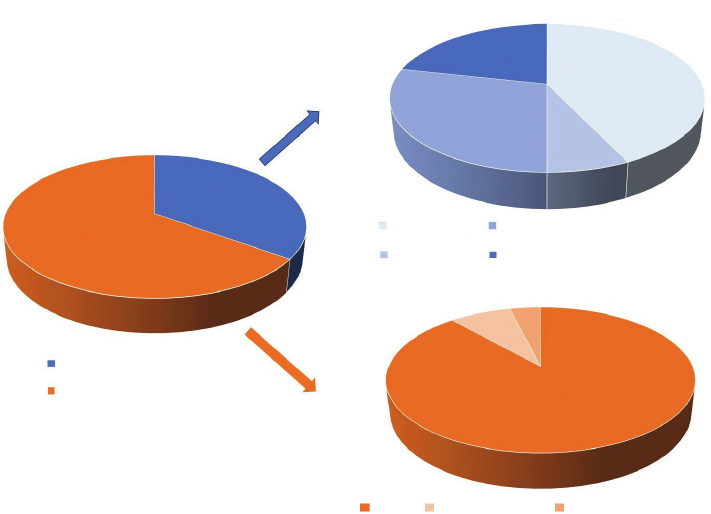
Fig. 6. Percentage values
of the use of nondestructive and
destructive foundation installation
methods at archaeological sites,
based on an analysis
of 40 selected examples
(elaborated by K. Stala)
Il. 6. Procentowe wartości
zastosowania nieniszczących
i niszczących metod
fundamentowania i montażu
na stanowiskach archeologicznych
opracowane na podstawie
analizy wybranych 40 przykładów
(oprac. K. Stala)
35%
21%
29%
7%
4%
8%
88%
43%
65%
non-destructive
on a ground
suspended
points foundation strip installation in a relic
based on the surface of the relic
installation in previous holes
destructive
Destructive supporting and installing structures
Non-destructive supporting and installing structures
Supporting and installing structures
Sheltering structures in archaeological reserves. Analysis and assessment of contemporary architectural design 93
architectural design, but is oversized, heavy, and complete
ly overwhelms the Roman ruins, additionally aggressively
inscribing itself into the city’s panorama (Stala 2015).
Conclusion
The design process for structures covering archaeolog
ical sites is a multifaceted and interdisciplinary challenge,
requiring the cooperation of many specialists and goes far
beyond the rules of ordinary architectural design – it is
strictly a conservation activity. It requires the development
of research and design principles as well as guidelines for
the implementation of this type of structure. It is import
ant that the standard procedures include simulation tests
on materials selected by the designer before installation
in situ.
Thus, in architectural design at an archaeological site it
is necessary to:
– Carry out pre and postdesign monitoring of the im
pact of harmful factors;
– Work in an interdisciplinary team;
– Minimise intervention in the historic substance and
archaeological layers;
– Minimise harmful external factors by using materials
with appropriate parameters (thermal resistance, light re
ection and transparency coecient, antiUV coating, du
rability and exibility, shape, etc.);
–
Create reversible and modular structures, passive where
possible, allowing archaeological research to continue with
out interfering with tourist trac;
– Integrate the structure into the cultural and natural
land scape.
The results of the research here indicate that contempo
rary trends in shelter design are heading in a positive direc
tion. Most of the examples analysed met basic conservation
requirements, and architects collaborated in interdisciplin
ary teams, implementing the data and guidelines received
into their designs. Research shows that, compared to 20
th
century practices, there has been a marked improvement in
the awareness of the need to protect cultural layers when
using loadbearing structures and fastening systems. Of the
40 examples examined, as many as 35% were nondestruc
tive solutions, i.e., types 1 and 2. Among the destructive
so lu tions, type 3, which is economical and minimises the
des tructive impact on archaeological stratigraphy, clearly
do mi nated. They accounted for as much as 88% of the de
structive solutions. It should also be added that in type 3
solutions, constructors use supports with an increasingly
smaller diameter of 30 cm or less, which minimally threat
ens underground cultural sequences.
What is more, their use does not require preliminary ar
chaeological research, but only supervision and sampling
from a borehole made under the structural element. Instal
lation directly into the relics, which was frequently used
throughout the 1960s–1990s, has now been almost com
pletely abandoned. The modularity and reversibility of
shelters is still negligible, although progress can be seen in
the number of projects using this type of solution. Similarly,
the passivity of covers is becoming an important element of
the design, as evidenced by recently awarded competitions
for new shelter, which are still in the implementation phase
(e.g., in Nea Pafos, Cyprus).
The use of new techniques and technologies as well as pro
ven highquality materials should also be viewed po si tively.
Plexiglas has been completely eliminated and multilayer
Fig. 7. Various aesthetic forms of contemporary archaeological covers:
a) GalloRoman villa in Seviac, design: Carrilho da Graça Arquitectos
(photo Elusa Capitale Antique, source: https://www.armagnacdartag
nan.com/en/culturalheritage/galloromanvillaofseviac),
b) San Juan Burgos monastery, design: BSA Barrio & Sainz de Aja
(photo: Santiago Escribano Martinez, source: https://www.european
heritageawards.eu/winners/roofruinsmonasterysanjuanburgos/),
c) Nestor’s Palace in Pylos (design: A.V. Karapanagiotou,
D. Kosmopoulos, S.R. Stocker, J.L. Davis) (photo by Chrissy,
source: https://unfoldinggreece.com/palaceofnestorinpylos/)
Il. 7. Różne formy estetyczne współczesnych osłon archeologicznych:
a) willa gallorzymska w Seviac, proj. Carrilho da Graça Arquitectos
(fot. Elusa Capitale Antique, źródło: https://www.armagnacdartagnan.
com/en/culturalheritage/galloromanvillaofseviac),
b) klasztor San Juan Burgos, proj. BSA Barrio & Sainz de Aja
(fot. Santiago Escribano Martinez, źródło: https://www.europeanheri
tageawards.eu/winners/roofruinsmonasterysanjuanburgos/),
c) Pałac Nestora w Pylos (proj. A.V. Karapanagiotou, D. Kosmopoulos,
S.R. Stocker, J.L. Davis) (fot. Chrissy,
źródło: https://unfoldinggreece.com/palaceofnestorinpylos/)
a
b
c

94 Klaudia Stala
roong (mixed techniques) with antiUV covers is used to
protect the relics from overheating. The popularity of textile
roong is also noticeable due to the parameters of this type
of solution described in the article, which responds very well
to the requirements related to the protection of relics against
variable and intense external factors. Such roong is not new
and was used in the 20
th
century not only for archaeological
covers. It was also widely used as a temporary solution to
enable archaeological work to be carried out in high tem
peratures and strong sunlight. In the 21
st
century, however,
the widespread use of such covers for longterm protection is
evident, with the possibility of modifying the surface of the
roong and the degree of coverage of the exhibition
2
.
Research has shown that these solutions dominate in
terms of quantity and account for 35% of the 40 sites sur
veyed. Thus, the postdesign monitoring of conditions un
der archaeological covers should be viewed positively. Re
search data indicate that most of the structures mentioned
eectively protect relics by reducing harmful factors. Re
search concerns relatively new realizations, so monitoring
must be continued over the coming years in order to sup
plement the data.
Translated by
Iwona Reichardt
References
Alagna, Alessandra. “Franco Minissi Restauro e Muzealissazione dei
Siti Archeologici in Sicilia.” PhD diss. Universita degli Studi di Na
poli, 2008. Accessed February 1, 2025, at http://www.fedoa.unina.
it/3224/1/Alagna_Franco_Minissi_PDFA_cmyk.pdf.
Aslan, Zaki. “Protective Structures for the Conservation and Preserva
tion of archaeological sites.” Journal of Conservation & Museum
Studies 3 (1997): 16–20. https://doi.org/10.5334/jcms.3974.
Aslan, Zaki. “The Design of Protective Structures for the Conservation
and Preservation of Archaeologial Sites.” PhD diss. University Col
lege London, 2007. Accessed August 12, 2025, at https://discovery.
ucl.ac.uk.
Barozzi, Marta, Salvatore Viscuso, and Alessandra Zanelli. “Design Novel
Covering System for Archaeological Areas.” In VII International
Conference on Textile Composites and Inatable, Structural Mem-
branes, Barcelona 2015, edited by Eugenio Oñate, KaiBletzinger,
and Bernd Kröplin. International Center of Numerical Methods in
Engineering (CIMNE), 2018.
Cabello Briones, Cristina. “The Eects of Open Shelters on the Preser
vation of Limestone Remains at Archaeological Sites.” PhD diss.
University of Oxford, 2016.
Cabello Briones, Cristina. “How to Evaluate Shelters for Archaeologi
cal Sites: Some Recommendations Based on the Use of Exposure
Trials.” Ge-conservación, no. 11 (2017): 34–41. https://doi.org/
10.37558/gec.v11i0.442.
Cassar, JoAnn, Shirley Cefai, Reuben Grima, and Katya Stroud. “Shelter
ing Archaeological Sites in Malta: Lessons Learnt.” Heritage Science,
no. 6 (2018): 2–18. https://doi.org/10.1186/s4049401802016.
Cassar May, Peter Brimblecombe, Taryn Nixon, Cliord Price, Cristina
Sabbioni, Cesareo Saiz Jimenez, and Koenraad Van Balen. Techno-
logical Requirements for Solutions in the Conservation and Protec-
tion of Historic Monuments and Archaeological Remains. European
Parliament, 2001.
Demas, Martha. “Protective Shelters for Archaeological Sites.” In Mo-
saics in Situ. An Overview of Literature on Conservation of Mosaics
in Situ, edited by Thomas Roby and Martha Demas. The Getty Con
servation Institute, 2013.
Ertosun, Atiye Işil. “Evaluation of Protective Structures in Archaeologi
cal Sites for In Situ Conservation of Architectural Remains and Arti
facts.” MSc diss. Middle East Technical University, 2012.
Fintikakis, Nikos. “Aristotle’s Theory as a Tool for Inspiration in Ar
chitecture. The Shelter of the Archaeological Site at Akrotiri.” In
International Conference Passive and Low Energy Cooling for the
Built Environment, edited by Matheos Santamouris. Heliotopos Con
ferences,
2005.
Laurenti, Maria Concetta. Le coperture delle aree archeologiche, Museo
Aperto. Gangemi Editore, 2006.
Maekawa, Sadamichi. “Comparison of Shelters’ Performance at Joya
de Ceren, El Salvado.” In Proceedings of the International Confer-
ence on Heritage, Weathering and Conservation, edited by Rafael
Fort, Monica Alvarez de Buergo, Miguel GomezHeras and Carmen
Vazquez Calvo. Vol. 1, Taylor & Francis, 2006.
Moghaddasi, Ahmad, and Khajepour Mansour. “Typology of Protective
Shelters in Archeological Sites. Advantages and Disadvantages.” In
SOMA (2012) Identity and Connectivity: Proceedings of the 16
th
Sym-
posium on Mediterranean Archaeology. Vol. 2. Archaeopress Pub
lishers of British Archaeological Reports Gordon House, 2013.
Neguer, Jacques, and Yael Alef. “Rapid, Assessment of Shelters over
Mosaics: Initial Results from Israel.” In Lessons Learned: Reect-
ing on the Theory and Practice of Mosaics Conservation. Proceed-
ings of the 9
th
ICCM Conference Hammamet, Tunisia, November
29–December 3, 2005, edited by Aïcha Ben Abed, Martha Demas,
and Thomas Roby. The Getty Conservation Institute, 2008.
Ranellucci, Sandro. Coperture archeologiche. Allestimenti protettivi sui
siti archeologici. DEI, 2011.
Rizzi, Gionata. “Sheltering the Mosaics of Piazza Armerina: Issues of
Conservation and Presentation.” In AIA Site Preservation Program,
Heritage, Conservation and Archaeology. Archaeological Institute
of America, 2008. Accessed June 15, 2025, at https://www.archaeo
logical.org/pdfs/site_preservation_Oct_08.pdf.
Rosina, Elisabetta, Alessandra Zanelli, Paolo Beccarelli, Marco Garga
no, and Elena Romoli. “New Procedures and Materials for Improv
ing Protection of Archaeological Areas.” Materials Evaluation 69,
no. 8 (2011): 979–89.
Sardella, Alessandro, Elisa Palazzi, Jost von Hardenberg, Carlo Del
Grande, Paola De Nuntiis, Cristina Sabbioni, and Alessandra Bo
nazza. “Risk Mapping for the Sustainable Protection of Cultural He
ritage in Extreme Changing Environments.” Atmosphere 11, no. 7,
700 (2020): 2–12. https://doi.org/10.3390/atmos11070700.
Stala, Klaudia. “The Role and Signicance of Archaeological Heri
tage in the Contemporary Urban Space.” Czasopismo Techniczne.
Architek tu ra 6A, (2015): 197–215. https://doi.org/10.4467/235373
7XCT.15. 248.4651
Stala, Klaudia. “Współczesne aspekty projektowania osłon w rezerwa
tach archeologicznoarchitektonicznych. Z zagadnień ochrony i eks
pozycji dziedzictwa archeologicznego.” Wiadomości Konserwator-
skie 60 (2019): 105–15. https://doi.org/10.17425/WK60SHELTERS.
Stala, Klaudia. “Rola wyprzedzających badań analitycznych w projek
towaniu konserwatorskim na stanowiskach archeologicznych na
2
Until now, archaeological reserves have been divided into three
basic types: open, semiopen, and closed. The latter allow for the cre
ation of articial environmental conditions and maintaining them at
a constant, unchanging level. In the case of textile covers, it is possible
to change not only the size of the covered area, but also, depending on
changing external conditions, to modify the socalled degree of exposure
(covering), from open, through various levels of coverage, to complete
closure.
Sheltering structures in archaeological reserves. Analysis and assessment of contemporary architectural design 95
Streszczenie
Konstrukcje osłaniające w rezerwatach archeologicznych.
Analiza i ocena współczesnych rozwiązań architektonicznych
Projektowanie architektury bezpośrednio w obszarze dziedzictwa archeologicznego, gdzie ochronie podlegają nieruchome relikty zachowane na po
wierzchni, ale też układ nawarstwień kulturowych oraz otaczający krajobraz, jest wyzwaniem nie tylko twórczym, ale też naukowym i konserwatorskim.
Tematem niniejszego artykułu jest przedstawienie najnowszych tendencji w procesie projektowania osłon w rezerwatach archeologicznych. Ponieważ
stanowiska archeologiczne są bardzo często mocno powiązane z otoczeniem, projekt powinien również uwzględniać kwestie ochrony krajobrazu zarów
no kulturowego, jak i przyrodniczego. Obecne standardy takich działań różnią się od tych z połowy, a nawet końca XX w. i pozostają w fazie zmian i roz
woju. Dzieje się tak za sprawą wyników przeprowadzonych na początku XXI w. badań analitycznych dotyczących istniejących osłon archeologicznych.
Dzięki nim wykazano w wielu przypadkach nieskuteczność, a czasem nawet szkodliwość powstałych obiektów wobec chronionych reliktów, co z kolei
spowodowało konieczność werykacji dotychczasowych wymogów. W artykule przedstawiono wyniki badań autorki dotyczące oceny skuteczności
współcześnie projektowanych osłon archeologicznych oraz nowych standardów przedprojektowych.
Słowa kluczowe: osłona archeologiczna, rezerwat archeologiczny, projektowanie konserwatorskie
wybranych przykładach.” Wiadomości Konserwatorskie 77 (2024):
58–71. https://doi.org/10.48234/WK77ANTICIPATORY.
Van Balen, Koenraad, and Vandesand Aziliz. “The Value of Heritage
in Sustainable Development and Spatial Planning.” In A Research
Agenda for Heritage Planning, edited by Eva Stegmeijer, and Loes
Veldpaus. Edward Elgar Publishing, 2021.
Villani, Stefano. Le protezioni delle aree archeologiche – Architettura per
l’archeologia. PhD diss. Università degli Studi di Roma Tre, 2012.
Viscuso, Salvatore, Alessandra Zanelli, and Marta Barozzi. “Textiles
and Ar chaeological Sites: Towards a Methodology for Designing
Light weight Protective Structures.” Advanced Materials Research
1149 (2018): 109–18. https://doi.org/10.4028/www.scientic.net/AMR.
1149. 109
Vivio, Beatrice A. “The ‘Narrative Sincerity’ in Museums, Architectural
and Archaeological Restoration of Franco Minissi.” Frontiers of Ar -
chi tectural Research 4, no. 3 (2015): 202–11. https://doi.org/ 10.1016
/ j.foar.2015.06.002.
Zanelli, Alessandra, Elisabetta Rosina, Maei Roberto, Paolo Beccarelli,
Guglielmo Carra. “Innovative Solutions for UltraLightweight Tex
tile Shelters Covering Archaeological Sites.” In Structures and Ar-
chitecture. New concepts, applications and challenges, edited by
Paulo J. Cruz. CRC Press, 2013. https://doi.org/10.1201/b15267.